Firefly to provide the launch rocket for Kratos’ hypersonic test vehicles

The rocket/lunar lander startup Firefly yesterday announced that it has signed a partnership deal with the hypersonic test startup Kratos.

In August Kratos partnered with the Australian company Hypersonix to build 20 scramjet test vehicles for the Pentagon for hypersonic test flights. Firefly with this new deal will provide the launch vehicle for getting those scramjets into the air at the speeds required. In fact, it appears Firefly is now going to do with its Alpha rocket the same thing that Rocket Lab did with its Electron rocket, revising it for suborbital testing.

Rocket Lab has already completed six successful HASTE launches. It will be interesting how quickly Firefly can get Alpha reconfigured and launched in this manner. Some of that schedule will also hinge on Kratos’ ability to provide the scramjets. The press release makes no mention of schedule.

Firefly’s action here continues the recent shift by many American space startups from rocketry and space exploration to defense work that is only tangentially related to space. It appears they are all diversifying to grab the expected rich contracts the Pentagon is expected to hand out to develop Trump’s proposed Golden Dome defense system. It also appears that many are diversifying because they have doubts the civilian space industry can sustain them, by itself.

1 comment

Spanish rocket startup PLD unveils the first qualification unit of its Miura-5 rocket

1st Miura-5 qualification unit
The 1st Miura-5 qualification unit. Click for original.

The Spanish rocket startup PLD yesterday unveiled the first of two full-scale qualification units it is building to test the design of its Miura-5 orbital rocket, scheduled for a first launch sometime in 2026.

The QM1 unit will serve to qualify two key elements of the launcher. Firstly, the MIURA 5 second stage will undergo a destruction test in the United States to validate the functioning of the Flight Termination System. This test will verify the operation of the explosive charges onboard the vehicle, designed to destroy the launcher in the event of an in-flight anomaly.

Secondly, a Wet Dress Rehearsal will be carried out on the rocket’s first stage – a full propellant loading test that replicates all structural load scenarios during the fuelling and pressurisation phase. This test is essential to validate the behaviour of structures under real operational conditions.

By December (next month) the company hopes to complete a second qualification unit for further testing, followed by the flight rocket, which will be shipped to French Guiana for a launch sometime next year.

Right now PLD and Germany’s Isar Aerospace are in the lead in the race to become the first European rocket startup to reach orbit. Isar — which in March attempted one launch that failed — has already shipped the stages to Norway for its second attempt before the end of this year. PLD thus appears to be just behind, though all this could easily change. This is rocket science y’know.

0 comments

SpaceX launches 29 more Starlink satellites

The beat never stops! SpaceX tonight successfully placed another 29 Starlink satellites into orbit, its Falcon 9 rocket lifting off from the Kennedy Space Center in Florida.

The first stage completed its 23rd flight, landing on a drone ship in the Atlantic.

The leaders in the 2025 launch race:

152 SpaceX (a new record)
71 China
15 Rocket Lab
13 Russia

SpaceX now leads the rest of the world in successful launches, 152 to 119.

0 comments

The DC swamp proposes beating China in space by creating another bureaucracy here on Earth

Gotta feed those DC pigs!

My heart be still: A bi-partisan group of senators, led by Senator John Cornyn (R-Texas), yesterday introduced legislation they claim will help the U.S. beat China in space by creating a new government agency called the “National Institute for Space Research,” designed to encourage research in space tied to the proposed commercial space stations.

Reports indicate that China is launching new modules to its Tiangong space station to meet growing demands for science and to boost international cooperation and is developing a new-generation crew spacecraft with two variants: one for low Earth orbit (LEO) and one for crewed lunar missions. China has been actively promoting international cooperation through Tiangong, offering countries like Oman, Egypt, Pakistan, and others opportunities to participate in space research largely for free or at an extremely low cost. China has also offered to train foreign astronauts, garnering interest from countries like Saudi Arabia, Pakistan, and the UAE to train engineers, scientists, and mission operators for satellite development, and to launch services in which Egypt, Algeria, and Argentina are actively involved. This is a part of China’s broader Belt and Road Initiative, where space cooperation is bundled with tech transfer, loans, development projects, and the like.

This underscores strategic and accelerating investment by foreign adversaries in space-based infrastructure, research, and exploration. China’s ability to offer space-based partnerships to other nations allows it to build soft power and potentially shift international norms in space governance and tech standards.

In response, the Space RACE Act would create a National Institute for Space Research, a federally controlled but independently operated entity designed to coordinate and advance U.S. microgravity research in LEO using next-generation space platforms after the retirement of the ISS.

The last thing this bill will achieve is a stronger American space industry. Rather than funding real research or development in space, this legislation simply creates another Washington government agency supposedly functioning independent of presidential or even congressional oversight (a legal structure the courts have increasingly declared unconstitutional).

This is just more pork. It is also symbolic of the stupidity of our elected officials, who still do not really understand the real reasons beyond the on-going renaissance in America’s space effort. It hasn’t been the government that made it happen. It has been the private dreams of competing companies and individuals, figuring out ways they could make money launching rockets, often with the government acting as a major obstacle. Rather than streamline our bloated government to get it out of the way of this new private sector, these senators want to create more government to dictate how that sector functions.

Ugh. There are times I wish I didn’t have to read the news from DC. It almost always depresses me.

25 comments

Blue Origin announces plans to upgrade New Glenn to match SLS

New Glenn compared to the Saturn-5
Graphic issued by Blue Origin’s CEO comparing
New Glenn to the Saturn-5. Click for source.

In an update posted today, Blue Origin announced that it is planning to begin upgrades to its New Glenn orbital rocket as soon as its very next launch early in 2026, with those upgrades eventually raising the rocket’s capabilities to that of NASA’s overpriced, cumbersome, and poorly designed SLS rocket.

One of the primary enhancements includes higher-performing engines on both stages. Total thrust for the seven BE-4 booster engines is increasing from 3.9 million lbf (17,219 kN) to 4.5 million lbf (19,928 kN). BE-4 has already demonstrated 625,000 lbf on the test stand at current propellant conditions and will achieve 640,000 lbf later this year, with propellant subcooling increasing the current thrust capability from the existing 550,000 lbf.

The total thrust of the two BE-3Us powering New Glenn’s upper stage is increasing from the original design of 320,000 lbf (1,423 kN) to 400,000 lbf (1,779 kN) thrust over the next few missions. BE-3U has already demonstrated 211,658 lbf on the test stand.

These numbers are a little more than half that put out by the Saturn-5 in the 1960s. New Glenn however has a reusable first stage, so it will cost far less to launch, and will be able to do so frequently. These changes will also make it comparable to SpaceX’s Falcon Heavy.

These engine upgrades however are only a start. Blue Origin also plans to offer a second more powerful version of New Glenn by adding two BE-4 engines to the first stage and two BE-3U engines to the upper stage.
» Read more

45 comments

Rocket Lab sets new annual launch record for the company

Rocket Lab today set new annual launch record for the company, quickly scheduling and launching a payload for a “confidential commercial customer”, its Electron rocket lifting off from one of the company’s two launchpads in New Zealand.

This was the 15th orbital launch by Rocket Lab in 2025, beating the record of 14 the company set in 2025. Rocket Lab has also launched its HASTE suborbital version of Electron three times, so the company has actually completed the equivalent of 18 Electron launches this year, though three were not intended to reach orbit.

What made this launch unusual is that it was not announced in advance, and took place suddenly without revealing the customer. It is likely the customer was flying a classified military payload. UPDATE on November 26, 2025: That customer was actually the commercial imagery company BlackSky, launching another one of its satellites for its constellation used by both the military and the public. The company did not explain why it wished its identity hidden during the launch.)

The leaders in the 2025 launch race:

151 SpaceX
71 China
15 Rocket Lab (a new record)
13 Russia

SpaceX still leads the rest of the world in successful launches, 151 to 119.

15 comments

More criticism and opposition to Europe’s proposed space law

The European Union
This label would be more accurate if it read
“NOT made in the European Union”

At a conference in Germany this week, officials from the U.S. and several European countries expressed strong reservations about a proposed new European space law that would impose significant regulations on satellite and rocket companies, even if they are not European-based.

The objections by the American representative merely underlined the opposition already expressed by the State Department two weeks ago, when it said the law placed ““unacceptable regulatory burdens on U.S. providers of space services to European customers.”

Objections however were also expressed by officials from the United Kingdom and Liechtenstein. The latter’s comments also suggested further opposition should be expected from other European nations as well.

Liechtenstein is not a member of the EU but is part of the European Economic Area (EEA), said Bianca Lins, lead for space in the Liechtenstein Office for Communications. Since the EU Space Act covers issues like a single market for space services in Europe, “it’s going to be incorporated into the EEA agreement and also means we have to transpose it into national law.”

Her concern, she said, is that the act “does not really consider the international obligations that every sovereign state has,” including responsibilities under the Outer Space Treaty. She expected Liechtenstein, Iceland and Norway — the other EEA states outside the EU — to submit comments on those issues.

The law has also been condemned by companies in the U.S. as well as the U.S. Chamber of Commerce.

It is unclear however if the European Union is reconsidering the bill. If it passes it will do significant harm. One possibility is that American companies will pull much of their satellite and launch business out of Europe. And if they do not, it will likely cause them to defy the law, with State Department backing. The EU has no right to impose its rules on American companies.

If the latter occurs, it will thus set a significant legal precedent that suggests the European Union is a toothless non-entity with no real legal power. I suspect this threat above all will force the EU to reconsider the bill.

10 comments

Canada commits a half billion to European Space Agency projects

During a conference yesterday, Canada’s industry minister Mélanie Joly announced that her government has increased its budget for European Space Agency (ESA) projects to a total of $528 million over the next three to five years.

This funding increases is quite significant, approximately ten times greater than Canada’s previous budget commitments to ESA projects.

Few details were provided on how the money would be spent.

Joly said the investment would advance research and development of Canadian-made space technologies for both civilian and defence purposes. These include satellite communications, Earth observation, space exploration, positioning, navigation and timing, and space situational awareness, she said.

While most of the western world is shifting to the capitalism model, where the government buys what it needs from products owned by the private sector, it appears the present leftwing Canadian government under Mark Carney is moving instead in the direction of the Soviet model, whereby the government builds and owns the projects itself. This ESA commitment falls into that latter category, at least on the surface. Much however will depend on how ESA and Canada eventually decide to spend the cash.

4 comments

SpaceX and China complete launches

Two launches on opposites sides of the globe this evening.

First, SpaceX launched another 29 Starlink satellites into orbit, its Falcon 9 rocket lifting off from Cape Canaveral. The first stage completed its 12th flight, landing on a drone ship in the Atlantic.

Next (November 19th local time), China placed three classified satellites into orbit, its Long March 2C rocket lifting off from its Jiuquan spaceport in northwest China. China’s state-run press would only say the satellites were for “space environment exploration and related technology verification,” an utterly meaningless statement. That state-run press also said nothing about where the rocket’s lower stages, using very toxic hypergolic fuels, crashed inside China.

The leaders in the 2025 launch race:

151 SpaceX (a new record)
71 China (a new record)
14 Rocket Lab
13 Russia

SpaceX now leads the rest of the world in successful launches, 151 to 118.

1 comment

Mexican anti-Musk activists whine about SpaceX’s Boca Chica launch operations

Chicken Little is once again panicking

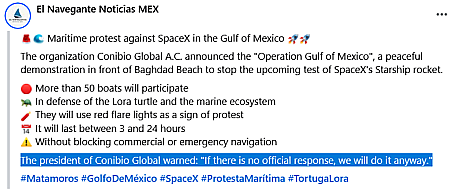
Mexican anti-Musk activists have now announced new complaints against SpaceX’s Boca Chica launch operations, claiming the soft-splash down of its Superheavy boosters in the Gulf of Mexico is damaging marine life, and the company’s effort to remove its stage and debris is further damaging the ocean floor.

Conibio Global A.C., a marine biodiversity organization in Mexico, launched “Expedition Booster 2025” this summer in partnership with the state of Tamaulipas and the Universidad Autónoma de Tamaulipas. The group is studying how booster landings near Playa Bagdad may be affecting wildlife and nearby communities. “We have 20 kilometers of space debris, which amounts to tons,” said Jesus Elias Ibarra Rodriguez, president of Conibio Global A.C. “If you go right now, you’ll find three or five pieces of plastic or metal or electrical parts from the thruster, even tanks—there is already a lot of debris.”

Researchers report that sea turtles and dolphins often mistake smaller debris for food, which can lead to deadly ingestion. They also documented debris fragments measuring between two and 10 meters long. According to the group, 3-D sonar imaging shows that a platform used in July to remove debris may have caused additional damage to the seafloor. “This platform has three structures that were sunk and anchored to the seafloor,” Rodriguez said. “During the investigation, we realized that it caused damage and holes when its structures were wedged in while removing the engines, and the engines were damaging the seabed and the species that live in the area.”

In other words, SpaceX is evil for dropping Superheavy in the Gulf, and it is also evil for removing it. Or to put this in real terms, these activists simply don’t want SpaceX to do anything. Their goal is to shut the company down entirely.

Moreover, their research is clearly bogus and overwrought. The entire world has been dropping lower stages in the oceans for more than three-quarters of a century, with no documented harm to marine life or the oceans. These faux scientists are simply puffing up their work to use this as a hammer against SpaceX.

Their complaint meanwhile appears somewhat bogus as well. They are “in communication” with Mexican authorities, and only “plan to present [their] findings” to that government eventually. In other words, their complaint hasn’t been filed with the government, but with our compliant propaganda press (in this case a local Texas news outlet), who are always glad to push the leftist agenda, no matter how idiotic.

Hat tip to Robert Pratt of Pratt on Texas.

19 comments

German rocket startup Isar wins another launch contract

Isar's first launch attempt fails
Spectrum falling seconds after its launch
in March 2025

The German rocket startup Isar Aerospace today won a new launch contract from the satellite aggregator SEOPS for a 2028 launch of its new Spectrum rocket.

SEOPS today announced during SpaceTech Expo it has purchased a dedicated launch on Isar Aerospace’s ‘Spectrum’ rocket. Targeted for launch in 2028, this marks SEOPS’ first collaboration with Isar Aerospace, expanding the company’s European launch capabilities.

SEOPS acts as an agent for satellite companies building small cubesats, arranging the launches for them because these companies often don’t have the resources or experience to do the job themselves. The choice of Isar’s Spectrum rocket suggests SEOPS wants to encourage new launch options, since Isar has only launched Spectrum once, and that launch was a failure. This contract acts to strengthen Isar’s future by giving it a powerful customer. It also gives SEOPS a European launch option, something that will attract European smallsat makers to it.

Isar is presently preparing Spectrum for its second launch out of Norway’s Andoya spaceport, with road closure announcements suggesting it will occur prior to December 21, 2025. If successful Isar will be the first new European rocket company in decades to reach orbit. It will also be the first German company to do so, ever. And it will give Andoya spaceport first place in the race to become Europe’s first orbital spaceport.

0 comments

Blue Origin targeting from 12 to 24 New Glenn launches in 2026

New Glenn prior to its first launch in January 2025
New Glenn on the launchpad prior to its
first launch in January 2025

Following the second successful launch last week of its New Glenn rocket, including a successful recovery of its first stage, Blue Origin’s CEO David Limp says the company’s goal for 2026 will be to attempt between 12 and 24 launches.

Limp said success on New Glenn’s second flight would set the company up for a significant increase in cadence. The company is building enough hardware for “well above” a dozen flights in 2026, with the upper-end limit of 24 launches. The pacing item is second stages. Right now Blue Origin can build one per month, but the production rate is increasing.

A pace of one launch a month would be unprecedented for Blue Origin in numerous ways. Since 2017 the company has built a poor reputation for slow and tentative operations. It took years for it to finally begin building BE-4 engines at a rate that could serve both it and its customer ULA. It took years to get New Glenn off the ground, a half decade later than initially announced. Moving from a lazy tortoise to a enthusiastic hare so quickly would thus seem very unlikely.

Blue Origin however has a major 27-launch contract with Amazon to launch its Amazon LEO constellation (formerly known as “Kuiper”). And Amazon desperately needs those launches to happen soon, as it only has 154 satellites in orbit and needs to get about another 1400 launched by July 2026 to meet its FCC license.

Even so, Limp noted that the next New Glenn launch will be to send its Blue Moon Mark-1 unmanned lunar lander to the Moon, and the best schedule he could offer was a launch sometime in the first quarter of ’26. If so, his prediction for the total launches in 2026 seems overly optimistic, at a minimum.

7 comments
1 34 35 36 37 38 684