Judge narrows SpaceX lawsuit against California Coastal Commission

Though U.S. district judge Stanley Blumenfeld ruled in May that SpaceX’s lawsuit against California Coastal Commission for targeting the company because the commissioners did not like Elon Musk’s political views can proceed, in early July he also narrowed the lawsuit significantly.

Blumenfeld granted a motion to dismiss violations of the First Amendment and due process against the commission and individual members based on lack of standing, sovereign immunity and failure to state a claim, but allowed allegations of “biased attempts to regulate SpaceX’s activity” and unlawfully demanding a CDP to proceed.

“In sum, SpaceX has plausibly alleged a ripe, nonspeculative case or controversy over whether it must obtain a CDP to continue its Falcon 9 launches,” Blumenfeld said in his order. “The credible threat that defendants will bring an enforcement action and subject SpaceX to daily fines for not having a CDP — which defendants pointedly do not disavow — is sufficient to establish an actual injury under Article III [of the U.S. Constitution].”

It appears the judge acted to protect the commissioners themselves from direct liability, using the made-up concept from the 20th century that government employees are somehow wholly immune from any responsibility for their actions.

Nonetheless, SpaceX has a great case, and is very likely to win in court, a victory that could very well cause the coastal commission and the state of California serious monetary pain.

4 comments

First suborbital launch of Taiwan rocket startup fails

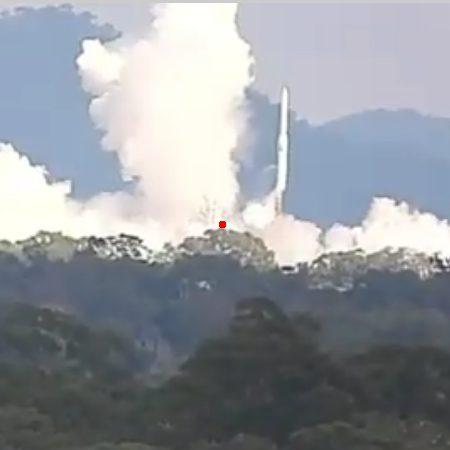
The first suborbital launch of the Taiwan rocket startup Tispace failed today shortly after lift-off from a new commercial spaceport on the northern island of Hokkaido in Japan.

The rocket took off from Hokkaido Space Port at 11:40 a.m. local time, but it was soon seen drifting, with smoke escaping. Footage of the launch was shown by NHK News on its website.

Nobody was reported injured in the incident, and the rocket was not carrying any payload. The first launch of a foreign-made rocket from Hokkaido served to test its engine’s capabilities, the report said.

The rocket startup was formed in 2016 and originally wanted to launch from Taiwan. After legal issues blocked that launch site it then attempted to arrange a launch from Australia. It appears similar red tape issues forced it to switch to Japan.

3 comments

Senate committee moves to cancel most of Trump’s proposed NASA budget cuts

Like pigs at the trough

We’ll just print it! Though disagreements prevented the Senate’s appropriations committee from approving the 2026 bills covering the commerce, justice, and science agencies of the federal government (including NASA) , the committee yesterday appeared poised to cancel most of Trump’s proposed NASA budget cuts and even add more spending across the board.

Sen. Chris Van Hollen (D-Maryland), the top Democrat on the CJS subcommittee, said this morning the bill would fund NASA at $24.9 billion, slightly above its current $24.8 billion level, with the Science Mission Directorate (SMD) remaining level at $7.3 billion.

By contrast, the Trump Administration wants to cut NASA overall by $6 billion, from $24.8 billion to $18.8 billion. SMD’s portion would drop 47 percent, from $7.3 billion to $3.9 billion.

The disagreements centered not on NASA, but on the Trump administration’s effort to cancel a very expensive new FBI headquarters building in the Maryland suburbs and instead shift the agency to an already existing building in DC. Van Hollen opposed this, and the ensuing political maneuvering forced the committee to cancel the vote.

This bill would once again continue full funding for SLS, Orion, and Lunar Gateway. It also includes funding for NASA’s very messed-up Mars Sample Return mission (which comprises the large bulk of the money added back in for science). From this it appears that the Republicans in the Senate are quite willing to join the Democrats in spending money wildly, as they have for decades. They have no interest in gaining some control over the out-of-control federal budget, in any way, as Trump is attempting to do.

What remains unknown is this: Who has the support of the American people? The election suggests the public agrees with Trump. History suggests that this support for cutting the budget is actually very shallow, and that while the public says it wants that budget brought under control, it refuses to accept any specific cuts to any program. “Cut the budget, but don’t you dare cut the programs I like!”

It is my sense that the public’s view is changing, and it is now quite ready to allow big cuts across the board. The problem is that the vested interests in Congress and in the DC work force are quite powerful, and appear to still control the actions of our corrupt elected officials.

Thus, the more of that work force that Trump can eliminate as quickly as possible, on his own, the more chance he will have to eventually bring this budget under some control.

28 comments

Varda raises another $187 million in private investment capital

Varda's third capsule, on the ground in Australia
Varda’s third capsule, on the ground in Australia.
Click for original image.

The in-space manufacturing startup Varda has now raised another $187 million in private investment capital, bringing the total cash the company has raised to $329 million.

The $187 million fundraise was led by Natural Capital and Shrug Capital, with participation from Founders Fund, Peter Thiel, Khosla Ventures, Caffeinated Capital, Lux Capital, and Also Capital. Since launching their first mission, W-1, in 2023, Varda has completed three successful launch and return missions, with a fourth, W-4, currently in orbit and a fifth expected to launch before the end of the year.

…”With this capital, Varda will continue to increase our flight cadence and build out the pharmaceutical lab that will deliver the world’s first microgravity-enabled drug formulation,” said Varda CEO Will Bruey.

Varda has expanded its footprint terrestrially as well, opening an office in Huntsville, Ala. and a new 10,000 square foot laboratory space in El Segundo, which will allow its pharmaceutical scientists to begin working on developing processes to crystallize biologics, such as monoclonal antibodies. As of 2022, the market size for monoclonal antibodies is estimated to be $210.06 billion.

As I have noted previously, a real market for pharmaceuticals produced in weightlessness has existed for decades. It appears Varda is now well placed to be the first to make money doing so, using its returnable capsules.

One more note: These products and this industry could have been developed on ISS, but NASA has banned all profit-making commercial manufacturing projects there from the station’s beginning. You can do research, but you are forbidden to create any products for sale later on Earth. This strange policy is left over from before the station, when Reagan discontinued all commercial missions on the shuttle following the Challenger accident.

0 comments

SpaceX gets approval to build oxygen plant at Boca Chica

SpaceX today received the okay from Cameron County to build a plant at Boca Chica to produce oxygen from the atmosphere for use in its Superheavy/Starship rocket.

The commissioners voted, 3-1, to give Elon Musk’s rocket company a beachfront construction certificate and dune protection permit, allowing the company to build a modern-day factory akin to an oil refinery to produce gases needed for space flight launches.

The plant will consist of 20 structures on 1.66 acres. The enclosed site will include a tower that will reach 159 feet, or about 15 stories high, much shorter than the nearby launch tower, which stretches 480 feet high. It is set to be built about 280 feet inland from the line of vegetation, which is where the dunes begin. The factory will separate air into nitrogen and oxygen. SpaceX utilizes liquid oxygen as a propellant and liquid nitrogen for testing and operations.

By having the facility on site, SpaceX hopes to make the delivery of those gases more efficient by eliminating the need to have dozens of trucks deliver them from Brownsville. The company says they need more than 200 trucks of liquid nitrogen and oxygen delivered for each launch, a SpaceX engineer told the county during a meeting last week.

As usual, the same cranks who always complain about this stuff are given space by this news outlet to whine, but the truth is that the commission’s vote well reflects the attitude of the local community. It supports what SpaceX is doing, because of the prosperity the company is bringing to this formerly depressed region.

Moreover, this facility will not only save SpaceX money and make it easier to launch more frequently, it is likely environmentally beneficial. I suspect the facility will be relatively clean compared to the truck convoys it will replace.

Hat tip Robert Pratt of Pratt on Texas.

6 comments

Why did Trump suddenly pick Transportation Secretary Sean Duffy to become temporary head of NASA?

The reason for Trump’s sudden decision yesterday to name Transportation Secretary Sean Duffy as interim NASA administrator, replacing long-time NASA manager Janet Piro — who had held the job since Trump took office — remains unclear.

This article suggests the president wanted someone with more political clout who was also part of his inner circle.

Two articles (here and here) imply the decision was related to the recent clashes politically between Trump and Musk, adding that Duffy and Musk have been reported to be in conflict over air traffic controller issues. Picking Duffy thus directly reduces Musk’s influence at NASA.

The truth is that we really don’t know exactly what motives brought Trump to make this appointment. It could be that Trump wants someone in charge who will have the political clout to push through his proposed NASA cuts. It also could be Trump wants someone with that clout to review those cuts and change them.

The bottom line is that NASA remains a political football, a situation that in the end had done decades of harm to the American space industry. The sooner it can be made irrelevant and replaced by a commercial, competitive, and (most important) profitable space industry, the better.

We really don’t need a “space agency.” We didn’t have such a thing when we settled the American west.

9 comments

SpaceX finally passes final regulatory hurdle to sell Starlink in India

You might get deja-vu from this story, since I have reported repeatedly in the past that SpaceX has finally gotten regulatory approval to sell Starlink in India.

However, India’s complex regulatory framework — leftover from the days of British rule and strengthened for decades after independence when the strongly socialist Congress Party ruled — ended up requiring SpaceX to leap multiple regulatory hurdles to get the Starlink approved. According to news reports today, that last licensing hurdle has now finally been leaped.

The final approval marks a crucial milestone that will pave the way for the Musk-led company to launch its commercial satellite operations in the country. The Elon Musk-led company has been waiting for regulatory approvals since 2022 to operate legally in India. With this approval, Starlink has become the third company to enter the satellite space in India after Reliance Jio and Eutelsat’s OneWeb, in which Bharti Airtel, led by Sunil Mittal, is a shareholder.

Does this mean SpaceX can now sell Starlink in India? Of course not:

The next step for Starlink is to secure spectrum from the government, which will likely be assigned in the coming months. It also needs to set up infrastructure on the ground. One of the most critical aspects of Starlink’s India foray will be its compliance with the country’s security rules.

Since Starlink doesn’t need a complex ground infrastructure, selling terminals directly to customers, the infrastructure mentioned in the quote likely involves partnering Starlink operations with the Indian telecommunications companies Airtell and Jio, so that they get a piece of the action.

0 comments

Sightseeing near Starship’s candidate Martian landing sites

An interesting mesa near Starship's Martian landing zone
Click for original image.

Today’s cool image takes us sightseeing in the region on Mars that SpaceX has chosen for its prime landing zone for its Starship spaceship. The picture to the right, cropped, reduced, and sharpened to post here, was taken on May 29, 2025 by the high resolution camera on Mars Reconnaissance Orbiter (MRO), and shows a 465-foot-high unusually shaped mesa in this region.

The full resolution inset at the bottom of the picture focuses at the strange tilted layers on the southern slope of this mesa. Apparently the layers at this spot were pushed sideways so they lie significantly angled to the horizontal. Though it isn’t clear from this picture, it is possible that the mesa itself is made up of similar tilted layers, hidden below the surface. We can see the tilt only on the mesa’s southern flank because erosion has apparently exposed it.

Note also the black stain that surrounds the mesa. Though this might be caused by wind distributing dust, such stains have also been seen at a location where scientists suspect an inactive hot spring might exist, as well as another location where there may have been relatively recent volcanic activity.

Is this stain caused by any of these processes? In situ exploration would probably be necessary to find out. And we may soon actually have spaceships landing here in the relatively near future with the capability to do this.
» Read more

1 comment

The walls of Jericho blocking Trump’s effort to streamline government have now fallen

Trump defiant after being shot
Trump defiant

Fight! Fight! Fight! The Supreme Court ruling yesterday that allowed Trump’s plan to reorganize and reduce the federal workforce to go forward was far more significant than most realize. It in fact tells us that opposition to Trump’s effort is dissolving, and that he will have the ability in the last three years of his present term in office to complete this effort in a manner that will reshape the federal bureaucracy in ways so radical we will not recognize it when he is done — assuming Trump maintains his present aggressive effort.

First the background. In February Trump issued an executive order requiring agency managements throughout the executive branch to institute plans for reducing staffing signficiantly.

Titled “Implementing The President’s ‘Department of Government Efficiency’ Workforce Optimization Initiative,” the executive order also severely limits federal departments’ ability to bring on more staffers and mandates that agency heads closely coordinate with their DOGE representatives on future hiring plans. Once the hiring freeze that Trump put in place is lifted, agencies will only be allowed to replace one of every four employees who leave and hiring will be restricted to the highest-need areas.

Plus, agencies will not be able to fill vacancies for career positions that DOGE team leaders think should remain open, unless the department head determines they should be filled. DOGE leaders at each agency will file a monthly hiring report to DOGE.

Not surprisingly numerous lawsuits were immediately filed to block this order, claiming that Trump was required to get Congressional approval for such actions.
» Read more

11 comments

ESA tests parachutes and guidance system for its proposed Space Rider reusable mini-shuttle

The engineering
Click for original image.

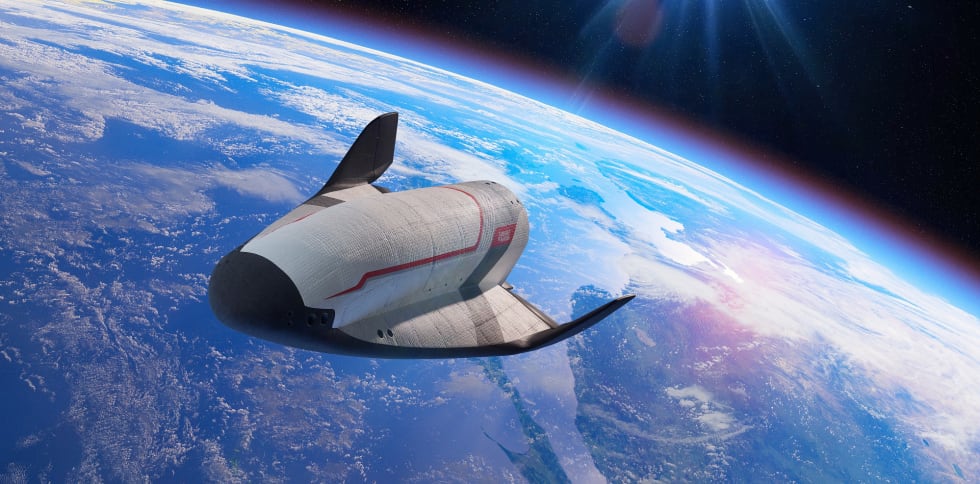
The European Space Agency (ESA) revealed today that it has completed drop tests from a helicopter of an engineering vehicle of its proposed Space Rider reusable mini-shuttle — similar in concept to the U.S. military’s X-37B — testing the spacecraft’s parachutes and re-entry guidance system.

The drop-test campaign had two objectives: the qualification of the parachutes used to slow the spacecraft during descent, and to test the software that controls the parafoil, guiding the Space Rider’s reentry module to its precise landing site. Space Rider models were dropped from a CH-47 Chinook Italian Army helicopter from altitudes ranging from 1 to 2.5 km, at the Italian military’s training and experimentation area Salto di Quirra.

The press release provides no movie of any of the drop tests, and the images it provides are almost all taken from very far away, making it impossible to see in detail what the engineering vehicle looks like. Only one picture clearly shows it, and that is what I have posted to the right. This is not a model of a spacecraft, but a square box carrying the parachutes and sensors.

Note also that ESA was doing similar drop tests last summer of a similar model. Apparently they aren’t yet ready to test the real thing.

This X-37B copy was first tested by ESA in 2015 and by 2017 the agency was promising it would be flying commercially by 2025. A decade later and they have not yet begun testing a full scale spacecraft. In addition, ESA has established some very complex rules about who can use it commercially, rules so complex I predict few will be interested.

Europe might be trying to adopt capitalism and freedom as its model, but in many ways it behaves as if it hasn’t the foggiest idea what it is doing.

6 comments

COVID health slanderer gets fired for wishing death on Texans because Texas voted for Trump

Christina Propst, spreading different lies at a town hall meeting during the COVID panic
Christina Propst, spreading different lies at a town
hall meeting during the COVID panic. Click for video.

Fight! Fight! Fight! A Houston pediatrician, Christina Propst, has now been fired because she expressed glee that some Texans might die in this week’s flash floods there because Texas had the nerve to vote for Trump in the 2024 election.

Her exact words:

May all visitors, children, non-MAGA voters and pets be safe and dry.
Kerr County MAGA voted to gut FEMA.
They deny climate change.
May they get what they voted for.
Bless their hearts.

The implication was that she really didn’t care that some kids died as well. She hates Trump that much.

This is not the attitude a health organization wants from its pediatricians, whose job it is to treat children. Within hours her employer, Blue Fish Pediatrics, suspended her, then quickly followed up by firing her.

This story though has a greater context. » Read more

13 comments

Canadian rocket startup hopes to fly first suborbital launch from its proposed Newfoundland spaceport in August

Nordspace's proposed spaceport
Nordspace’s proposed spaceport. Click for original.

Though details remain slim, the Canadian rocket startup Nordspace now says it is targeting an August launch of its hopes to fly first suborbital launch from its proposed spaceport in August.

NordSpace’s Taiga rocket isn’t going to reach orbit when it launches in August, but it’s a big step toward the company’s ultimate goal. Taiga is a small, liquid-fueled, hypersonic launch vehicle capable of carrying just over 110 pounds (50 kilograms) above the Karman Line. This summer’s shakedown cruise will be a low-altitude demonstration of Taiga’s capabilities.

The map to the right indicates the location of the spaceport, near the town of St. Lawrence on the southern coast of the island of Newfoundland.

Whether this launch occurs is very uncertain. For example, a previous report in January 2025 about this launch site suggested that government approvals were still required. It is not known if those approvals have been obtained.

Nordspace is the second company in Canada to propose offering a combined spaceport/rocket service. The other, Maritime Launch Services, first appeared almost a decade ago, but has never gotten off the ground. Nordspace first announced its plans in July 2024, so achieving a first test launch in 2025 will clearly place it ahead of Maritime.

7 comments

SpaceX gets launch contract from Globalstar

As it appears right now to be the only American rocket company capable of taking on new launch contracts, SpaceX today was awarded a new launch contract from Globalstar to launch its third generation set of satellites.

The press release is not clear about the number of satellites or launches involved, but either way the deal signals SpaceX’s continuing dominance. For larger satellites it has no real competitors. Not only are its launch prices the cheapest, none of its competitors are capable of adding new customers to their launch manifests. In fact, those competitors, ULA, Arianespace, and Blue Origin, are having trouble simply getting their rockets off the ground on a regular basis.

This situation however is likely to change by two years, assuming the new rockets being developed by Rocket Lab, Stoke Space, and Relativity finally begin flying.

0 comments

Spanish high altitude balloon company to fly tourist flights from South Korea

The Spanish high altitude balloon startup Zero-2-Infinity has now established an office in South Korea with the intention of flying tourist flights from there for a ticket price of about $60k per flight.

Zero 2 Infinity plans to begin its Korean operations with a project called “Byul” — the Korean word for star — which offers a symbolic farewell for pet lovers. The initiative will invite volunteers to send the ashes of their deceased furry companions into the stratosphere, carried in star-shaped, biodegradable capsules. The company aims to begin collecting participants this September, with the first near-space release scheduled for December in Korea.

Byul will apparently be a smaller balloon with no human passengers. The company claims it has already test flown a larger helium balloon with humans aboard to an altitude of 6 miles, and again unmanned to 20 miles. If so it has done so with no publicity at all. This announcement today appears more a push to raise the $70 million the company says it needs to develop this manned balloon capsule.

3 comments

SpaceX launches 28 Starlink satellites

After an unusual pause of launches of several days (likely due to the July 4th weekend), SpaceX last night successfully launched by placing another 28 Starlink satellites into orbit, its Falcon 9 rocket lifting off from Cape Canaveral in Florida.

The first stage completed its 22nd flight, landing on a drone ship in the Atlantic.

The leaders in the 2025 launch race:

85 SpaceX
36 China
10 Rocket Lab
8 Russia

SpaceX now leads the rest of the world in successful launches, 85 to 63.

0 comments

Woke heads of Merchant Marine Academy who banned painting of Jesus fired

USSMA Superintendent Vice Admiral Joanna Nunan

Fight! Fight! Fight! The two top officials whom Biden brought in to head the Merchant Marine Academy and who then proceeded to cover a painting of Jesus because some leftists complained about it — painted originally by a private citizen for the academy’s chapels — have now been relieved of duty.

The two fired individuals were superintendent Vice Admiral Joanna Nunan and deputy superintendent Rear Admiral David M. Wulf.

While the Transportation Department didn’t pronounce that the leaders were fired, Restoration News obtained a text message sent by Admiral Nunan’s husband that confirms it was not Nunan’s choice to leave.

…There is no lack of cause for these removals—parents, midshipmen, and alumni applaud that these leaders are no longer in charge. Brooke Garrison, USMMA alumna and parent of a recent graduate, told Restoration News that she is “very thankful Nunan is gone.” Garrison said, “Joanna Nunan started implementing her woke agenda from day one.”

» Read more

3 comments

ESA picks five rocket startups for future launch contracts

European Space Agency

Capitalism in space: The European Space Agency (ESA) today announced that it has chosen five rocket startups — out of twelve that applied to its “European Launcher Challenge” — now approved to bid on future ESA launch contracts.

The startups are Isar Aerospace and Rocket Factory Augsburg from Germany, PLD Space from Spain, MaiaSpace from France, and Orbex from Great Britain. Though none have successfully completed a first launch. all five showed the most advancement. Isar has had one attempted launch failure, while Rocket Factory lost its rocket during a static fire test just before launch. PLD meanwhile has achieved a short suborbital test, while Orbex has said it was ready to launch three years ago but was blocked by red tape in the United Kingdom.

MaiaSpace is technically the least advanced, but it is also a subdivision wholly owned by ArianeGroup, a partnership of Europe’s largest aerospace companies, Airbus and Safran. It was also established in partnership with France’s space agency CNES. Thus, it has well-established connections within Europe’s aerospace industry that makes it favored.

The goal of this ESA program is to shift from the government model it has used for decades, where ESA builds and owns the rockets, to develop a competitive rocket industry of independent companies that market their rockets to ESA for contracts. ESA has seen the success in the U.S. when NASA shifted to this capitalism model in the past decade, and wishes to emulate this.

Whether it remains uncertain. ESA is still mired by bureaucratic government thinking, as illustrated by the next phrase in this challenge:

The next phase of the proposal will see ESA open dialogue between the preselected companies and their respective Member States. This process will help formalise the proposal ahead of the agency’s Ministerial-Level Council meeting (CM25), which will take place toward the end of the year. At CM25, Member States are expected to formally commit funding to the initiative. Following the meeting, ESA will issue a Phase 2 call for proposals, which will be restricted to the preselected candidate companies. European Launcher Challenge contracts will then be awarded after a final evaluation period.

The ESA’s very nature seems to impose odious bureaucratic rules on its member nations that could hinder these private companies. For example, these rules now block any other independent rocket startups from bidding on contracts. Like the bootleggers during Prohibitioin, the ESA has essentially divided competition up by territory and given it to these favored companies. No one else is allowed in.

0 comments

1776 – Hatching an Egg

A evening pause: It is July 4th, a time to celebrate not only the Declaration of Independence but the geniuses who created it. This wonderful song from the 1976 movie version of the 1972 musical, 1776 does it so perfectly. I posted it several times before, but it bears repeating because, as I said in those earlier Independence Day posts, “not only did the musical capture the essence of the men who made independency happen, it is also a rollicking and entertaining work of art.”

And as I have also said previously, “Despite the hate being spewed against America and its founding principle that all humans are created free with the right to life, liberty, and the pursuit of happiness, that truth still shines. As John Kennedy said of himself, ourselves, and these founding fathers. ‘We stand for freedom.'”

I pray that most Americans still agree, and are willing to fight with me the growing mobs across our land who no longer do.

9 comments

A Martian meteorite discovered in Africa is up for auction

A Martian rock that fell as a meteorite in Africa and was discovered by a professional meteorite hunter and is the largest such Mars rock found so far is about to go up for sale by auction.

NWA16788 is the largest known piece of Mars on Earth, and its internal composition suggests it was disgorged from the surface of the Red Planet by an asteroid impact so extreme that it turned some of the meteorite’s minerals into glass.

Looking certain to blow past its lower estimate of US$2.0 million, this monumental 54-lb (24.67-kg) lump of Mars has already been bid to $1,920,000 (inc Buyer’s Premium) 12 days before the on-line hammer falls, and even its $4-milllion upper estimate doesn’t look safe with this much interest so early in an online auction.

The expected high price is partly because of the meteorite’s size, and partly because almost such meteorites are found by scientists working for NASA, and are thus never made available for sale. To have one available for purchase is rare indeed.

5 comments

ULA finally begins stacking Vulcan for next launch

After months of delay following the nozzle failure on the rocket’s second launch, ULA has now finally begun preparing a new Vulcan rocket for its third launch, carrying a number of a classified NSSL national security payloads.

Based on statements by ULA’s CEO, Tory Bruno, the company is finally about to begin the aggressive 2025 launch schedule he had promised last year.

During a media roundtable on the sidelines of the 40th Space Symposium in early April, Bruno said they planned to launch around 11 to 13 times by the end of the year. He said that would be a roughly 50-50 split between Atlas and Vulcan rockets.

The next two Vulcan launches are planned to be two NSSL Phase 2 missions: USSF-106 and USSF-87. The Vulcan rockets for both have been at the Cape since last year, but the status of the payloads hasn’t been publicly discussed given their ties to national security.

Bruno said following those two NSSL missions, ULA will launch the first Kuiper Vulcan mission and then bounce back and forth between Atlas and Vulcan flights through the end of the year.

If this schedule turns out to be true, it will be good news not only for ULA but for Amazon, as it indicates the possibility of ULA launching more than 500 Kuiper satellites before the end of the year. That will make a significant dent in its requirement to place 1,600 satellites in orbit by July 2026. At the moment only 54 are in space.

4 comments
1 36 37 38 39 40 413