Universities in Taiwan and the United Kingdom sign partnership deal

The University of Surrey in the United Kingdom, a decades-long pioneer in cubesat technology, has now signed a partnership deal with the National Central University in Taiwan to work together.

Both universities began their work with cubesats to simply as a low-cost way to teach students about satellite design, but quickly found there was money to be made selling this technology commercially. This deal attempts to make two plus two equal six.

The collaborative plans follow multiple successful engagements between the Universities, from NCU professor Loren Chang joining a Taiwanese delegation to Guildford in March to partnership working between students from each university earlier this summer when Surrey and NCU worked with launch provider Stellar Kinetics at Etlaq Spaceport in Oman. The students worked together to integrate the Jovian-O and SIGHT space payloads that they had developed onto the KEA-1 rocket.

The universities also share research interests. The Surrey Space Centre has built space-based radiation detectors and, as part of the UK’s SWIMMR programme to improve resilience to space weather, developed miniature detectors to measure radiation at different altitudes and created a model for the UK Met Office to predict radiation levels experienced by aircraft.

NCU has developed multiple scientific payloads and small satellite science missions, including the Deep Space Radiation Probe (DSRP), which flew aboard the commercial lunar payload service provider, ispace, Inc.’s Resilience lunar lander, launched in January 2025. DSRP was operational for more than 97% of the five-month mission, providing measurements of the radiation belts, several solar radiation storms and radiation in lunar orbit. It was the first Taiwanese payload to fly and operate beyond Low Earth Orbit.

This deal now enhances both universities and the products both sell (educating students and developing new satellite technologies).

0 comments

The left’s hatred and violence is finally driving people away

Erika Kirk, at the moment she publicly forgave her husband's murderer
Erika Kirk, at the moment she publicly forgave
her husband’s murderer. Click for video.

As numerous pundits on the web have already noted, the assassination of Charlie Kirk last week has clarified most starkly the political divide in both the United States as well as across the world.

On the right, we have Kirk’s widow yesterday speaking at a memorial service for her husband, and with tears standing before the world to forgive his killer.

I forgive him. I forgive him because it was what Christ did, and it is what Charlie would do. The answer to hate is not hate. The answer, we know from the Gospel, is love. And always love. Love for our enemies, and love for those who persecute us.

Her speech matched the general tone of most of the speakers at that memorial service. The service itself, as well as the numerous peaceful candlelight vigils nationwide in memory of Kirk, illustrate clearly the response of the right to this heinous act. No riots, no violence, no calls for bloodshed. Only prayer and a cold fury to make sure such violence never happens again.

That tone was set by Kirk himself, before he died. All he ever did was want to debate his very mainstream conservative ideas with leftists, with good will and rationality. He proved it in a text he sent to leftist pundit Van Jones just before his murder:

I’d love to have you on my show to have a respectful conversation about crime and race. I would be a gentleman as I know you would be as well. We can disagree about the issues agreeably.

The left’s response to Kirk however has been not love or good will but hate. Hundreds and hundreds of partisan leftists went on social media to gleefully celebrate his assassination. Leftist politicians and entertainers defamed both him and what he stood for, with lies and slanders. And when the television show of one entertainer, Jimmy Kimmel, got canceled by ABC because Kimmel had falsely claimed on the air that a Trump supporter had killed Kirk, one leftist and former teacher’s union employee decided it was okay to protest Kimmel’s cancellation by firing multiple bullets into the offices of an ABC affiliate in Sacramento. The man, Al Hernandez Santana, also has an extensive X feed where he had expressed hate for Donald Trump, often wishing him dead.

He is clearly not sane, but he is also not an outlier on the left. The response of the left to Kirk’s murder has revealed that for too many Democratic Party supporters, Santana is mainstream.
» Read more

16 comments

SpaceX launches classified reconnaissance payload

SpaceX this morning successfully launched a classified payload for the National Reconnaissance Office, its Falcon 9 rocket lifting off from Vandenberg in California.

The first stage completed its 18th flight, landing back at Vandenberg. The two fairing halves completed their 27th and 28th flights respectively. As of posting the payload had not yet been deployed.

The leaders in the 2025 launch race:

122 SpaceX
54 China
13 Russia
12 Rocket Lab

SpaceX now leads the rest of the world in successful launches, 122 to 93.

0 comments

South Korean rocket startup Innospace wins launch and marketing contract with German broadcast company

The South Korean rocket startup Innospace announced last week that it has signed a $5.8 million launch with the German broadcast company Media Broadcast Satellites (MBS) to not only launch two MBS satellites in 2026 and 2028 using its Hanbit rocket, but to have MBS market the rocket in Germany.

Under the agreement, INNOSPACE will carry out two HANBIT launch missions to deploy MBS satellites into Low Earth orbit (LEO), with one launch in 2026 and the other planned by 2028. In both launch missions, MBS satellites will serve as the primary payloads, with priority in launch scheduling and orbit determination.

INNOSPACE also signed a separate contract on the same day, officially appointing MBS as its exclusive agent for launch service sales and marketing within Germany, marking the company’s entry into the European space launch market. Following the contract, MBS will exclusively distribute launch services based on the HANBIT series to satellite customers in Germany.

Innospace has not yet launched Hanbit. It had hoped to attempt the first launch in July, but in May it delayed it to the end of 2025 due to issues found in a first stage pump. The launch itself will take place at Brazil’s long abandoned Alcântara spaceport on that nation’s northeast coast.

4 comments

Avio wins U.S. launch contract for its Vega-C rocket

Capitalism in space: In what I think is a first, the Italian rocket company Avio has won a Vega-C launch contract without any participation from the European Space Agency’s (ESA) commercial division Arianespace.

The contract is also with an American company, SpaceLaunch, to put an “institutional Earth observation satellite” in orbit in 2027.

The significance of the deal is that Avio is now successfully marketing and selling its Vega-C rocket, without the middleman Arianespace taking a cut. As part of the shift of ESA and Europe to the capitalism model, whereby it no longer runs things but acts merely as a customer, it also freed Avio from the clutches of Arianespace. Previously, Avio built the rocket for that government agency, which then marketed and sold it to satellite companies. Avio had no control over profit or price. In fact, it didn’t really own its own rocket.

This absurd situation is now ending. There are still a handful of Vega-C launches that were contracted for under Arianespace, but after these Avio will be completely in charge. This deal, announced yesterday, is the beginning of that process.

2 comments

SpaceX launches 28 Starlink satellites

The beat goes on. SpaceX early this morning successfully placed another 28 Starlink satellites in orbit, its Falcon 9 rocket lifting off from Cape Canaveral in Florida.

The first stage completed its eleventh flight, landing on a drone ship in the Atlantic.

The leaders in the 2025 launch race:

121 SpaceX
54 China
13 Russia
12 Rocket Lab

SpaceX now leads the rest of the world in successful launches, 121 to 93.

4 comments

Blue Origin wins contract to bring NASA’s Viper rover to the Moon

NASA yesterday awarded Blue Origin a contract to use its Blue Moon lunar lander to transport the agency’s troubled Viper rover to the Moon’s south pole region.

The CLPS task order has a total potential value of $190 million. This is the second CLPS lunar delivery awarded to Blue Origin. Their first delivery – using their Blue Moon Mark 1 (MK1) robotic lander – is targeted for launch later this year to deliver NASA’s Stereo Cameras for Lunar-Plume Surface Studies and Laser Retroreflective Array payloads to the Moon’s South Pole region.

With this new award, Blue Origin will deliver VIPER to the lunar surface in late 2027, using a second Blue Moon MK1 lander, which is in production. NASA previously canceled the VIPER project and has since explored alternative approaches to achieve the agency’s goals of mapping potential off-planet resources, like water.

The contract does not guarantee this mission. NASA has several options along the way to shut things down, depending on the milestones Blue Origin achieves. The first of course is the success of that first lunar lander.

The announcement does not make clear how NASA is going to pay for the work needed to finish Viper. VIPER was originally budgeted at $250 million. When cancelled in 2024 its budget had ballooned to over $600 million, and that wasn’t enough to complete the rover for launch. Moreover, after getting eleven proposals from the private sector companies to finish and launch Viper, in May 2025 NASA canceled that solicitation.

It is very likely Blue Origin is picking up the tab, but if so the press release does not say so.

10 comments

FAA releases proposed revisions to environmental assessment at Boca Chica to accomodate full orbital testing and return of both Superheavy and Starship

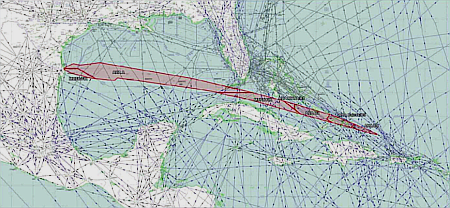
The planned return trajectories for both Superheavy and Starship
The planned return trajectories for both
Superheavy and Starship

The FAA today released [pdf] a new draft of the environmental assessment of SpaceX’s Superheavy/Starship operations at Boca Chica that will allow for full orbital flights as well as for both to return to that launchpad.

The two maps to the right show the two planned return paths for Superheavy (top) and Starship (bottom) as it comes back from orbit. In both cases the ships will return to Boca Chica to be caught by tower chopsticks. The reassessment analyzed the impacts of these trajectories, including its impact on aviation traffic, and concluded the proposal was acceptable. From its conclusion:

The 2022 PEA [Programmatic Environmental Assessment] and April 2025 Tiered EA [environmental assessment] examined the potential for significant environmental impacts from Starship-Super Heavy launch operations at the Boca Chica Launch Site and defined the regulatory setting for impacts associated with Starship-Super Heavy. The areas evaluated for environmental impacts in this Tiered EA include aviation emissions and air quality; noise and noise-compatible land use; hazardous materials; and socioeconomics. In each of these areas, the FAA has concluded that no significant impacts would occur as a result of the Proposed Action. [emphasis mine]

This approval is still only a draft. It must go through a public comment period, ending October 20, 2025. There will also be a virtual public meeting on October 7, 2025. Information about submitting comments or participating in that virtual meeting can be found here.

Such meetings are likely to see the leftist anti-Musk crowd come out in droves, screeching how we are all gonna die if these launches are allowed. The FAA will nod its head, and then ignore the Chicken Littles and approve this plan.

The plan itself tells us that SpaceX is definitely gearing up the first orbital flights of Starship next year, along with the first attempts to catch it with the tower chopsticks.

2 comments

Luxembourg cargo capsule startup Space Cargo raises $32 million in private investment capital

The Luxembourg cargo capsule startup Space Cargo has now raised $32 million in private investment capital in a new funding round focused on developing its BentoBox platform for in-space manufacturing and experimentation.

On 15 September, the company announced that it had closed a €27.5 million Series A funding round led by Expansion Ventures and supported by Eurazeo. The round included participation from the European Innovation Council, the European Investment Bank, and the Luxembourg Future Fund II, which is managed by Société Nationale de Crédit et d’Investissement and the European Investment Fund. It also included contributions from numerous private investors who participated through the crowd-equity platform Tudigo.

Unlike Varda’s returnable capsule, BentoBox is smaller and not designed to return to Earth. Instead it gets launched incorporated on orbital spacecraft built by others, such as Thales Alenia’s REV-1 tug and Atmos’s Phoenix returnable capsule.

0 comments

Astra is now targeting mid-’26 for first launch of its new Rocket-4 rocket

According to a presentation by Astra officials this week, the company now plans the first launch of its larger Rocket-4 rocket in the summer of 2026, followed by a second launch in the fall for the Pentagon.

The summer 2026 inaugural launch will be a test flight, Kemp said, followed by one in October or November for the Defense Department’s Space Test Program. Astra plans quarterly launches of Rocket 4 in 2027, with long-term goals for much higher launch rates. Astra has maintained plans to make Rocket 4 a transportable launch system using standard shipping containers, allowing it to operate from sites with little more than a concrete pad.

This company has had a checkered history. It built and launched its smaller Rocket-3 rocket several times back in 2021 and 2022, with mixed results. After those launch failures it then decided to retire that smaller rocket for Rocket-4, only to run out of cash in 2023-2024. In 2024 its founders put together the cash to buy up the company’s stock to go private, and since then it has made most of its money from that one military test contract as well as selling its electrical propulsion systems to satellite companies.

If it gets Rocket-4 off the ground and begins regularly launches it will be an amazing recovery.

1 comment

At last some real pushback against the left’s slander culture

For years I have been writing about the slander culture of the left, whereby they can say any lie about anyone who disagrees with them without any consequence. These lies are often pure slander and defamation, based on no facts. Often they grow to a point that anyone attacked in this manner becomes a persona non grata, ostracized by all society out of fear.

Here are some recent examples of this kind of slander:

This is what destroyed the Proud Boys organization. The left — and the propaganda press that works for it — labeled it as “racist”, “white supremacist”, and “neo-fascist” based on no evidence, so that soon it collapsed because ordinary people were afraid to associate with it. And in describing this slander campaign back in 2019, I correctly predicted even worse:

I fully expect the rhetoric against Trump supporters in the coming election to spread and get more vicious. This in turn will act to encourage more extreme actions, including violence comparable to what Antifa now does with impunity in Portland. Be prepared. When people abandon the truth for emotional labels inspired by hate, they are liable to do anything.

Meanwhile, this lying name-calling never seemed to carry any consequences. Big name Democratic Party politicians, celebrities, and leftist pundits could defame conservatives routinely in the same manner and get away with it. The only ones who would suffer would be the unjustly accused.

The events in the past two days in connection with former host Jimmy Kimmel of Jimmy Kimmel Live! however tells me that the murder of Charlie Kirk has truly changed things.
» Read more

37 comments
1 45 46 47 48 49 684