Scientists to pollute atmosphere to stop global warming

The coming dark age: In order to stop global warming a team of scientists plan a first test of a method designed to block sunlight by injecting aerosols (the scientific term for pollution) into the upper atmosphere.

If all goes as planned, the Harvard team will be the first in the world to move solar geoengineering out of the lab and into the stratosphere, with a project called the Stratospheric Controlled Perturbation Experiment (SCoPEx). The first phase — a US$3-million test involving two flights of a steerable balloon 20 kilometres above the southwest United States — could launch as early as the first half of 2019. Once in place, the experiment would release small plumes of calcium carbonate, each of around 100 grams, roughly equivalent to the amount found in an average bottle of off-the-shelf antacid. The balloon would then turn around to observe how the particles disperse.

The test itself is extremely modest. Dai, whose doctoral work over the past four years has involved building a tabletop device to simulate and measure chemical reactions in the stratosphere in advance of the experiment, does not stress about concerns over such research. “I’m studying a chemical substance,” she says. “It’s not like it’s a nuclear bomb.”

Nevertheless, the experiment will be the first to fly under the banner of solar geoengineering. And so it is under intense scrutiny, including from some environmental groups, who say such efforts are a dangerous distraction from addressing the only permanent solution to climate change: reducing greenhouse-gas emissions. The scientific outcome of SCoPEx doesn’t really matter, says Jim Thomas, co-executive director of the ETC Group, an environmental advocacy organization in Val-David, near Montreal, Canada, that opposes geoengineering: “This is as much an experiment in changing social norms and crossing a line as it is a science experiment.” [emphasis mine]

The number of stupid and ill-documented conclusions mentioned in this article are so many it would be hard to list them all. For one, it assumes the climate is warming in a disastrous manner, an assumption that remains entirely unproven. For another, the last paragraph in the quote above illustrates how much politics dominates this scientific field. Science has nothing to do with this experiment.

Third, the risks involved in doing this kind of geoengineering are impossible to measure. They very easily could be very negative, for us and the environment. Fourth, the only objections to this experiment quoted in the article come from activist groups who believe in global warming, but would rather impose political restrictions on freedom and property rights than do geoengineering. Skepticism of the global warming theory is merely mentioned as an aside, coming from “the occasional conspiracy theorist.”

I could go on. The worst part of this article and the scientists proposing this work is their utter refusal to consider the gigantic amounts of research that has shown the many benefits of increased atmospheric carbon dioxide and warming for agriculture and plant growth. Global warming, should it happen, could have negative consequences, but the data so far is very far from conclusive.

Let me add one more side note: The same environmentalists who generally support geoengineering to halt global warming are also likely to agree with this infantile op-ed: Richard Branson and Elon Musk threaten the purity of space.

Despite all the money the US and Russia have spent attempting to show who has the biggest balls, space remains pure. But, while Nasa re-engages and fuels up for another go, so-called space pioneers and entrepreneurs are already selling seats.

I don’t know about you, but I don’t want space to be commercialised, owner [sic] by Richard Branson or Elon Musk. For me, this would ruin something very special.

I’d suggest you read it all, but I would fear your level of education and ability to think will be seriously damaged.

For these anti-human environmentalists, manipulating the Earth’s atmosphere, based on weak scientific theories, is perfectly okay. Having humans and private enterprise in space, however, is evil and must be prevented at all costs.

The empty-headed lack of thought and ignorance required to come to these conclusions, simultaneously, boggles my mind.
27 comments

Scientists admit to many errors in ocean warming paper

The uncertainty of science: The scientists who wrote a much heralded paper a few weeks ago claiming that the oceans are retaining far more heat than previously believed have admitted that their paper has many errors that make its conclusions far more uncertain.

Scientists behind a major study that claimed the Earth’s oceans are warming faster than previously thought now say their work contained inadvertent errors that made their conclusions seem more certain than they actually are.

Two weeks after the high-profile study was published in the journal Nature, its authors have submitted corrections to the publication. The Scripps Institution of Oceanography, home to several of the researchers involved, also noted the problems in the scientists’ work and corrected a news release on its website, which previously had asserted that the study detailed how the Earth’s oceans “have absorbed 60 percent more heat than previously thought.”

“Unfortunately, we made mistakes here,” said Ralph Keeling, a climate scientist at Scripps, who was a co-author of the study. “I think the main lesson is that you work as fast as you can to fix mistakes when you find them.”

The central problem, according to Keeling, came in how the researchers dealt with the uncertainty in their measurements. As a result, the findings suffer from too much doubt to definitively support the paper’s conclusion about how much heat the oceans have absorbed over time. [emphasis mine]

To put it more bluntly, their conclusions are worthless, the data being too uncertain.

When this paper came out two weeks ago I looked at it, and found myself questioning its results. They seemed too certain. Moreover, their work was too perfect for confirming the theory that the oceans are retaining more heat and thus causing the pause in global warming that no global warming model predicted. It fit the model of most climate research these days, unreliable and unconvincing, which is why I did not post it on Behind the Black.

Now, only two weeks later, we find the researchers backing off from their certain conclusions. If anything is a perfect demonstration of confirmation bias, this story is it. These global warming scientists want desperately to prove their theories, and since their models haven’t been working they are desperately searching everywhere they can for explanations. In this case that search led them astray.

The truth is that maybe the climate field should take a step back and reconsider its entire assumptions about carbon dioxide and global warming. They might actually end up doing better science, and thus do a better job at getting us closer to the truth.

A side note: That this paper passed peer review, and was strongly touted by the media and the science community, illustrates once again how much that media and science community has allowed its biases to cloud its vision. This paper should never have been published with these errors. Period.

10 comments

Earth’s atmosphere cooling as solar minimum arrives

The uncertainty of science: With the early arrival of the solar minimum, the Earth’s atmosphere has quickly shown signs of cooling.

New research shows that Earth’s upper atmosphere is responding. “We see a cooling trend,” says Martin Mlynczak of NASA’s Langley Research Center. “High above Earth’s surface, near the edge of space, our atmosphere is losing heat energy. If current trends continue, it could soon set a Space Age record for cold.”

These results come from the SABER instrument onboard NASA’s TIMED satellite. SABER monitors infrared emissions from carbon dioxide (CO2) and nitric oxide (NO), two substances that play a key role in the energy balance of air 100 to 300 kilometers above our planet’s surface. By measuring the infrared glow of these molecules, SABER can assess the thermal state of gas at the very top of the atmosphere–a layer researchers call “the thermosphere.”

“The thermosphere always cools off during Solar Minimum. It’s one of the most important ways the solar cycle affects our planet,” explains Mlynczak, who is the associate principal investigator for SABER.

What effect this upper atmosphere cooling will have on the surface climate is somewhat uncertain, though there is a great deal of evidence suggesting the surface climate will cool also.

6 comments

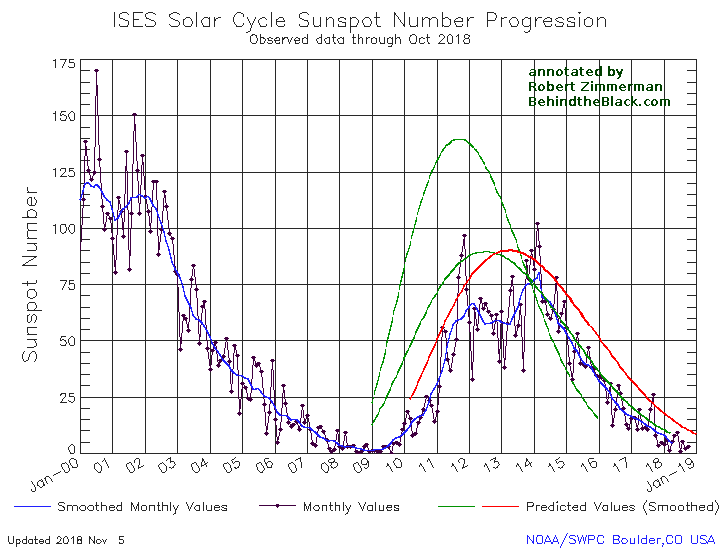
Sunspot update October 2018: Deepening minimum

The monthly NOAA update of the solar cycle, covering sunspot activity for October 2018, was released yesterday. As I have done every month since this website began in July 2011, I am posting it below, annotated to give it some context.

Though there was a tiny uptick in sunspot activity on the Sun in October, the uptick was inconsequential. Overall, the activity in the past few months appears to closely match the weak activity seen in late 2007 and early 2008, just when the last solar minimum began.

October 2018 sunspot activity

The graph above has been modified to show the predictions of the solar science community. The green curves show the community’s two original predictions from April 2007, with half the scientists predicting a very strong maximum and half predicting a weak one. The red curve is their revised May 2009 prediction.

As I noted in August, the NOAA graph is now getting very close to its right edge, which ends in December 2018. They will very soon have to update this graph so that it can take us into the next solar cycle. While they must do this, it will unfortunately end the standard visual used by them for more than a decade for showing the progress of the solar cycle. Depending on how they change it, I might be able adapt it to include this graph to allow a continuation of the same visual into the future. We will have to see.

Having seen now the full solar maximum for this cycle (weak and short), we are now moving to the next question: Will the developing solar minimum be as long and as deep as the last? Will it evolve into a grand minimum, lasting decades, as some solar scientists believe?

Or will the Sun return to the higher levels of activity seen during most of the 24 solar cycles observed since the last grand minimum in the 1600s?

Since our understanding of these changes is very poor, your guess is likely as good as anyone else’s. All we can really do is keep our eyes open and watch what happens.

1 comment

Strong India monsoons cause more hurricane landfalls in North America

A new study has found a correlation between the strength of the monsoon season in India and the number of hurricanes that make landfall in North America.

According to Kelly, La Niña and the Indian monsoon are correlated, but the strength of the monsoon influences the steering of hurricanes independently of La Niña fluctuations, which are responsible for changes in hurricane frequency. In other words, La Niña fluctuations may result in more Atlantic hurricanes, but strong Indian monsoons steer them further westward, making it more likely they will make landfall in the Americas.

It’s important to account for the correlation when studying hurricane steering and landfall probability.

In reading the article, ignore the propaganda promoting global warming, as the research has zero to do with that subject. It instead now provides meteorologists another clue to predicting the frequency and paths of hurricanes in the Atlantic.

2 comments

Trump scraps academic EPA air pollution panel

The head of EPA in the Trump administration has scrapped the academic EPA air pollution panel that has dominated the agency’s air quality control standards for decades.

Andrew Wheeler, the acting chief of the U.S. Environmental Protection Agency (EPA), yesterday fired a panel of scientific experts charged with assisting the agency’s latest review of air quality standards for particulate matter. He also scrapped plans to form a similar advisory panel to aid in a recently launched assessment of the ground-level ozone limits.

Those steps, coupled with Wheeler’s previously announced decision to concentrate authority in a seven-member committee made up mostly of his appointees, quickly sparked objections that the agency is intent on skewing the outcome of those reviews in favor of industry.

…Under the Clean Air Act, EPA is supposed to review the adequacy of the standards for particulate matter, ozone and four other common pollutants every 5 years with help from outside experts. While the seven-member committee, officially known as the Clean Air Scientific Advisory Committee (CASAC), has the lead in the process, the [scrapped] review panels are supposed to provide additional know-how in assessing the relevant scientific literature, which can span a variety of academic disciplines.

Essentially the acting administrator is continuing the effort of the former EPA head, Scott Pruitt, to de-emphasize the domination of the leftist academic community in these matters. Naturally, the academics are screaming, but then, screaming has recently become the left’s only debating point in all matters of national discussion.

3 comments

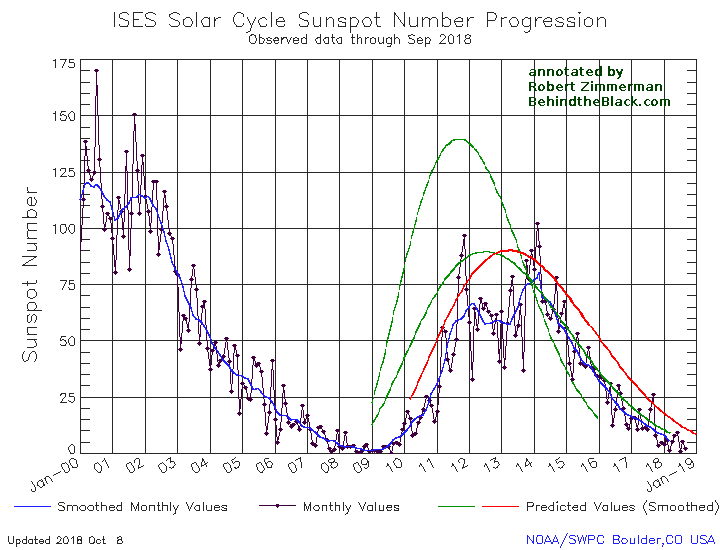
Sunspot update September 2018: Minimum!

NOAA yesterday released its monthly update of the solar cycle, covering sunspot activity for September 2018. As I have done every month since this website began in July 2011, I am posting it below, annotated to give it some context.

Sunspot activity on the Sun in September dropped slightly from August. More significantly, the activity continues to match closely the weak activity seen in 2008, when the Sun last went through its last solar minimum. We are unquestionably now in the new minimum, and its arrival in the past few months makes the now-ending solar cycle about one to two years shorter than predicted.

September 2018 sunspot activity

The graph above has been modified to show the predictions of the solar science community. The green curves show the community’s two original predictions from April 2007, with half the scientists predicting a very strong maximum and half predicting a weak one. The red curve is their revised May 2009 prediction.

As I noted last month, the NOAA graph is now getting very close to its right edge, which ends in December 2019. They will very soon have to update this graph so that it can take us into the next solar cycle.

What that new cycle will bring will be the next mystery. I have been following this cycle now since its unusual beginning, with a solar minimum much much longer and more inactive than any solar scientist had ever expected. We can only guess at the surprises the Sun will give us in the coming decade, especially since the science of solar sunspot activity remains superficial and in its infancy. We do not really understand why the Sun’s activity fluctuates. Nor do we understand why it periodically stops producing sunspots for long periods, resulting in what solar scientists call a grand minimum.

There are some scientists who think another grand minimum is coming. We shall have to wait and see. I certainly am going to follow their upcoming observations, as this work remains one of the great scientific studies humans are presently pursuing.

5 comments

New study: Forest cover has blossomed since 1980s

The uncertainty of science: According to new research the world’s tree canopy has grown by almost a million square miles since 1982.

While the area of bare ground and short vegetation is diminishing, forest area is growing. As Ronald Bailey notes in Reason, “Forests in montane regions are expanding as climate warming enables trees to grow higher up on mountains.”

The greatest increase in tree canopy occurred in Europe, including European Russia, where it exploded by 35%. A close second was found in China, where tree canopy gained 34%. In the U.S., tree canopy increased by 15%.

This study confirms numerous other forest and agricultural research that has shown that increased carbon dioxide in the atmosphere encourages plant growth. Numerous other studies have also found that the Earth has been greening in the past century.

My review of the scientific literature on this subject also matches this finding, having found that if global warming is happening, research looking at what has actually happened generally show that increased CO2 and warming have tended to have beneficial effects, despite the endless doomsday predictions by global warming scientists of what might happen.

9 comments

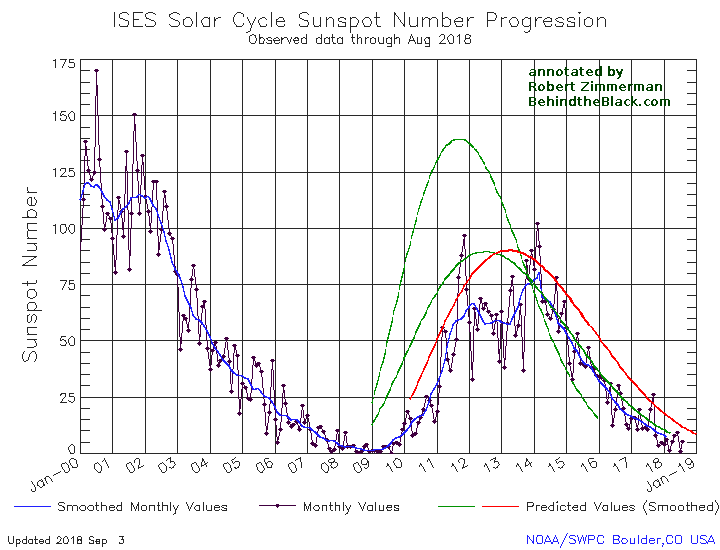
Sunspot update for August 2018: The slide to minimum

As it does the first Sunday of each month, yesterday NOAA posted its monthly update of the solar cycle, covering sunspot activity for August 2018. And as I do every month, I am posting it below, annotated to give it some context.

The Sun in August had a slight uptick in sunspot activity, but not a very significant one. As such, the slide to solar minimum continues. Right now the lack of sunspot activity in 2018 is heading to match or even exceed 2007, the year in which the previous solar minimum began.

August 2018 sunspot activity

The graph above has been modified to show the predictions of the solar science community. The green curves show the community’s two original predictions from April 2007, with half the scientists predicting a very strong maximum and half predicting a weak one. The red curve is their revised May 2009 prediction.

If you look at the original graph at NOAA, you will see that we are getting very close to the right edge of the graph. I expect that sometime in the next few months NOAA will update the graph, a necessary act that will in one sense be a shame, as they have been adding monthly updates to this graph since the beginning of the last solar minimum. This has allowed everyone to see a standard visual, month to month, for comparing solar activity. It has also allowed me to annotate the graph properly to show how the 2007 and 2009 predictions held up against actual activity. Once the graph changes it will be more difficult to do this.

Anyway, it is very clear we are entering solar minimum, and that the solar cycle we are now completing will be both a short and weak cycle. What happens next is really the big question. Will the Sun sunspot activity recover? Or will we enter the first grand minimum since the 1600s? Either way, for solar scientists the coming years are going to be very exciting.

Posted on interstate 10 going from Tucson to Phoenix, on the way to the wooded northern forests of Arizona, where Diane and I will spend a couple of days visiting friends at their upstate cabin/home.

10 comments

The failed Arctic Ocean predictions of global warming scientists

Link here. The post at the link carefully documents the endless numbers of failed doomsday predictions foisted upon us for the past decade, claiming that due to global warming the Arctic Ocean icecap would be gone by 2018.

Instead, in the past three years there is evidence that the icecap has begun to thicken and expand, recovering from a two decade decline. Though this is not a certain conclusion, what is certain is that there is no sign of the icecap vanishing, in any sense. Every prediction documented at the link, by so-called experts, is completely bogus.

There is a reason the public does not take global warming very seriously. Its advocates have cried wolf too many times. Their predictions of doom have consistently failed. Every. Single. Time.

11 comments

Sunspot update for July 2018: The Sun flatlines!

Yesterday NOAA posted its monthly update of the solar cycle, covering sunspot activity for July 2018. As I do every month, I am posting it below, annotated to give it some context.

This might be the most significant month of solar activity that has been observed since Galileo. Except for two very short-lived and very weak sunspots that observers hardly noted, the Sun was blank for entire month of July. This has not happened since 2009, during the height of the last solar minimum.

What makes this so significant and unique is that it almost certainly signals the return of the next solar minimum, a return that comes more than a year early. The solar cycle the Sun is now completing has only been ten years long. It is also one of the weakest in more than a hundred years. This combination is unprecedented. In the past such a weak cycle required a long cycle, not a short one.
» Read more

9 comments

A science journal describes how evil Trump is destroying EPA

Link here.

If you have no idea why we have Trump, and why we are likely to get more of him, read this article from the science journal Nature. It is a carefully written screed, written entirely from the point of view of those hostile to Trump and his effort to rein in the EPA’s regulatory culture. No one is interviewed to give the Trump perspective, and even if some had been, the author is so certain that Trump is evil and wrong in his efforts that I am sure the Trump perspective would have been misinterpreted, or even slandered. (This I am sure is why the article says that EPA management did not “respond to requests to comment on the article’s allegations.” The allegations were already set. Nothing anyone said from the administration would change those conclusions.)

Still, I am certain the author could have gotten opinions from some of the skeptical scientists whom the Trump administration has brought in to advise EPA. None however were interviewed.

What is most embarrassing about the article is its description of two of the main changes the Trump administration has imposed on EPA to widen and make more transparent the scientific work it does. First,
» Read more

4 comments
1 13 14 15 16 17 57