The Greatest Scientific Fraud Of All Time — Part XXIII

Link here. The author continues a long running series outlining the data manipulation and tampering that has been going on at NOAA and NASA to distort the global temperature record so it will confirm the theories of global warming activists. As he notes,

Sure enough, there have been additional adjustments, as always in the same direction — older down, and newer up. But those adjustments between v.3 and v.4 have been relatively minor. More significantly, Kirye discovered a different maneuver which is even more incredible, and which he proves by direct links back to NASA’s own website: In the v.4 graphs that it provides, NASA has relabeled the hugely-adjusted v.3 data as “unadjusted.”

He pinpoints how NASA is now taking its adjusted data and labeling them unadjusted, so that it can justify even more adjustments, all always cooling the past and warming the present. As he adds,

Funny that once again, each one of the adjustments somehow enhances the warming trend. Is it really possible that never once does any new data, or adjustment to data, lead to a change in the other direction?

This is political hackwork disguised as science. Until the climate science community does something to stop this and clean up the mess in its global temperature data, they will find themselves unable to convince anyone of their scientific credibility. Which by the way is generally in the sewer.
9 comments

Glaciers growing on Greenland

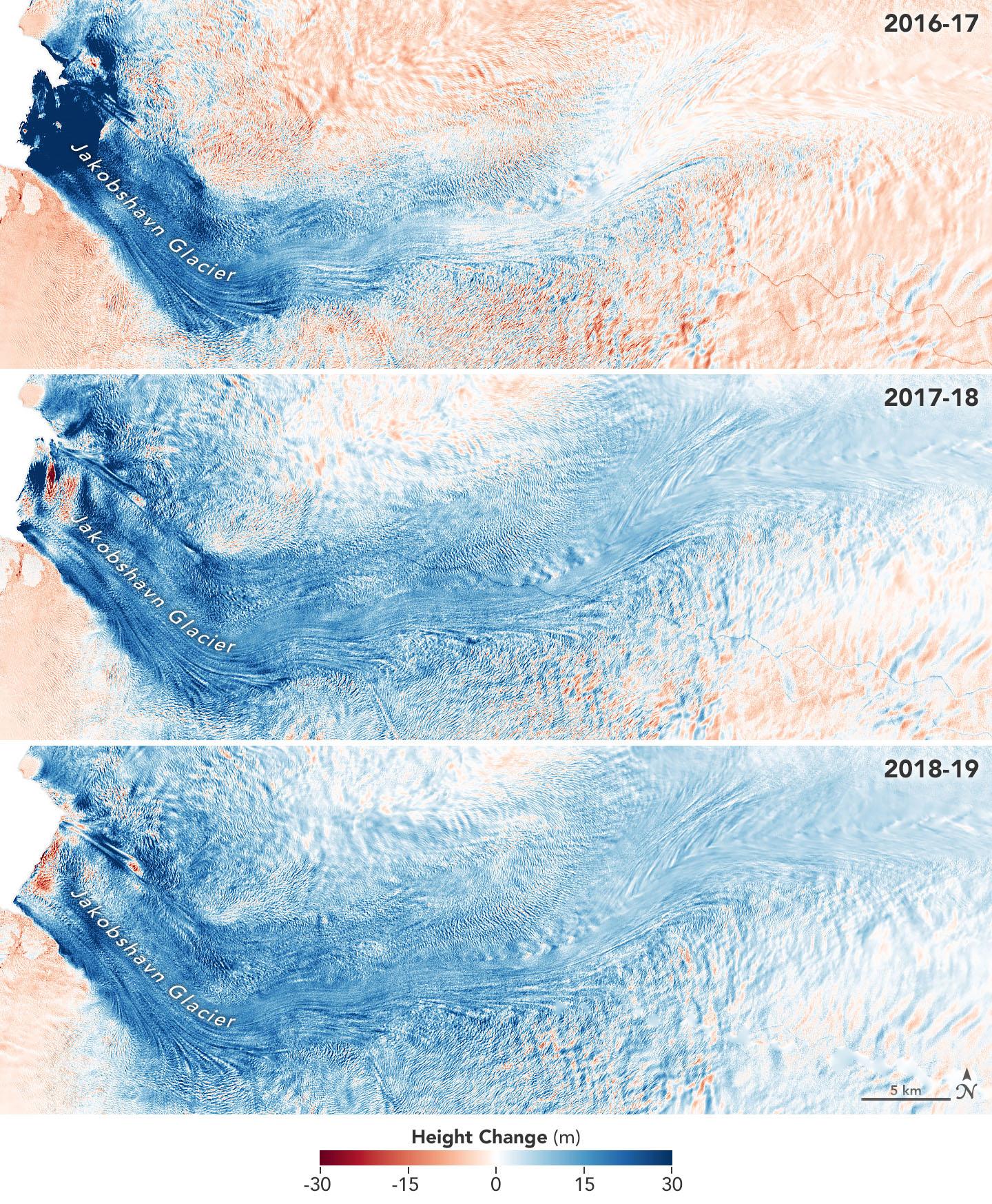
Greenland's growing Jakobshavn Glacier
Click for full image.

Despite what the fake mainstream media and leftist Democratic Party politicians insist on telling us daily, the Greenland icecap remains largely stable, and shows no sign of disappearing anytime in the near future.

The image on the right, reduced to post here, is a series of images produced by radar instruments flown by a NASA airplane over Jakobshavn Glacier during the past three years and released this week by its project scientists. As noted in the release,

These images show the mass Greenland’s Jakobshavn Glacier has gained from 2016-17, 2017-18 and 2018-19. Areas with the most growth are shown in dark blue. Red areas represent thinning. The images were produced using GLISTIN-A radar data as part of NASA’s Ocean’s Melting Greenland (OMG) mission.

While this research is absolutely worthwhile, the mission has clearly been shaped by the global warming activism in NASA and the climate science community. Thus, the scientists for this mission are forced to say this on their website:

Humans are changing the climate by burning fossil fuels for energy. These add greenhouse gases to the atmosphere, which trap extra heat from the sun and warm the air and oceans.

I would bet however that the scientists for this project remain very skeptical about this NASA political statement. That they highlighted here a glacier that is growing, in contradiction to the routine media and activist claims that Greenland’s ice sheet is disappearing, indicates this.

Tony Heller at his climate blog today posted a very good summary of the very stable state of Greenland’s icecap, while also pointing out the dishonest and incompetent reporting about it from mainstream media sources like the Washington Post and Fox News. Check it out. As he concludes:

There has been no trend Arctic sea ice since the start of MASIE records thirteen years ago.

Greenland glaciers are growing. The last two years had near record surface mass gain. The current journalistic standard of cherry picking a day here and there, and then misrepresenting the meaning of it, is journalism at its worst.

The data shows a decline in that icecap in the early part of this century, followed by a significant recovery in the past three years. As he says, there has been no trend.

Be aware of this when ignorant politicians like Congresswoman Alexandria Ocasio-Cortez (D-New York) try to tell you we are all going to die of global warming in mere years. These fear-mongers know nothing, and should be laughed from the stage.

5 comments

New prediction for upcoming solar cycle

The uncertainty of science: A new prediction for the upcoming solar cycle, announced today, calls for a much weaker cycle then the general consensus of the solar science community.

The new prediction:

The forecast for the next solar cycle says it will be the weakest of the last 200 years. The maximum of this next cycle – measured in terms of sunspot number, a standard measure of solar activity level – could be 30 to 50% lower than the most recent one. The results show that the next cycle will start in 2020 and reach its maximum in 2025.

The consensus prediction:

[They] dutifully tabulate the estimates, and come up with a peak sunspot range: 95 to 130. This spells a weak cycle, but not notably so, and it’s marginally stronger than the past cycle. [They do] the same with the votes for the timing of minimum. The consensus is that it will come sometime between July 2019 and September 2020. Maximum will follow sometime between 2023 and 2026.

The main difference is that the consensus expects the next maximum to be weak but stronger than the maximum that just ended, while the new prediction says the next maximum will be the weakest in 200 years.

It has been my impression that there is unhappiness in the solar science community over the consensus prediction. I suspect today’s independent prediction is an indication of that unhappiness. The scientists involved in this research wanted to go on record that they disagree with the consensus.

I expect that NOAA will eventually put the consensus prediction on their monthly sunspot graph that I post here each month. If they do, I might also add this independent prediction so that we can compare the accuracy of the two as the next cycle unfolds.

3 comments

Park Service removes signs saying glaciers to be gone by 2020 and 2030

The National Park Service has finally recognized reality and removed or changed its displays at Glacier National Park that as recently September 2018 had said that the glaciers would be gone by either 2020 and 2030.

At the same time, the park service is still clinging, quite bitterly if you ask me, to its religious faith in global warming, even though the glaciers in the park have not been shrinking at all in recent years.

The National Park Service (NPS) quietly removed a visitor center sign saying the glaciers at Glacier National Park would disappear by 2020 due to climate change.

As it turns out, higher-than-average snowfall in recent years upended computer model projections from the early 2000s that NPS based its claim glaciers “will all be gone by the year 2020,” federal officials said.

“Glacier retreat in Glacier National Park speeds up and slows down with fluctuations in the local climate,” the U.S. Geological Survey (USGS), which monitors Glacier National Park, told The Daily Caller News Foundation. “Those signs were based on the observation prior to 2010 that glaciers were shrinking more quickly than a computer model predicted they would,” USGS said. “Subsequently, larger than average snowfall over several winters slowed down that retreat rate and the 2020 date used in the NPS display does not apply anymore.”

NPS updated signs at the St. Mary Visitor Center glacier exhibit over the winter. Sign changes meant the display warning glaciers would all disappear by 2020 now says: “When they completely disappear, however, will depend on how and when we act.” [emphasis mine]

The highlighted text illustrates the political agenda of the park service, something they have no mandate to have.

If you want to see how stupid the signage was, read my report when Diane and I visited Glacier in summer of 2017. As I wrote then,

The park’s sloppiness and political posturing here however does serve to produce one good, though certainly unintended, result. It helps to discredit the National Park Service’s global-warming activism, which hasn’t been based on good science for quite awhile. It will also help to raise the skepticism of ordinary park visitors, who will either notice the contradictions, or laugh at the absurdity of the prediction that the glaciers will vanish only three years hence.

I guess the park service finally got tired of dealing with the ridicule.

4 comments

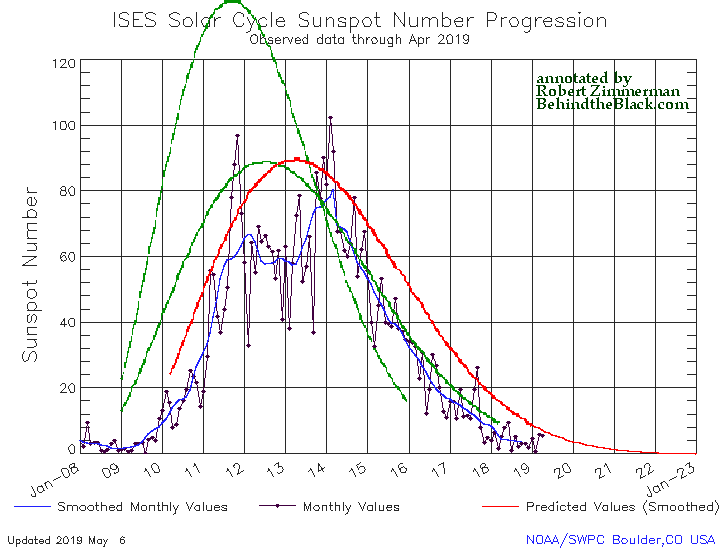
Sunspot update May 2019: The long ramp down

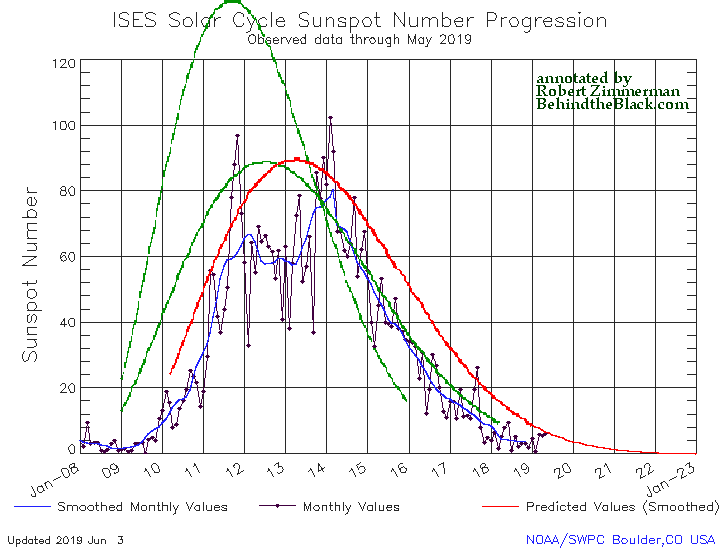
NOAA yesterday released its May update for the Sun’s sunspot cycle. The graph is posted below, annotated by me to give it some context.

The Sun in May continued to show the exact same amount of activity as it had shown for March and April. This steady uptick in sunspot activity once again shows that the ramp down to full solar minimum will be long and extended.

May 2019 sunspot activity

The graph above has been modified to show the predictions of the solar science community for the previous solar maximum. The green curves show the community’s two original predictions from April 2007, with half the scientists predicting a very strong maximum and half predicting a weak one. The red curve is their revised May 2009 prediction, extended in November 2018 four years into the future.

That we are definitely ramping downward to minimum, even with the slight increase in the past three months, is shown by the fact that the Sun has shown no sunspots for the past fifteen days. In fact, all the activity shown in May comes from the first half of the month. This pattern is actually a reflection of the Sun’s 27-day rotation period. As I noted in my February 2017 update,

January’s activity however illustrated a statistical phenomenon that is typical of the sunspot count. That count is determined not by the numbers of sunspots on the entire surface of the Sun, but on the sunspots visible on the side of the Sun facing the Earth. Since it is not unusual for one face to be more active than the other, as we transition from maximum to minimum the sunspot counts will often show a more pronounced up-and-down curve reflecting this fact. Since the Sun’s day equals about 27 Earth days, this means that about every two weeks the active side will dominate our view until it rotates away and the inactive side reveals itself for two weeks.

In 2017 the number of spots were greater, so the period of inactivity was generally less. Now, it is not unusual for the Sun to be blank for weeks at a time. When it does become active, it is also not unusual for that activity to be confined to one hemisphere, so we get two weeks or less of activity, followed by two weeks or more of blankness.

So far there have been no sunspots in June. Expect that to continue for at least another week, when the more active hemisphere of the Sun returns to face us. I would not be surprise however if that other hemisphere arrives with its sunspots gone, so that the present streak of blankness continues unabated.

Meanwhile, solar scientists struggle to figure out what is going to happen next. Unlike climate scientists, who know as little about the climate, the solar science community admits to its ignorance about the Sun, and the uncertainty of its solar models.

6 comments

Solar scientists struggle to predict the next sunspot cycle

Link here. This is a detailed article describing the meeting in March where the solar science community gathered to formulate its prediction for the next solar cycle.

What stands out about the meeting is the outright uncertainty the scientists have about any prediction they might make. It is very clear that they recognize that all their predictions, both in the past and now, are not based on any actual understanding the Sun’s magnetic processes that form sunspots and cause its activity cycles, but on superficial statistics and using the past visual behavior of the Sun to predict its future behavior.

“There’s not very much physics involved,” concedes panelist Rachel Howe of the University of Birmingham in the United Kingdom, who has been tasked with reviewing the mishmash of statistical models. “There’s not very much statistical sophistication either.”

Panelist Andrés Muñoz-Jaramillo of the Southwest Research Institute in Boulder agrees with Howe. “There is no connection whatsoever to solar physics,” he says in frustration. McIntosh, who by now has walked downstairs from his office and appears in the doorway, is blunter. “You’re trying to get rid of numerology?” he says, smirking.

The result, as I repeatedly note in my monthly sunspot updates, is that the last prediction failed, and that there is now great disagreement among these scientists about what will happen in the upcoming cycle.

[They] dutifully tabulate the estimates, and come up with a peak sunspot range: 95 to 130. This spells a weak cycle, but not notably so, and it’s marginally stronger than the past cycle. [They do] the same with the votes for the timing of minimum. The consensus is that it will come sometime between July 2019 and September 2020. Maximum will follow sometime between 2023 and 2026.

The range of predictions here is so great that essentially it shows that there really is no consensus on what will happen, which also explains why the prediction has still not been added to NOAA’s monthly sunspot graph. For past cycles the Sun’s behavior was relatively consistent and reliable, making such statistical and superficial predictions reasonably successful.

The situation now is more elusive. For the past dozen or so years the Sun has not been behaving in a consistent or reliable manner. Thus, the next cycle might be stronger, it could be weak, or we might be heading into a grand minimum, with no sunspots for many decades. These scientists simply do not know, and without a proper understanding of the Sun’s dynamo and magnetic field, they cannot make a sunspot prediction that anyone can trust.

And so they wait and watch, as we all. The Sun will do what the Sun wants to do, and only from this we will maybe be able to finally begin to glean an understanding of why.

8 comments

Scientists propose planetary orbital alignments cause the sunspot cycle

The uncertainty of science: Scientists today proposed a new model that says the orbital alignments of the planets, most especially Venus-Earth-Jupiter, act to initiate the eleven-year solar sunspot cycle.

As with the gravitational pull of the Moon causing tides on Earth, planets are able to displace the hot plasma on the Sun’s surface. Tidal forces are strongest when there is maximum Venus-Earth-Jupiter alignment; a constellation that occurs every 11.07 years. But the effect is too weak to significantly perturb the flow in the solar interior, which is why the temporal coincidence was long neglected. However, the HZDR researchers then found evidence of a potential indirect mechanism that may be able to influence the solar magnetic field via tidal forces: oscillations in the Tayler instability, a physical effect that, from a certain current, can change the behavior of a conductive liquid or of a plasma. Building on this concept, the scientists developed their first model in 2016; they have since advanced this model in their new study to present a more realistic scenario.

More details at the link. To put it mildly, this theory is far from proven. While they mention how it might also cause grand minimums and double-peaked maximums, they are somewhat vague in explaining this process. If valid, however, they should be able to use this model to predict future cycles, including the possible arrival of a new grand minimum in the coming decades.

7 comments

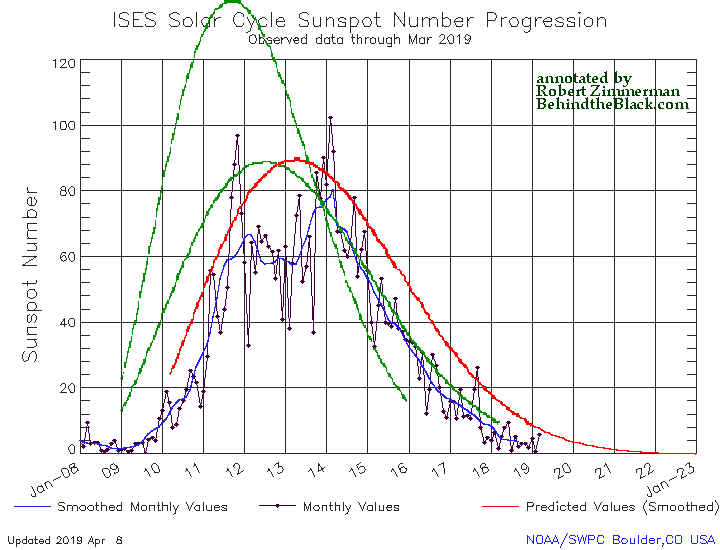
Sunspot update April 2019: Not quite minimum

Time for the monthly sunspot update: NOAA yesterday released its the monthly update for the Sun’s sunspot cycle, adding sunspot activity for April 2019 to its graph. As I do every month, I have annotated that graph to give it some context and am posting it below.

While the Sun is clearly at the beginning of what might be an extended or very extended solar minimum, the continuing uptick in activity in both March and April illustrates that we have still not arrived at full minimum.

April 2019 sunspot activity

The graph above has been modified to show the predictions of the solar science community for the previous solar maximum. The green curves show the community’s two original predictions from April 2007, with half the scientists predicting a very strong maximum and half predicting a weak one. The red curve is their revised May 2009 prediction, extended in November 2018 four years into the future.

As the Sun ramps down to minimum it will have months where there is no activity, as happened in February 2019, and months, such as in March and April, where more sunspots appear.

Eventually the quiet months will become dominate, and soon thereafter, when activity increases again (assuming it does), the solar science community will then announce the date of true minimum.

We are not there. Normally it can take a year or more for the Sun to settle down. If activity declines as indicated by the red curve, it could take as long four years, which would be a record-long minimum. The difference will tell us whether the eleven-year solar cycle is continuing, or the Sun is heading into a grand minimum, with no significant sunspots for decades.

And as I have said repeatedly in the past five years, a grand minimum could significantly impact the global climate, cooling it. Or not. It is that unknown that will be answered should a grand minimum occur. Circumstantial data suggests an inactive Sun cools the planet, and the arrival of a new grand minimum will allow scientists to confirm or refute that circumstantial data.

6 comments

Sunspot update March 2019: An upcoming Grand Minimum?

Even though we are now deep into the beginning of what might become the first grand minimum in sunspot activity since the invention of the telescope, that does not mean the Sun has as yet stopped producing sunspots. Yesterday NOAA released its the monthly update of its tracking of the solar cycle, adding sunspot activity for March 2019 to its graph. Below is that graph, annotated by me to give it some context.

It shows the Sun with a slight burst in activity in March, suggesting that though we are now in the solar minimum that minimum still has the ability to produce sunspots.

At the same time, for me to say that we might be heading to a grand minimum, a time period lasting many decades where no sunspots are visible and the sunspot cycle essentially ceases, is not click bait or hyperbole. It is instead based on what I now think the solar science community is thinking, based on this very graph.

March 2019 sunspot activity

The graph above has been modified to show the predictions of the solar science community for the previous solar maximum. The green curves show the community’s two original predictions from April 2007, with half the scientists predicting a very strong maximum and half predicting a weak one. The red curve is their revised May 2009 prediction, extended in November 2018 four years into the future.

For past half dozen or so cycles the solar science community had issued its prediction for the upcoming solar maximum at about this stage in the overall cycle, during the final ramp down to minimum when it was clear that the Sun had entered that minimum.

This cycle’s prediction however has not yet happened, and in fact appears to be late. In fact, the extension of the May 2009 red curve that was made in November 2018 might very well be the only prediction we see. That extension is shown by the differences between the green 2007 prediction and the red 2009 prediction in the graph. Before November 2018 both curves ended at the same place, the end of 2018.

The extension of that red curve is important. As I noted in my December 2018 sunspot update,
» Read more

19 comments

Senate rejects Democratic New Green Deal 57-0

The Senate yesterday rejected the Democratic New Green Deal proposal by a vote of 57-0, with 43 Democrats (including Bernie Sanders) voting present.

No senator voted to begin debate on the legislation, while 57 lawmakers voted against breaking the filibuster. Democratic Sens. Doug Jones of Alabama, Joe Manchin of West Virginia and Kyrsten Sinema of Arizona joined 53 Republicans in voting “no.” Sen. Angus King, I-Maine, who caucuses with the Democrats, also voted “no.”

The vote had been teed up by Senate Majority Leader Mitch McConnell, R-Ky., in a bid to make Democratic senators — including several 2020 presidential candidates — go on the record about the measure. McConnell had called the proposal “a radical, top-down, socialist makeover of the entire U.S. economy.”

The speech that Senator Mike Lee (R-Utah) gave prior to the vote is worth watching for every one of its 13 minutes. He describes the substance of this bill quite accurately, and he does so in a most amusing manner.

4 comments

New method to turn CO2 into coal

Scientists have developed a new relatively low-cost method for turning atmospheric carbon dioxide into solid carbon that then be used as a synthetic fuel.

“By using liquid metals as a catalyst, we’ve shown it’s possible to turn the gas back into carbon at room temperature, in a process that’s efficient and scaleable,” [Dr. Torben Daeneke, a research scientist at RMIT University.] said. The liquid metal catalyst was developed by the researchers with specific surface properties, making it extremely efficient at conducting electricity, while chemically activating the surface.

According to the press release: “The carbon dioxide is dissolved in a beaker with an electrolyte liquid and a small amount of the liquid metal, which is then charged with an electric current. The CO2 slowly converts into solid flakes of carbon, which are naturally detached from the liquid metal surface, allowing the continuous production of carbonaceous solid.”

And, yes, the process has the potential to yield a future energy source. The carbon produced may be able to be used as an electrode.

This is excellent news, for a lot of reasons. At the same time, I always find this effort to use technology to grab and convert atmospheric carbon dioxide somewhat ironic. We already have a very efficient biological tool for doing this, called plant life, which is presently thriving worldwide because of the increased CO2 in the atmosphere. The more you plant, the more oxygen you create. And what’s more, it gives you a lot more food to eat. Why do anything else?

Hat tip reader John Vernoski.

6 comments

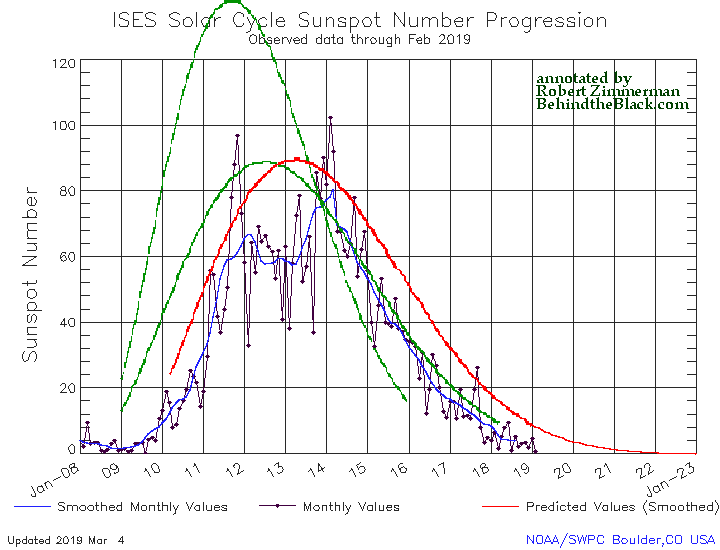
Sunspot update February 2019: The Sun flatlines again

We are now deep into solar minimum. On Sunday NOAA released its the monthly update of the solar cycle, covering sunspot activity for February 2019. As I have done every month since the start of Behind the Black, I am posting it below, annotated to give it some context.

February 2019 sunspot activity

The graph above has been modified to show the predictions of the solar science community. The green curves show the community’s two original predictions from April 2007, with half the scientists predicting a very strong maximum and half predicting a weak one. The red curve is their revised May 2009 prediction.

For the second time since the beginning of the solar minimum last year, the Sun flat-lined for an month, producing no visible sunspots during the entire month of February.

That streak has continued into March. At present we are four days into March, and still no sunspots.

The big question that I will be repeating probably every month for the next two years is whether we are merely experiencing an early and possibly deep solar minimum, or the advent of a new grand minimum, with no visible sunspots for decades. During the last grand minimum in the 1600s there is evidence the Earth cooled, so much so that it was labeled the Little Ice Age. And with previous grand minimums over the past few thousand years there is evidence that similar coolings occurred. Similarly, periods where sunspot activity was high also appear to have been periods of warmer temperatures.

Why is not clearly understood, though there is some evidence that it might be related to the increasd cosmic ray flux during solar minimum.Those rays might interact with the atmosphere to produce more clouds, thus cooling the Earth. This is not proven however and remains merely a theory linked to some tentative preliminary evidence.

If we do enter a grand minimum, scientists will likely get the answers to these questions. However, we might also find ourselves experiencing significantly colder weather. I am right now flying from Chicago to Columbus, over Lake Michigan, which is filled with ice floes, something we have not seen in March for decades. Nor has this kind of cold weather been unusual for the past decade or so. Could it be because of the weak solar maximum we just experienced and the deep and extended solar minimum just before that? No one knows.

All we can do is gather data, and find out.

13 comments
1 11 12 13 14 15 57