Bad climate science, bad climate journalism

The coming dark age: It appears that the most fundamental concept of science, that all research is subject to skepticism, questioning, and doubt, is no longer followed by the world’s leading science journal Science, in either the research or journalism it publishes.

In reporting today how the Trump administration is establishing a climate review panel that will include global warming skeptics, this so-called science journal describes this effort as follows:

The White House is recruiting researchers who reject the scientific consensus on climate change for its “adversarial” review of the issue.

The proposal to form a “Presidential Committee on Climate Security” at the National Security Council (NSC) has shifted, into an ad-hoc group that will review climate science out of the public eye. Those involved in the preliminary discussions said it is focused on recruiting academics to conduct a review of the science that shows climate change presents a national security risk.

William Happer, a senior director at the NSC and an emeritus Princeton University physics professor not trained in climate science, is leading the effort.

Among those who have been contacted are the relatively small number of researchers with legitimate academic credentials who question the notion that humans are warming the planet at a rapid pace through the burning of fossil fuels. A number of the names the White House is targeting are those frequently invited by Republicans to testify at congressional hearings on climate change where uncertainty is emphasized.

The stated goal of the committee, according to a leaked White House memo, is to conduct “adversarial scientific peer review” of climate science. [emphasis mine]

The article also stated that the panel “will also include scientists who agree with the vast majority in the field of climate science that humans are warming the planet at a pace unprecedented in the history of civilization.”

First of all, it is not clear that “a vast majority in the field of climate science” agree with that global warming hypothesis. And even if it was, it would not matter. Science isn’t determined by consensus or majority rule. It is determined by facts, and if the facts don’t support the beliefs of 97% of all climate scientists, all 97% of those scientists are wrong. That this writer and the editors at Science don’t understand this is shocking.
» Read more
34 comments

Global warming in Tucson!

Global warming in Tucson!

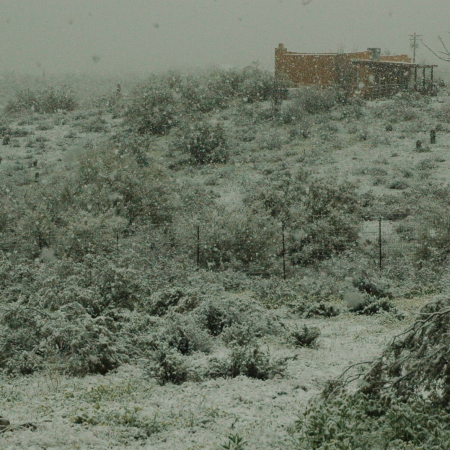
As I start writing this post it is snowing hard here in normally sunny and warm Tucson. In fact, this winter has been one of the coldest in years, averaging about 15 degrees below average, according to one long time resident and friend. He might have his number wrong, but without doubt this is the coldest winter I’ve experienced since we moved here in 2011. The image on the right was taken looking out across my backyard about ten minutes ago. The city of Tucson and the Santa Catalina mountains should be plainly visible in the distance. Instead, between falling snowflakes all one can see is whiteout.

Obviously, this is proof of global warming!

I am of course joking. A single storm, a single cold winter, or even a half dozen cold or warm winters, are nothing more than weather. Such events tell you nothing about the Earth’s climate or any of its global trends. Unfortunately, the global warming crowd does not seem to understand this. Get the temperature above normal for an hour, and they are screaming about how we are burning up and it is now necessary to abandon our constitutional rights to give the government the power to do whatever it wants, with them in charge.

And when the weather is cold? These same “experts” then claim that this also is proof of global warming. To any rational person, such claims are absurd, and serve only to prove that these experts are untrustworthy.

Today, Tony Heller at his The Deplorable Climate Science Blog put together a masterful essay outlining the failure of these irrational experts, entitled “The Five Top Arguments Against Climate Alarmism”, then summarized what this means in a second essay, “The Malicious Intent Behind Climate Alarmism.” As he so correctly concludes:

We need to have a robust discussion about our energy future centered around engineers – not decisions based on hysteria by politicians and academics who don’t know the first thing about climate or energy. The American people need to be educated, not fed propaganda and have their information sources censored. Our survival depends on an adequate supply of energy, not mindless hysteria and fear over an essential trace gas. Without carbon dioxide, life itself can not exist.

Without a reliable supply of energy, modern civilization can’t exist.

Read both of Heller’s posts. He backs up his conclusions with facts.

And by the way, by the time I finished this short post it stopped snowing. More proof of global warming!

13 comments

The bigoted communist “New Green Deal” of the Democratic Party

They’re coming for you next: This week Congresswoman Alexandria Ocasio-Cortez used National Public Radio to (D-New York) announce her proposed radical environmental policy, dubbed by her “the New Green Deal,” a name meant to harken back to Franklin Roosevelt’s policies during the Depression.

You can read the entire proposal here.

The link above is a blunt but I think honest analysis of her proposal.

As predicted, it is pure socialism.

The legislation, co-authored by Sen. Ed Markey (D-MA), is a non-binding resolution that reads, to borrow a phrase from the late Jeanne Kirkpatrick, like a letter to Santa Claus — or, in this case, a wish list to Gaia or Mother Nature.

The proposal is also incredibly bigoted, being entirely focused on helping certain racial and ethnic groups at the expense of others. If you have doubts about this conclusion, consider this quote from the policy itself:
» Read more

41 comments

Sunspot update January 2019: The early solar minimum

As I have done every month since 2011, I am now posting NOAA’s the monthly update of the solar cycle, covering sunspot activity for January 2019. They posted this update on Monday, and I am posting it below, annotated to give it some context.

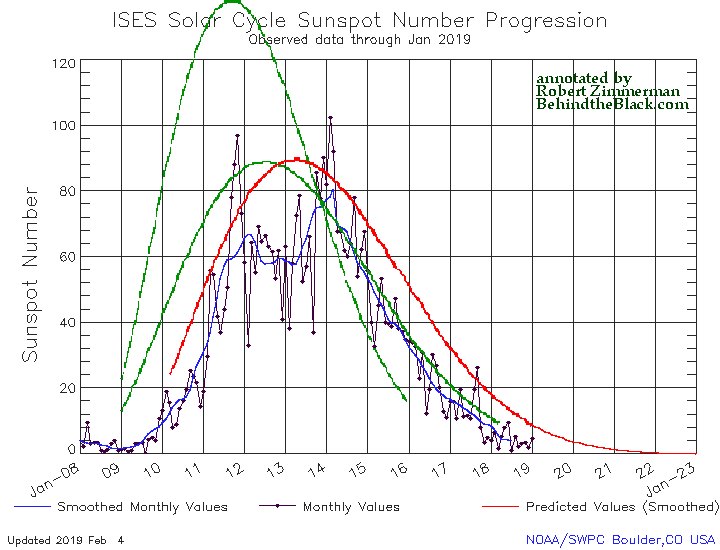
January 2019 sunspot activity

The graph above has been modified to show the predictions of the solar science community. The green curves show the community’s two original predictions from April 2007, with half the scientists predicting a very strong maximum and half predicting a weak one. The red curve is their revised May 2009 prediction.

January saw a slight uptick in sunspot activity, but the overall activity remains comparable to mid-2008, when the last prolonged solar minimum began. If you go to my October 2018 update, you can see the graph when it included data going back to 2000 and see the entire last minimum.

That last minimum started in the last half of 2007, and lasted until mid-2009, a full two years. If you look at the red line prediction of the solar science community, it appears that they are expecting this coming minimum to last far longer, almost forever. I expect this is not really true, but that they have simply not agreed on a prediction for the next cycle. Some in that solar science community have hypothesized that we are about to enter a grand minimum, with no sunspots for decades and thus no solar maximum. Others do not agree.

Since neither faction really understands the mechanism that causes these sunspot cycles, there is no way now to determine what will happen, until it does so. What we do know from climate data is that the Earth cools when the Sun is inactive. Why remains unclear, though there is at least one theory, with some evidence, that attempts to explain it.

And despite the untrustworthy claims of NOAA and NASA scientists that the last few years have been hot, experience on the ground disputes this. Their data has been adjusted (tampered if one wants to be more blunt) to make it fit their global warming theory. The raw unadjusted data suggests things have instead cooled, which better fits with the brutal winters Americans experienced for the past decade or so.

If the Sun does enter a grand minimum in the coming decades, I suspect it will become increasingly difficult for NOAA and NASA to continue their temperature adjustments and continue claiming things are getting warmer. At a minimum, we will learn something about the Sun and its behavior and its influence on the climate that we never knew before.

6 comments

Global warming must be happening! A politician declares it!

Stop the presses! Expert climate scientist and former New York City mayor Michael Bloomberg has used his extensive scientific research to determine, without a doubt, that the polar vortex that is presently freezing most of the country in record cold temperatures is unequivocally the result of global warming!

“The science is clear: Climate change makes extreme weather more frequent and more intense,” tweeted Mr. Bloomberg. “Americans are seeing this first hand from wildfires to hurricanes to the #PolarVortex in the Midwest. We need a climate champion in the WH who can lead us forward.”

I always go to politicians to get my science information. Don’t you? And in doing so, I immediately dismiss other details, such as the fact that the recent wildfires in California is mostly due to bad policy in clearing brush by California and the federal government, that there is no evidence of an increase hurricanes activity, and that back in the 1970s scientists linked the polar vortex to global cooling.

None of that actual data matters. A politician has spoken, and his word is always reliable. Moreover, this is a liberal politician, whose word is even more reliable, because he cares.

Finally, and maybe most important, he did this on twitter, that icon of thoughtful analysis and deep complex thought.

We should immediately shut down all fossil fuel operations, even if it means there will be no way to heat homes across most of the country and people will freeze to death. The world is being destroyed by those fuels, and we must save it!

17 comments

China fails to reduce its methane coal mine emissions

Surprise, surprise! Using satellite data, a new study has now shown that China has not only failed to reduce its methane coal mine emissions, it has allowed those emissions to increase.

China, already the world’s leading emitter of human-caused greenhouse gases, continues to pump increasing amounts of climate-changing methane into the atmosphere despite tough new regulations on gas releases from its coal mines, a study shows.

China is the world’s largest producer and consumer of coal, which accounts for approximately 72 percent of the country’s electricity generation. While data show that coal production has increased in China, it has been unclear until now much methane gas, or CH4, has increased. Methane that is released during coal mining is responsible for the majority of coal-related CH4 emissions and is likely the largest human-caused CH4 source in China.

“Our study indicates that, at least in terms of methane emissions, China’s government is talking the talk, but has not been able to walk the walk,” says Scot Miller, an assistant professor of environmental health and engineering and of earth and planetary sciences at Johns Hopkins University.

The truth is that while China might say it has imposed “tough new regulations,” its commitment under the Paris climate accords actually allowed it to increase its emissions significantly for years to come, even as those same accords required the U.S. to decrease its emissions. This unfair situation, which China has apparently taking full advantage of, is one of the major reasons Trump dumped the accords. It also illustrates how little the Paris Accords had to do with climate change. Its real goal was to shift the balance of power and wealth from the U.S. to other countries.

8 comments

The absolute uncertainty of climate science

Even as the United States is being plunged right now into an epic cold spell (something that has been happening repeatedly for almost all the winters of the past decade), and politicians continue to rant about the coming doom due to global warming, none of the data allows anyone the right to make any claims about the future global climate, in any direction.

Why do I feel so certain I can make this claim of uncertainty? Because the data simply isn’t there. And where we do have it, it has been tampered with so badly it is no longer very trustworthy. This very well documented post by Tony Heller proves this reality, quite thoroughly.

First, until the late 20th century, we simply do not have good reliable climate data for the southern hemisphere. Any statement by anyone claiming to know with certainty what the global temperature was prior to 1978 (when the first Nimbus climate satellite was launched) should be treated with some skepticism. Take a look at all the graphs Heller posts, all from reputable science sources, all confirming my own essay on this subject from 2015. The only regions where temperatures were thoroughly measured prior to satellite data was in the United States, Europe, and Japan. There are scattered data points elsewhere, but not many, with none in the southern oceans. And while we do have a great deal of proxy data that provides some guidance as to the global temperature prior to the space age, strongly suggesting there was a global warm period around the year 1000 AD, and a global cold period around 1600 AD, this data also has a lot of uncertainty, so it is entirely reasonable to express some skepticism about it.

Second, the data in those well-covered regions have been tampered with extensively, and always in a manner that reinforces the theory of global warming. Actual temperature readings have been adjusted everywhere, always to cool the past and warm the present. As Heller notes,
» Read more

13 comments

Sunspot update December 2018: Decline to solar minimum continues

Time for the monthly solar cycle update! NOAA today posted its monthly update of the solar cycle, covering sunspot activity for December 2018. As I do every month, I am posting it below, annotated to give it some context.

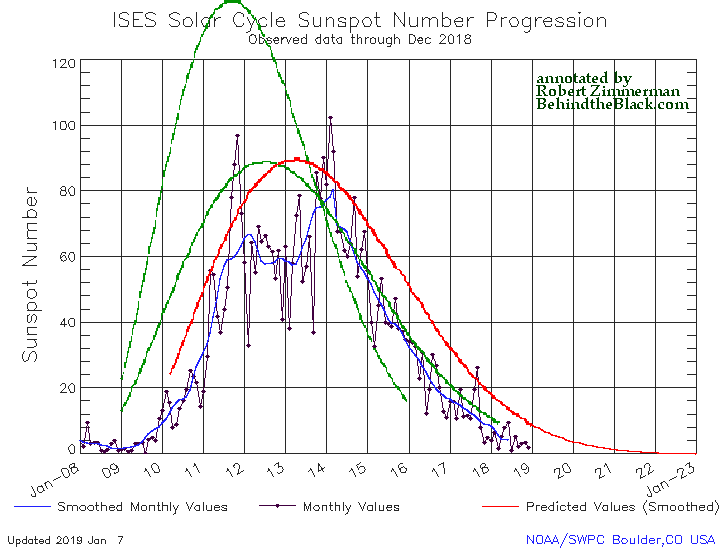
December 2018 sunspot activity

The graph above has been modified to show the predictions of the solar science community. The green curves show the community’s two original predictions from April 2007, with half the scientists predicting a very strong maximum and half predicting a weak one. The red curve is their revised May 2009 prediction.

There really isn’t much to say about the sunspot activity in December. It continued to show a steady decline to solar minimum, exhibiting activity very comparable to what we saw in mid-2008 when the previous unusually long and extended solar minimum began.

One interested detail however: When NOAA issued this graph last month, it finally extended it out beyond the end of 2019 to the end of 2022. In doing so, it also extended out the 2009 prediction of the solar science community, as indicated by the red curve. I hadn’t commented on this last month, but if you look at that curve it drops to zero and then flatlines for the entire year of 2022.

If this is what the solar science community now expects for this upcoming minimum, it means that community is now expecting a record-breaking minimum, lasting far longer than any previous minimum, two to three years at least. It also means that they have not dismissed the possibility that the Sun is about to enter a Grand Minimum, where no significant sunspot activity is seen for literally decades.

Should such a grand minimum occur, it bodes ill for global warming advocates. The track record of the Earth’s climate consistently shows that when sunspot activity declines, the global climate gets colder. Why this happens is not clearly understood, though there is at least one theory backed up by good experimental data. Should this happen, we shall discover that global cooling is a far worse thing to fear than global warming.

9 comments

2018 – One Of The Least Extreme Weather Years On Record

Link here. For the past half decade or so global warming activists both in and out of the climate science community have been pitching the idea, based on literally no evidence, that increased CO2 in the atmosphere would cause an increase in extreme weather events.

The article at the link illustrates how badly that prediction is turning out. In fact, it was clear five years ago that there was no trend visible in the amount of extreme weather events, and that lack of a trend has continued since.

The bottom line remains: The uncertainties in the field of climate science remain gigantic. Our knowledge of how the climate functions remains poor and somewhat limited. And any theory about the consequences of the increase in CO2 in the atmosphere remains tentative and unproven, at best.

Good science is based on cold-hearted skepticism and a recognition of the uncertainties in our knowledge. To be a good scientist you have to strive for intellectual honesty every moment of your life.

For the past two decades the climate science community has decided to abandon these fundamentals, and pushed hard instead to confirm the theory that a trace gas in the atmosphere (carbon dioxide) can cause significant global warming. And they have pushed this theory regardless of the facts. Sometimes they have even pushed this theory despite the facts. Sometimes they have even changed the facts to conform to the theory.

This corruption of scientific principle has harmed the reputation of science badly, and made future work in this field difficult, because much of the data that exists now has been tampered with in ways that make much of it untrustworthy.

Worse, it appears that this is all a terrible indicator of the corruption of our entire society. Everywhere I look, intellectual honesty has been abandoned. Instead, we have become a society of unruly children, picking petty twitter fights based on minor details we pick and choose at our convenience in order to prove our point. Thoughtful consideration of all the facts has become abandoned. And if you try to encourage it, you are called names and blackballed.

Under these circumstances, I do not see a civilized way to recover our society. It seems that very bad times must happen first. Whether we can then recover our civilization afterward remains an open question.

36 comments

Why the Drake equation is overrated

The uncertainty of science: An astrophysicist explains why the Drake equation is useless for predicting the number of alien species in the universe.

While the Drake equation may have spurred the early scientific discussion of the search for extraterrestrial intelligence, it doesn’t have much value beyond that. We can’t use to it further our understanding, and we can’t use it to properly guide our thinking. The huge uncertainties in the parameters, the unknown ways those uncertainties mix, and the absolute lack of any guidance in even choosing those parameters robs it of any predictive power. Prediction is at the heart of science. Prediction is what makes an idea useful. And if an idea isn’t useful, why keep it around?

I just wish this same logic was applied to all climate models. They are as useless. Their own huge uncertainties have made them utterly unable to predict anything, for decades. Yet, despite this ongoing failure, vast amounts of research money continues to be poured into the cottage industry that produces them. Worse, too many people in both the intellectual and journalist communities take them far too seriously.

It is a tragedy that is hurting science badly.

32 comments

Sunspot update November 2018: Minimum continues

NOAA’s monthly update of the solar cycle, covering sunspot activity for November 2018, was released yesterday. As I have done every month since this website began in July 2011, I am posting it below, annotated to give it some context.

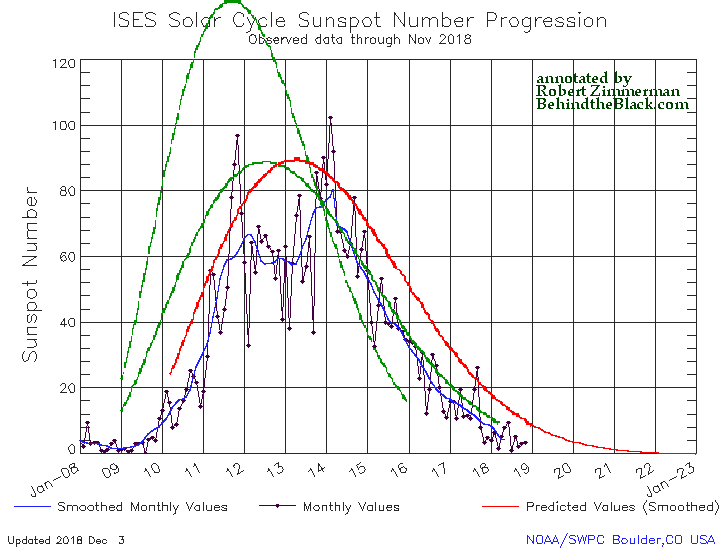
November 2018 sunspot activity

The graph above has been modified to show the predictions of the solar science community. The green curves show the community’s two original predictions from April 2007, with half the scientists predicting a very strong maximum and half predicting a weak one. The red curve is their revised May 2009 prediction.

As I have been expecting now for the last three months, NOAA has finally revised this graph to extend it past the end of 2018. The graph below is the graph from October, which follows the layout and design used since 2007. You can see the differences by comparing the two graphs. In extending the new graph to the end of 2022, they fortunately did not change the design significantly. However, because the new graph has a slightly different scale, I have stretched the green and red curves to make them fit properly. While I suspect the poor quality of the 2007 and 2009 predictions is one reason they do not include them on their graph, I think it essential to add them to better understand the limitations of the science.
» Read more

15 comments

Solar scientists: sunspot increase in next solar cycle

The uncertainty of science: Using new computer models, two solar scientists are now predicting that the next solar cycle will begin in about a year and will see an increase in sunspot activity, compared to the weak cycle just ending.

Their ensemble forecast surprisingly suggests it could even be stronger than the cycle which is just ending. They expect the next cycle to start rising in about a year following the end of the current sunspot cycle minimum and peak in 2024. Bhowmik and Nandi predict space environmental conditions over the next decade would be similar or slightly harsher compared to the last decade. They find no evidence of an impending disappearance of sunspot cycles and thus conclude that speculations of an imminent Sun-induced cooling of global climate is very unlikely.

Their conclusion is different than other predictions that are claiming a weak next cycle, or even the beginning of a grand minimum, with no suspots at all. Since an real understanding of the sunspot cycle remains elusive, and all these predictions rely on computer models, it is hard to say which will be right. The advantage this particular prediction has is that their model appears able to match what has happened for the past 100 years.

Stay tuned.

10 comments
1 12 13 14 15 16 57