Testing new high speed rotors for the next generation of Mars helicopters
Ingenuity with missing blade
Ingenuity with its missing blade, at its final resting place on Mars.
Click for original image.

Engineers from JPL and the aerospace company AeroVironment have been testing a new set of high speed rotors that they hope to use on the next generation Mars helicopters, designed to increase their payload capacity by as much as 30%.

The rotors of Ingenuity — the first helicopter to fly on Mars — never spun faster than 2,700 rpm, because at faster speeds it would be approaching the speed of sound (on Mars), when unpredictable things could happen. Engineers are pushing those limits with these new rotors, in a chamber mimicking the thin Martian atmosphere.

The test engineers had taken the precaution of lining part of the chamber with sheet metal in case the blades broke apart during the supersonic experiment. From a control room a few yards away from the chamber, the team watched displays showing data and a view inside the chamber as the rpm climbed as high as 3,750. At that rate, the tips were traveling at Mach 0.98 [just under the Martian speed of sound]. Then the engineers activated a fan inside the chamber that pelted the rotors with headwinds. After each run, they increased in wind velocity for the next run.

The team pushed rotor tip speeds to Mach 1.08, boosting the Mars vehicle’s lift capability by 30%. This breakthrough allows future missions to support heavier scientific payloads, including advanced sensors and larger batteries for extended flight. Next the team tried their luck with the two-bladed SkyFall rotor. Because it is slightly longer than the three-bladed version, only 3,570 rpm was needed to achieve the same near-supersonic speed at the rotor tips prior to introducing the headwinds.

NASA administrator Jared Isaacman has said he wants to send a fleet of helicopters to Mars in 2028, on that first nuclear-powered mission. Whether or not that mission happens as he proposed, there is ample evidence scientists plan on sending more helicopters there in the next few years (see here, here, here). These tests lay the groundwork for those future missions.

2 comments

Ingenuity’s last flight: an accident investigation

Ingenuity accident investigation conclusions
Click for original image.

Using all the data available, engineers at JPL have done a more detailed accident investigation into Ingenuity’s last flight on Mars on January 18, 2024, and are about to publish their report. Their conclusions however were published today by NASA, with the graphic to the right the main conclusion.

One of the navigation system’s main requirements was to provide velocity estimates that would enable the helicopter to land within a small envelope of vertical and horizontal velocities. Data sent down during Flight 72 shows that, around 20 seconds after takeoff, the navigation system couldn’t find enough surface features to track.

Photographs taken after the flight indicate the navigation errors created high horizontal velocities at touchdown. In the most likely scenario, the hard impact on the sand ripple’s slope caused Ingenuity to pitch and roll. The rapid attitude change resulted in loads on the fast-rotating rotor blades beyond their design limits, snapping all four of them off at their weakest point — about a third of the way from the tip. The damaged blades caused excessive vibration in the rotor system, ripping the remainder of one blade from its root and generating an excessive power demand that resulted in loss of communications.

The reason Ingenuity’s system couldn’t find enough features to track was because it was flying over a dune field, the ground almost all smooth sand. The only features were the soft changes of topography caused by the dunes, which were not small.

Not surprisingly, these same engineers are working on a larger drone-type helicopter for a future mission, dubbed Mars Chopper, which based on an short animation released by NASA, is the mission targeting Valles Mariner that I first described in June 2022. The investigation into Ingenuity’s failure will inform the design of Chopper.

6 comments

Engineers say goodbye to Ingenuity

Ingenuity with missing blade
Ingenuity with its missing blade. Click for original image.

Because Perseverance is about to move out of range of direct communications with the disabled Ingenuity helicopter, engineers have now completed their final transmission from the helicopter yesterday, confirming that a new software update has been successfully installed.

The telemetry confirmed that a software update previously beamed up to Ingenuity was operating as expected. The new software contains commands that direct the helicopter to continue collecting data well after communications with the rover have ceased.

With the software patch in place, Ingenuity will now wake up daily, activate its flight computers, and test the performance of its solar panel, batteries, and electronic equipment. In addition, the helicopter will take a picture of the surface with its color camera and collect temperature data from sensors placed throughout the rotorcraft. Ingenuity’s engineers and Mars scientists believe such long-term data collection could not only benefit future designers of aircraft and other vehicles for the Red Planet, but also provide a long-term perspective on Martian weather patterns and dust movement.

The engineers belief that the helicopter could collect data for as long as twenty years. That data will sit on Ingenuity until such time as a later exploration team arrives, either manned or unmanned. There is also the possibility that later in Perseverance’s mission it could pass nearby again, allowing engineers to grab some of the data then.

According to the press release, those same engineers are now exploring future helicopter missions to Mars. Based on imagery I have seen coming down from Mars Reconnaissance Orbiter (MRO), the as yet unstated target locations could be inside the eastern end of Valles Marineris or on the northern perimeter of Hellas Basin.

4 comments

Ingenuity’s final resting place on Mars

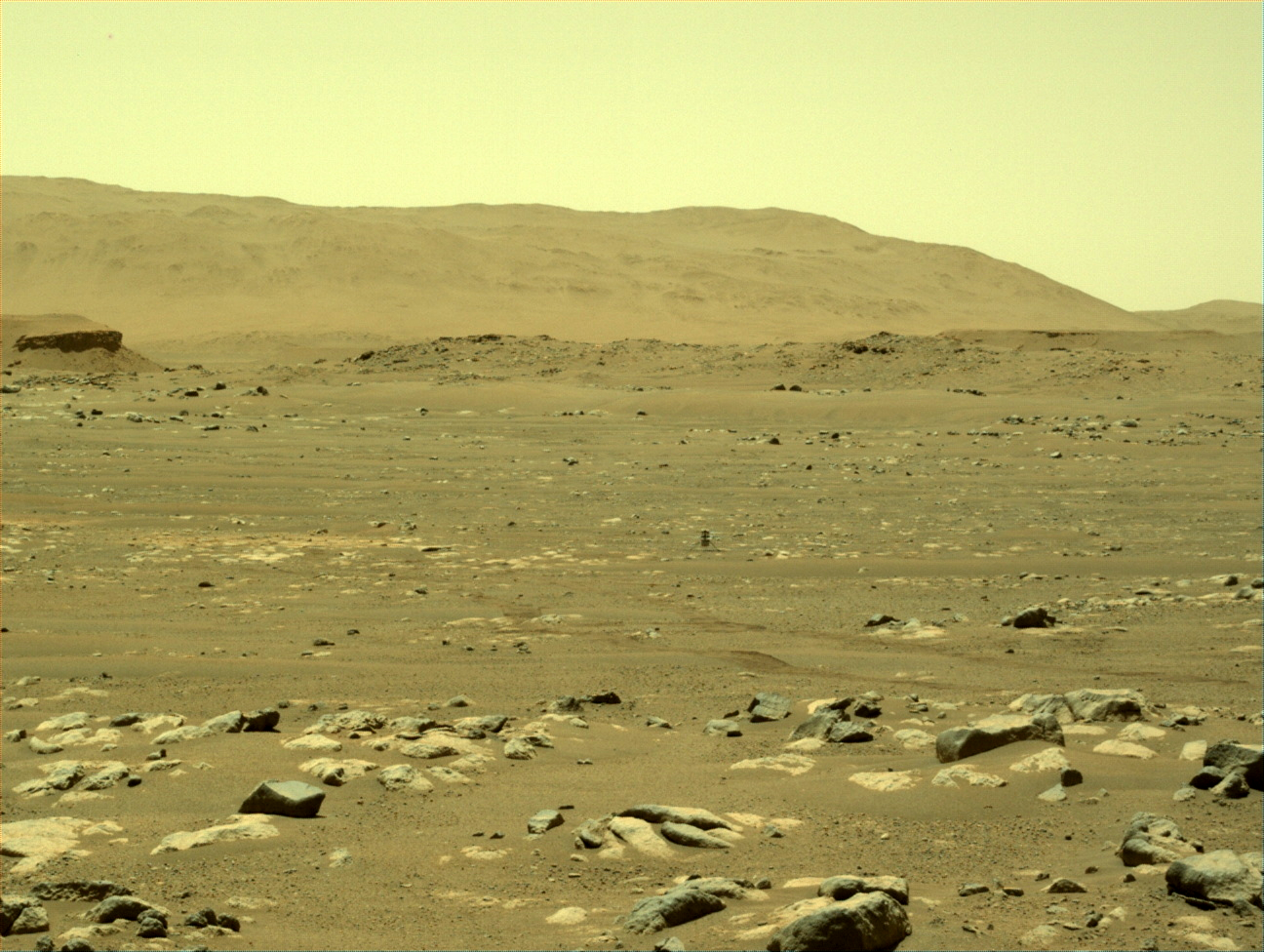
Panorama showing Ingenuity in Jezero Crater
Click for original image.

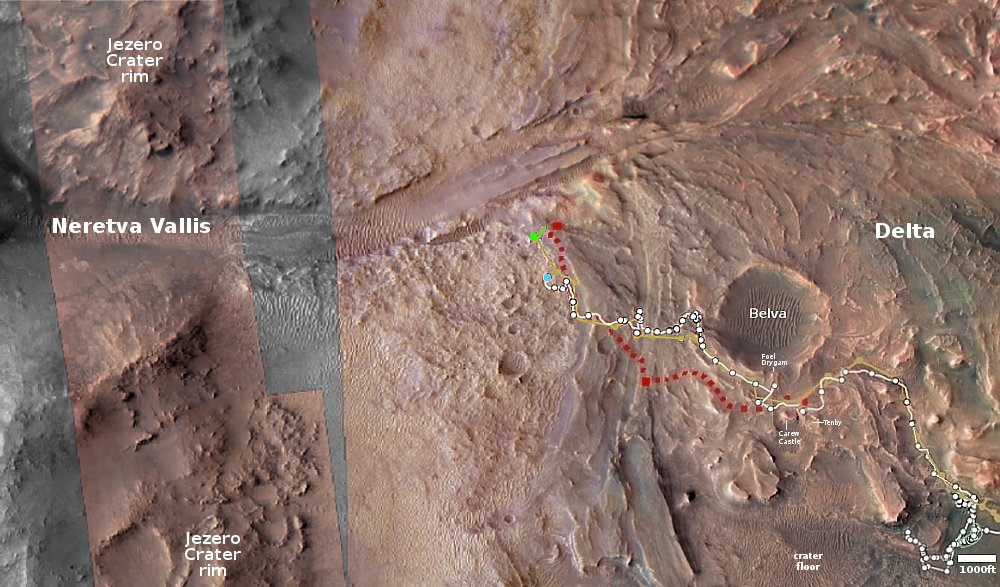
Overview map
Click for interactive map.

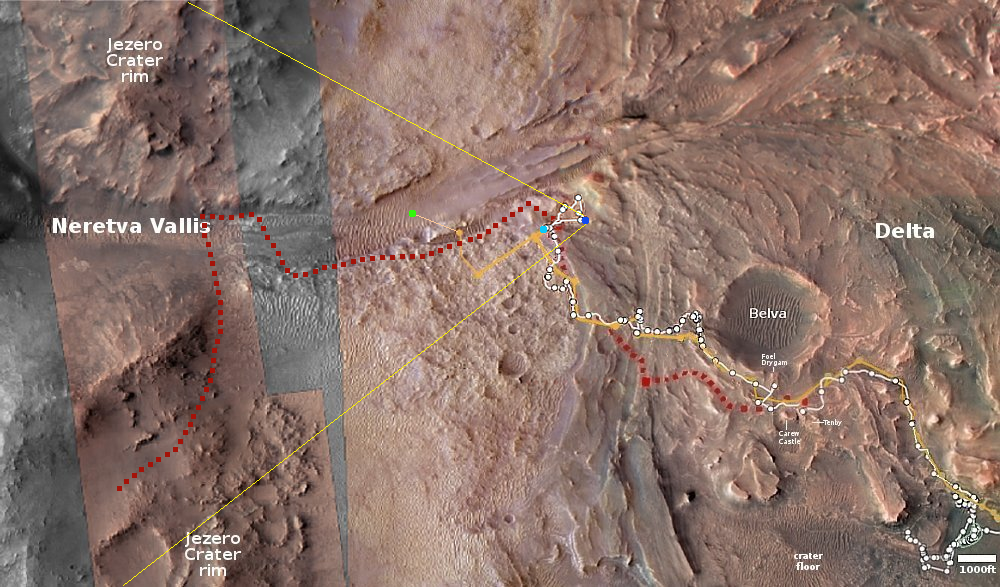
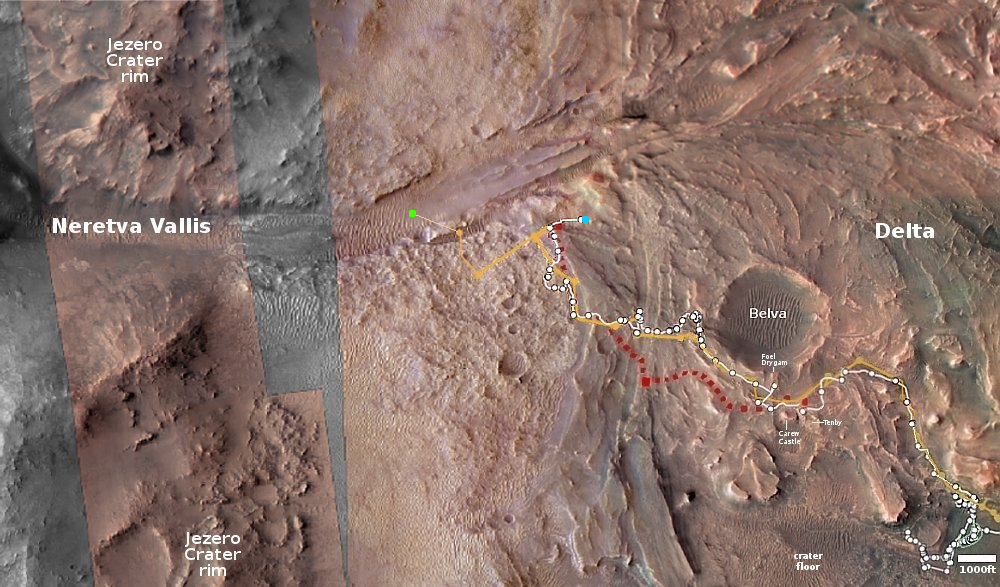
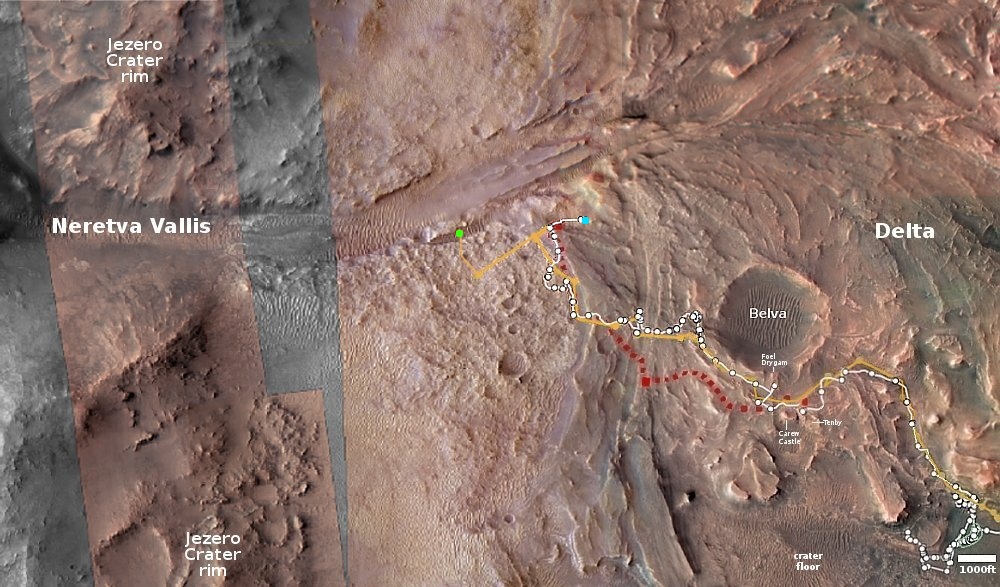
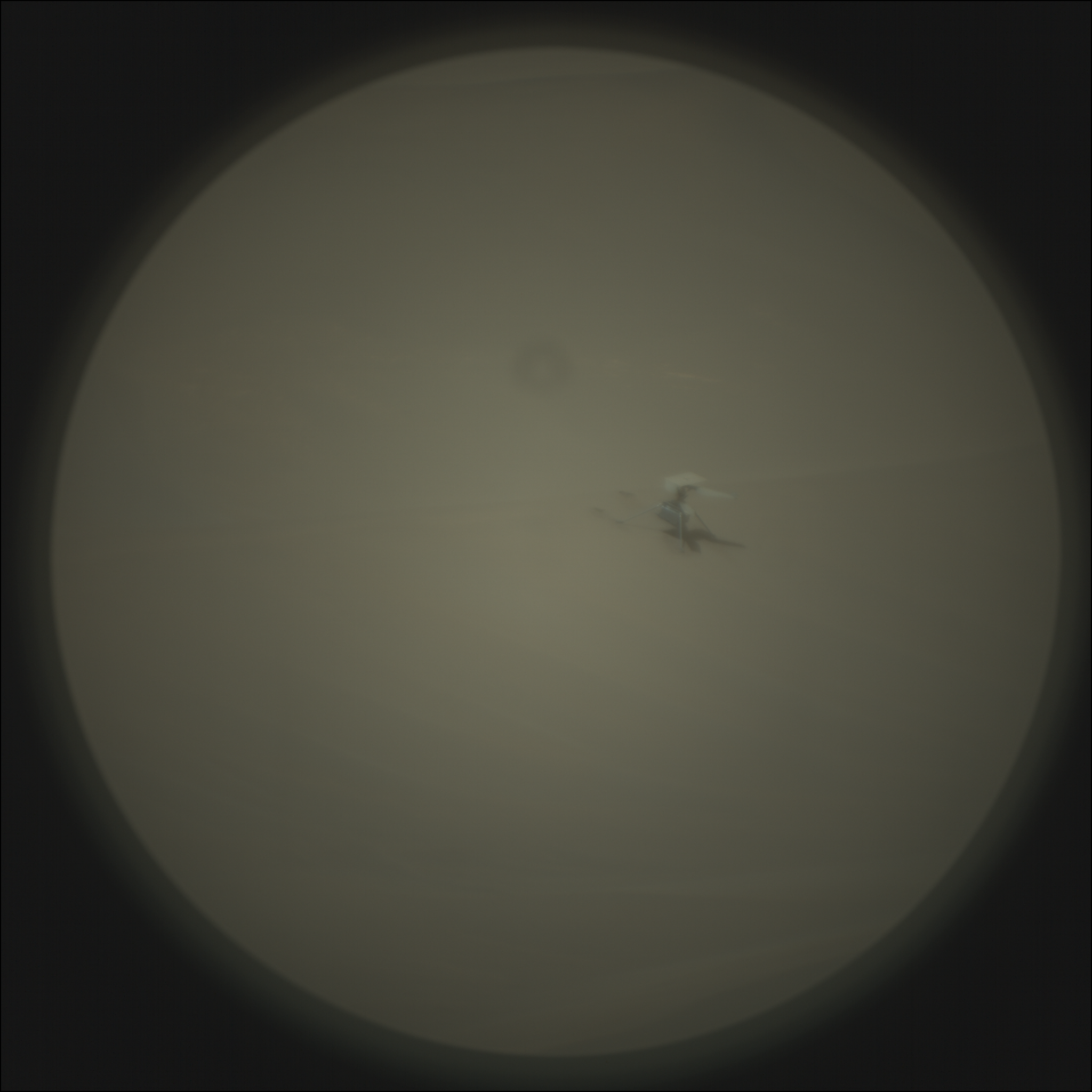
Time for one last cool image of Ingenuity. The picture above, cropped, reduced, and annotated to post here, was created from a mosaic of 67 images taken on February 21, 2024 by the high resolution camera on the Mars rover Perseverance. The white rectangle marks the approximate area covered by the image below, a mosaic of seven pictures taken on February 24, 2024 by Perseverance’s Remote Microscopic Imager camera, normally used to take very close images of nearby rocks but repurposed here to provide a close up of Ingenuity about 1,365 feet away, inside Neretva Vallis. Ingenuity is on the right, and the speck on the left is the section of the rotor blade that broke off and was apparently flung about 49 feet away.

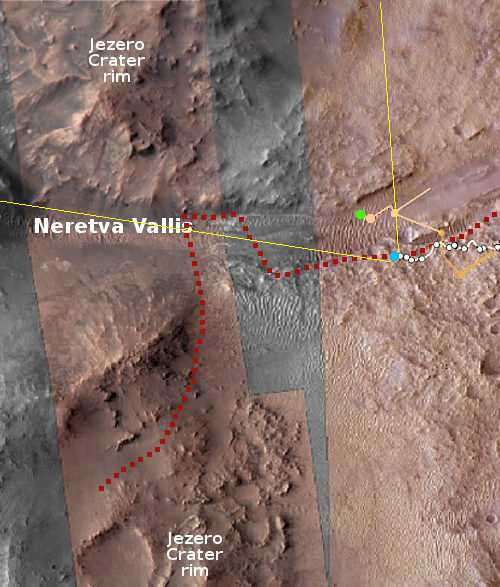
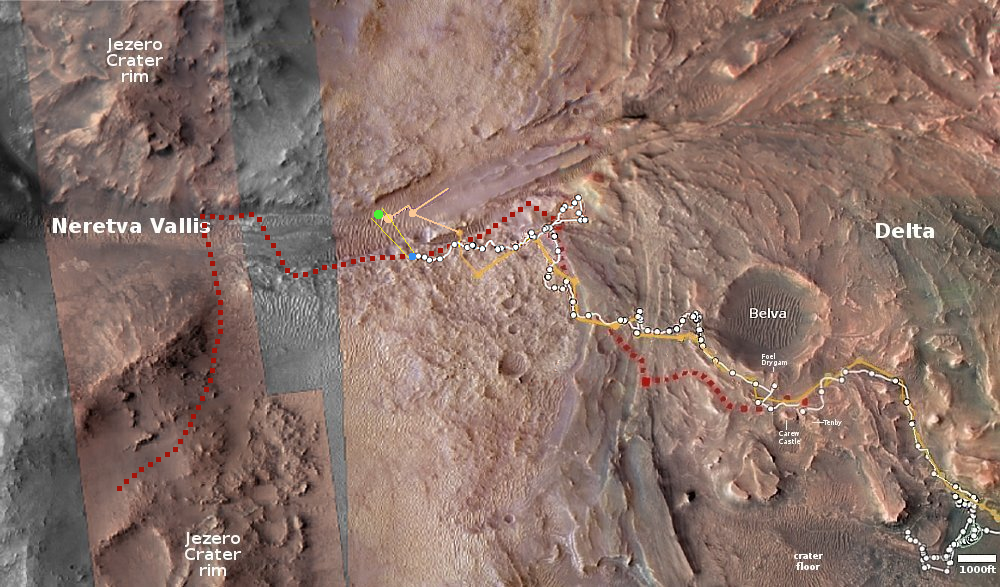
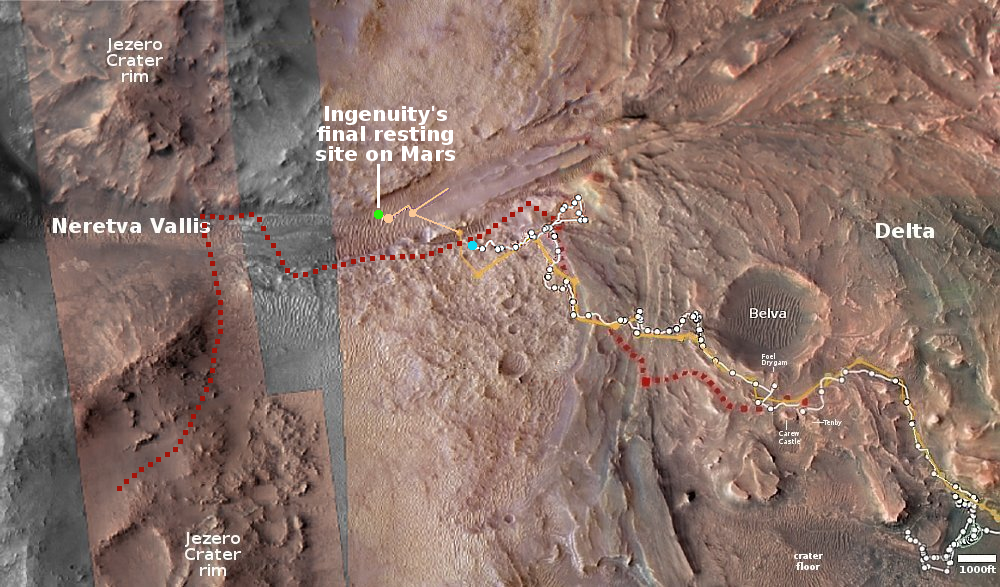
On the overview map to the right, the blue dot marks Perseverance’s position, the green dot Ingenuity’s, and the yellow lines mark the approximate area covered by the panorama above. The red dotted line is Perseverance’s planned route in the coming months.

Close-up of Ingenuity and broken rotor blade
Click for original image.

4 comments

Ingenuity broke off one blade entirely

Ingenuity with missing blade
Click for original image.

Images using a camera on Perseverance originally designed to look closely at rocks nearby but was found capable of doing distant photography (by engineers running the rover Curiosity), Perseverance has obtained the first good close-up picture of Ingenuity since its last flight, and found that one half of one propeller blade apparently broke off during or at the end of its last flight.

That image is to the right, cropped and sharpened to post here. It was taken on February 25, 2024 by Perseverance’s Supercam camera. A second Supercam image spotted the broken blade about fifty feet away, on the sand.

Why the blade broke off remains unknown. You can see from the tracks on the ground that Ingenuity jumped downhill and sideways after landing, but if the blade had hit the ground while spinning that jump would probably have been more violent. The pictures instead suggest it broke off not from contact with something else but because it broke on its own.

The Ingenuity engineers will of course do some very careful analysis of both pictures, and possibly determine better what happened.

4 comments

Perseverance snaps its first picture of grounded Ingenuity

Overview map
Click for interactive map.

Ingenuity on dune, as seen by Perseverance on February 4, 2024
Click for original image.

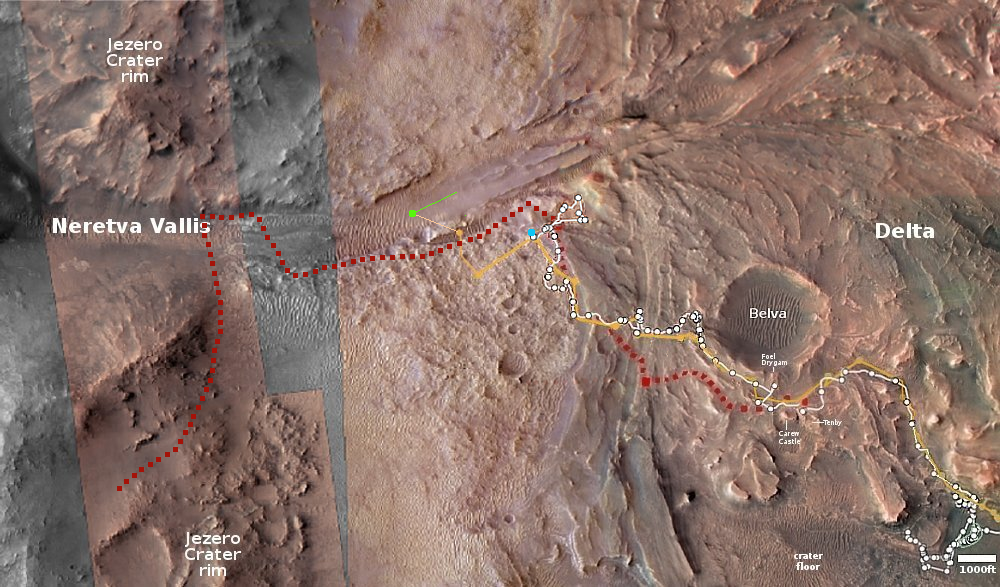
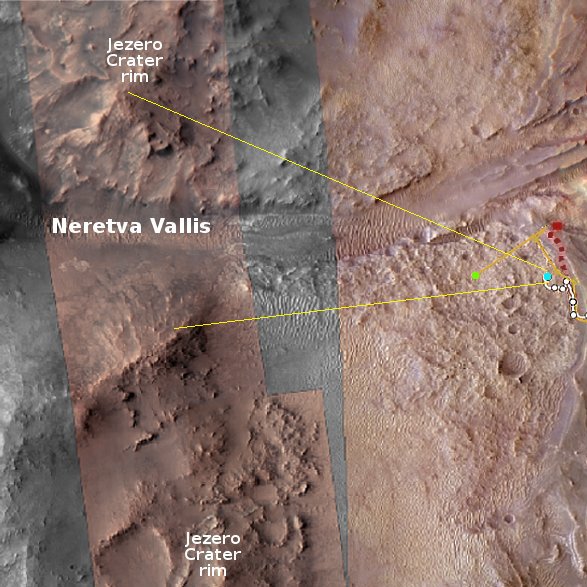
Perseverance on February 4, 2024 finally moved into a position where it was close enough to take its first picture of the now grounded Ingenuity helicopter. That picture, cropped, reduced, and enhanced to post here, is to the right, taken by the rover’s left high resolution camera. You can see Ingenuity sitting on the slope of a dune near the upper right.

The overview map above provides the context. The green dot marks Ingenuity’s final resting spot. The blue dot marks Perseverance’s present location, with the yellow lines indicating approximately the area covered by the photo.

Whether the rover is now close enough to get good imagery for a final engineering test of Ingenuity — where its rotors will be rotated and shifted slowly to determine the extent of the propeller damage — is not clear. Perseverance could move much closer, but its science team might not want to cross these dunes out of fear the rover would get stuck. They might move forward a few more feet, to the top of the south bank of Neretva Vallis, before doing that test.

7 comments

One last engineering test planned for Ingenuity

Engineers plan to do one last engineering test with Ingenuity, slowly rotate its propellers while collecting imagery, likely from both the helicopter and Perseverance.

Teddy Tzanetos, Ingenuity Project Manager, said that NASA and JPL still aren’t sure what caused the damage to Ingenuity’s blades; it remains unclear whether the helicopter’s power dipped during landing, causing unwanted ground contact, or if it accidentally struck the ground to cause a “brownout.”

Tzanetos added that NASA and the Jet Propulsion Laboratory (JPL) will slowly rotate the helicopter’s blades and “wiggle” them, or adjust their angle, while collecting video in order to allow the team to determine the extent of Ingenuity’s damage. However, Tzanetos said that no matter what such imaging will show, the dual-rotor drone has flown its last flight and will soon end its mission.

This test will likely not occur until Perseverance gets into a position where it can film the test also. The helicopter’s cameras look downward, so all it will be able to photograph is the shadow of those blades as they move. Perseverance can look directly at it, and if it gets into a position slightly higher than Ingenuity it can get a good viewing angle down at the blades.

At the moment the rover is about a thousand feet to the east, though steadily working its way towards it.

8 comments

Ingenuity’s final resting site on Mars

Overview map
Click for interactive map.

Ingenuity's damaged propeller
Click for orignal image.

The photo to the right was downloaded from Ingenuity today, and looks downward at the ground below the helicopter, showing the shadow of one of its propellers, with the damage at its tip indicated by the arrow.

It is this damage that forced NASA management to retire the helicopter yesterday. With the tip of one of Ingenuity’s two propellers damaged, the helicopter simply can no longer fly reliably, or at all.

The green dot on the map above shows Ingenuity’s final resting spot. The blue dot shows Perseverance’s present position. Perseverance will surely at some point approach Ingenuity closely to get better pictures of the damage to help engineers better figure out what happened and why. For example, did the propellor simply break during flight? And if so, why?

I freely admit that my optimistic speculations last week were wrong, that Ingenuity was merely having communications issues with Perseverance. I also suspect the Ingenuity engineers were hoping the same thing, and were far more disappointed than I to discover otherwise.

7 comments

Ingenuity’s mission on Mars is over

Ingenuity takes off!
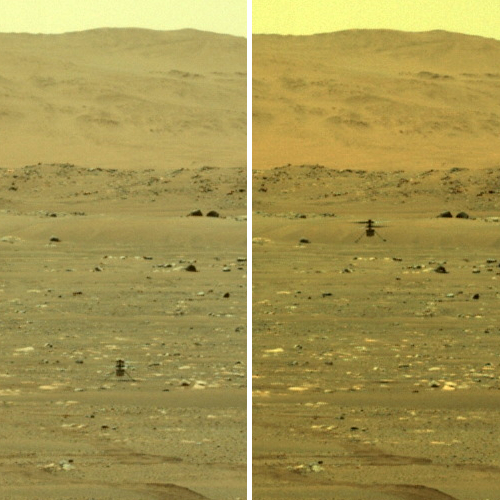
Ingenuity takes off on its first flight, April 19, 2021.
For full images go here and here.

NASA today announced that Ingenuity’s mission on Mars has now ended due to damage sustained to one of its propellers during its 72nd flight.

While the helicopter remains upright and in communication with ground controllers, imagery of its Jan. 18 flight sent to Earth this week indicates one or more of its rotor blades sustained damage during landing, and it is no longer capable of flight.

Ingenuity’s engineering mission was designed initially to simply prove that air-powered flight in Mars’ thin atmosphere was possible by a test program of four flights over 30 days. It worked so well that it just kept going and going. During its almost three years of operation on Mars, the helicopter completed 72 flights, for a total air time of about 128 minuntes. It flew a total of about eleven miles, reaching a maximum speed of over 22 miles per hour and a top altitude of about 79 feet. On its 69th flight it traveled a record 2,315 feet, almost a half mile.

All future Mars missions have been changed forever by the success of Ingenuity and its designers and engineers. For example, there are already hints of a helicopter mission to Mars’ giant canyon Valles Marineris. In addition, NASA redesigned its Mars Sample Return Mission to include helicopters based on what it learned from Ingenuity.

More important, Ingenuity suggests that when settlers finally colonize the red planet, it is very possible that air travel will start out more important than ground transport. In fact, long distance roads might never be built, for any number of reasons, because air travel will be available from the beginning.

2 comments

Ingenuity team confirms the helicopter is healthy

In a slightly more detailed status update today, the engineering team that operates the Mars helicopter Ingenuity has confirmed that the helicopter is healthy and apparently undamaged after its 72nd flight.

During that last flight, a vertical up-and-down hop to allow communications with the helicopter and thus obtain better information as to its status and location, contact was lost as Ingenuity descended to land.

On Saturday, Jan. 20, communications were reestablished between Ingenuity and NASA’s Perseverance rover. The Ingenuity team has determined the helicopter is power-positive and is sitting vertically on the surface. Next steps include running further diagnostic checks, commanding Ingenuity to take photos of its location on the surface, and performing a spin test.

It is still unclear if full communications have been restored. Ingenuity must be within line-of-sight of the rover Perseverance for this to happen, and it appears that still might not be so. During its 71st flight the helicopter landed prematurely in an unexpected spot, apparently limiting communications significantly. The 72nd flight was likely to locate it more precisely and gather data.

1 comment

Ingenuity’s status uncertain but likely healthy

Overview map
Click for interactive map.

Updates from the engineering team that operates the Mars helicopter Ingenuity in the past two days have suggested the helicopter might be in trouble. First the team issued a status update yesterday that indicated communications had been lost prematurely during the helicopter’s 72nd flight.

The flight was designed as a quick pop-up vertical flight to check out the helicopter’s systems, following an unplanned early landing during its previous flight. Data Ingenuity sent to the Perseverance rover (which acts as a relay between the helicopter and Earth) during the flight indicates it successfully climbed to its assigned maximum altitude of 40 feet (12 meters). During its planned descent, communications between the helicopter and rover terminated early, prior to touchdown.

A further update today said that communications had been regained, but also noted that the engineering team still did not have a full understanding of the helicopter’s status.

We’ve reestablished contact with the #MarsHelicopter after instructing @NASAPersevere
to perform long-duration listening sessions for Ingenuity’s signal.

Based on the information released (or lack thereof) from the previous flight, the 71st, it is my sense that the situation is not as dire as these reports suggest, and that the situation might simply be related to issues of communications. Let me explain why I have come to this conclusion.
» Read more

1 comment

Update on Ingenuity

Overview mapClick for interactive map.

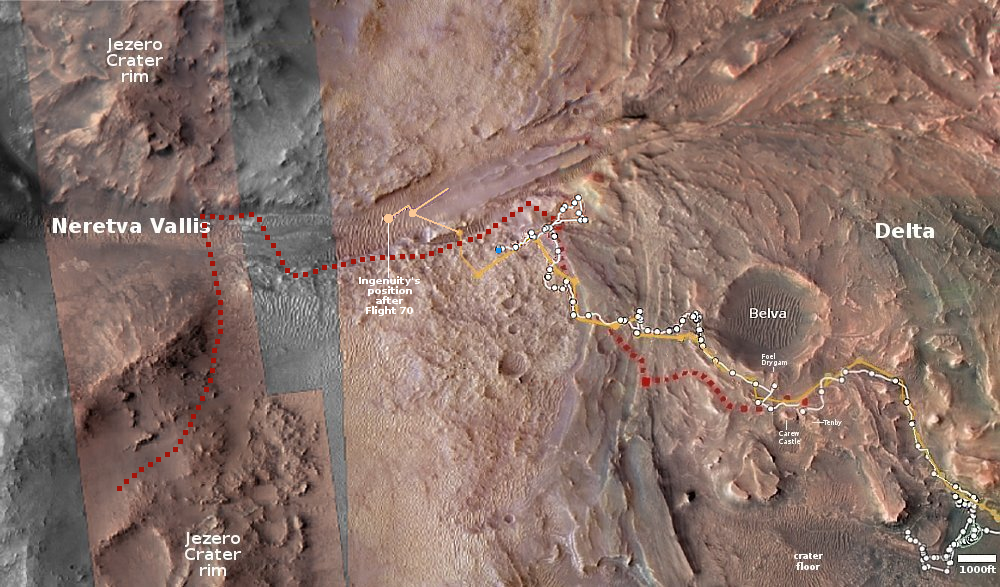
The overview map above shows the travels of both the rover Perseverance and the helicopter Ingenuity on Mars through today, with the blue dot marking Perseverance’s present location and the green dot Ingenuity’s. Because of image downloads today from Perseverance — including a few more pictures taken by the helicopter during several of its recent flights — the helicopter’s engineering team has finally been able to add the flight paths for flights #68, #69, and #70 to this map, as well as provide more accurate information about what each accomplished..

Flight #68, which took place on December 15, 2023, a few days later than originally planned, as I reported on December 20, 2023 when the first preliminary data arrived. At the time it appeared the flight had ended prematurely by almost 1,500 feet. We now know the flight did end early, but by not that much. Instead of flying, as per its flightplan, to the northeast 2,716 feet for 147 seconds and then returning to its take-off point, it flew out and back 2,304 feet for 131 seconds. The engineering team has not explained why it turned around prematurely by about 200 feet.

Flight #69 on December 20, 2023 was supposed fly 2,304 feet total over 131 seconds, also going out and back, traveling to the east-northeast. It ended up flying 2,315 feet over 135 seconds on a flight path that was almost identical to flight #68. Like most previous flights, it appears it hovered over its landing spot for a few extra seconds before descending in order to make sure it would land safely.

The final numbers for flight #70 have not yet been added to the flight log, but the engineering team has apparently been able to figure out the path the helicopter took and where it landed from the images that have been downloaded in the past few days. The flight plan had called for a relatively short flight, 849 feet long, but taking almost as long as the previous two, 129 seconds, thus allowing Ingenuity to get better and more detailed scouting pictures of the terrain below it for scientists to review.

One more detail: It appears that the Perseverance science team has decided to use Ingenuity data to guide its route. Rather than follow the planned course, as indicated by the red dotted line, the rover has been following the ground scouted by Ingenuity on its 63rd flight on October 19, 2023. This has taken Perseverance deeper into the rough fractured terrain to the south, where it likely can obtain better geological data.

It also suggests that Ingenuity’s more recent flight paths are giving us a hint as to Perseverance’s future travels.

0 comments

Ingenuity’s engineers explain what they have learned flying the helicopter on Mars

Link here. The essay details carefully the problems they have faced, and how they have not only overcome them but used them to refine operations to squeeze far more capabilities out of the helicopter, beyond its initial design.

Saving flight time saves energy, reduces heating, and provides more freedom to use slower speeds to tiptoe around disruptive terrain that might otherwise endanger or significantly degrade the landing accuracy of the helicopter. Higher speeds and higher accelerations reduce the time needed to execute a given flight path. Higher altitudes permit higher speeds, as the wider field of view helps to keep ground features in view of Ingenuity’s navigation camera longer, counteracting the effect of increased speed. Expanding Ingenuity’s flight envelope had the potential to relax flight planning constraints and allow Ingenuity to operate more effectively alongside Perseverance.

As a result, beginning with flight 45 the team has made changes to increase flight speeds and acceleration at every point of every flight, thus allowing the helicopter to fly higher and farther with less strain.

This report however does not provide any information on Ingenuity’s last two flights, especially its 68th, which did not go as planned. The helicopter appears to be in good shape (the team has already planned the 69th flight, which was supposed to happen two days ago), but a more detailed update would be appreciated.

0 comments

Ingenuity’s most recent flight, the 68th, a mystery

Overview map
Click for interactive map.

UPDATE: See this December 26, 2023 post for more accurate information.

Original post:
————————–
According to a recent update to the flight log of the Mars helicopter Ingenuity, it finally completed its 68th flight on December 15, 2023, not on December 9, 2023 as announced in the flight plan on December 8th.

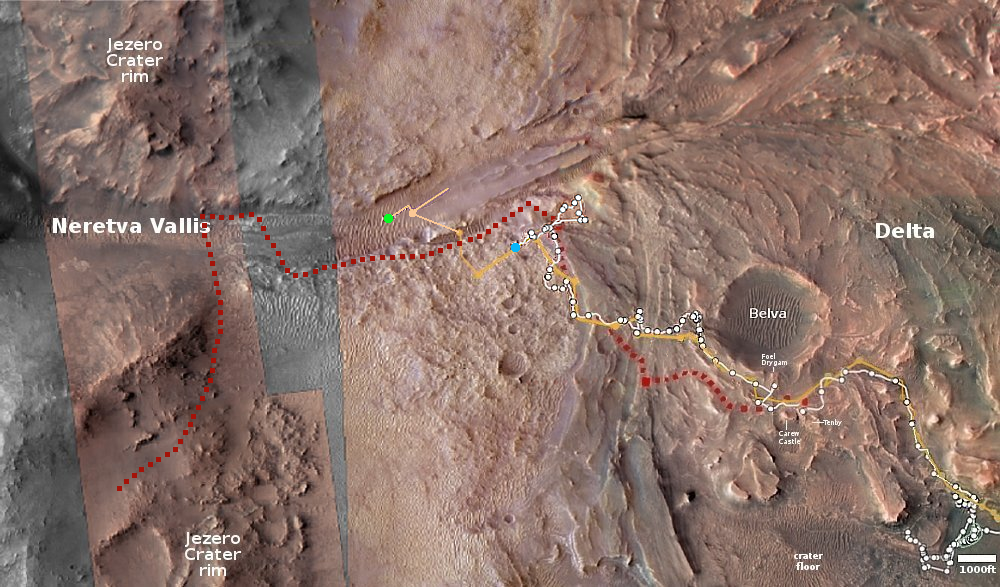
More significantly, the flight only traveled 1,289 feet (393 meters), not the 2,716 feet (828 meters) intended. The flight was supposed to travel out to the northeast and then return to its take-off point, indicated by the green dot on the map above, completing a “flight test” as well as scouting the ground below. It appears it did not do this, but where the 68th flight actually went and landed has as yet not been released. According to the flight plan, Ingenuity likely landed somewhere in Neretva Vallis to the northeast, as indicated by the green line.

What we do know is that the engineering team knows enough about Ingenuity’s condition to release today the flight plan for the 69th flight, which was actually scheduled to occur yesterday. That flight plan calls for Ingenuity to travel about 2,300 feet to the east-northeast and then return to its take-off point.

Meanwhile, Perseverance (the blue dot) is working its way west back to its planned route, the red dotted line.

0 comments

Perseverance looks at Jezero Crater in high resolution

Perseverance's future route
Click for full image.

The Perseverance science team earlier this week released a mosaic taken by the rover’s high resolution over three days in November, showing the entire 360 degree view of Jezero Crater from where Perservance sat during the month long solar conjunction that month, when communications with Mars was cut off due to the Sun being in the way.

Part of that panorama, significantly reduced, cropped, and enhanced, is posted above, focusing on the western rim of Jezero Crater and the route that Perseverance will likely take in the future. Below is an overview map that indicates by the yellow lines the approximate area covered by this picture. The light blue dot marks Perseverance’s present location, while the dark blue dot marks where it took the mosaic and was also stationed during that solar conjunction. The dotted red line on both images marks the approximate proposed route that the science team is considering for leaving Jezero crater. Instead of going out through Neretva Vallis, they are instead considering heading south to go over the crater’s rim itself.

Ingenuity’s present position is marked by the green dot. This is where it landed after flight 67 on December 2nd. On December 8th the helicopter’s engineering team had released the flight plan for flight 68, scheduling it for December 9th, but as of this date it appears that flight has not occurred. I suspect the delay is because communication between Ingenuity and Perseverance is presently spotty, though the Ingenuity team has released no information.

Overview map
Click for interactive map.

0 comments

Ingenuity completes its 67th flight on Mars

Overview map
Click for interactive map.

Almost immediately after communications were re-established with Mars after the monthlong solar conjunction — where the Sun stood between the Earth and Mars — the Ingenuity engineering team uploaded instructions for Ingenuity’s 67th flight, and on December 2, 2023, the helicopter successfully completed that flight, traveling 1,289 feet to the west at a height of 39 feet for 136 seconds, almost exactly what the flight planned dictated.

The overview map above shows with the green dot the helicopter’s new position after that flight. It has moved ahead of Perseverance into Neretva Vallis, the gap out of Jezero Crater through which the rover will eventually travel. At the moment however Perseverance sits much farther east, as indicated by the blue dot, where it has been studying the surface geology of the delta that once flowed through that gap into the crater.

0 comments

Ingenuity completes very short 65th flight

Overview map
Click for interactive map.

Ingenuity yesterday completed a very short 48 second flight that shifted its position only slightly to the west, by about 23 feet. The distance, time, and highest elevation (33 feet) matched the flight plan exactly.

The green dot on the overview map above indicates its present position, with the blue dot marking Perseverance’s location. This particular flight was so short that it actually fits entirely within that green dot. Furthermore, the helicopter’s next flight, scheduled for today as well, is intended to also only reposition the helicopter, but even less so, moving only two feet or so sideways while rising only ten feet.

It appears the engineering team is preparing the helicopter for the upcoming solar conjunction, when the Sun will be between the Earth and Mars and no communications will be possible for several weeks. Such conjunctions occur about every two years, with this one beginning on November 6th and lasting until November 29th. Getting the helicopter in the right spot during that down time will increase the chances for regaining communications afterward. Since Perseverance acts as a relay station, Ingenuity must get placed in a spot where there is a direct line of communications, blocked by no objects or intevening rise in land.

Note that all the Martian rovers and orbiters are preparing for conjunction right now.

0 comments

Perseverance looks ahead, beyond Jezero Crater

Perseverance looks ahead, beyond Jezero Crater
Click for original image.

Overview map
Click for interactive map.

Cool image time! The panorama above, enhanced and annotated to post here, was taken on October 21, 2023 by one of the navigation cameras on the Mars rover Perseverance. As shown on the overview map to the right, it looks to the west, at the gap in the rim of Jezero crater, dubbed Neretva Vallis, through which the delta in the crater had once poured.

The blue dot marks the location of Perseverance. The green dot marks the location of Ingenuity, which suggests it is visible within the panorama. I have indicated two features on the panorama that could be the helicopter, but the resolution of this navigation camera image is not good enough to determine with certainty if either is the helicopter or simply a rock.

Beyond the gap can be seen several small mountains, a hint at the generally rough terrain that sits to the west of Jezero that Perseverance will eventually enter and explore. This region is also an area where orbital images suggest a wide variety of minerals, making it a potentially valuable mining location for future Martian settlers.

2 comments

Ingenuity completes 63rd flight on Mars

Overview map
Click for interactive map.

On October 19, 2023 the Mars helicopter Ingenuity successfully completed its 63rd flight on Mars, traveling 1,901 feet (its third longest flight) for 142.6 seconds.

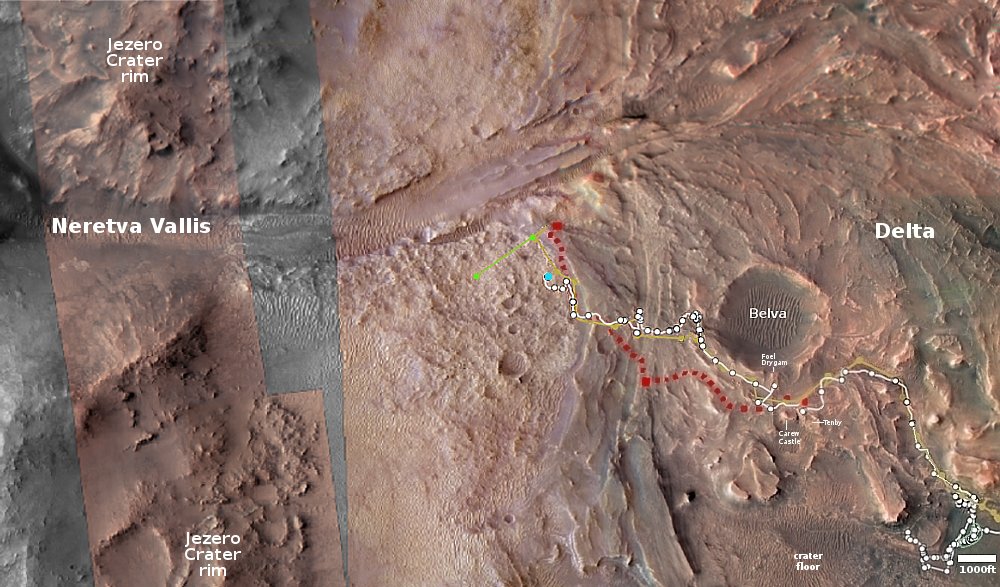
On the overview map above the two dots and the green line mark the flight path, to the southwest and landing about 2,000 feet to the west of where the rover Perseverance presently sits (indicated by the blue dot).

Both the flight time and distance were slightly longer than the flight plan, likely caused by the helicopter making sure it had a safe landing spot before lowering itself to the ground.

Ingenuity is no longer simply an engineering test of whether flight is possible on Mars. It is now serving wholly as a scout for Perseverance, either moving ahead of its planned route (the red dotted line) in order to provide pictures of the ground so that the rover’s science team can better plan their future travels, or going into territory that the rover is not intended to travel in order to gather data that would previously been unavailable.

3 comments

Ingenuity completes 62nd flight on Mars

Overview map
Click for interactive map.

On October 12, 2023 the Mars helicopter Ingeniuty successfully completed its 62nd flight on Mars, flying a total of 880 feet for just over two minutes while setting a new ground speed record of 22.4 miles per hour.

The flight was a scouting trip to the northeast about 440 feet, then returning to land back at about its take-off point. The green line on the overview map above shows the route of that flight, with the green dot marking Ingenuity’s landing spot. The blue dot marks Perseverance’s present location.

The distance and time of the flight, as well as the speed record, were almost identical to the flight plan released prior to the flight.

0 comments
1 2 3 7