Status update on Mars Reconnaissance Orbiter

Link here. The story is focused on the decision by NASA to hold off launching a replacement for MRO and instead keep it operating for another decade. In telling this story, however, the article also provides us a detail look at the spacecraft’s present condition.

[A]ging batteries and gyroscopes, used to store electricity and aid navigation, will have to be carefully watched in the coming years to keep the mission going. “We found that they weren’t charging at full capacity,” Tamppari said of the batteries. MRO charges its batteries through its solar arrays while in sunlight. During night passes over Mars, the orbiter draws electricity from its batteries for about 40 minutes during each two-hour lap around the planet. The spacecraft now charges its batteries higher than before, NASA said, and engineers sent up commands for MRO to reduce the draw on the batteries while in shadow.

MRO’s two inertial measurement units are also showing signs of their age. Each redundant unit contains three gyroscopes and three accelerometers, feeding data about the spacecraft’s orientation to on-board computers. One measurement unit likely in the final months of its useful lifetime, Tamppari said, and the other is showing signs of degradation.

Ground controllers found a work-around by implementing an “all-stellar” navigation mode on MRO in March. The new technique allows the orbiter to sense the positions of the stars to determine which way it is pointing. “In all-stellar mode, we can do normal science and normal relay,” said Dan Johnston, MRO project manager at JPL, in a statement released in February. “The inertial measurement unit powers back on only when it’s needed, such as during safe mode, orbital trim maneuvers, or communications coverage during critical events around a Mars landing.”

There’s more at the link. Since MRO is also used as the main communications relay satellite between the Martian ground-based probes and the Earth, the story also outlines the communications capabilities of all spacecraft presently orbiting Mars. All told, it seems that if MRO fails the research on the surface will be significantly impacted, even if the rovers and landers are all still working.

3 comments

Europe’s Trace Gas Orbiter achieves operational orbit around Mars

After a year of aerobraking to lower its orbit, the European Space Agency’s Trace Gas Orbiter has reached its planned orbit around Mars, and is about to begin studying the red planet’s atmosphere.

The primary goal is to take a detailed inventory of trace gases – those that make up less than 1% of the total volume of the planet’s atmosphere. In particular, the orbiter will seek evidence of methane and other gases that could be signatures of active biological or geological activity.

On Earth, living organisms release much of the planet’s methane. It is also the main component of naturally occurring hydrocarbon gas reservoirs, and a contribution is also provided by volcanic and hydrothermal activity. Methane on Mars is expected to have a rather short lifetime – around 400 years – because it is broken down by ultraviolet light from the Sun. It also reacts with other species in the atmosphere, and is subject to mixing and dispersal by winds. That means, if it is detected today, it was likely created or released from an ancient reservoir relatively recently. Previous possible detections of methane by ESA’s Mars Express and more recently by NASA’s Curiosity rover have been hinted at, but are still the subject of much debate.

The Trace Gas Orbiter can detect and analyse methane and other trace gases even in extremely low concentrations, with an improved accuracy of three orders of magnitude over previous measurements. It will also be able to help distinguish between the different possible origins. [emphasis mine]

The highlighted sentence is important. Pinpointing a region where methane is concentrated will allow scientists to better understand where it is coming from, and what is causing its release. It could be microbiological life, but it also could be from active volcanic processes. Finding either or both would be significant, to put it mildly.

4 comments

A spray of volcanic ejecta on Mars?

pit features on floor of crater

Time for some more weird Mars geology! Today the science team for the high resolution camera on Mars Reconnaissance Orbiter released its monthly batch of new images. There is a lot of interesting stuff buried therein, some of which I will feature periodically in the next month.

The image on the right, reduced in resolution to post here, is a good example. (If you click on the image you can see the full resolution version.) It shows a scattering of pits in three specific areas on the crater floor, all in a line going from the northeast to the southwest. Yet, the rest of the crater floor lacks similar pits, and is either very smooth or has a mottled appearance. Both the smooth and the mottled areas appear to have a very faint trend going from the northwest to the southeast, which to my eye appears caused by the general wind direction that flows across the crater floor.

Even more intriguing, the pits in these three areas appear to be mostly oblong and also trend from the northeast to the southwest, cutting across the general trend of the rest of the crater floor. You can see this in the cropped closeups from the full resolution image below, showing the two boxed areas indicated on the image on the right.
» Read more

0 comments

Near the Martian shoreline

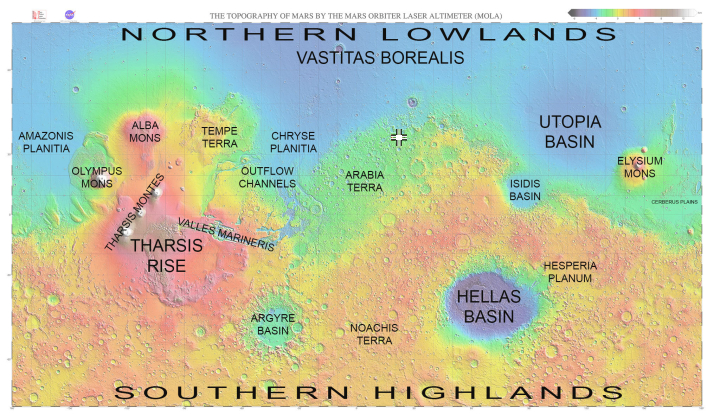
One of the prime areas of research for Mars planetary geologists is the region on Mars where the geography appears to transition from the southern cratered, rough terrain to the northern low, generally smooth, and flat plains. It is theorized by some scientists that the northern plains were once an ocean, probably shallow and probably intermittent, but wet nonetheless for considerable periods. The global map of Mars below, created by the laser altimeter on Mars Global Surveyor, clearly shows the obvious elevation differences between the low northern plans (blue) and the high, more cratered southern regions (changing from yellow to orange as you move higher).

Labeled global Map of Mars

Scientists have spent a considerable effort studying this transition zone (green on the map), illustrated by just one example I recently highlighted, showing that, though there does not appear to be a clear shoreline in many places, there is strong evidence that a shallow ocean repeatedly rose and fell in this transition zone, leaving behind geological ripple marks vaguely reminiscent of those seen on a beach caused by the rise and fall of the tides.

Today we highlight another example, taken in January 2018 at the location indicated by the cross on the above map.
» Read more

1 comment

ESA successfully completes first parachute test for 2020 ExoMars mission

Early in March the European Space Agency successfully completed the first of a series of parachute tests for its 2020 ExoMars rover mission.

The focus of the latest test, conducted in sub-zero conditions in Kiruna, Sweden earlier this month, was the 35 m-diameter second main parachute. The test demonstrated the deployment and inflation of the parachute with its 112 lines connected to a drop test vehicle, via the deployment of a smaller 4.8 m-wide pilot chute.

This test only tested the parachutes deployment system. They still need to do this test at high altitudes to duplicate Mars’ conditions using high-altitude balloons.

When ExoMars reaches Mars, the parachute will act to slow the spacecraft down during descent. For the actual landing, they will be using systems designed and built by the Russians.

1 comment

Mars rover update: March 21, 2018

Summary: Curiosity continues its exploration of Vera Rubin Ridge, including several drilling attempts. Opportunity is halfway down Perseverance Valley.

For a complete list of all past updates going back to July 2016, see my February 8, 2018 update.

Curiosity

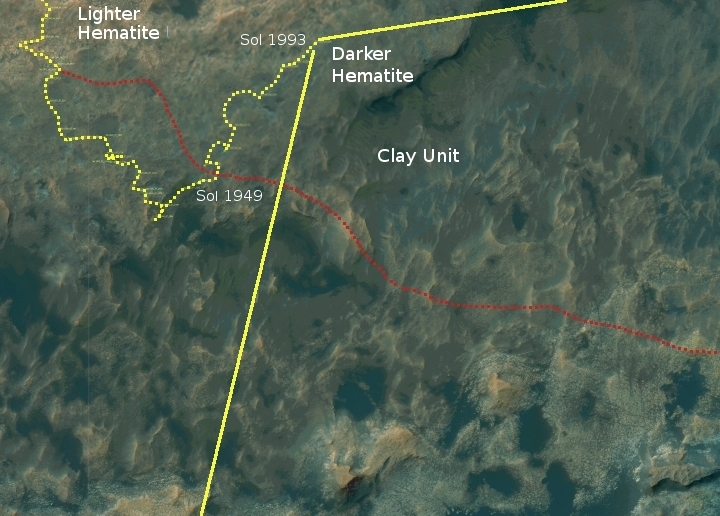
Curiosity's traverse map, Sol 1993

For the overall context of Curiosity’s travels, see Pinpointing Curiosity’s location in Gale Crater.

Since my February 8, 2018 update, the Curiosity science team has apparently been loath to leave Vera Rubin Ridge. They had begun the trek to the northeast that would take them towards the exit ridge heading to the southeast, as indicated by the dotted red line on the traverse map above, but then continued past that planned route to continue to the northeast. Along the way they attempted to drill twice using an improvised approach that they hoped would bypass the drill’s stuck feed mechanism, without apparent success.

The panorama below is looking to the west and south, as indicated by the yellow lines in the image above.
» Read more

4 comments

New theory suggests Mars’ oceans formed earlier and intermittently

Scientists have proposed a new model for the existence of oceans on Mars’ northern plains that proposes they formed earlier, were shallower, were variable in size, and formed in conjunction with the eruptions that formed the planet’s giant volcanoes.

The proposal by UC Berkeley geophysicists links the existence of oceans early in Mars history to the rise of the solar system’s largest volcanic system, Tharsis, and highlights the key role played by global warming in allowing liquid water to exist on Mars. “Volcanoes may be important in creating the conditions for Mars to be wet,” said Michael Manga, a UC Berkeley professor of earth and planetary science and senior author of a paper appearing in Nature this week and posted online March 19.

…The new model proposes that the oceans formed before or at the same time as Mars’ largest volcanic feature, Tharsis, instead of after Tharsis formed 3.7 billion years ago. Because Tharsis was smaller at that time, it did not distort the planet as much as it did later, in particular the plains that cover most of the northern hemisphere and are the presumed ancient seabed. The absence of crustal deformation from Tharsis means the seas would have been shallower, holding about half the water of earlier estimates. “The assumption was that Tharsis formed quickly and early, rather than gradually, and that the oceans came later,” Manga said. “We’re saying that the oceans predate and accompany the lava outpourings that made Tharsis.”

2 comments

Putin promises a Russian Mars mission in 2019

The new colonial movement: In a documentary released this week Russian President Vladimir Putin pledged that his country will send an unmanned mission to Mars in 2019, and that it will be aimed at studying water at the red planet’s poles.

This is funny. Putin is likely referring to ExoMars 2020, which Russia is partnering with the European Space Agency (ESA). In that mission, Russia is providing the rocket and the descent and landing technology for ESA’s rover. To claim that this is a Russian mission is a bit of an over-statement, since the only Mars-related equipment Russia is building involves the landing, and the ESA is also participating in that work.

Nonetheless, Putin’s words here illustrate how the competition is heating up. Every nation wants its share of the exploration of the solar system, and they are beginning to ramp up their efforts to make that happen.

4 comments

Martian craters go splat!

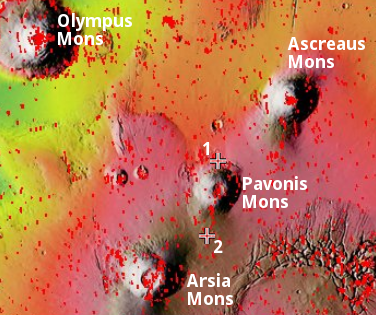
Overview of the volcanic Tharsis Bulge on Mars

Cool image time! In continuing my exploration of this month’s Mars Reconnaissance Orbiter (MRO) image release, I found two interesting images of small craters, one as part of that image release, the other found completely by accident.

The map on the right, taken from the MRO HiRISE archive page, shows the locations of these two images. Both are located in the lava plains that surround the giant volcano Pavonis Mons, the central volcano of the three volcanoes to the east of Olympus Mons. Previously, I have done posts focusing specifically on both Pavonis Mons and Arsia Mons. Not only is the geology of these gigantic volcanoes fascinating, there is evidence that ancient glacial ice lurks in lava tubes on their slopes, making them potentially prime real estate for future explorers.

The first image, labeled #1 on the image above, was taken in January 2018 to get a better look at a small crater on the surrounding lava plains, and was part of the MRO March image release. I have cropped it to post here, focusing on the crater itself.

My first reaction on seeing the image was, “Did this impact not go splat when it hit?”
» Read more

2 comments

Ground too hard for Curiosity’s drill

A second drill attempt by Curiosity, using an improvised drilling technique designed to bypass the failure of the drill’s feed mechanism, once again failed to drill deep enough to obtain a sample.

After two drilling attempts, Curiosity’s drill was not able to dig into the bedrock sufficiently to collect a sample of rock at this location. Curiosity’s engineers are continuing to refine the new drilling method. In the future, this might include adding percussion, which could enable drilling into harder rock.

Either the ground on Vera Rubin Ridge is too hard for Curiosity’s drill, or the new drilling technique does not allow the drill to push with the same force as previously. The update at the link implies the former, but I suspect the latter is a factor as well.

0 comments

More weird Mars geology

Low resolution of full image of crater

Cool image time! Yesterday the Mars Reconnaissance Orbiter team released 460 images taken by the spacecraft’s high resolution camera, HiRISE, as part of their normal and routine image release program. Obsessed with space exploration as I am, I like to scan through these new images to see if there is anything interesting hidden there that will show up eventually in a press release. For example, the first image in this release is a look at Vera Rubin Ridge and Curiosity. I would not be surprised if there is a press release soon using this image, probably aimed at outlining the rover’s future route up Mount Sharp. (The present overview traverse map is getting out of date.)

Sometimes however I find images that might never get a press release but probably deserve it. The image on the right, reduced in resolution to show here, is one such example. It is a strip taken from rim to rim across an unnamed crater located in the mid-northern latitudes of Mars, west of Olympus Mons. A review of past images by other Mars orbiters/probes suggests that no good high resolution image of this crater had ever been taken before.

If you click on the image on the right, or go to the actual image site, you can see the original in full resolution. It is definitely worthwhile doing this, because the strip shows some strange and inexplicable geology on the floor of the crater as well in its confusing central peak region. Numerous features appear to have been exposed by later erosion. The many small craters for example are I think what planetary geologists call pedestal craters. The surrounding terrain is less erosion-resistant, so as that terrain erodes away it leaves the crater behind, with its floor actually sitting higher than the surrounding flats.

What makes these craters even weirder however is that their rims appear to have eroded away even more than the surrounding terrain, so that all of these small craters (assuming that is what they are) have ringlike depressions surrounding a circular platform.

In the crater’s central peak region the terrain is even more strange. Sticking up out of the ground are some arched short ridgelines, which appear to have been exposed by erosion. That peak area however also has many strange flow features that I find completely baffling. It almost appears to me that as the molten peak area started to solidify after impact, someone went in with a stirring spoon and did some mixing!

The map below the fold provides the location context for this crater, with the crater’s location indicated by the arrow.
» Read more

29 comments

Mars Reconnaissance Orbiter comes out of safe mode

On February 23 the Mars Reconnaissance Orbiter (MRO) engineering team was able to bring the spacecraft out of safe mode, after a low battery voltage reading caused it to shut down.

Mission team members brought MRO out of safe mode on Friday (Feb. 23), NASA officials said. The orbiter seems to be in good health overall; the battery voltage is back to normal, MRO is communicating with Earth, and temperatures and power levels are stable, agency officials said.

But MRO’s handlers haven’t put the orbiter back to work yet. “We’re in the diagnostic stage, to better understand the behavior of the batteries and ways to give ourselves more options for managing them in the future,” MRO project manager Dan Johnston, of NASA’s Jet Propulsion Laboratory in Pasadena, California, said in a statement. “We will restore MRO’s service as a relay for other missions as soon as we can do so with confidence in spacecraft safety — likely in about one week. After that, we will resume science observations.”

Overall this sounds like very good news.

3 comments
1 155 156 157 158 159 212