Another intriguing pit on Mars

pit on Mars

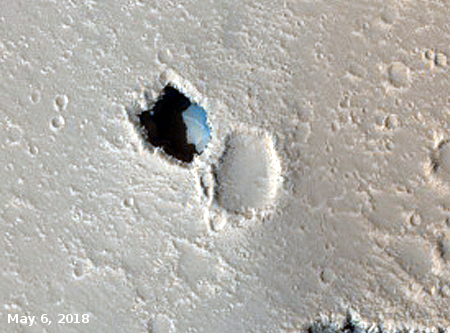
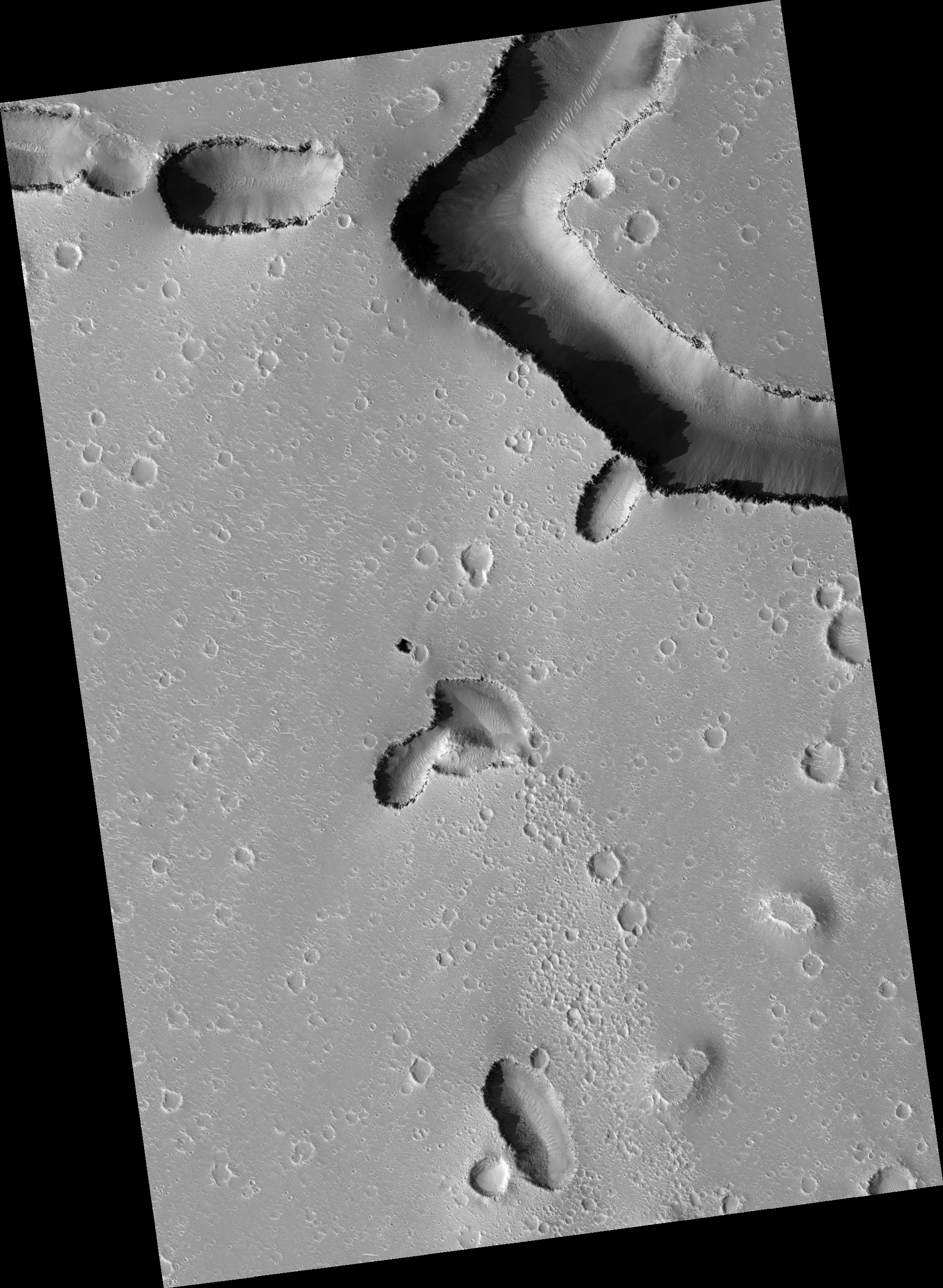
Cool image time! In the June release of images from the high resolution camera on Mars Reconnaissance Orbiter, I came across the image on the right, cropped slightly to post here, of a pit in a region dubbed Hephaestus Fossae that is located just at the margin of Mars’s vast northern plains.

Below and to the right is an annotated second image showing the area around this pit. If you click on it you can see the full resolution image, uncropped, and unannotated.
wider view of pit

The scale bar is based on the 25 centimeter per pixel scale provided at the image link. Based on this, this pit is only about ten to fifteen meters across, or 30 to 50 feet wide. The image webpage says the sun was 39 degrees above the horizon, with what they call a sun angle of 51 degrees. Based on these angles, the shadow on the floor of the pit suggests it is about the same depth, 30 to 50 feet.

The shadows suggest overhung walls. This, plus the presence of nearby aligned sinks, strongly suggests that there are extensive underground passages leading away from this pit.

For a caver on Earth to drop into a pit 30 to 50 feet deep is nowadays a trivial thing. You rig a rope (properly), put on your vertical system, and rappel in. When you want to leave you use that same vertical system to climb the rope, using mechanical cams that slide up the rope but will not slide down.

On Mars such a climb would be both easier and harder. The gravity is only one third that of Earth, but the lack of atmosphere means you must wear some form of spacesuit. Moreover, this system is not great for getting large amounts of gear up and down. Usually, people only bring what they can carry in a pack. To use this Martian pit as a habitat will require easier access, preferable by a wheeled vehicle that can drive in.

The pit’s location however is intriguing. The map below shows its location on a global map of Mars. This region is part of the Utopia Basin, the place with the second lowest elevation on Mars.
» Read more
7 comments

Curiosity’s new drilling technique declared a success

In order to bypass a failed feed mechanism in the rover’s drill, Curiosity’s engineering team has declared successful the new techniques they have developed for drilling and getting samples.

They had successfully completed a new drill hole two weeks ago, but are only now are satisfied that the new method for depositing samples in the laboratories will work.

This delivery method had already been successfully tested at JPL. But that’s here on Earth; on Mars, the thin, dry atmosphere provides very different conditions for powder falling out of the drill. “On Mars we have to try and estimate visually whether this is working, just by looking at images of how much powder falls out,” said John Michael Moorokian of JPL, the engineer who led development of the new sample delivery method. “We’re talking about as little as half a baby aspirin worth of sample.”

Too little powder, and the laboratories can’t provide accurate analyses. Too much, and it could overfill the instruments, clogging parts or contaminating future measurements. A successful test of the delivery method on May 22 led to even further improvements in the delivery technique.

Part of the challenge is that Curiosity’s drill is now permanently extended. That new configuration no longer gives it access to a special device that sieves and portions drilled samples in precise amounts. That device, called the Collection and Handling for In-Situ Martian Rock Analysis (CHIMRA), played an important role in delivering measured portions of sample to the laboratories inside the rover.

I suspect that they still need to do more tests, and that the new method of shaking off material from the drill itself will not always work. At the same time, it reopens the option of using the drill and getting samples from it, which is a very good thing.

0 comments

Cubesats heading to Mars complete first course correction

The two cubesats, MarCO-A and MarCO-B, that were launched with NASA’s InSight Mars lander, have both completed their first course corrections, the first ever done in interplanetary space by cubesats.

While MarCO-A corrected its course to Mars relatively smoothly, MarCO-B faced some unexpected challenges. Its maneuver was smaller due to a leaky thruster valve that engineers have been monitoring for the past several weeks. The leak creates small trajectory changes on its own. Engineers have factored in these nudges so that MarCO-B can still perform a trajectory correction maneuver. It will take several more weeks of tracking to refine these nudges so that MarCO-B can follow InSight on its cruise through space.

“We’re cautiously optimistic that MarCO-B can follow MarCO-A,” said Joel Krajewski of JPL, MarCO’s project manager. “But we wanted to take more time to understand the underlying issues before attempting the next course-correction maneuver.”

Once the MarCO team has analyzed data, they’ll know the size of follow-on maneuvers. Several more course corrections will be needed to reach the Red Planet.

Since these two cubesats are an engineering test, even MarCo-B’s fuel leak issue provides valuable information that will make future interplanetary missions more likely and viable.

1 comment

New impact craters on Mars

New impact crater on Mars

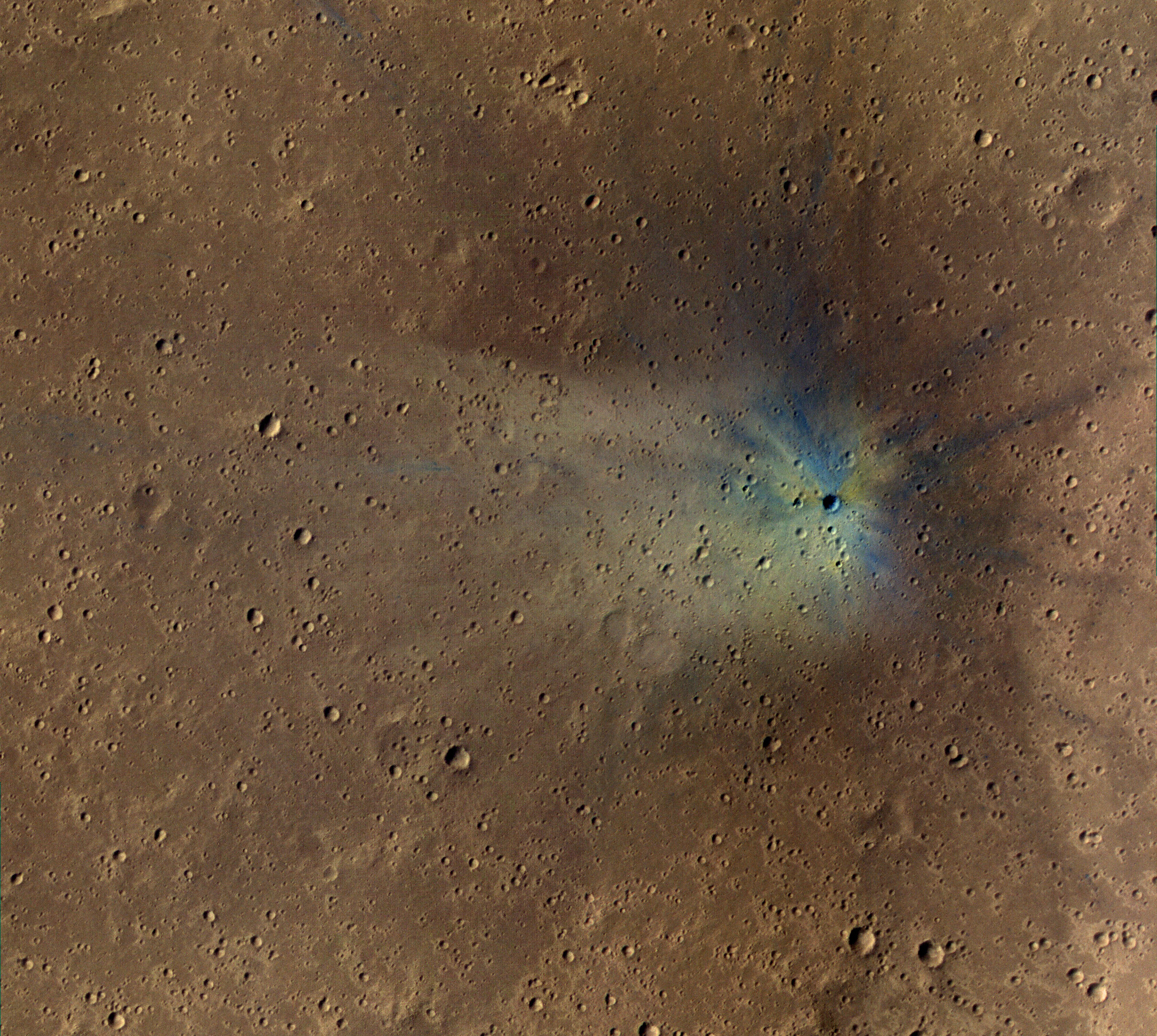
Cool image time! The high resolution camera on Mars Reconnaissance Orbiter (MRO) keeps finding recent impact craters, all of which the science team try to monitor periodically to see how the surface evolves over time. The image on the right, cropped to post here, is one such crater, the image taken in January 2018 and released with as one of the captioned images from this month’s image catalog release. If you click on the image you can see the full picture.

What is notable about this particular impact are the colors.

The new crater and its ejecta have distinctive color patterns. Once the colors have faded in a few decades, this new crater will still be distinctive compared to the secondaries by having a deeper cavity compared to its diameter.

Those colors of course have importance to researchers, as they reveal the different materials found beneath the surface at this location, normally hidden by surface dust and debris.

Nor is this the only impact crater revealed in this month’s image release. Earlier in the month the science team highlighted an image that captured two small impacts. While all three of these impacts are in the general region called Elysium Planitia, they are not particularly close to each other. They are however surrounding the landing site for the InSight lander now heading to Mars. This last link takes you to my January 28, 2018 post detailing some information about this landing site, and also includes another recent crater impact, found at the center of the landing zone.

It is not clear if these recent impacts are related to each other. As noted by Alfred McEwen of the science team, “Often, a bolide breaks apart in the atmosphere and makes a tight cluster of new craters.” It could be that all these recent impacts came from the same bolide, which is why there appear to be a surplus of them in Elysium Planitia.

Then again, our surface survey of Mars is very incomplete. These impacts could simply be marking the normal impact rate for Mars. We will not know until we have completed a detail survey of all recent impacts on Mars, and have been able to date them all.

Who wants to do it?

2 comments

Mars rover update: May 23, 2018

Summary: Curiosity drives down off of Vera Rubin Ridge to do drilling in lower Murray Formation geology unit, while Opportunity continues to puzzle over the formation process that created Perseverance Valley in the rim of Endeavour Crater.

For a list of past updates beginning in July 2016, see my February 8, 2018 update.

Curiosity

Curiosity's travels on and off Vera Rubin Ridge

For the overall context of Curiosity’s travels, see Pinpointing Curiosityโ€™s location in Gale Crater.

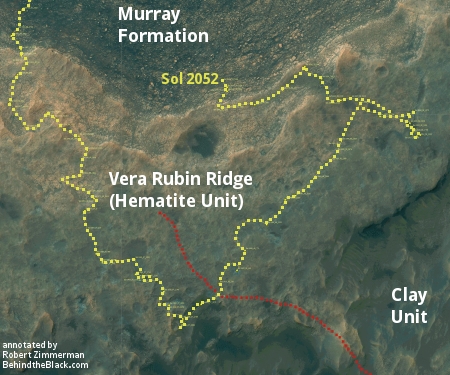
Since my April 27, 2018 update, Curiosity has continued its downward trek off of Vera Rubin Ridge back in the direction from which it came. The annotated traverse map to the right, cropped and taken from the rover’s most recent full traverse map, shows the rover’s recent circuitous route with the yellow dotted line. The red dotted line shows the originally planned route off of Vera Rubin Ridge, which they have presently bypassed.

It appears they have had several reasons for returning to the Murray Formation below the Hematite Unit on Vera Rubin Ridge. First, it appears they wanted to get more data about the geological layers just below the Hematite Unit, including the layer immediately below, dubbed the Blunts Point member.

While this is certainly their main goal, I also suspect that they wanted to find a good and relatively easy drilling candidate to test their new drill technique. The last two times they tested this new technique, which bypasses the drill’s stuck feed mechanism by having the robot arm itself push the drill bit against the rock, the drilling did not succeed. It appeared the force applied by the robot arm to push the drill into the rock was not sufficient. The rock was too hard.

In these first attempts, however, they only used the drill’s rotation to drill, thus reducing the stress on the robot arm. The rotation however was insufficient. Thus, they decided with the next drill attempt to add the drill’s “percussion” capability, where it would not only rotate but also repeatedly pound up and down, the way a standard hammer drill works on Earth.

I suspect that they are proceeding carefully with this because this new technique places stress the operation of the robot arm, something they absolutely do not want to lose. By leaving Vera Rubin Ridge they return to the more delicate and softer materials already explored in the Murray Formation. This is very clear in the photo below, cropped from the original to post here, showing the boulder they have chosen to drill into, dubbed “Duluth,” with the successful drill hole to the right.
» Read more

0 comments

Drilling success for Curiosity

For the first time in more than a year, Curiosity has successfully used its drill to obtain a sample from beneath the surface of Mars.

Curiosity tested percussive drilling this past weekend, penetrating about 2 inches (50 millimeters) into a target called “Duluth.”

NASA’s Jet Propulsion Laboratory in Pasadena, California, has been testing this drilling technique since a mechanical problem took Curiosity’s drill offline in December of 2016. This technique, called Feed Extended Drilling, keeps the drill’s bit extended out past two stabilizer posts that were originally used to steady the drill against Martian rocks. It lets Curiosity drill using the force of its robotic arm, a little more like the way a human would drill into a wall at home.

I plan to post a rover update either today or tomorrow, with more details about this success. Stay tuned!

0 comments

Mars cubesats take picture of Earth and Moon

One of the two MarCO cubesats heading to Mars on the first interplanetary cubesat mission, has taken its a picture of the Earth and the Moon.

NASA set a new distance record for CubeSats on May 8 when a pair of CubeSats called Mars Cube One (MarCO) reached 621,371 miles (1 million kilometers) from Earth. One of the CubeSats, called MarCO-B (and affectionately known as “Wall-E” to the MarCO team) used a fisheye camera to snap its first photo on May 9. That photo is part of the process used by the engineering team to confirm the spacecraft’s high-gain antenna has properly unfolded.

As a bonus, it captured Earth and its moon as tiny specks floating in space.

In a few weeks the two cubesats will make a mid-course correction, also the first time a cubesat has attempted such a thing.

4 comments

Chaos on Mars

chaos terrain

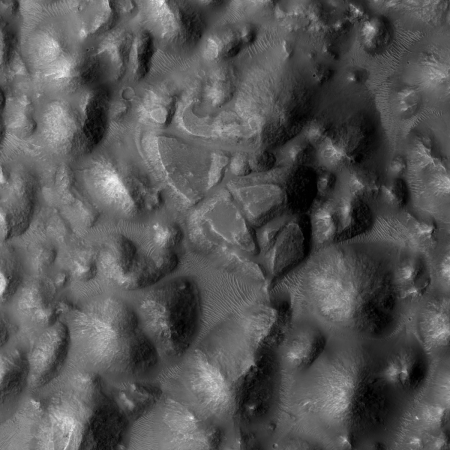
Cool image time! The image on the right, cropped and reduced in resolution to post here, shows an area on Mars that geologists have dubbed “Chaos Terrain.” If you click on the image you can see the full image, which also includes several canyons oriented in what seem to be random directions.

I first heard this geological term for regions on Mars shortly after the first orbital missions circling Mars began taking images back in the 1970s. It applied to places where the terrain was hummocky, a crazy collection of hills forming no pattern at all. Earth does not really have such terrain.

The close-up to the right also shows that at least one of these hills is fractured, made up of several large pieces that have separated over time.

This image was part of the May 2nd image release from the high resolution camera on Mars Reconnaissance Orbiter. What makes it interesting is its location on Mars. The image below shows that location, indicated by a white cross.
» Read more

3 comments

NASA will fly a test drone on 2020 Mars rover mission

NASA today announced that a test drone, dubbed Mars Helicopter, will be flown on the 2020 Mars rover mission.

Once the rover is on the planet’s surface, a suitable location will be found to deploy the helicopter down from the vehicle and place it onto the ground. The rover then will be driven away from the helicopter to a safe distance from which it will relay commands. After its batteries are charged and a myriad of tests are performed, controllers on Earth will command the Mars Helicopter to take its first autonomous flight into history.

“We don’t have a pilot and Earth will be several light minutes away, so there is no way to joystick this mission in real time,” said Aung. “Instead, we have an autonomous capability that will be able to receive and interpret commands from the ground, and then fly the mission on its own.”

The full 30-day flight test campaign will include up to five flights of incrementally farther flight distances, up to a few hundred meters, and longer durations as long as 90 seconds, over a period. On its first flight, the helicopter will make a short vertical climb to 10 feet (3 meters), where it will hover for about 30 seconds.

As a technology demonstration, the Mars Helicopter is considered a high-risk, high-reward project. If it does not work, the Mars 2020 mission will not be impacted. If it does work, helicopters may have a real future as low-flying scouts and aerial vehicles to access locations not reachable by ground travel.

The only word I can think of to express my thoughts on this is “Cool!”

5 comments

Mars Odyssey looks down at Curiosity

Gale Crater

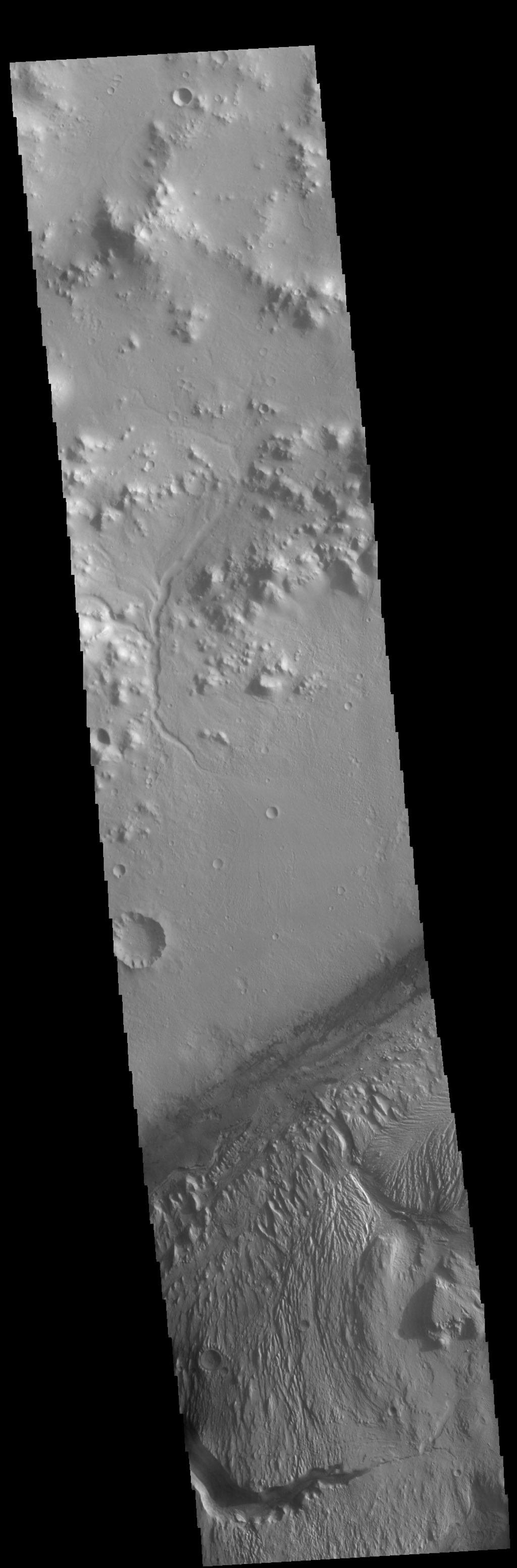
The Mars Odyssey team today released an image the spacecraft took of Gale Crater on January 16, 2018. This image, reduced in resolution, is posted on the right and captures the entire region that the rover Curiosity has been traversing for the past six years. If you click on the image you can view the full resolution original.

I have placed Curiosity’s full route since its landing on this image so that we can see where the rover has been. The actual peak of Mount Sharp is a considerable distance to the south and is not visible in this image. (For the full context of the crater and Curiosity’s travels see my March 2016 post, Pinpointing Curiosityโ€™s location in Gale Crater)

The river-like flow feature cutting through the north rim is called Peace Vallis. Scientists think this was formed by water flowing into the crater when the climate of Mars was wetter and there was a lake inside the crater floor.

You can get another perspective of this same view by looking at the panorama looking north that Curiosity took once it climbed up onto Vera Rubin Ridge.

I have said this before, but this Mars Odyssey image once again illustrates how little of Mars we have so far seen. Curiosity has barely begun its climb into the foothills of Mount Sharp. The mile-high mountains that form the rim of Gale Crater are far away, and will not be walked for probably generations. I do not expect any space probe or explorer to enter Peace Vallis for at least a hundred years, since there are so many other places on Mars to visit and Gale Crater has already gotten its first reconnaissance by Curiosity.

The image also gives as a view of Curiosity’s future travels. Based on this October 3, 2016 press release, Curiosity will eventually head into the mouth of the large canyon directly to the south of its present position. Whether the mission will continue up this canyon wash, using it as the route up Mount Sharp, will depend on many things, including the roughness of the terrain in that canyon and the simple question of whether the rover will be able to operate that long.

If it does, the views then from inside that canyon should be quite breathtaking.

6 comments

Craters, cones, pits, amid endless plains

Pits, cones, and craters

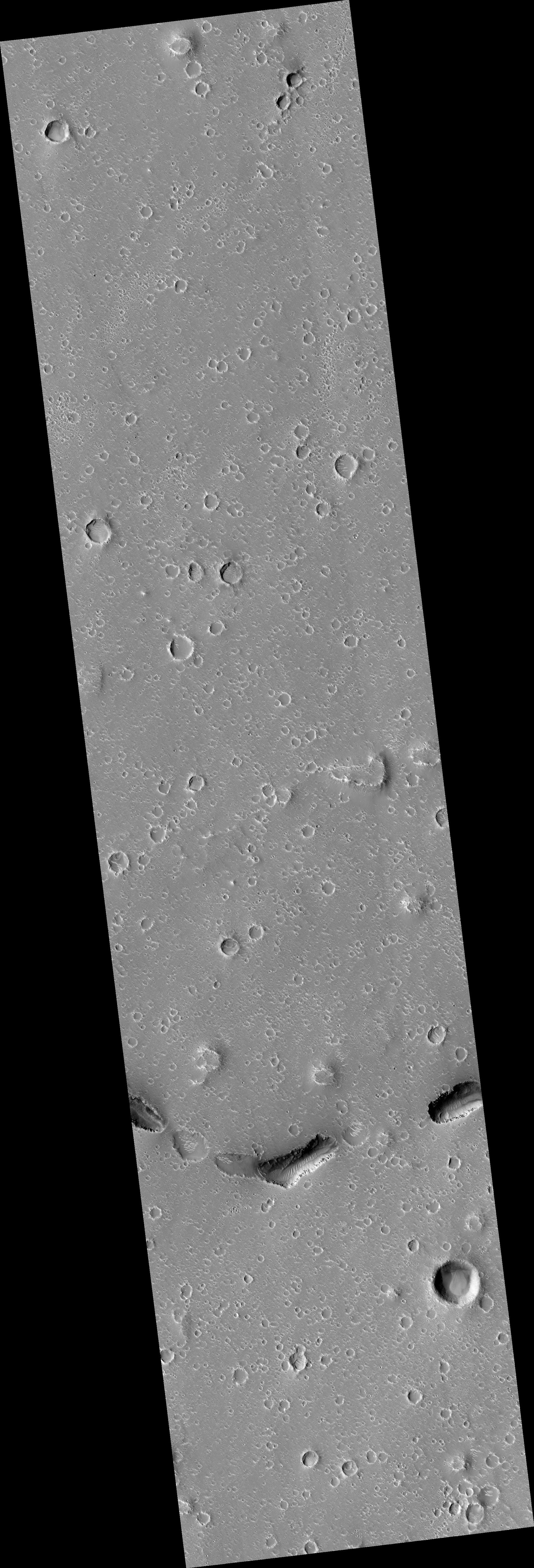
Cool image time! Buried in the catalog of recent high resolution images from Mars Reconnaissance Orbiter are places on Mars that are inexplicable and fascinating, while also indicative of its vastness. The image on the right, reduced in resolution and cropped to post here, shows us one such place. If you click on the image you can see the full image at high resolution.

The archive posting of this image is titled “Cones near Pits.” As you can see, to the north and east of the pits are some mesas (why they call them cones I do not know).

The pits are unusual, and appear to be some form of collapse. In the larger image several additional mesas can be seen at farther distances, but most of the overall terrain is remarkably flat and featureless, except for numerous small craters that appear either partly buried by dust or significantly eroded.

I am not going to guess at the geology that caused the pits and mesas. What I do want to focus on is the vastness of Mars. This location is on the southern edge of Utopia Basin, the second deepest basin on Mars. It is part of the planet’s endless northern plains, an immense region covering almost half the planet that tends to be at a lower elevation, is relatively smooth, and is thought by some scientists to be evidence of what was once an intermittent ocean. The global map of Mars below indicates the location of the above image with a black cross.
» Read more

16 comments
1 153 154 155 156 157 212