Mars rover update: December 8, 2016

Curiosity
Mars' dusty sky

For the overall context of Curiosity’s travels, see Pinpointing Curiosity’s location in Gale Crater.

Since my last rover update on November 14th, Curiosity moved relatively little. They drove a short distance to the southeast to a point where they wanted to drill, but have not moved from this location for the past two weeks because of drill issues.

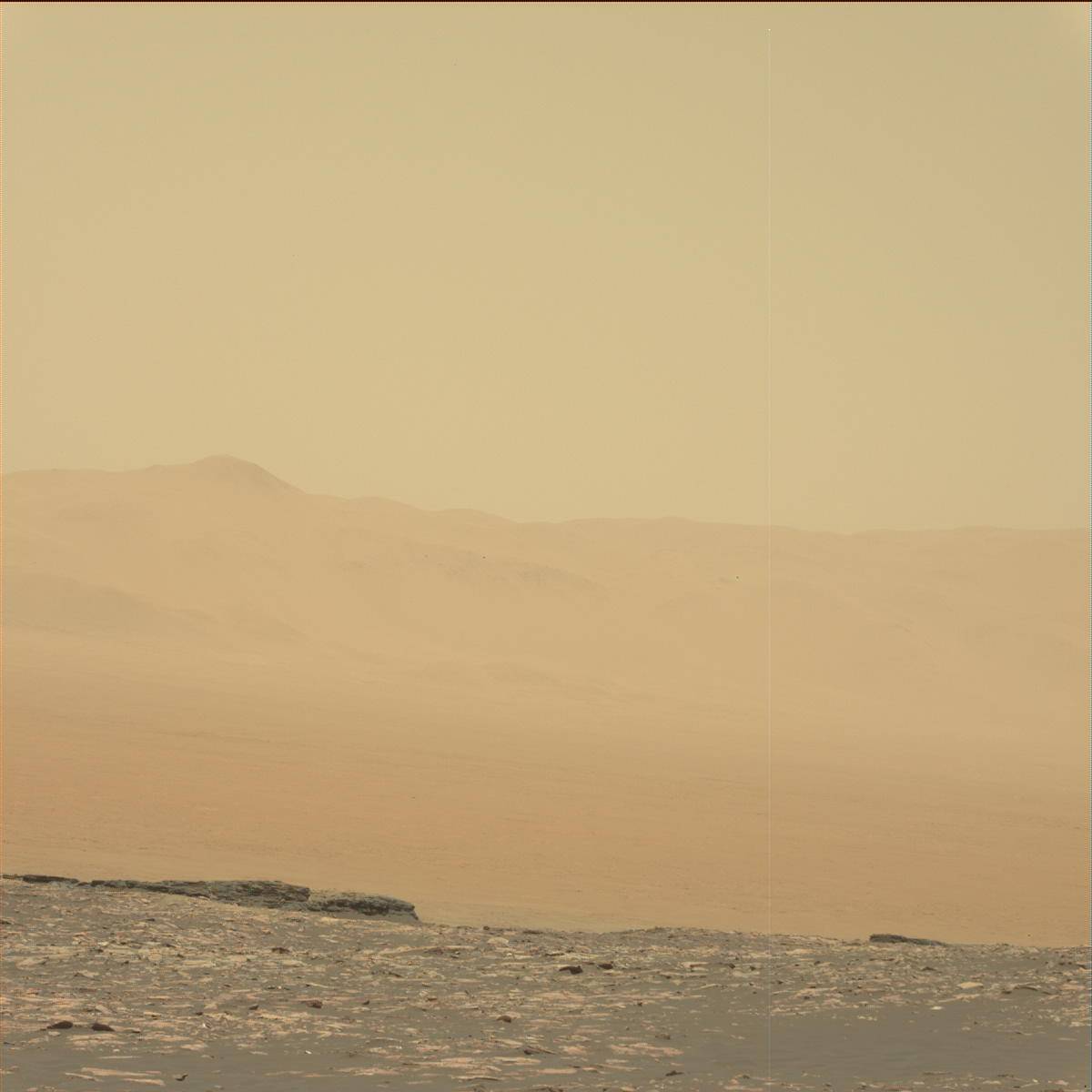
While the engineers study the drill problem, which requires them to not move either the rover or the drill arm, the scientists have still used Curiosity to take images of the dust in the sky, to take hourly images of the dust on the ground (to see how it is changed by the wind), and to take images of nearby interesting nearby features (below the fold).
» Read more
5 comments

Design flaw in India’s Mars Orbiter

According to American researchers, a fundamental design flaw in the primary scientific instrument on India’s Mangalyaan Mars orbiter prevents it from carrying out its mission of measuring the methane in the Martian atmosphere.

“They did not design this properly for the detection of methane on Mars,” Michael Mumma, senior scientist at NASA’s Goddard Space Flight Center, told Seeker. In 2003, Mumma led a team that made the first definitive measurements of methane on Mars using an infrared telescope in Hawaii. The methane, which appeared in plumes over specific regions of Mars, reached a maximum density of about 60 parts per billion. “The (MOM) instrument is beautifully engineered, but not for the methane task. It has other value, but unfortunately they will not be able to provide measurements of methane at the levels needed to sample even the plumes we saw,” Mumma said.

They are re-purposing the instrument to measure the reflected sunlight coming off the Martian surface, useful data to be sure but hardly worth an entire space mission.

1 comment

The weird south pole of Mars

Mars' south pole region

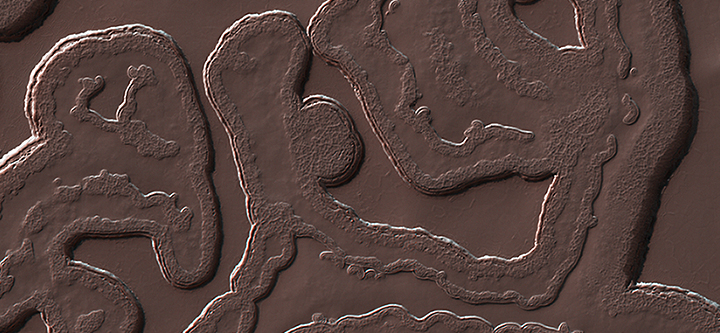
Cool image time (literally)! The photo above, cropped slightly to show here, was taken by Mars Reconnaissance Orbit (MRO) in August 2016 and was released today as part of the monthly release of captioned images. And though it looks like a fractal computer-generated animation still, it is instead real, showing the strange and quite alien terrain that routinely forms at the carbon dioxide ice cap there.

The polar cap is made from carbon dioxide (dry ice), which does not occur naturally on the Earth. The circular pits are holes in this dry ice layer that expand by a few meters each Martian year. New dry ice is constantly being added to this landscape by freezing directly out of the carbon dioxide atmosphere or falling as snow. Freezing out the atmosphere like this limits how cold the surface can get to the frost point at -130 degrees Celsius (-200 F). Nowhere on Mars can ever get any colder this, making this this coolest landscape on Earth and Mars combined!

This region is about 4 degrees north of the south pole itself.

6 comments

ExoMars’ Trace Gas Orbiter images Phobos

As part of its checkout, Europe’s ExoMars’ Trace Gas Orbiter has taken test images of the Martian moon Phobos.

The camera imaged the moon on 26 November from a distance of 7700 km, during the closest part of the spacecraft’s orbit around Mars. TGO’s elliptical orbit currently takes it to within 230–310 km of the surface at its closest point and around 98 000 km at its furthest every 4.2 days. A colour composite has been created from several individual images taken through several filters. The camera’s filters are optimised to reveal differences in mineralogical composition, seen as ‘bluer’ or ‘redder’ colours in the processed image. An anaglyph created from a stereo pair of images captured is also presented, and can be viewed using red–blue 3D glasses.

The images were done to test the spacecraft’s operation, and have apparently shown that it is functioning well.

0 comments

Drill issues at Curiosity

The recent failure by Curiosity to drill has caused engineers to stop the rover in its tracks while they analyze the cause of the problem.

The rover team learned Dec. 1 that Curiosity did not complete the commands for drilling. The rover detected a fault in an early step in which the “drill feed” mechanism did not extend the drill to touch the rock target with the bit. “We are in the process of defining a set of diagnostic tests to carefully assess the drill feed mechanism. We are using our test rover here on Earth to try out these tests before we run them on Mars,” Curiosity Deputy Project Manager Steven Lee, at NASA’s Jet Propulsion Laboratory in Pasadena, California, said Monday. “To be cautious, until we run the tests on Curiosity, we want to restrict any dynamic changes that could affect the diagnosis. That means not moving the arm and not driving, which could shake it.”

Two among the set of possible causes being assessed are that a brake on the drill feed mechanism did not disengage fully or that an electronic encoder for the mechanism’s motor did not function as expected. Lee said that workarounds may exist for both of those scenarios, but the first step is to identify why the motor did not operate properly last week.

Though they do not say so, the problem is almost certainly related to a fundamental design flaw in the drill’s design that causes intermittent short-circuits when they use it, and has the possibility of shorting out the entire rover if they are not careful.

0 comments

ESA approves ExoMars 2020 funding

Despite the failure of the Schiaparelli lander on ExoMars 2016, the European Space Agency today approved funds to build and fly the ExoMars 2020 rover mission.

At a meeting of European government ministers in Lucerne, Switzerland, on 1 and 2 December, ESA member states agreed to provide an extra €339 million for ExoMars 2020. ESA also announced that it will find a further €97 million by moving funds internally. Speaking at a press briefing after the meeting, ESA director-general Jan Wörner said this would be done “without detriment” to ESA’s wider science budget.

But not all projects were so fortunate. Member states did not commit the €250 million needed to fund a plan for ESA to participate in a mission to deflect the moon of an asteroid, although they left door open to future, similar projects.

I am not at present sure how they are going to divide up the work between Europe and Russia. Earlier it was my understanding that Russia would provide the roving technology, but right now I am very unsure about this.

One side note: At this same meeting ESA committed to sticking with ISS through 2024.

4 comments

ExoMars’ Trace Gas Orbiter takes first pictures

The European Trace Gas Orbiter (TGO), part of the ExoMars 2016 mission, has successfully transmitted its first images back to Earth.

I have posted a video they have assembled of the first images below the fold. It is quite spectacular. As for TGO’s future misssion:

In the next months, the team will be starting preparations for the prime mission. “The test was very successful but we have identified a couple of things that need to be improved in the onboard software and in the ground post-processing», says Thomas. “It’s an incredibly exciting time.” Eventually, TGO will use “aerobraking” (skimming into the atmosphere) to slow the spacecraft down and enter a roughly circular orbit 400 km above this surface. This process will start in March 2017 and take around 9-12 months. The primary science phase will start around the end of 2017. CaSSIS will then enter nominal operations acquiring 12-20 high resolution stereo and colour images of selected targets per day.

» Read more

0 comments

Software error caused Schiaparelli crash

A new ESA report says that the ExoMars 2016 Schiaparelli lander failed because its navigation system thought the lander was on the ground when it was still more than two miles from the surface.

Europe’s Schiaparelli Mars lander crashed last month after a sensor failure caused it to cast away its parachute and turn off braking thrusters more than two miles (3.7 km) above the surface of the planet, as if it had already landed, a report released on Wednesday said.

Figuring out what caused this failure will be helpful for the design of the ExoMars 2020 rover, but the failure here is likely going to make it more difficult for Europe to raise the money needed for that next mission, including a 400 million euro cost overrun.

11 comments

UAE sheikh okays next phase in Mars mission

The competition heats up: The Vice President and Prime Minister of the United Arab Emirates and the ruler of Dubai, Sheikh Mohammed bin Rashid Al Maktoum, has approved the start of construction of the prototypes for the UAE’s Mars Mission, dubbed Hope.

Sheikh Mohammed gave the greenlight to start manufacturing the probe’s prototypes, the Arab world’s first Mars probe. The project places the UAE with the nine countries that aim to explore Mars. His Highness said: “UAE ambitions is to explore the outer space. We are investing in our national cadres to lead this project and contribute in expanding our knowledge about Mars. Hope Probe is a qualitative leap for UAE’s scientific efforts, it the first contribution for the Arab world in this regard”.

Sheikh Mohammed’s remarks came while visiting the Mohammed Bin Rashid Space Centre (MBRSC) to open the second phase of the UAE satellite manufacturing and assembly complex, a multitasking facility capable of handling several space projects at a time.

It will be very interesting to see how this top-down mission proceeds, as it is being pushed heavily by the sheikh in a country with almost no experience in building such things.

12 comments

Mars rover update: November 14, 2016

Curiosity

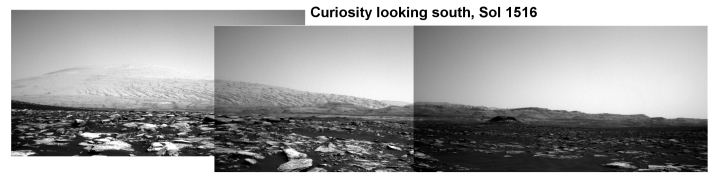
Curiosity looking south, Sol 1516

For the overall context of Curiosity’s travels, see Pinpointing Curiosity’s location in Gale Crater.

Since my last update on November 3rd, Curiosity has reached the region of sand dunes and has started to pick its way through it. The panorama above was created using images from the rover’s left navigation camera, taken on Sol 1516. It looks south, with Mount Sharp rising on the left.

That same day Curiosity also used its mast camera to zoom in on the canyon gap in the center of the panorama. The first image below is the wider mast camera shot, with the an outline showing the even closer zoom-in below that.
» Read more

1 comment

MRO color images of Schiaparelli crash site

Schiaparelli crash site

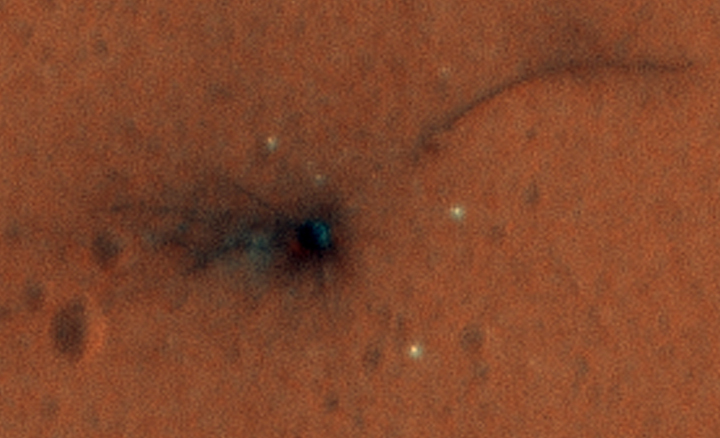
The image above, cropped from a wider image released today by the Mars Reconnaissance Orbiter science team, shows the Schiaparelli impact sites in color and in very high resolution. There are also high resolution images of the heat shield and parachute/back shell. As they note in describing the above image,

Where the lander module struck the ground, dark radial patterns that extend from a dark spot are interpreted as “ejecta,” or material thrown outward from the impact, which may have excavated a shallow crater. From the earlier image, it was not clear whether the relatively bright pixels and clusters of pixels scattered around the lander module’s impact site are fragments of the module or image noise. Now it is clear that at least the four brightest spots near the impact are not noise. These bright spots are in the same location in the two images and have a white color, unusual for this region of Mars. The module may have broken up at impact, and some fragments might have been thrown outward like impact ejecta.

In other words, the lander crashed hard when it hit the ground, throwing pieces and ground material everywhere.

1 comment
1 164 165 166 167 168 212