Curiosity finds a meteorite

The Curiosity science team have identified and now analyzed a nickel-iron meteorite that Curiosity spotted on October 27.

Scientists of the Mars Science Laboratory (MSL) project, which operates the rover, first noticed the odd-looking rock in images taken by Curiosity’s Mast Camera (Mastcam) at at a site the rover reached by an Oct. 27 drive. “The dark, smooth and lustrous aspect of this target, and its sort of spherical shape attracted the attention of some MSL scientists when we received the Mastcam images at the new location,” said ChemCam team member Pierre-Yves Meslin, at the Research Institute in Astrophysics and Planetology (IRAP), of France’s National Center for Scientific Research (CNRS) and the University of Toulouse, France.

ChemCam found iron, nickel and phosphorus, plus lesser ingredients, in concentrations still being determined through analysis of the spectrum of light produced from dozens of laser pulses at nine spots on the object. The enrichment in both nickel and phosphorus at some of the same points suggests the presence of an iron-nickel-phosphide mineral that is rare except in iron-nickel meteorites, Meslin said.

The find is not unprecedented but it is interesting nonetheless.

2 comments

Mars rover update: November 3, 2016

Curiosity

Post updated: See last paragraph in Curiosity section.

Curiosity location 1507

For the overall context of Curiosity’s travels, see Pinpointing Curiosity’s location in Gale Crater.

After spending almost a month on the flats south of Murray Buttes, during which the rover drilled another hole, in the past week Curiosity has finally resumed its journey south toward the slopes of Mount Sharp and the sand dune area that it must cross to get there.

Unfortunately, NASA has decided to change how it shows the rover’s progress, and these changes seem to me to be a clever and careful effort to make it more difficult for the public to make educated guesses about where the rover might be heading in the very near future. The image to the right is the cropped inset showing the rover’s recent travels that is part of a new a larger image that puts this inset in the context of the rover’s entire journey. This has replaced the wider orbital mosaic that they used to provide (see for example my September 27, 2016 rover update) that gave a very good view of the entire terrain surrounding the rover from which a reasonable estimate of its future path could be guessed.
» Read more

1 comment

New details emerge of Schiaparelli crash site

Schiaparelli crash site

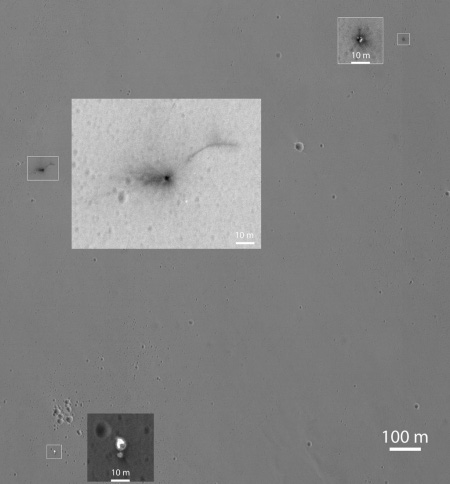
A new high resolution image from Mars Reconnaissance Orbiter’s HIRISE camera, reduced in resolution on the right, confirms that Schiaparelli crashed into the ground on October 19.

The scene shown by HiRISE includes three locations where hardware reached the ground. A dark, roughly circular feature is interpreted as where the lander itself struck. A pattern of rays extending from the circle suggests that a shallow crater was excavated by the impact, as expected given the premature engine shutdown. About 0.8 mile (1.4 kilometers) eastward, an object with several bright spots surrounded by darkened ground is likely the heat shield. About 0.8 mile (1.4 kilometers) south of the lander impact site, two features side-by-side are interpreted as the spacecraft’s parachute and the back shell to which the parachute was attached.

The center insert is a close-up of the impact site on the left, which clearly shows that the lander hit the ground hard, producing impact ejecta. That the rays are somewhat asymmetric also suggests that Schiaparellit hit the ground at an oblique angle.

12 comments

Schiaparelli failure focuses in on altimeter data

The investigation into the landing failure last week of the ExoMars 2016 lander, Schiaparelli, is now focusing on a failure in the spacecraft’s altitude software.

The most likely culprit is a flaw in the craft’s software or a problem in merging the data coming from different sensors, which may have led the craft to believe it was lower in altitude than it really was, says Andrea Accomazzo, ESA’s head of solar and planetary missions. Accomazzo says that this is a hunch; he is reluctant to diagnose the fault before a full post-mortem has been carried out. But if he is right, that is both bad and good news.

European-designed computing, software and sensors are among the elements of the lander that are to be reused on the ExoMars 2020 landing system, which, unlike Schiaparelli, will involve a mixture of European and Russian technology. But software glitches should be easier to fix than a fundamental problem with the landing hardware, which ESA scientists say seems to have passed its test with flying colours. “If we have a serious technological issue, then it’s different, then we have to re-evaluate carefully. But I don’t expect it to be the case,” says Accomazzo.

0 comments

MRO images Schiaparelli on Mars

before and after Schiaparelli

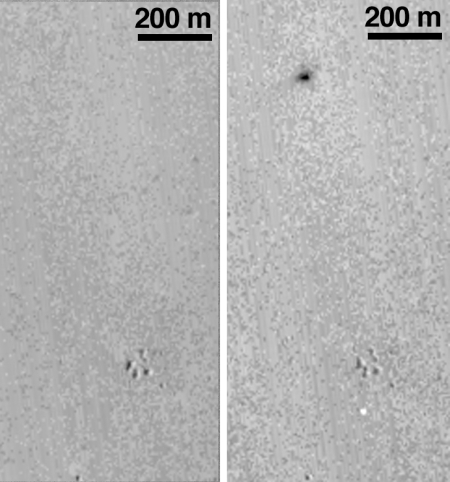
A comparison of images taken by Mars Reconnaissance Orbiter before and after Schiaparelli’s failed attempt to land on Mars have revealed changes that are likely the lander on the surface. The image on the right is a composite that I’ve made showing the two images. The black spot near the top and the white spot near the bottom are not in the first image.

It is thought that the white spot is likely Schiaparelli’s parachute, while the dark spot is thought to be the lander’s impact point.

The larger dark spot near the upper edge of the enlargement was likely formed by the Schiaparelli lander. The spot is elliptical, about 50 by 130 feet (15 by 40 meters) in size, and is probably too large to have been made by the impact of the heat shield.

The large size of the dark spot suggests that the lander hit the ground hard enough to create this large scar.

3 comments

Did Viking discover life on Mars?

Link here. The article provides a very detailed review of the conflicting results from the various 1970s Viking lander experiments, one of which strongly suggested the presence of microorganisms.

Overall, these life-detection experiments produced surprising and contradictory results. One experiment, the Labeled Release (LR) experiment, showed that the Martian soil tested positive for metabolism—a sign that, on Earth, would almost certainly suggest the presence of life. However, a related experiment found no trace of organic material, suggesting the absence of life. With no organic substances, what could be, or seem to be, metabolizing?

In the forty years since these experiments, scientists have been unable to reconcile the conflicting results, and the general consensus is that the Viking landers found no conclusive evidence of life on Mars. However, a small minority of scientists argues that the Viking results were positive for life on Mars.

The contradictory Viking results have never been fully explained. Many theories have been proposed, ranging from the chemical to the biological, but none have satisfied anyone.

2 comments

Did Opportunity see Schiaparelli?

Opportunity image of Schiaparelli?

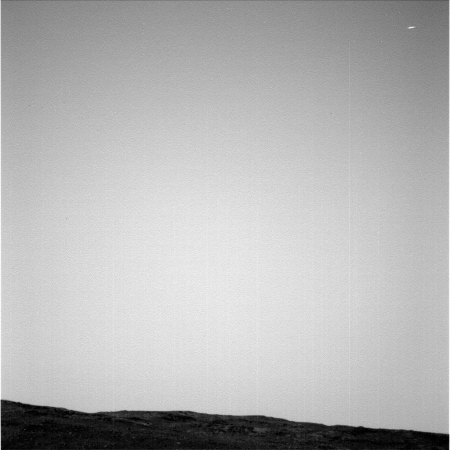
Because Schiaparelli was aimed at a landing site somewhat close to the Mars rover Opportunity, the science team aimed the rover’s panoramic camera at the sky yesterday, taking fourteen pictures in the hope of capturing the lander as it came down. Of those fourteen images, the image on the right, reduced in resolution, is the only one that shows that bright streak in the upper right.

close-up of streak

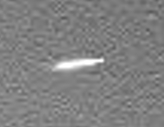
Though this streak might be an artifact, I do not think so. To the left is a close-up from the full resolution image, showing the streak in detail. That doesn’t look like an artifact. It still could be a meteorite, but I also think that doubtful. The coincidence of a meteorite flashing across the sky at the same exact moment Opportunity is looking to photograph Schiaparelli’s landing is too unlikely.

If this is Schiaparelli, expect a press release from NASA in the next few days.

4 comments

Schiaparelli landing apparently a failure

This report from russianspaceweb.com provides some details about the apparent landing failure of the European Mars probe Schiaparelli on Wednesday.

The very preliminary analysis of the data revealed a number of serious problems in the final phase of the parachute descent. The telemetry showed that the back heat shield holding the parachute had been ejected earlier than scheduled — 50 seconds instead of 30 seconds before the touchdown. Also, the lander was apparently descending at a speed higher than planned. There were also indications that the soft-landing engines had fired for only three or four seconds and all communications from the lander were cut 19 seconds later, or shortly before touchdown. By that time, Schiaparelli’s landing radar had been activated.

It appears the parachutes were released too soon so that they did not function properly and slow the spacecraft down enough. When the retro-rockets fired the spacecraft was probably also closer to the ground than planned and falling too fast, so they failed to stop it from impacting the surface hard and prematurely.

13 comments

Fate of Schiaparelli remains unknown

While Europe’s Trace Gas Orbiter has successfully gone into orbit around Mars, it remains unknown whether the lander Schiaparelli was able today to land successfully on the surface.

The carrier signal from Schiaparelli recorded by Mars Express abruptly ended shortly before landing, just as the beacon tone received by a ground-based radio telescope in India stopped in real-time earlier today.

Paolo Ferri, head of ESA’s mission operations department, just gave an update on the situation. “We saw the signal through the atmospheric phase — the descent phase. At a certain point, it stopped,” Ferri said. “This was unexpected, but we couldn’t conclude anything from that because this very weak signal picked up on the ground was coming from an experimental tool.

“We (waited) for the Mars Express measurement, which was taken in parallel, and it was of the same kind. It was only recording the radio signal. The Mars Express measurement came at 1830 (CEST) and confirmed exactly the same: the signal went through the majority of the descent phase, and it stopped at a certain point that we reckon was before the landing.

“There could be many many reasons for that,” Ferri said. “It’s clear these are not good signs, but we will need more information.”

11 comments

Mars rover update

Emily Lakdawalla at Sky & Telescope today provides an update of the two Mars rovers, but takes a different approach than I have. While I have been focusing on tracking where the rovers are going and what they are doing, she gives a very nice overview of each rovers’ condition, what instruments continue to work and what have failed.

I myself have not done a new rover update since October 6 for several reasons. First and foremost, neither rover has gone anywhere since my last report. Opportunity is still sitting on Spirit Mound, studying the rocks there. Curiosity is still in the flats south of Murray Buttes, preparing to drill another hole.

Secondly, there was a delay this past weekend in downloading data, especially from Curiosity. I strongly suspect that the delay was simply because the Deep Space Network was being used to help with communications between Europe and its ExoMars probes, now set to arrive at Mars tomorrow. When the lander Schiaparelli separated from the orbiter on Sunday they had had some initial communications problems, and it is likely that though ESA was using its own deep space network, they also enlisted ours to help.

Thirdly, I have been very tied up trying to finish my cave project monograph. This is done now, so I finally have more time to work on Behind the Black.

0 comments
1 165 166 167 168 169 212