Mars in ultraviolet

Data from the Mars orbiter MAVEN have given scientists their first detailed look at the red planet in ultraviolet wavelengths.

New global images of Mars from NASA’s Mars Atmosphere and Volatile Evolution (MAVEN) mission being led by CU Boulder show the ultraviolet glow from the Martian atmosphere in unprecedented detail, revealing dynamic, previously invisible behavior.

They include the first images of “nightglow” that can be used to show how winds circulate at high altitudes. Additionally, dayside ultraviolet imagery from the spacecraft shows how ozone amounts change over the seasons and how afternoon clouds form over giant Martian volcanoes. The images were taken by the Imaging UltraViolet Spectrograph (IUVS) on MAVEN.

The build-up of clouds over Mars’ four big volcanoes is especially interesting, since it is thought this water vapor likely comes from underground ice left over from glaciers that were once on the mountains’ slopes. A very short video of that build up can be seen, below the fold.
» Read more
0 comments

ExoMars 2016 in detail

This Nature article provides a nice summary of the European/Russian ExoMars 2016 mission that on Wednesday will try to place a lander on Mars as well as put an orbiter in orbit.

Neither probe is going to provide many exciting photos. The orbiter, dubbed boringly the Trace Gas Orbiter, is designed to study Mars’ atmosphere, while the lander, Schiaparelli, is essentially a technology test mission for planning and designing what Europe and Russia hope will be a more ambitious lander/orbiter mission in 2020.

Anyone expecting spectacular pictures from Schiaparelli itself might be disappointed — photos will be limited to 15 black-and-white shots of the Martian surface from the air, intended to help piece together the craft’s trajectory. No photos will be taken on the surface, because the lander lacks a surface camera.

Schiaparelli’s instruments will study the Martian atmosphere, including the possible global dust storm that might happen this month but so far has not yet appeared. The instruments will also be able to detect lightning, should it exist on Mars.

1 comment

ExoMars 2016 bearing down on Mars

This article provides a detailed look at Sunday’s arrival of ExoMars 2016 at Mars.

If all goes right the Schiaparelli lander will soft land on the surface while the Trace Gas Orbiter will enter an initial 185 by 60,000 mile orbit, which will slowly be adjusted so that by January it can begin its atmospheric research.

Though the Russian contribution to this mission was only the rocket that sent it to Mars, if the mission succeeds it will be the first time any Mars mission with major Russian participation has succeeded. The failure rate for any Russian effort to go to Mars has been 100%. And it hasn’t been because the missions have been particularly difficult. The majority of their failures occurred in the 1960s and 1970s, even as they were very successfully completing much harder lander missions to Venus.

It has almost as if there is a curse against any Russian attempt to visit the Red Planet. Hopefully, that curse will finally be broken on Sunday.

1 comment

Opportunity to head into Endeavour Crater

The Opportunity science team has decided to next take the rover into the floor of Endeavour Crater.

The gully chosen as the next major destination slices west-to-east through the rim about half a mile (less than a kilometer) south of the rover’s current location. It is about as long as two football fields. “We are confident this is a fluid-carved gully, and that water was involved,” said Opportunity Principal Investigator Steve Squyres of Cornell University, Ithaca, New York. “Fluid-carved gullies on Mars have been seen from orbit since the 1970s, but none had been examined up close on the surface before. One of the three main objectives of our new mission extension is to investigate this gully. We hope to learn whether the fluid was a debris flow, with lots of rubble lubricated by water, or a flow with mostly water and less other material.”

The team intends to drive Opportunity down the full length of the gully, onto the crater floor. The second goal of the extended mission is to compare rocks inside Endeavour Crater to the dominant type of rock Opportunity examined on the plains it explored before reaching Endeavour.

If it is the gully I think, it is the slope visible in the panorama I created for this rover update two weeks ago. The science team has named the mound they have been studying Spirit Mound. The ridge line, visible in the panorama and to the south of the rover in the overhead view provided in the same September 27 rover update, has been dubbed Wharton Ridge. It is also possible that the entrance gully is the gully to the south of Wharton Ridge. Based on the information NASA has provided, I am not sure.

Either way, I had guessed that they would work their way south to Wharton Ridge along the edge of the crater rim, and then retreat away from the crater floor to do more study of the interior crater rim. It appears they have decided that the rover can safely descend the slope to enter the crater floor itself, and they aren’t going to wait any longer to do it.

0 comments

Mars rover update: October 6, 2016

Curiosity

Post updated. See last paragraph of Curiosity section.

For the overall context of Curiosity’s travels, see Pinpointing Curiosity’s location in Gale Crater.

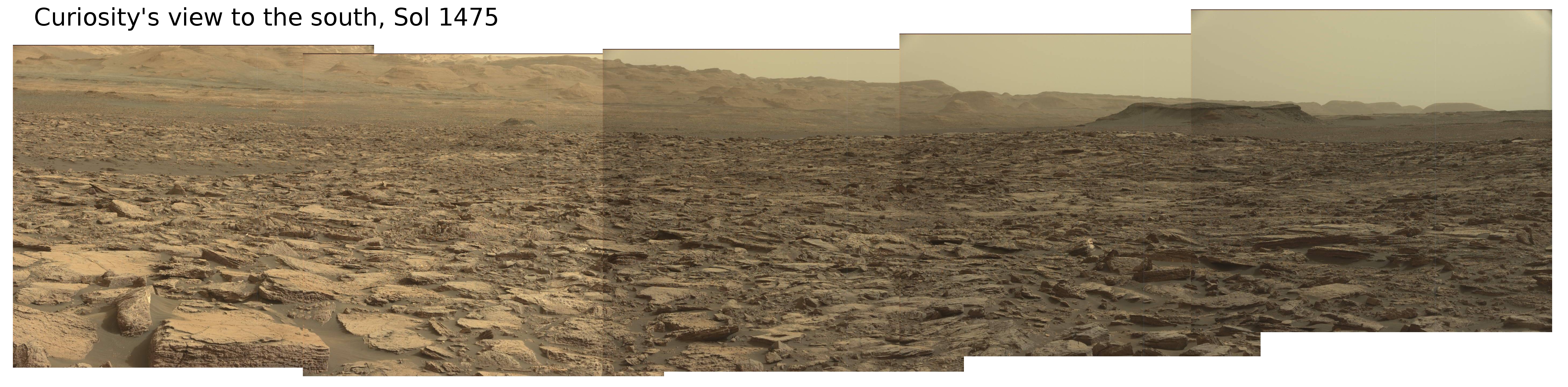
Curiosity looking west, Sol 1475

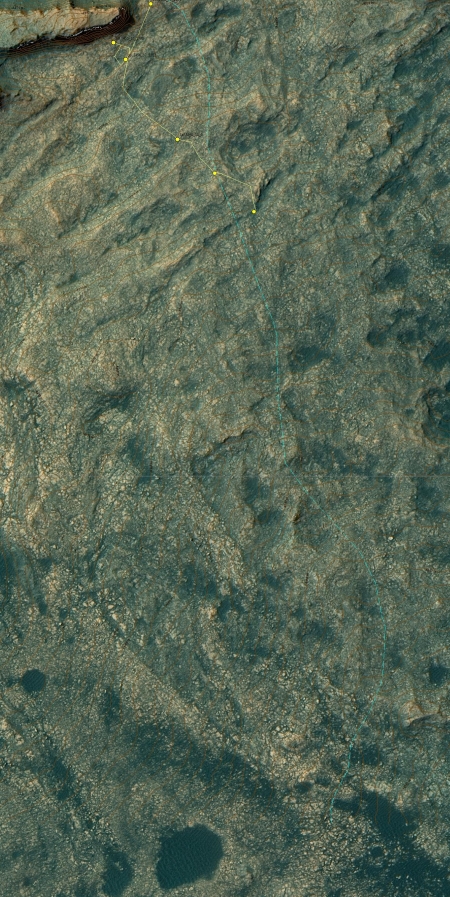
Having moved south from Murray Buttes, the Curiosity science team has decided [see Sol 1473] that they will veer the rover to the southwest a bit, partly to check out some interesting features but also I think as part of a long term plan to find the best route through an area of sand dunes that blocks their path to the more interesting landscape at the base of Mount Sharp. The panorama above, created by me from images taken by the rover’s mast camera on Sol 1475, was taken to scope out this route, and is indicated below the fold in the overview released earlier this week by the rover science team and annotated by me to indicate the direction of this panorama as well as the rover’s present location. (Be sure to click on the panorama above to see it at full resolution.)
» Read more

4 comments

Predicting the next Martian global dust storm

Scientists think they now have a method to predict the next global-wide dust storm on Mars, and based on this theory they predict it will happen very soon.

Global dust storms on Mars could soon become more predictable — which would be a boon for future astronauts there — if the next one follows a pattern suggested by those in the past. A published prediction, based on this pattern, points to Mars experiencing a global dust storm in the next few months. “Mars will reach the midpoint of its current dust storm season on October 29th of this year. Based on the historical pattern we found, we believe it is very likely that a global dust storm will begin within a few weeks or months of this date,” James Shirley, a planetary scientist at NASA’s Jet Propulsion Laboratory, Pasadena, California.

This is most interesting because my next rover update, later today or tomorrow, is going to note the increasingly dusty atmosphere in Gale Crater. It isn’t a global dust storm, but maybe it is indicative of one that is about to happen.

5 comments

Curiosity moves on

The Curiosity science team today put out press release summarizing what they have accomplished at Murray Buttes and what they hope to do next.

For those who have been reading my weekly rover updates on Behind the Black, most of this release will be old news. However, the release did provide the following interesting geological information that supplements what I have been reporting:

This latest drill site — the 14th for Curiosity — is in a geological layer about 600 feet (180 meters) thick, called the Murray formation. Curiosity has climbed nearly half of this formation’s thickness so far and found it consists primarily of mudstone, formed from mud that accumulated at the bottom of ancient lakes. The findings indicate that the lake environment was enduring, not fleeting. For roughly the first half of the new two-year mission extension, the rover team anticipates investigating the upper half of the Murray formation. “We will see whether that record of lakes continues further,” Vasavada said. “The more vertical thickness we see, the longer the lakes were present, and the longer habitable conditions existed here. Did the ancient environment change over time? Will the type of evidence we’ve found so far transition to something else?”

The “Hematite Unit” and “Clay Unit” above the Murray formation were identified from Mars orbiter observations before Curiosity’s landing. Information about their composition, from the Compact Reconnaissance Imaging Spectrometer aboard NASA’s Mars Reconnaissance Orbiter, made them high priorities as destinations for the rover mission. Both hematite and clay typically form in wet environments.

It also appears that the problems they had while doing the last drill hole were related to the electrical design flaw of Curiosity’s drill. It caused a short circuit this time, which is worrisome based on what I understand because this design flaw has the capability of shorting out the rover’s entire electrical system, ending the mission.

I will post a new rover update later this week, once I get back from Illinois.

0 comments

Mars rover update: Sept 27, 2016

Curiosity

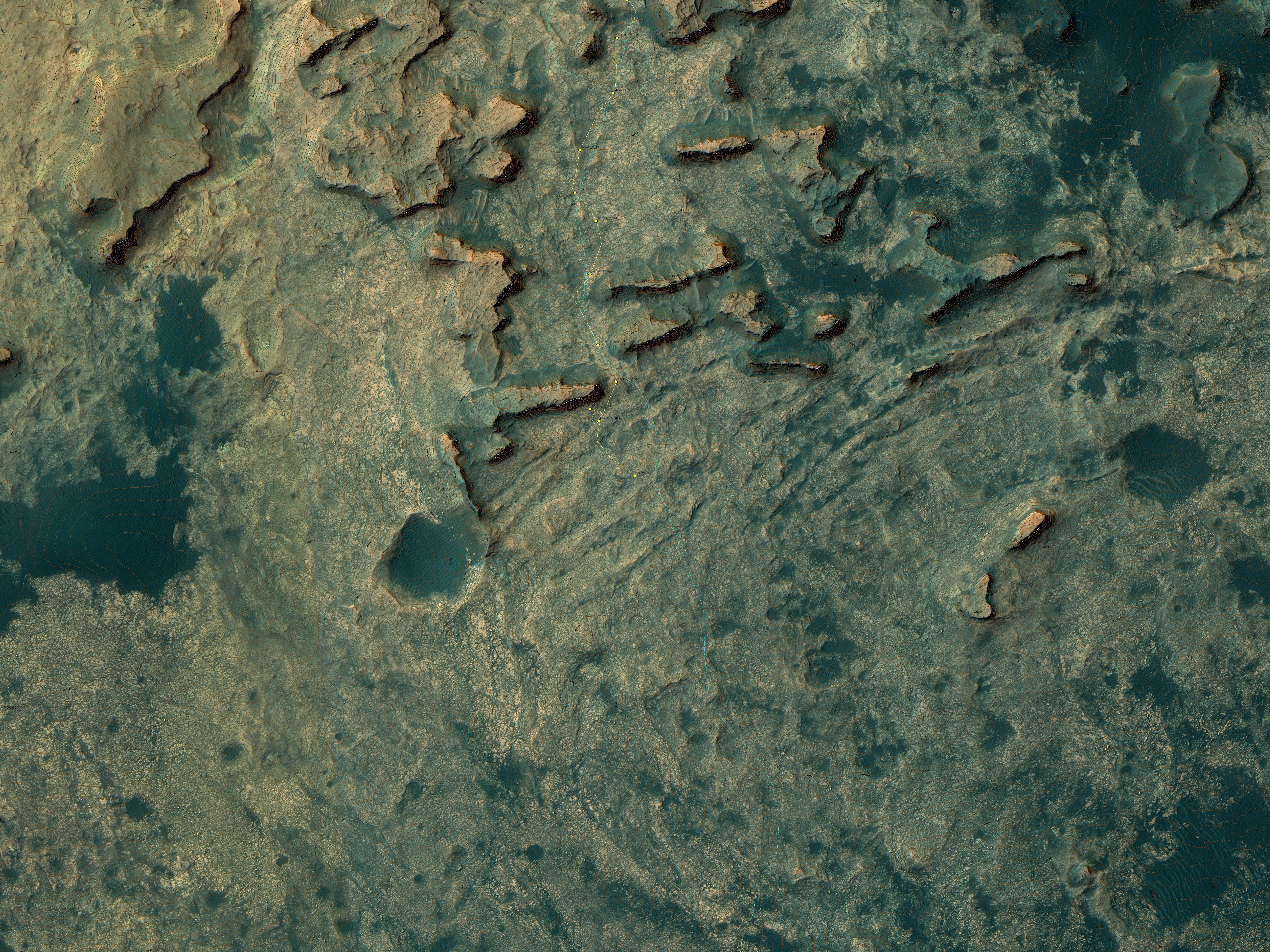
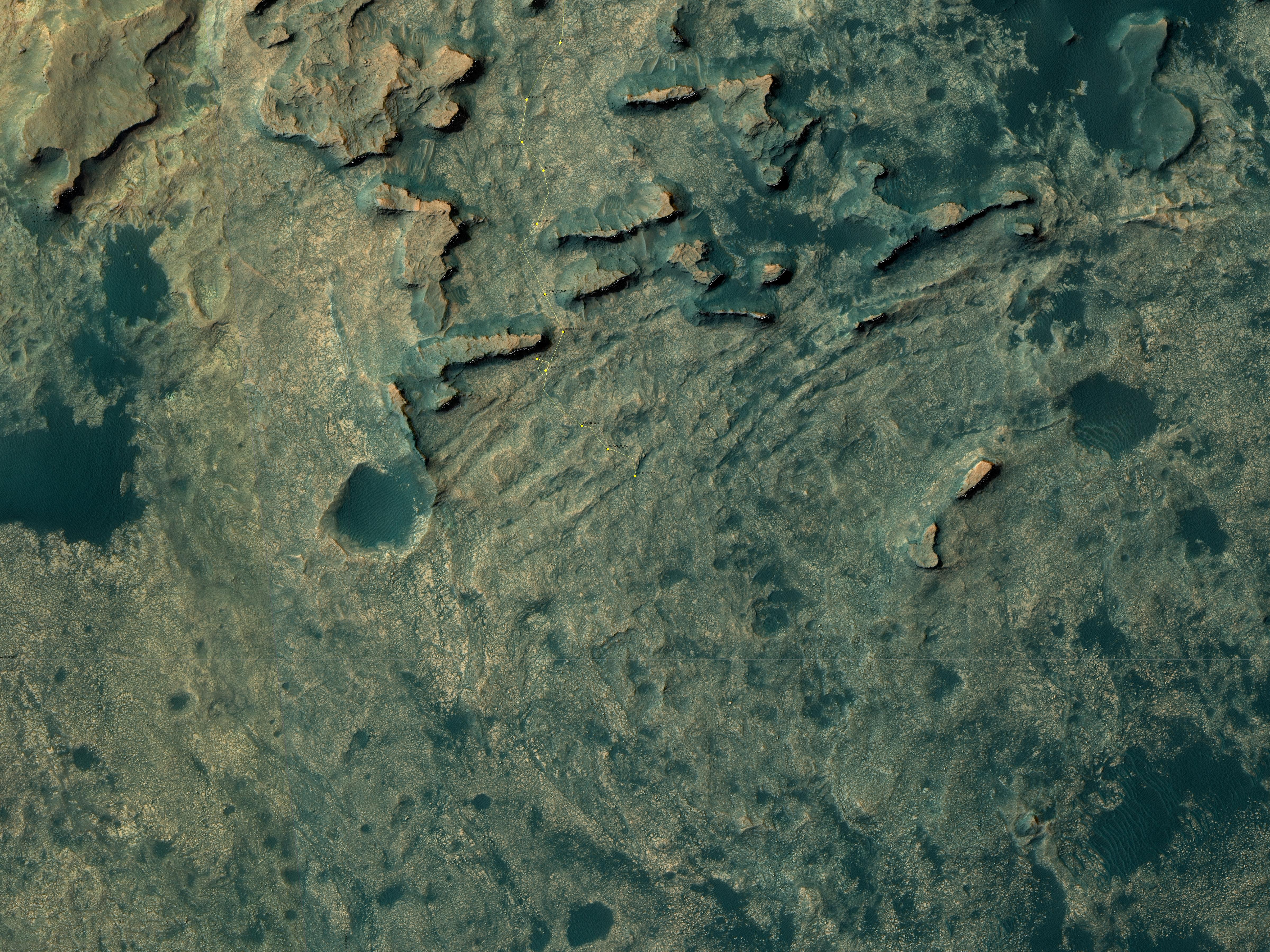
Curiosity traverse map, Sol 1471

For the overall context of Curiosity’s travels, see this post, Pinpointing Curiosity’s location in Gale Crater.

In the past week Curiosity finally left Murray Buttes and began moving south towards Mount Sharp, and, for at least one day, I thought tracking the rover’s movements might become easier. Early in the week the science team published an updated overhead traverse map that not only showed the topographical elevation contour lines for the surrounding terrain, but also included a blue line roughly indicating the rover’s future route. For reasons I do not understand, however, they only did this for one day, and then went back to the un-annotated traverse maps they had been using previously. I have therefore revised the most recent traverse map, shown on the right, to include these contour lines as well as the planned future route. The contour lines are hard to read on the full image, but below the fold on the right is a zoomed in view of Curiosity’s position as it left Murray Buttes, which shows the rover’s elevation at about 4376 meters below the peak of Mount Sharp. This means the rover has gained about 1,150 meters, or about 3,775 feet, since its landing, but only 50 meters or about 150 feet since March of this year. It is still not on the mountain but in the low foothills at its base.
» Read more

0 comments

An ancient volcanic mountain chain on Mars

Using data from Mars Odyssey scientists have determined that a mountain chain on Mars was likely created as a chain of volcanoes.

They analyzed the geography and mineralogy of this area they termed Greater Thaumasia, which is about the size of North America. They also studied the chemistry of this area based on Gamma Ray Spectrometer data collected by the Mars Odyssey Orbiter, which was launched in 2001. What they found was the mountain ridge that outlines Greater Thaumasia was most likely created by a chain of volcanoes.

Their research also looked to see if water influenced the mountains’ formation and found no evidence for it. The mountain chain itself is south of the giant Valles Marineris canyons and southeast of the Tharsis region where Mars’ biggest four volcanoes are located.

0 comments

Mars’ weird windblown surface

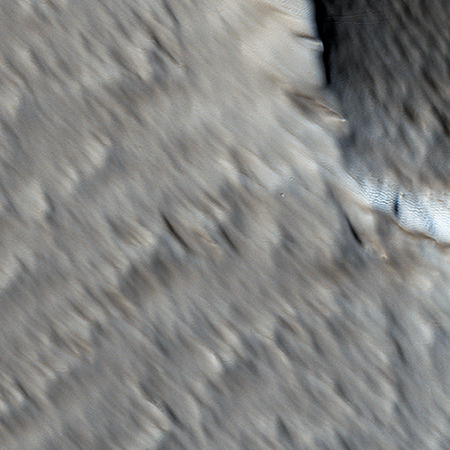
Wind scoured Martian surface

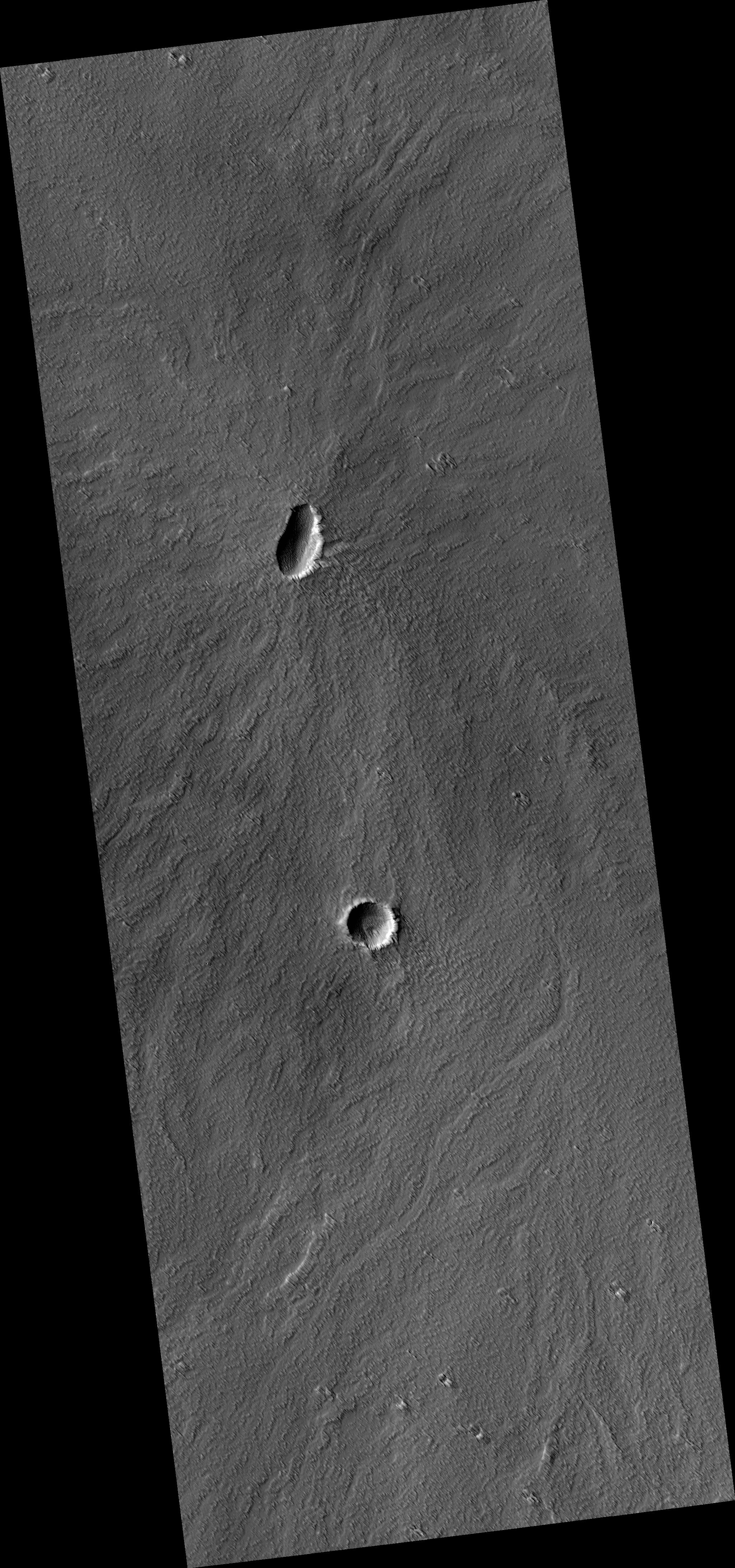
Cool image time! The image on the right, taken by Mars Reconnaissance Orbiter (MRO) and cropped from a wider view of a small crater and a small volcano caldera, certainly appears blurred and out of focus. Is MRO malfunctioning?

Nope. The blurring is actually an optical illusion caused almost entirely by our own assumptions of what a planet surface should look like combined with the alien processes occurring on Mars that have no equivalent here on Earth.

Below the fold is a wider view from the full image, showing the area of the cropped image to the right as well as the entire crater. Below that is another full resolution inset, this time showing the features on the crater rim that are sharp and stand out clearly. The blurriness of the rest of the image is not because the image is out-of-focus, but because a steady northwest-to- southeast wind has distorted everything in the same direction.
» Read more

3 comments

An avalanche pile on Mars

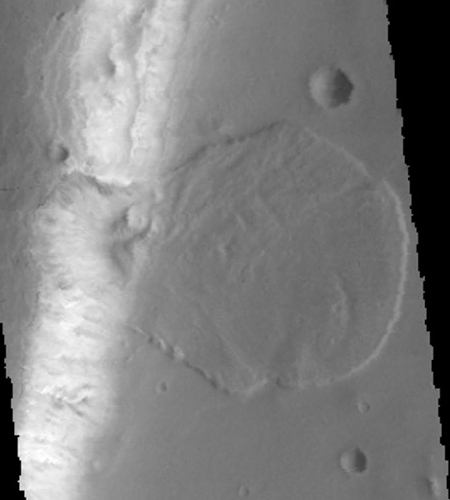
Avalanche pile on Mars

Cool image time! The Mars Odyssey science team has released this very interesting image, cropped on the right, of an avalanche debris pile formed when the large section of cliff on the left broke off and collapsed into the valley below. The valley is called Tiu Valles and is located close to Mars’ equator.

The wide spread of the debris is an indication of several things. For one, it illustrates the light Martian gravity, which allowed the debris to flow much farther than it would have on Earth.

For another, the spread of the debris pile suggests to me that the material that fell was very crumbly. It might have been able to hold together as a cliff for a long time, but when it collapsed the material broke apart almost like sand. Think of a sand castle you might have built as a kid on the beach. With a little moisture you can pack the sand to form solid shapes, but if your shape breaks apart the sand falls not as large blocks but as crumbly soft and loose sand. That is what appears to have happened here.

There is also the suggestion to me that water might have been involved somehow in this collapse. I am not a geologist so this speculation on my part is very unreliable. However, the shape of the debris pile suggests a liquid flow. The flow itself wasn’t liquid, but liquid might have somehow been involved in causing this geological event. We would need a geologist however to clarify these guesses on my part.

3 comments
1 166 167 168 169 170 212