Fossilized rivers on Mars

The uncertainty of science: Using high resolution images from Mars Reconnaissance Orbiter scientists have identified more than 10,000 miles of fossilized rivers on Mars.

The new study examined images covering an area roughly the size of Brazil at a much higher resolution than was previously possible – six metres per pixel compared to 100 metres per pixel. While a few valleys were identified, the team revealed the existence of many systems of fossilised riverbeds which are visible as inverted channels spread across the Arabia Terra plain.

The inverted channels are similar to those found elsewhere on Mars and Earth. They are made of sand and gravel deposited by a river and when the river becomes dry, the channels are left upstanding as the surrounding material erodes. On Earth, inverted channels often occur in dry, desert environments like Oman, Egypt, or Utah, where erosion rates are low – in most other environments, the channels are worn away before they can become inverted. “The networks of inverted channels in Arabia Terra are about 30m high and up to 1–2km wide, so we think they are probably the remains of giant rivers that flowed billions of years ago. Arabia Terra was essentially one massive flood plain bordering the highlands and lowlands of Mars. We think the rivers were active 3.9–3.7 billion years ago, but gradually dried up before being rapidly buried and protected for billions of years, potentially preserving any ancient biological material that might have been present,” added Joel Davis.

These geological forms are different than most of the more well-known Martian channels in that they are not channels but meandering riverlike ridges, higher than the surrounding terrain. Arabia Terra, where they are located, is a transition region in the northern mid-latitudes between Mars’s southern highlands and its northern flat plains, where some believe an ocean once existed.
2 comments

China unveils its 2020 Mars lander/rover

The competition heats up: China today released design concepts of its planned 2020 Mars lander and rover.

According to Ye Peijian, one of China’s leading aerospace experts and a consultant to the program, the 2020 mission will be launched on a Long March-5 carrier rocket from the Wenchang space launch center in south China’s Hainan province. The lander will separate from the orbiter at the end of a journey of around seven months and touch down in a low latitude area in the northern hemisphere of Mars where the rover will explore the surface.

If they succeed they will have definitely moved ahead of Russia in the ranks of space-faring nations.

0 comments

Mars’ wet streaks might not be wet

The uncertainty of science: An analysis of five years of data from Mars Odyssey suggests that the dark streaks flowing down Martian slopes might contain very little and possibly no water at all.

This year, planetary scientists Christopher Edwards and Sylvain Piqueux took a closer look at the feature using a thermal imaging instrument on board Mars Odyssey, another orbiter. They found no temperature differences between the dark RSL streaks and surrounding terrain — which suggests that the streaks aren’t really patches of wet sand streaming down a slope. At best, they say, the RSLs could contain no more than 3 percent liquid water — making them more like mildly damp, slightly salty dirt. And that’s an optimistic interpretation, Edwards said; it’s possible the RSLs contain no water at all. “Why this process is happening in this area, or what is causing this darkening, I don’t think is exactly obvious at this point,” he continued. “But to say it’s flowing liquid water, I don’t think it’s the whole story. It’s not necessarily even the right story.”

This data once again illustrates why we must be very careful with our conclusions when looking at features on an alien world that seem to resemble things we are familiar with here on Earth. Just because they might look alike is not evidence that they are the same. Mars has a very different gravitational field (one-third of Earth’s) and a significantly different make-up. We might be witnessing processes we’ve never seen before that produce features that mimic Earthlike forms.

2 comments

Beyond Murray Buttes

Panorama ahead for Curiosity, Sol 1438

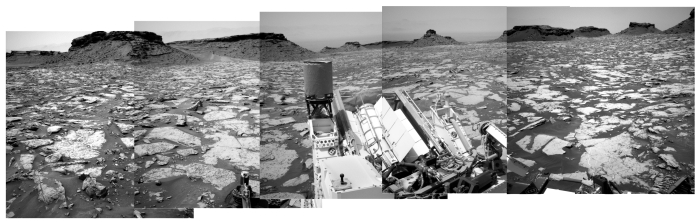
Time for a Curiosity update. Above is a panorama I’ve created from raw images released today from the rover’s left navigation camera of the mesa filled terrain within which Curiosity now sits. Since my last update they have traveled about 200 feet south, moving away from the mesa with the balanced rock

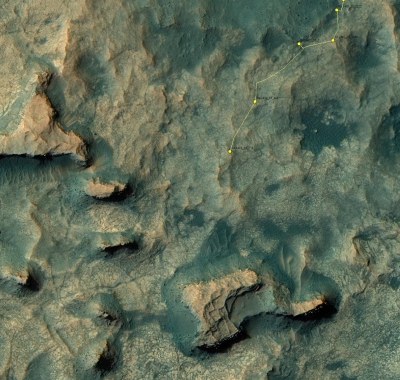
Below the fold is a Mars Reconnaissance Orbiter image with Curiosity’s path indicated. I have marked the balanced rock with an X, and have indicated with the yellow lines the area covered by the panorama above.

They appear to be aiming due south for the narrow gap between the long ridge-like mesas. This will bring Curiosity out into the open and sloping terrain that can be seen in the distance in the last image of my last update. I suspect they want to get a closer look at those parallel grooves, even if it means the journey will be a little rougher.
» Read more

6 comments

Murray Buttes panorama by Curiosity released

The Curiosity science team has released a full panorama taken by Curiosity of Murray Buttes prior to its journey through them.

The reason I am not posting this new panorama here on Behind the Black is because I had already posted an almost identical panorama more than a week ago, and my assembled panorama used higher resolution images from Curiosity and was not partly obscured by Curiosity itself. Moreover, I provided better context for that panorama, placing it within Curiosity’s overall travels, something NASA in today’s press release fails to do.

So, if you want to see the best cool images from space and see them sooner than everyone else, why bother reading NASA press releases? Read Behind the Black instead! :)

4 comments

An isolated dune on Mars

Isolated dune on Mars

Close-up of Dune

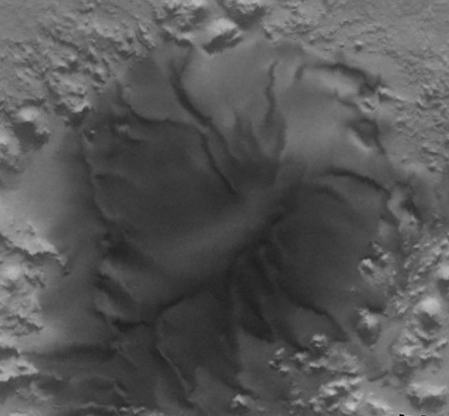
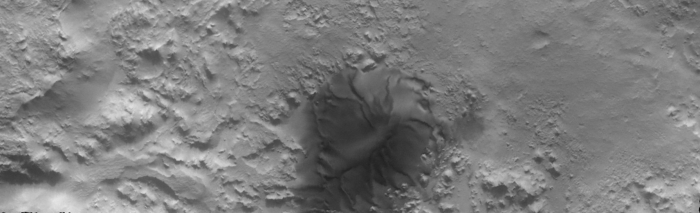
Cool image time! The image above, cropped and rotated to post it here, shows a single isolated large dune inside an unnamed crater on Mars. The image was taken by Mars Odyssey on June 5. To the right is a close-up of the dune itself. Its isolated nature as well as the darkness of its sand in comparison with the surrounding territory has probably got some planetary scientists scratching their heads. Furthermore, the darker streaks that appear to flow down the dune are quite intriguing. Were they formed by briny seep water, as has been found with other seasonal dark slope streaks? Or are they evidence of sand avalanches?

I imagine that there will be an effort to monitor this dune over time, to see if it changes.

4 comments

Balanced Rock at last

Balanced rock close-up

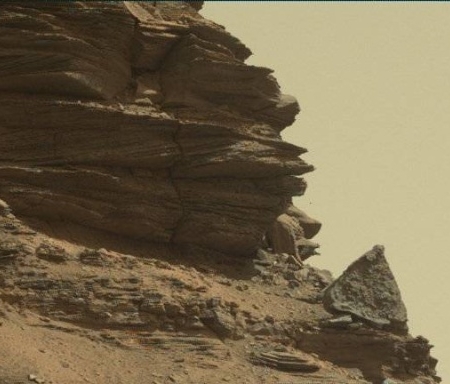
My pessimistic prediction that Curiosity’s science team would take the least risky route and thus not pass close to the butte with the balanced rock has fortunately turned out to be very wrong! They have moved Curiosity into the closest gap to get the best views of both the balanced rock as well as the butte behind it. The image on the right, cropped, was taken by the rover’s mast camera as Curiosity entered the gap between the buttes. It shows clearly that balanced rock broke off from the layers above and landed on its side.

The image below the fold shows the same butte after Curiosity had passed the balanced rock (inside red box).
» Read more

1 comment

Curiosity prepares to move on

Route through Murray Buttes

After several days of drilling, the Curiosity science team is preparing to move forward. As one member of the team notes,

After a short drive we’ll acquire images for context and targeting. Overnight, Curiosity will complete a SAM electrical baseline test to monitor instrument health. Based on some of the recent Mastcam images that we’ve acquired…, the view ahead should be quite scenic as we drive through the Murray Buttes!

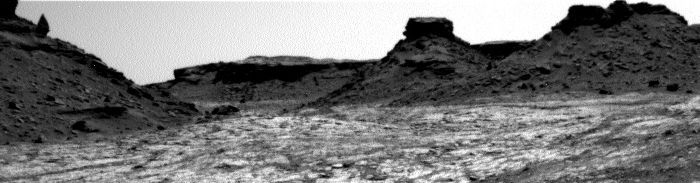
The image above is a close-up of those Buttes, showing Balanced Rock on the left, taken from one of three raw left navigation images. The image below is a panorama I have created from those navigation images, with an inset box to show the location of the above picture.
» Read more

5 comments

Wind erosion on Mars

Wind erosion on Mars

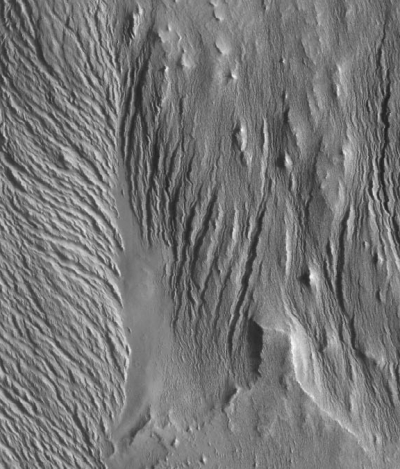
Cool image time! The image on the right, cropped to show here, was taken by Mars Odyssey. While the features shown appear at first glance to have been formed by water, they have instead in etched by wind.

The narrow ridge/valley system seen in this image are a feature called yardangs. Yardangs form when unidirectional winds blow across poorly cemented materials. Multiple yardang directions can indicate changes in regional wind regimes.

The release does not say what direction the wind was blowing, but if I had to guess, I’d say from south to north.

1 comment

New evidence suggest lake once existed in Gale Crater

Scientists have concluded that mineral veins seen by Curiosity in Gale Crater were created when a lake existed there.

The study suggests that the veins formed as the sediments from the ancient lake were buried, heated to about 50 degrees Celsius and corroded. Professor John Bridges from the University of Leicester Department of Physics and Astronomy said: “The taste of this Martian groundwater would be rather unpleasant, with about 20 times the content of sulphate and sodium than bottled mineral water for instance!”

3 comments

Martian gullies not formed by water flow

The uncertainty of science: Spectroscopy of many of the gullies on Mars strongly suggests that water had nothing to do with their formation, even though these gullies resemble closely similar gullies on Earth that were carved by flowing water..

Color coding in light blue corresponds to surface composition of unaltered mafic material, of volcanic origin. Mafic material from the crater rim is carved and transported downslope along the gully channels. No hydrated minerals are observed within the gullies, in the data from CRISM, indicating limited interaction or no interaction of the mafic material with liquid water. These findings and related observations at about 100 other gully sites on Mars suggest that a mechanism not requiring liquid water may be responsible for carving these gullies on Mars. (Gullies on Mars are a different type of feature than seasonal dark streaks called recurring slope lineae or RSL; water in the form of hydrated salt has been identified at RSL sites.) [emphasis mine]

In other words, these gullies were formed by flowing lava, not water. Considering Mars’s lower gravity, one third that of Earth’s, we should not be surprised if lava is capable of doing things there that it is not generally capable of doing on Earth. In fact, we should remind ourselves constantly that Mars is an alien planet, and that conditions there are different enough to make any predictions based on our knowledge of Earth very unreliable.

More details here.

5 comments

Heading directly for Balanced Rock

Curiosity's course to Balanced Rock

As I predicted Sunday, the Curiosity science team is aiming the rover directly towards the gap in the mesas, dubbed the Murray Buttes, that also has the balanced rock seen in earlier images.

The image on the right shows the rover’s most recent two traverses, superimposed on a Mars Reconnaissance Orbiter image. I have cropped it to focus in on the area of most interest.

Based on the rover’s general rate of travel, I would expect them to enter the gap after about two or three more traverses. This means they will be there in about a week, since after each traverse they usually stop and do science and reconnaissance before resuming travel.

7 comments
1 168 169 170 171 172 212