Mars Express has found more evidence that Mars once had oceans.

Mars Express has found more evidence that Mars once had oceans.

Two oceans have been proposed: 4 billion years ago, when warmer conditions prevailed, and also 3 billion years ago when subsurface ice melted following a large impact, creating outflow channels that drained the water into areas of low elevation.

“MARSIS penetrates deep into the ground, revealing the first 60–80 metres of the planet’s subsurface,” says Wlodek Kofman, leader of the radar team at IPAG. “Throughout all of this depth, we see the evidence for sedimentary material and ice.” The sediments revealed by MARSIS are areas of low radar reflectivity. Such sediments are typically low-density granular materials that have been eroded away by water and carried to their final destination.

This later ocean would however have been temporary. Within a million years or less, Dr Mouginot estimates, the water would have either frozen back in place and been preserved underground again, or turned into vapour and lifted gradually into the atmosphere. “I don’t think it could have stayed as an ocean long enough for life to form.”

0 comments

Phobos-Grunt due to crash to Earth anytime in the next ten hours

path of Phobos-Grunt's reentry

Updated and bumped. An updated prediction from Aerospace now calls for Phobos-Grunt to come down sometime between 9 and 3 pm (Eastern). This puts the U.S. now out of danger, though Europe, South America, Africa, Australia, and the southern half of Asia all remain in the spacecraft’s path.

Watch your heads! Phobos-Grunt is due to crash to Earth anytime in the next ten hours. And unfortunately, this new prediction has it flying over both North America and much of Europe and Africa during that time period.

0 comments

A fitting memorial

Greeley Haven

Opportunity has settled into its winter haven.

NASA’s Mars Exploration Rover Opportunity will spend the next few months during the coldest part of Martian winter at Greeley Haven, an outcrop of rock on Mars recently named informally to honor Ronald Greeley, Arizona State University Regents’ professor of planetary geology, who died October 27, 2011.

I met and interviewed Greeley a number of times in writing articles for magazines like Sky & Telescope and Astronomy. For years he was a central figure in the field of planetary geology, and his life effort is one of the prime reasons the United States has dominated this field for most of the past half century, with a fleet of planetary missions presently at Mercury, Mars, Jupiter, Saturn, and Pluto, with many more to come.

The article notes that the International Astronomical Union (IAU) has the job of naming objects in space, and could take years to honor Greeley. I say that if these scientists, the true explorers of Mars, want to name something for him, then they should go ahead, and future generations should honor that choice, regardless of what the IAU says.

0 comments

What is this stuff?

What is this stuff?

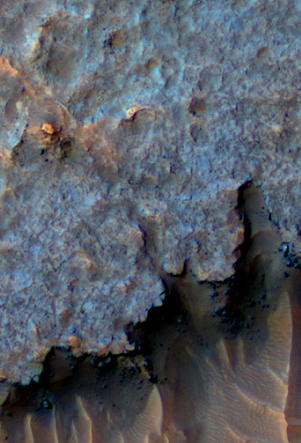
The uncertainty of science: In this week’s release of images from Mars Reconnaissance Orbiter, the science team posted the image on the right and asked, “What is this stuff?”

Here’s a hypothetical geologic history that might explain this scene: layered sediments were deposited by water or airfall (including volcanic pyroclastics). A crudely polygonal patterned ground was created by stresses in the sediments, and groundwater followed the fractures and deposited minerals that cemented the sediments. This was followed by perhaps billions of years of erosion by the wind, leaving the cemented fractures as high-standing ridges.

Of course, this story is almost certainly incomplete if not totally wrong.

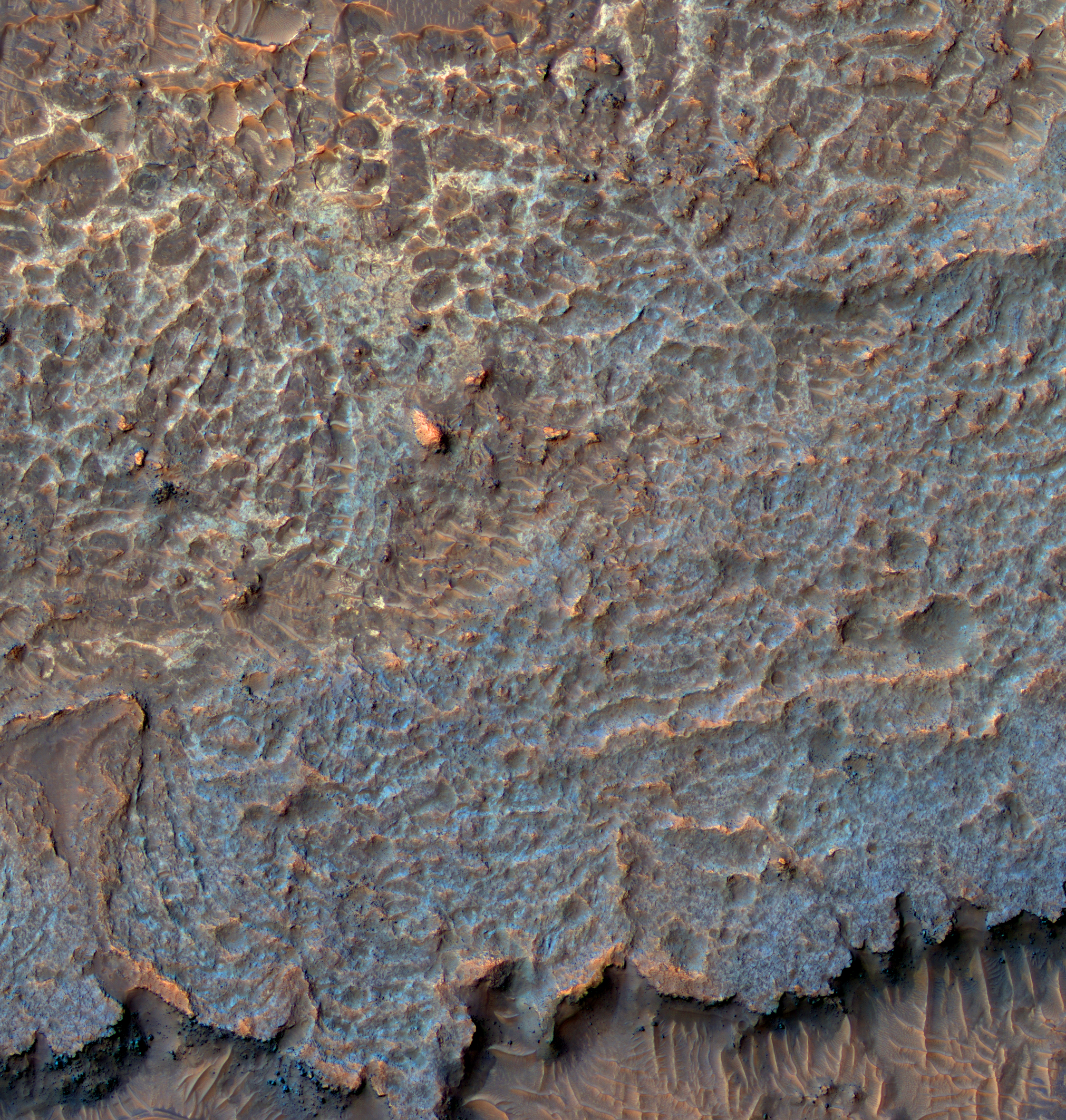
Click here to see the close-up subimage from which I cropped the image on the right.

0 comments

Scientists have found microbes inside a lava tube that can thrive in the freezing cold and low oxygen environment of Mars.

Scientists have found microbes inside a lava tube that can thrive in the freezing cold and low oxygen environment of Mars.

In a laboratory setting at room temperature and with normal oxygen levels, the scientists demonstrated that the microbes can consume organic material (sugar). But when the researchers removed the organic material, reduced the temperature to near-freezing, and lowered the oxygen levels, the microbes began to use the iron within olivine – a common silicate material found in volcanic rocks on Earth and on Mars – as its energy source.

0 comments

A big sideways slip on Mars

Mars Reconnaissance Orbiter today released an image of a really spectacular transform fault on Mars, a spot where the ground cracked and two sections moved sideways to each other. In this case, the sideways movement was about 300 feet. The image is posted below the fold.

Compare that with the Japanese magnitude 9 earthquake on March 11, which only shifted the seabed sideways 165 feet while raising it 33 feet. The quake that moved these two pieces of Martian bedrock sideways must have been quite a ride.
» Read more

1 comment

On the way to its winter haven, Opportunity found more evidence of water on Mars

On the way to its winter haven, Opportunity found more evidence of liquid water that once flowed on Mars, specifically a geological vein that they think might be gypsum.

The vein examined most closely by Opportunity is about the width of a human thumb (0.4 to 0.8 inch, or 1 to 2 centimeters), 16 to 20 inches (40 to 50 centimeters) long, and protrudes slightly higher than the bedrock on either side of it. Observations by the durable rover reveal this vein and others like it within an apron surrounding a segment of the rim of Endeavour Crater. None like it were seen in the 20 miles (33 kilometers) of crater-pocked plains that Opportunity explored for 90 months before it reached Endeavour, nor in the higher ground of the rim.

According to what project scientist Steve Squyres said at a press conference today at the AGU meeting, “This is the single most significant piece of evidence that liquid water once flowed on Mars.”

0 comments

Mountains and buried ice on Mars

Mountains and buried ice on Mars.

New images from the high-resolution stereo camera on ESA’s Mars Express orbiter allow a closer inspection [of the Phlegra Montes mountain range] and show that almost every mountain is surrounded by β€˜lobate debris aprons’ – curved features typically observed around plateaus and mountains at these latitudes. Previous studies have shown that this material appears to have moved down the mountain slopes over time, and looks similar to the debris found covering glaciers here on Earth.

0 comments
1 200 201 202 203 204 212