America’s first foreign war on “the shores of Tripoli” has apparently never ended
I have just finished two books that very nicely recount America’s first foreign war in the first decade of the 1800s, following its independence from Great Britain. The war was President Thomas Jefferson’s effort to stop the piracy of American ships by the three Islamic nations on the north coast of Africa — Algeria, Tunis, and Tripoli (now in Libya) — then called the Barbary coast.
These Arab nations had for decades made it policy to hold all Mediterranean shipping hostage, demanding tribute from everyone or else they would attack ships, steal their goods, and either enslave their crew and passengers or hold them for ransom. The European nations paid, endlessly, rather than fight. The U.S. initially paid, but by 1800 and the election of Jefferson as president, it was tired of paying — especially because the payments were never enough to stop the raiding, nor were they enough to free those already captured and enslaved. When the ruler of Tripoli declared war against the U.S., Jefferson was glad to oblige.
The war that followed was the first in which American troops fought on foreign soil and planted the American flag in victory. It was also the first in which joint operations by American naval and land forces led to that victory. And finally, it was the first battle for the U.S. Marines, thus establishing firmly that branch of the military.
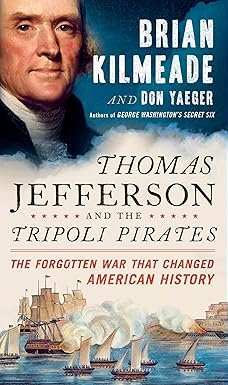
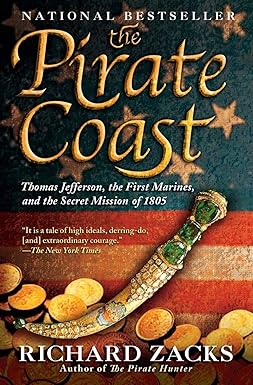
The two books to the right tell this story most effectively, but in very different ways.
First there is The Pirate Coast: Thomas Jefferson, the first Marines, and the secret mission of 1805 by Richard Zacks. Published in 2005, it is a very rich and well-researched work, while being remarkably readable because it tells the story from the point of view of the individuals involved. There is much triumph and tragedy in this story, and Zacks captures both.
Then we have Thomas Jefferson and the Tripoli Pirates, written by Brian Kilmeade and Don Yaeger and published ten years later in 2015. Unlike Zacks’ book, it does not delve as deeply into the lives of the many players, Instead, it is a fast-reading short but very thorough overview of this war.
Both books are worth reading, though The Pirate Coast is the better history. I strongly recommend you read both, however, beginning with the Kilmeade/Yaeger book.
» Read more