Weird crater on Moon

Strange Ryder Crater on the Moon
Click for full image.

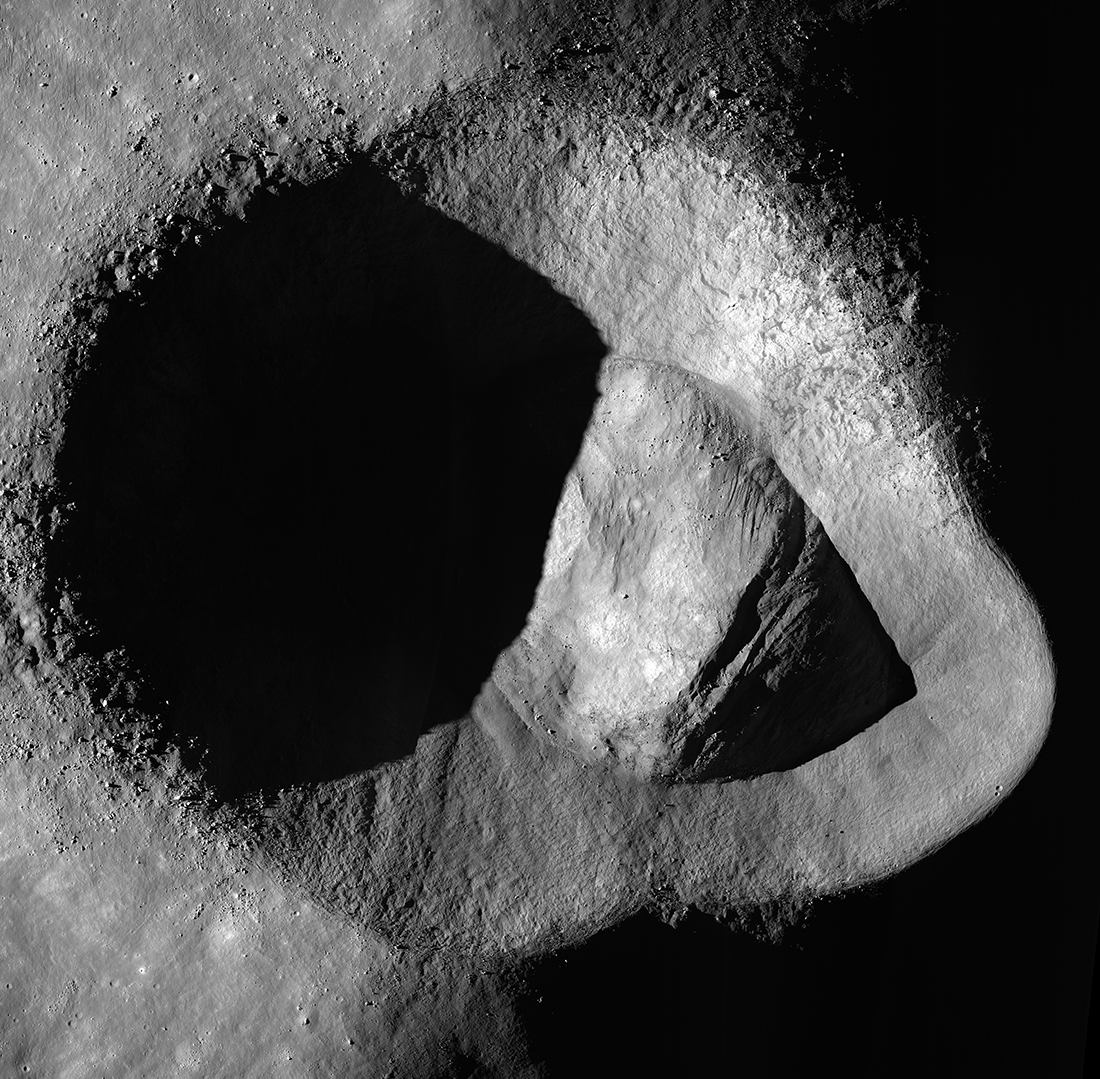
The photo to the right, released today by the science team of Lunar Reconnaissance Orbiter (LRO), takes a overhead view of the unusual crater dubbed Ryder (named after lunar scientist Graham Ryder).

The crater is located on the Moon’s far side, on the edge of the South Pole-Aitken Basin, the Moon’s largest and possibly oldest impact basin. What makes Ryder Crater intriguing is its strange shape, as well as its interior north-south interior ridge.

This crater was featured previously in 2012 in a spectacular oblique image looking east across the crater. Then, the scientists theorized its strange shape was caused by two factors, first that the impact was oblique, and second that it occurred on a steep slope.

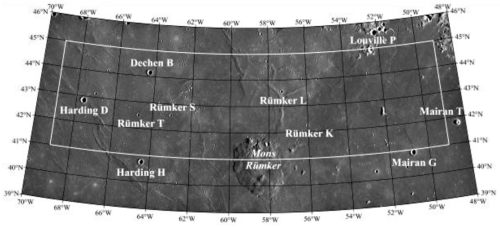
Today’s release adds another factor that might explain the interior ridge. The context map below makes that explanation obvious.
» Read more

Chang’e-4 and Yutu-2 awake for 23rd lunar day on far side of the Moon

The new colonial movement: China’s Chang’e-4 lander and Yutu-2 rover have both been reactivated for their 23rd lunar day on far side of the Moon.

Yutu 2 is set to continue its journey northwest from the landing site and will target a roughly 12-inch (30 centimeters) rock on the rim of a nearby crater for analysis with a spectrometer. The rover has used that instrument to analyze a range of specimens in Von Kármán crater, notably causing a stir when it discovered an impact melt breccia initially described as “gel-like.”

It is the hope of the Chinese scientists that this rock will be ejected material from that crater and will have come from the lunar interior.

Also, though you need to read Chinese to understand how to access it, the project has released to the public another batch of data from both spacecraft.

A lunar landslide

Landslide on the Moon
Click for full image.

Cool image time! The image to the right was posted by the Lunar Reconnaissance Orbiter (LRO) science team on October 9, 2020, and shows a spectacular landslide almost a mile and a half long that had occurred on the interior rim of a crater on the Moon.

The top of the rim is on the left, with the landslide breaking out onto the floor of the crater on the right.

The walls of Kepler crater (30 kilometer diameter) exhibit numerous landslides. In this example, a landslide of dark material begins about 100 meters below the rim from a narrow box canyon. The box canyon is about 50 meters wide and 300 meters long. Overall, the slide is extends some 2300 meters (from the end of the canyon to its base). The base of the slide is on a fault block that lies some 1800 meters below the rim. The wall slope is about 33 degrees.

This slide is actually composed of a series of narrow landslides 20-30 meters wide. Along most of the slope, the individual slides overrun each other forming a band of debris up to about 180 meters wide. At the base of the slope, the individual slides can be recognized as they move apart forming a fan of material. A few individual isolated slides also occur adjacent to the main mass. The overlapping nature of these small slides indicate that the overall feature may have formed over a period of time, rather than all at once.

From above and at this resolution, the landslide looks almost like frozen flowing liquid. It allso looks like it began with a scattering of boulders breaking free at the top all at once that quickly consolidated into a single massive avalanche.

At the link you can zoom in or out to look at the entire image, at full resolution.

A donut on the Moon

A donut crater on the Moon
Click for full image.

In this case the donut is a crater dubbed Bell E Crater, with a second concentric rim in its interior. The photo to the right, reduced to post here, was taken by Lunar Reconnaissance Orbiter (LRO) as part of its high resolution survey of the entire Moon. As noted at the first link:

Craters not only vary in shape but also in complexity. There are simple craters and complex craters with ring structures and mountains at the center. Somewhere in between is Bell E, a small crater located within the larger Bell crater. These donut-shaped formations are commonly known as concentric craters. Many questions remain on the origin of donut craters. While there have been several ideas about their origin, including double impacts, the currently favored hypotheses involve volcanic processes and compositional variations.

The article outlines four hypotheses for explaining this crater’s formation, a perfectly aligned double impact, ripples at impact into thick warm lava, layers of different densities, and later volcanic activity. None do a good job of explaining all of the concentric craters found on the Moon, and thus suggest that these craters might have formed from some combination of more than one theory.

UAE leader confirms goal to land rover on Moon by ’24

The new colonial movement: The ruler of the United Arab Emirates (UAE) has confirmed the initiation of a project to land a rover on the Moon by 2024, and have it built entirely by UAE engineers.

The Emirates Lunar Mission will be a 100 percent Emirati-built lunar rover that will land on the moon by 2024, according to a series of tweets by Sheikh Mohammed bin Rashid Al Maktoum, the UAE Prime Minister and Vice President and Ruler of Dubai.

The lunar rover has been named “Rashid” in honour of Sheikh Rashid bin Saeed Al Maktoum who ruled Dubai for 32 years from 1958 until his death in 1990 and who “sparked” the emirate’s advancement.

This is an ambitious goal, but not completely unreasonable. Their engineers were closely involved in the construction of their Hope Mars orbiter, mostly built by U.S. universities and subcontractors. That knowledge can now be applied to their own spacecraft. I also suspect that their 2016 agreement with India to invest billions there in exchange for space-related engineering assistance included technical information about India’s own lunar rover missions.

German instrument on Chang’e-4 documents dangerous radiation levels

This result is not a surprise: A German instrument on China’s Chang’e-4 lander, located now on the Moon’s far side, has measured the radiation levels there, and found them to be much worse than found on Earth.

DLR radiation physicist Thomas Berger from the DLR Institute of Aerospace Medicine, who participated in the publication explains: “The radiation exposure we measured is a good indication of the radiation inside a spacesuit. The measurements give us an equivalent dose rate – the biologically weighted radiation dose per unit of time – of around 60 microsieverts per hour. For comparison, during a long-haul flight from Frankfurt to New York, the dose rate is five to 10 times lower than this. On Earth’s surface, it is some 200 times lower. In other words, a long-term stay on the Moon will expose astronauts’ bodies to high doses of radiation.”

“Human bodies are simply not made to be exposed to space radiation,” adds Robert Wimmer-Schweingruber of the Christian-Albrecht University (CAU) in Kiel, whose team developed and built the LND instrument . “On longer missions to the Moon, astronauts will have to protect themselves from it – by covering their habitat with a thick layer of lunar rock, for example. This could reduce the risk of cancer and other illnesses caused by long periods of time spent on the Moon.”

Previous instruments had only measured the cumulative radiation for the entire mission. This instrument took multiple readings lasting one, ten, or sixty minutes, which gives a more realistic measure of what an astronaut would actually experience, once there.

New Shepard test flight set for tomorrow

Capitalism in space: Blue Origin has scheduled a New Shepard test flight set for tomorrow morning at 10 am (Central), the first test flight in ten months.

This will be the seventh flight of this particular New Shepard spacecraft, the thirteenth overall for the program.

In March the company’s CEO had promised three flights by the end of 2020, with the last manned. The press release above howeveronly mentions that tomorrow’s test flight is the first of two, both now emphasizing how they will be flying payloads testing technology for lunar landings. No mention is made of a later manned mission.

It seems increasingly that Blue Origin is abandoning its suborbital space tourism business. If not, they sure don’t seem very enthusiastic about it any longer. Instead, they appear to be hyping New Shepard as a testbed for their effort to develop the manned lunar lander for NASA.

That same March update from the CEO had also said they would be initiating commercial production of their BE-4 rocket engine this year. All we have had so far is delivery of one testbed engine — not flightworthy — to ULA. ULA soon revealed there are problems with the engine.

All in all, Blue Origin is becoming less and less impressive, as time passes. Their suborbital tourism project appears to be abandoned. Their rocket engine has problems. And their New Glenn orbital rocket appears stalled.

All they have right now is their development contract with NASA to build a manned lunar lander, and in that case Blue Origin is only a minor player, even if the company is listed as the lead contractor. Their big partners (Lockheed Martin, Northrop Grumman, and Draper) will build the bulk of the lander, should NASA finally get the project financed by Congress.

The company’s failure to deliver so far is a true shame, as the company has ample finances, backed by Jeff Bezos’ billions.

NASA lays out Artemis budget and plan to get astronauts to Moon

In a obvious lobbying effort to get Congress to fund the Trump administration’s Artemis project to land humans on the Moon by 2024, NASA yesterday released a new updated plan and budget for the program.

More here.

The document [pdf] outlines the specific plans for each of the first three Artemis flights, with the first unmanned, the second manned and designed to fly around the Moon, and the third to land a man and a woman on the Moon. Overall the plan is budgeted at about $28 billion, with $3.2 billion needed immediately to fund construction of the lunar lander. From the second link:

Bridenstine said he remains optimistic Congress will fully fund lander development because of what he described as broad bipartisan support for the Artemis program. He said he’s hopeful an expected continuing resolution that would freeze NASA’s budget at last year’s spending levels will be resolved in an “omnibus” spending bill before Christmas or, if the CR is extended, by early spring. “It is critically important that we get that $3.2 billion,” he said. “And I think that if we can have that done before Christmas, we’re still on track for a 2024 moon landing. … If we go beyond March, and we still don’t have the human landing system funded, it becomes increasingly more difficult.”

And what happens then?

“It’s really simple. If Congress doesn’t fund the moon landing program, then it won’t be achieved (in 2024), I mean it’s really that simple,” Bridenstine said. But he quickly added: “I want to be clear, if they push the funding off, our goal will be to get to the moon at the earliest possible opportunity.”

I remain doubtful the present Congress, with the House controlled by the Democrats, will fund this 2024 lunar landing. Since 2016 the entire political platform of the Democratic Party has been “oppose anything Trump.” They will not fund this project if it means he will get this landing during his second term.

If however Trump loses in November, the lame duck Congress might then go ahead and fund it before December, since the landing in 2024 will then occur during the Biden presidency.

Technically the plan reveals that NASA is trying to accelerate the development of the rendezvous and docking software for Orion. During the second flight, the first manned, the crew will do proximity maneuvers with the upper stage of the rocket. Under previous management NASA had not included this ability, as they had not planned to have Orion do any rendezvouses or dockings. That lack makes it impossible for Orion to fly on any other rocket but SLS. This change means the Trump administration recognizes this is a problem, and wants to fix it, especially because they also recognize that SLS is a poor long term option for future lunar missions.

First manned Artemis Moon mission might not go to south pole

In order to meet the Trump administration’s 2024 deadline for the first Artemis manned lunar landing, NASA is now considering sending that first mission to an equatorial target, rather than the Moon’s south pole.

The Artemis program landing site issue came up at two separate events with agency leaders this week, beginning with NASA Administrator Jim Bridenstine’s comments to open a digital meeting held by a NASA advisory group called the Lunar Exploration Analysis Group, on Monday (Sept. 14).

“For the first mission, Artemis 3, our objective is to get to the south pole,” Bridenstine said. “But … it would not surprise me if, for example, if we made a determination that the south pole might be out of reach for Artemis 3, which I’m not saying it is or isn’t,” interest in the Apollo sites may win out.

The engineering to get to the polar regions is more challenging, so rather than delay that first mission they are considering simplifying it instead.

The fact remains that Congress has still not funded any Artemis missions beyond the first unmanned and first manned flights, neither of which will land on the Moon. Whether that money will ever be forthcoming really depends entirely on the November election, as well as the success or failure of the upcoming full-up static fire engine test of the SLS first stage.

Dynetics’ manned lunar lander requires multiple launches and in-space refueling

According to company officials, the manned lunar lander being developed by Dynetics — one of three under NASA contract — will require three quick ULA Vulcan launches and in-space refueling before it will be capable of landing humans on the Moon.

Dynetics’ proposed Human Landing System (HLS) depends upon fuel depots and multiple rocket launches to achieve NASA’s goal of landing two astronauts on the moon in 2024, officials said during a webinar earlier this week. “Our lander is unique in that we need lunar fueling to accomplish our mission. In the next couple years, we will take in-space cryogenic propellant refueling technologies from the lab to [technology readiness level] 10 and operational,” said Kathy Laurini, payloads and commercialization lead for Dynetics’ HLS program.

The lander would launch on one Vulcan rocket, with the next two launches bringing the additional fuel.

More details here.

While it is good that this design does not require the long delayed and likely not-ready SLS rocket, it appears to require in-space capabilities that will not be ready by 2024, the Trump administration’s target date for its manned lunar landing. Instead, this design seems more aimed at subsequent operations in later years.

Since Congress has not yet funded the 2024 mission, though both parties seem interested in later manned lunar operations, this design seems cleverly aimed at that reality, designed to encourage long term government funding.

Regardless, everything hangs on the November elections, and who ends up in charge, both in the White House and in Congress. We presently have really have no way of predicting what will happen, until we know those election results.

NASA to buy lunar mined material from private companies

Capitalism in space: NASA yesterday announced that, rather than develop its own lunar sample missions, it wants to buy such lunar mined material obtained from private companies.

NASA on Thursday launched an effort to pay companies to mine resources on the moon, announcing it would buy from them rocks, dirt and other lunar materials as the U.S. space agency seeks to spur private extraction of coveted off-world resources for its use.

NASA Administrator Jim Bridenstine wrote in a blog post accompanying the announcement that the plans would not violate a 1967 treaty that holds that celestial bodies and space are exempt from national claims of ownership.

The initiative, targeting companies that plan to send robots to mine lunar resources, is part of NASA’s goal of setting what Bridenstine called “norms of behavior” in space and allowing private mining on the moon in ways that could help sustain future astronaut missions. NASA said it views the mined resources as the property of the company, and the materials would become “the sole property of NASA” after purchase.

This announcement continues NASA’s transition under the Trump administration from trying to run everything to simply being a customer buying what it needs and wants from the private sector. The idea is smart, as it will guarantee that these samples will be obtained in the cheapest and fastest way possible, while simultaneously sparking the development of a competitive and thriving private industry capable of flying all kinds of planetary missions. The lower costs of these private planetary probes will in turn will spark the creation of a new private sector of customers buying those probes for their own profit-centered needs.

The mystery of rust on the Moon

Link here. The data shows that there is rust on the Moon, in an environment lacking oxygen and water that should make it impossible for it to form.

Yet the rust is there, in the form of hematite, and in fact the data from India’s first lunar orbiter, Chandrayaan-1, has found that the Moon’s nearside has much more of it. To explain how it got there the scientists have come up with a complex hypothesis, first requiring the Moon to be shielded from the Sun’s solar wind by the Earth’s magnetic field for part of its orbit, then having that magnet field transport oxygen from the Earth’s upper atmosphere to the Moon.

This oxygen then reacts with the tiny amount of water that some scientists believe Chandrayaan-1 detected scattered in the Moon’s regolith, the equivalent of its topsoil. The result, according to this hypothesis, is that over time that oxygen and water reacted with the surface iron on the Moon’s nearside, facing the Earth, causing it to rust.

The explanation is elegant, and fits the known facts (though the presence of that water in the lunar regolith remains unconfirmed). It is also complex, which should raise doubts. Regardless, the nearside of the Moon appears to have more hematite than the farside, and the formation of that iron oxide remains baffling.

NASA solicits lunar landers to bid on bringing science instruments to Moon

UPDATE: It appears I misunderstood the nature of this NASA solicitation in my initial post. I have rewritten it to correct it. Hat tip reader Rex Ridenoure.

Capitalism in space: NASA has issued a request from the private companies building unmanned lunar landers to bid on carrying a variety of science instruments to the Moon by ’23.

Initially NASA had indicated it was farming out the design and construction of the lunar landers to private companies, but would have the science instruments designed and built in-house. Since ’19 however NASA has had private companies designing and building these fourteen small science payloads, and is now in the process of determining which private landers will bring them to the Moon.

Though this approach is not very different than past NASA arrangements, what is different is NASA’s public approach. Instead of touting NASA’s part in this work, the agency is touting the work of the private companies.

SpaceX wins launch contract for unmanned lunar lander

Capitalism in space: Masten Space Systems has awarded SpaceX the launch contract for its unmanned lunar lander, being built to carry nine NASA science payloads to the south pole of the Moon.

Launch is tentatively scheduled for late ’22.

NASA will be an anchor customer for the mission but Masten intends to sign up others. “There is a tremendous amount of interest,” he said, including from both the public and private sector, although he didn’t mention any specific potential customers.

Mahoney said the level of customer interest soared after Masten won the CLPS award and had a firm schedule for the mission. “Once the CLPS award was made and we crossed from speculative to having a schedule, the tenor and tone of our conversations have changed dramatically.”

The limiting factor for the lander mission has not been the amount of mass available for payloads, he said, but instead positions on the lander that have views of the surface desired by payloads. “There’s a game of positioning among the various instruments so that they can get the view angles that they need and not interfere,” he said.

However, he said the company isn’t considering major changes in the lander’s design to accommodate payloads. “The design principle is the ‘pickup truck’ that can haul a bunch of different things,” he said. “We’re trying to escape the completely unique, bespoke system that does one job and one mission really well.”

I guarantee that at least one university student-built payload will end up on the lander.

Majestic dunes on Mars

Beautiful dunes on Mars
Click for full image.

Cool image time! The photo to the right, rotated, cropped, and reduced to post here, was taken by the high resolution camera on Mars Reconnaissance Orbiter on May 10, 2020, and shows the dune field inside a large unnamed sixty-mile-wide crater in the highlands of Mars.

Scientists have been using MRO to monitor this site to track both dust devils and dune changes since at least 2009. In 2009 the focus was on the numerous dust devil tracks, and in fact I posted in March 2020 a comparison of an earlier image with a more recent picture, showing how the earlier tracks had vanished in recent pictures, probably wiped clean by the global dust storm in 2018.

This time however I am less interested in the science, which I covered in detail in that previous post, but in the beauty of these dunes. They are large and majestic, and the color strip tells us that they exhibit striking colors of green, gold, and tan. Is there a place on Earth with dunes of such colors? If so, it is rare.

Make sure you click on the image to see the full resolution photograph. It is even more breath-taking.

Criminal investigation begun against former NASA manned program head

The U.S. Attorney’s office for DC has opened a criminal investigation into actions taken by Doug Loverro, the former head of NASA’s manned program, during contract bidding for a NASA lunar lander project.

The grand jury investigation concerns communications between Doug Loverro, then the chief of human spaceflight for NASA, and Jim Chilton, senior vice president of Boeing’s space and launch division. These discussions occurred early this year, during a blackout period when NASA was taking bids to construct a Human Landing System for the Artemis Moon Program. It is not permissible to interfere with a competition for government contracts.

“Mr. Loverro, who wasn’t part of NASA’s official contracting staff, informed Mr.Chilton that the Chicago aerospace giant was about to be eliminated from the competition based on cost and technical evaluations,” the report states, citing unidentified sources. “Within days, Boeing submitted a revised proposal.”

The analysis at the link is excellent. Read it all.

Study: Lava tubes on Mars and the Moon will be gigantic

A new study comparing lava tubes on the Earth with those detected from orbit on Mars and the Moon now suggests that tubes on those other worlds will be many times larger than on Earth.

Researchers found that Martian and lunar tubes are respectively 100 and 1,000 times wider than those on Earth, which typically have a diameter of 10 to 30 meters. Lower gravity and its effect on volcanism explain these outstanding dimensions (with total volumes exceeding 1 billion of cubic meters on the Moon).

Riccardo Pozzobon adds: “Tubes as wide as these can be longer than 40 kilometres, making the Moon an extraordinary target for subsurface exploration and potential settlement in the wide protected and stable environments of lava tubes. The latter are so big they can contain Padua’s entire city centre”.

Moreover, the data suggests their roofs, even at this size, will be very stable because of the lower gravity, making them excellent locations for large human colonies.

The researchers also suggest that there are many intact such lava tubes under the mare regions on the Moon, their existence only hinted at by the rare skylights created due to asteroid impact.

Midnight repost: The real meaning of the Apollo 8 Earthrise image

Tonight’s midnight repost essay, written to celebrate the 50th anniversary in December 2018 of the Apollo 8 mission to the Moon, I think is a fitting finale to my month-long retrospective of past essays from Behind the Black. Unlike many others, which document the culture decline of our once great country, this essay looks hopefully to the grand future of the human race, once we have escaped this prison of Earth and begin to explore and settle the wider universe.

————————
The real meaning of the Apollo 8 Earthrise image

Earthrise, as seen by a space-farer

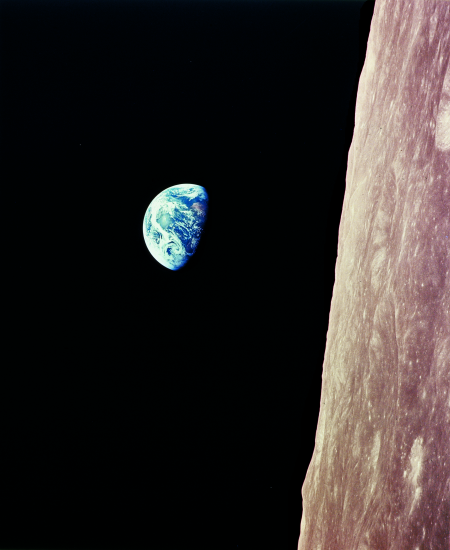
Today is the fiftieth anniversary of the moment when the three astronauts on Apollo 8 witnessed their first Earthrise while in orbit around the Moon, and Bill Anders snapped the picture of that Earthrise that has been been called “the most influential environmental picture ever taken.”

The last few days have seen numerous articles celebrating this iconic image. While all have captured in varying degrees the significance and influence of that picture on human society on Earth, all have failed to depict this image as Bill Anders, the photographer, took it. He did not frame the shot, in his mind, with the horizon on the bottom of the frame, as it has been depicted repeatedly in practically every article about this image, since the day it was published back in 1968.

Instead, Anders saw himself as an spaceman in a capsule orbiting the waist of the Moon. He also saw the Earth as merely another space object, now appearing from behind the waist of that Moon. As a result, he framed the shot with the horizon to the right, with the Earth moving from right to left as it moved out from behind the Moon, as shown on the right.

His perspective was that of a spacefarer, an explorer of the universe that sees the planets around him as objects within that universe in which he floats.
» Read more

Yutu-2 completes 20th lunar day on Moon

The new colonial movement: The Chinese lunar rover Yutu-2 has completed its 20th lunar day on the farside of the Moon, and has now been put in sleep mode for the long lunar night.

Yutu 2 continued on its planned journey to the northwest of the lander, according to the China Lunar Exploration Program (CLEP). The rover covered 90 feet (27.64 meters) during the lunar day to make a total of 1,610 feet (490.9 m) of roving since setting down on the far side of the moon in January 2019.

The article at the link includes some images, including visual data from the ground-piercing radar that suggests at least four layers in the lunar subsurface.

Midnight repost: A flag in the dust

The tenth anniversary retrospective of Behind the Black continues: This essay was posted originally on July 20, 2010, then reposted on July 20, 2011, to celebrate the anniversary of the Apollo 11 landing on the Moon. It seems fitting to post it again, on this, the 51st anniversary of that landing.

————————–
A flag in the dust

Today, July 20th, is the anniversary of the Apollo 11 landing on the Moon, the first time ever that a human being arrived on another planet. Americans love to celebrate this event, as it symbolizes one of the finest moments in our history, when we set out to achieve something truly great and noble and succeeded far better than we could have imagined. Not only did we get to the Moon as promised, over the next three and a half years we sent another five missions, each with increasingly sophisticated equipment, each sent to explore some increasingly alien terrain. Forty-plus years later, no one has come close to matching this achievement, a fact that emphasizes how difficult it was for the United States to accomplish it.

There is one small but very important detail about the Apollo 11 mission, however, that most Americans are unaware of. » Read more

Results from Yutu-2 determine “gel-like” rocks are impact melt

Chinese scientists have now published their analysis of the “gel-like” rocks seen by China’s Yutu-2 lunar rover back in October 2019, and have concluded that they are glasses produced from melt occurring during an impact.

The authors describe the material as a dark greenish and glistening impact melt breccia, measuring 20 inches by 6 inches (52 by 16 centimeters). These features are signs of possible presence of glasses, which are usually sourced from impact melts or from volcanic eruptions.

According to the paper, the breccia — broken fragment of minerals cemented together — was formed by impact-generated welding, cementing and agglutinating of lunar regolith and breccia. The material, they say, resembles lunar impact melt breccia samples returned by NASA’s Apollo missions. In particular, similarities with the Apollo samples designated 15466 and 70019 are noted, a comparison made earlier by lunar scientist Clive Neal at the University of Notre Dame. Sample 70019, collected by astronaut and trained geologist Harrison “Jack” Schmitt, is made of dark, broken fragments of minerals cemented together and black, shiny glass.

The results are not definitive, however. The paper notes that the analysis is limited by the fact that VNIS measurements were taken under bad illumination conditions and other factors.

This conclusion is not surprising, as the rover has been traveling through a region dominated by impact ejecta.

Midnight repost: “We stand for freedom.”

The tenth anniversary retrospective of Behind the Black continues: This essay, portions of which was adapted from the fourth chapter of Genesis: The Story of Apollo 8, was posted originally on May 25, 2011, the fiftieth anniversary of Kennedy’s speech to Congress where he committed the nation to landing a man on the Moon by the end of the decade.

It seems fitting to repost on July 4th, Independence Day.

————————————

Kennedy's speech

“We stand for freedom.”

Fifty years ago today, John Kennedy stood before Congress and the nation and declared that the United States was going to the Moon. Amazingly, though this is by far the most remembered speech Kennedy ever gave, very few people remember why he gave the speech, and what he was actually trying to achieve by making it.

Above all, going to the Moon and exploring space was not his primary goal.
» Read more

A minor rill on the Moon

Kathleen, a rill on the Moon
Click for full image.

Cool image time! The image above, reduced to post here, is a colorized digital terrain model produced from Lunar Reconnaissance Orbiter (LRO) data. On top of the original mosaic of photos the LRO science team has overlaid the elevation data obtained by LRO’s laser altimeter. It shows a tadpole shaped pit dubbed Kathleen, with its tail trailing off to the southeast. As they note:

Kathleen is a pyroclastic vent with a sinuous rille (colloquially known as Rima Mozart [Not IAU confirmed]) that extends from the southeast end of the vent. Rilles are large channels formed by sustained channelized lava flows. This vent is a great location to investigate ancient volcanism on the Moon.

The elevation data reveals one interesting feature: The lowest part of the vent pit is not at its western end, where one would think at first glance, based on the general dip that produced the rill flowing to the east. That the lowest point is at the widest section of the pit instead suggests that this pit no longer looks as it did when it was venting. In the almost four billion years since it is thought all volcanic activity here ceased, there has been plenty of time for the slow erosion processes on the Moon, caused by radiation, micrometeorites, and the solar wind, to partly fill this pit and round out its cliff walls.

The two overview maps below provide some context.
» Read more

Yutu-2 travels 62 feet during 19th lunar day

According to the official Chinese press, Yutu-2 traveled another 62 feet during its 19th lunar day on the far side of the Moon.

I did not get that number from the article, which was written to imply falsely that the rover’s total travel distance since landing (463 meters) was what it did during this single lunar day. To get the real travel distance I took the total from the previously reported total travel distance and figured the difference.

If you want to be educated to the absolutely useless nature of a state-run press, put both links above in separate tabs and compare. You will discover that other than some very minor changes, the new news story is essentially a cut-and-paste of the previous. Which by the way is a cut-and-paste of the last few reports. They don’t even bother to make believe (like the leftist American mainstream media) that they are giving us some information. They simply don’t.

Yutu-2 to resume travels after day of rest

The new colonial movement: After lunar day of no activity, China has reactivated its Yutu-2 rover on its 19th lunar day on the far side of the Moon.

The Yutu 2 rover had remained stationary during lunar day 18 (May 16-29), while teams back on Earth upgraded ground stations in preparation for the Tianwen-1 Mars mission, due to launch in late July or early August. Upgrades to the tracking and command facilities at Jiamusi, northeast China, and Kashi in the northwest were completed June 13 according to CLEP, meaning normal roving service can now resume.

While the rover has been stationary, the Yutu 2 science team have identified a nearby crater for examination. The 4-foot-wide (1.3 meters), 8-inch-deep (20 centimeters) crater contains reflective material which may be similar in nature to suspected impact melt glass the rover discovered last year. After checking out the crater, Yutu 2 will continue its journey northwest from the Chang’e 4 landing site. Yutu 2 has driven a total of 1,469 feet (447.68 meters) since setting down on the far side of the moon in January 2019.

Generally Yutu-2 has averaged about a hundred feet for each lunar day of actual travel.

Astrobotic wins contract to land VIPER rover at Moon’s south pole

Capitalism in space: NASA today awarded the private company Astrobotic a $199 million contract to provide the lander that place place the agency’s VIPER rover down near Moon’s south pole.

The target date for the mission is late 2023, and is intended as a scouting mission for the Artemis manned landing to follow.

During its 100-Earth-day mission, the approximately 1,000-pound VIPER rover will roam several miles and use its four science instruments to sample various soil environments. Versions of its three water-hunting instruments are flying to the Moon on earlier CLPS lander deliveries in 2021 and 2022 to help test their performance on the lunar surface prior to VIPER’s mission. The rover also will have a drill to bore approximately 3 feet into the lunar surface.

The key to this mission continues to be NASA’s shift from building things to hiring others to build them. If Astrobotic is successfully, they will then be positioned to offer their lander design to others, since it belongs to them, not NASA.

A global map of rockfalls on the Moon

A global map of the rockfalls found on the Moon
Click for full resolution image.

A review of more than two million Lunar Reconnaissance Orbiter (LRO) images of the Moon has allowed scientists to compile the first global map of lunar rockfalls.

The map on the right comes from the paper. From the press release:

The result is a map of the lunar surface between 80 degrees northern and southern latitude that shows 136,610 rockfalls with diameters of more than two and a half meters. “For the first time, this map enables us to systematically analyze the occurrence and causes of rockfalls on another celestial body”, says Dr. Urs Mall from MPS.

Previously, scientists had assumed that lunar quakes in particular were responsible for the displacement of boulders. The new global map of rockfalls indicates that impacts from asteroids may play a much more important role. They are apparently – directly or indirectly – responsible for more than 80 percent of all observed rockfalls.

“Most of the rockfalls are found near crater walls,” says Prof. Dr. Simon Loew of ETH Zurich. Some of the boulders are displaced soon after the impact, others much later. The researchers hypothesize that impacts cause a network of cracks that extend in the underlying bedrock. Parts of the surface can thus become unstable even after very long periods of time.

Though the map suggests vaguely that these rockfalls are more scattered on the lunar farside and more concentrated in the mid-latitudes on the nearside, I suspect this is likely not so. If it is however it reveals something about the Moon that needs to be explained.

SpaceX’s first Starship tourist customer accused of tax evasion

Capitalism in space: Yusaku Maezawa, the first person to buy a ticket to fly on SpaceX’s Starship around the Moon, has now been accused in the Japanese press to have evaded $4.6 million in taxes.

The reports, which first appeared in the Yomiuri newspaper, suggested that Mr Maezawa had failed to fully declare the personal use of a corporate jet owned by his asset management firm over a three-year period.

Japan’s national tax agency declined to comment.

Maezawa has vigorously denied the allegations on Twitter.

Russia says it will oppose Artemis Accords

My heart be still: Roscosmos head Dmitri Rogozin declared today that Russia “will not, in any case, accept any attempts to privatize the Moon.”

“It is illegal, it runs counter to international law,” Rogozin pointed out.

The Roscosmos CEO emphasized that Russia would begin the implementation of a lunar program in 2021 by launching the Luna-25 spacecraft to the Moon. Roscosmos intends to launch the Luna-26 spacecraft in 2024. After that, the Luna-27 lander will be sent to the Moon to dig up regolith and carry out research on the lunar surface.

Rogozin is doing the equivalent of a 2-year-old’s temper tantrum. Being a top-down authoritarian culture that likes to centralize power with those in charge, Russia doesn’t like Trump’s effort to regularize private enterprise and private property in space, including the administration’s new requirement that any international partner in its Artemis Moon program must agree to that effort.

Russia would rather we maintain the status quo as defined by the Outer Space Treaty, with no private property in space and everything controlled by UN bureaucrats and regulations, who are in turn controlled by the leaders from authoritarian places like Russia.

If Russia wants into Artemis, however, it looks like they will have to bend to the Trump accords. Or they will have to build their own independent space effort, competing with ours. Their problem is that their own program has been incredibly lame for the past twenty years, unable to get any new spacecraft or interplanetary mission off the ground.

Maybe the competition will help Russia, as it did in space in the 1960s. Or maybe they will simply help Biden get elected, and then all will be well! That brainless puppet will be glad to do the bidding of Russia and China, and will almost certainly dismantle Trump’s policies in favor of private enterprise.

1 17 18 19 20 21 37