Chandrayaan-2 likely delayed to July

The new colonial movement: The launch of India’s first lunar lander/rover, Chandrayaan-2, will likely be delayed again, from May until July.

This further delay is not confirmed by ISRO, India’s space agency. Nor is any clear reason given in the article above to explain this additional delay.

It would not surprise me however. The head of ISRO, K. Sivan, is a trained engineer. He has shown himself to be very willing to impose delays if he has any doubts about the success of the mission.

0 comments

Beresheet’s first pictures of the Moon

Beresheet looks at the Moon

The new colonial movement: The privately built Israeli planetary probe Beresheet, now in lunar orbit, has released its first pictures of the Moon.

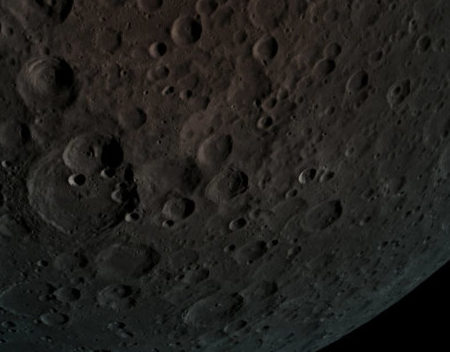
The image on the right is one of those images, cropped to post here, and was taken from about 300 miles altitude. The link has a second image showing the Moon with the Earth in the distance. The resolution of both images is quite impressive.

The landing is scheduled for April 11. Stay tuned!

4 comments

Chandrayaan-2’s new delay is due to damage during test

The new colonial movement: It appears the reason for the new delay in the launch of India’s Chandrayaan-2 lunar lander is that the spacecraft suffered minor damage during a landing test.

A source in the know, said: “The rover and orbiter are in good health and tests met all the parameters. However, after the ‘Lander Drop Test’, we found that Vikram (the lander) needed to be strengthened in its legs. Prima facie, it appears that not all parameters were set correctly before the test, it could also be that the additional mass—a result of the new configuration—caused the problem.”

They still seem determined to launch in May, though I suspect this is not realistic. It depends on exactly when this test occurred. The article does not say, and if it occurred several months ago then the May date might make sense. Otherwise, expect further delays.

0 comments

Beresheet enters lunar orbit

The privately-built lunar lander Beresheet today successfully entered lunar orbit.

They achieved this by completing an engine burn that changed their Earth orbit to an elliptical lunar one.

At 5:18 p.m. Israel time on April 4, the spacecraft’s engine activated for six minutes and reduced its speed by 1,000 km/hour, from 8,500 km/hour to 7,500 km/hour, relative to the moon’s velocity. The maneuver was conducted with full communication between Beresheet’s control room in Israel and the spacecraft, and signals in real time match the correct course. In the coming week, with expected intense engineering activities, many more maneuvers will take Beresheet from an elliptical to a round orbit, at a height of 200 km. from the moon. The maneuvers will aim to reduce the spacecraft’s distance from the moon and reach the optimal point to conduct an autonomic landing in the Sea of Serenity in the evening Israel time, April 11.

You can see a video of their mission control at the completion of this burn here.

0 comments

Beresheet makes course adjustment just prior to entering lunar orbit

Earth as seen by Beresheet

The Israeli privately-funded lunar lander Beresheet yesterday completed a one-minute engine burn to adjust its course slightly in preparation for entering lunar orbit on April 4.

This morning’s 72-second-long burn helped make some “final adjustments” ahead of capture into lunar orbit, mission team members said in an update this morning. It’s unclear if any further such tweaks will be needed. “The teams are assessing the results to determine if another alignment will be required before Beresheet enters the lunar orbit this Thursday,” project team members said.

The image to the right was taken by Beresheet of the Earth during its last close approach on March 31. It appropriately shows the Middle East, with the Arabian peninsula visible just below center.

The landing is still scheduled for April 11.

0 comments

Yutu-2 and Chang’e-4 awake for fourth lunar day

The Chinese rover Yutu-2 and lander Chang’e-4 were awakened on March 30, 2019 to begin work for their fourth lunar day on the surface of the Moon’s far side.

The rover was designed to last for three lunar days, but much like NASA missions that regularly outlive their initial mandates, Yutu 2’s mission may stretch on longer, the Chinese space agency hopes. (The current rover’s predecessor, Yutu, lost its roving ability on its second day on the moon.)

The China Lunar Exploration Program, which heads up the mission, has not provided any details about its scientific plans for the fourth day of Chang’e 4, which is focused on exploring the far side of the moon and how it differs from the near side.

Based on the images taken by Lunar Reconnaissance Orbiter, it appears they will be heading west, following the smoothest route away from Chang’e-4. This will place Yutu-2 in an area of small craters.

0 comments

Yutu-2 heads west!

LRO images of Yutu-2 on the Moon
Click for full image.

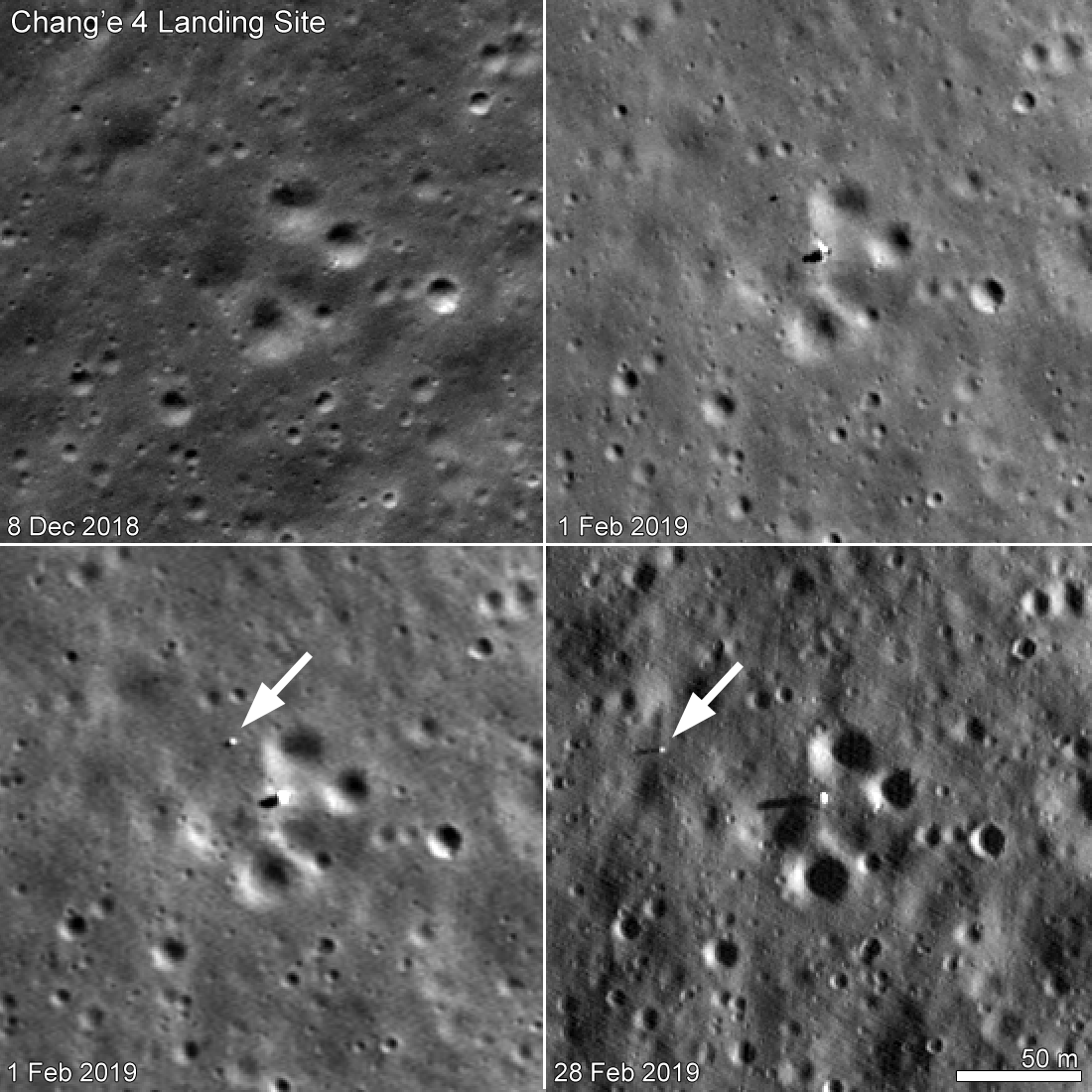
A new image from Lunar Reconnaissance Orbiter (LRO) shows the path taken by the Chinese lunar rover Yutu-2 during its second lunar day of travel on the Moon. The LRO images on the right, cropped and reduced in resolution to show here, compares the rovers position at the start and end of February. The white arrow indicates the rover, with its Chang’e-4 lander visible between the three craters to the east. As noted by the LRO science team:

LRO passes over any given place on the Moon at least once every month (in the daylight), allowing the westward progress of the Yutu-2 rover to be seen. At the end of February, Yutu-2 was 69 meters from it’s home base, the Chang’e 4 lander; LROC images show Yutu-2 made 46 meters of westward progress during the month of February.

It appears from these orbital images that they are taking the smoothest route, with the fewest obstacles, away from the lander.

0 comments

China’s future lunar exploration plans

In a poster presented on Tuesday at this week’s 50th Lunar and Planetary Science Conference in Texas, China outlined its future plans for lunar exploration.

Systematically considering the major scientific issues of the Moon and the lunar in-situ utilization resources, Chinese scientists and technical experts have proposed a vision to preliminarily build a research station on the Moon’s South Pole by implementing 3-4 missions before 2035.

The first mission will carry out a comprehensive exploration in the South Pole of the Moon, including the topography, elemental composition and volatile contents of the Moon, and the information on the structure of the South Pole from shallow to deep levels. Water (ice) in the permanent shadow area was detected in-situ to reveal the content, distribution and source of water and volatiles on the surface of the Moon. After that, a sampling return mission will be arranged to collect samples from the South Pole of the Moon and return them to the Earth. In addition to the scientific exploration of the Moon, the utilization of lunar resources should also be taken into consideration. In later missions, lunar platforms will be used to make astronomical or earth observations and to consider the use of lunar resources. [emphasis mine]

China clearly intends to put its footprints on the Moon. It is not fiddling around with an orbital lunar station, as it looks like we are with NASA’s Gateway project. While China explores the surface, we will be stuck in orbit (maybe).

4 comments

Test drone maps ice cave in Iceland

Engineers have tested a prototype lidar-equipped drone by flying it through a lava tube in Iceland and using it to automatically map the tube.

While a cave-exploring drone on Earth may use propellers, free-flying spacecraft exploring caves on the Moon, where there is practically no atmosphere, or in the thin air of high altitude lava tubes on Mars’ giant volcanoes, would have to use small thrusters. The mission of the terrestrial drone deployed at the Lofthellir Ice Cave focused on validating the idea of using a drone-equipped LiDAR to safely navigate and accurately map rock and ice inside a dark lava tube in the absence of GPS or any prior map.

Under a research contract with NASA, Astrobotic has developed a custom navigation software product, known as AstroNav, to give drones and small free-flying spacecraft the ability to autonomously explore and map subterranean environments. AstroNav employs both stereo vision and LiDAR, works without GPS or previously stored maps, and can operate in real-time while a novel environment is explored at a high rate of speed.

…”The Astrobotic drone and LiDAR performed exactly as we had hoped, and was able to help us map the Lofthellir Lava Tube in 3D within minutes” says Lee. “We now have a highly accurate model of the shape and dimensions of the cave, and of the configuration of its many rocky and icy features, such as rock falls, ice columns, and micro-glaciers.”

The concept is an excellent one, especially for exploring the caves and pits of Mars. This test however only checked out the lidar. A drone that could do this on either Mars or the Moon does not yet exist.

I have posted their video of the flight below the fold.

Note: Thanks to reader Eddie Willers for noting that I mistakenly located this research in Greenland, not Iceland. Post now corrected.
» Read more

3 comments

Chinese lunar rover and lander enter their third lunar night

The Chinese lunar rover Yutu-2 and its lander Chang’e-4 have gone into hibernation as they enter their third lunar night on the far side of the Moon.

According to Chinese news reports, both spacecraft have now exceeded their nominal lifespan.

With all systems and payloads operating well, the Yutu-2 team will continue roving and science data collection on lunar day 4 of the Chang’e-4 mission, according to a [Chinese] announcement.

Yutu-2 added 43 meters to its overall drive distance in its third day of activities, continuing a path to the northwest of the landing site, which was recently named ‘Statio Tianhe’ by the International Astronomical Union. The rover just covered seven meters between waking for lunar day 3 on Feb. 28 and Mar. 3, during which time it navigated carefully toward a 20 centimeter diameter rock in order to analyze the specimen with an infrared and visible light spectrometer to determine its origin.

I am struck by how tentative the Chinese and their rover appear. The first Russian lunar rover, Luna 17, traveled 6.5 miles in eleven months. The second, Luna 21, traveled 23 miles in four months. At the pace Yutu-2 is setting, it will not come close to these mileages. Moreover, my impression of Chinese space technology in the past decade has been that it is quite robust. This tentativeness thus surprises me. Maybe because this is a government project they are simply covering their butts should something go wrong, and thus making believe the rover is more delicate than it really is.

As Scotty on Star Trek once said, “Always under predict, then over perform.” We might be seeing that pattern here.

0 comments

The travels of Moon’s scarce surface water

An analysis of data from one of Lunar Reconnaissance Orbiter’s (LRO) instruments have allowed scientists to map the movements of the scarce water on the lunar surface.

Up until the last decade or so, scientists thought the Moon was arid, with any water existing mainly as pockets of ice in permanently shaded craters near the poles. More recently, scientists have identified surface water in sparse populations of molecules bound to the lunar soil, or regolith. The amount and locations vary based on the time of day. This water is more common at higher latitudes and tends to hop around as the surface heats up.

…Water molecules remain tightly bound to the regolith until surface temperatures peak near lunar noon. Then, molecules thermally desorb and can bounce to a nearby location that is cold enough for the molecule to stick or populate the Moon’s extremely tenuous atmosphere, or “exosphere”, until temperatures drop and the molecules return to the surface.

The quantities we are talking about here are very tiny. This will not be the water that future settlers will depend on. Instead, it will be those pockets of ice in the permanently shaded craters.

2 comments

Beresheet sends back first pictures

The privately-built Israeli lunar lander Beresheet has sent back its first pictures, taken on its way to the moon.

The picture, taken 37,600 km from Earth, shows the Israeli flag and the inscription with “Am Yisrael Hai” (the People of Israel Live) in Hebrew and the inscription “Small Country, Big Dreams” in English. The spacecraft was snapped as it passed over Australia, and the photograph was taken during a very slow rotation by Beresheet. The Israeli spacecraft, built in an IAI factory, is in an elliptical orbit around Earth – its greatest distance from Earth (the apogee) at this stage is some 131,000 kilometers.

While the press wants to trivialize this image by calling it a selfie, it was taken for very important engineering reasons. It demonstrates that the camera and the spacecraft’s pointing systems are working, exactly as planned.

Beresheet will continue to raise the apogee of its orbit until it enters the Moon’s gravitational sphere of influence, when it will then shift into lunar orbit.

0 comments

Beresheet successfully completes engine burn

After a computer issue prevented its last course correction, Beresheet, the Israeli private lunar probe, successfully completed that engine burn yesterday, raising its Earth orbit’s apogee to 81,000 miles, almost a third of the way to the Moon.

The Beresheet team has not explained exactly what went wrong with the computer earlier this week, or what they have done to fix the problem. All they said is that they have figured it out and worked around it.

The next engine burn to raise the orbit further will occur in about a week.

2 comments

Beresheet’s second engine burn stopped by computer reset

It appears that the second engine burn to raise the orbit of Israel’s privately built lunar lander, Beresheet, did not happen as planned because of an unexpected computer reboot.

In a statement Tuesday morning, SpaceIL and Israel Aerospace Industries (IAI) engineers said they were investigating the malfunction, but said that other than a known problem with the navigation system’s star tracker, the Beresheet’s systems were all functioning properly.

The maneuver was scheduled to take place Monday night, as the spacecraft passed near the Earth in an area where the Ramat Gan-based SpaceIL ground crew would not be in direct communication with the craft.

During the pre-maneuver phase, the spacecraft computer reset unexpectedly, and the maneuver was automatically cancelled.

The question that immediately comes to mind: Did they purchase a space-hardened computer? Cosmic rays can wreck havoc on computer memory, causing just this type of unexpected reset, so computers in space need to be much better shielded than on Earth.

2 comments

SpaceX successfully launches three satellites

Capitalism in space: SpaceX tonight used its Falcon 9 rocket, including a first stage that had already flown twice before, to launch an Indonesian communications satellite, an Air Force smallsat, and most importantly, the Israeli-built Beresheet lunar lander, the first planetary mission entirely funded from private sources.

You can get some details about Beresheet here. If all goes as planned, it will land on the Moon on April 11 and operate for two Earth days on the surface.

SpaceX was also able to successfully land that first stage, which I think is the first time they have successfully used and recovered a first stage three times. Look for this first stage to fly a fourth time.

The 2019 launch race:

2 China
2 SpaceX
1 ULA
1 Japan
1 India
1 Europe
1 Russia

The U.S. now leads China in the national rankings, 3-2.

9 comments

NASA selects experiments it wants to put on commercial lunar spacecraft

Capitalism in space: NASA has selected a dozen experiments/instruments it wants to put on private commercial lunar spacecraft, either landers or rovers.

According to the press release, some of these could fly as early as before the end of this year. If so, I suspect they will go on one of the finalists for the Google Lunar X-prize, some of whom are planning to fly this year.

1 comment

New LRO image of Chang’e-4 and Yutu-2

Chang'e-4 and Yutu-2

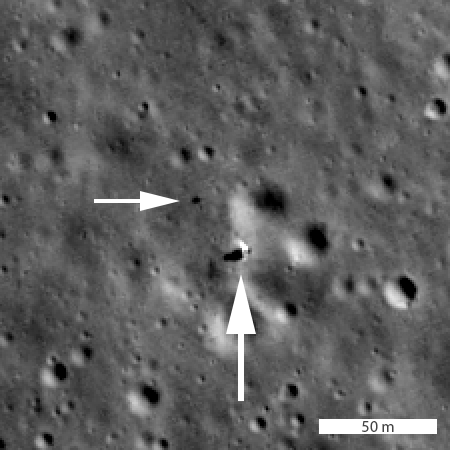
The Lunar Reconnaissance Orbiter (LRO) science team has released its third and best image of the Chinese Chang’e-4 lander and Yutu-2 rover. The image on the right is a full resolution cropped section, with the lander on the bottom and the rover above and to the left.

Just after midnight (UTC) on 1 February 2019 LRO passed nearly overhead the Chang’e 4 landing site. From an altitude of 82 kilometers the LROC Narrow Angle Camera pixel scale was 0.85 meters (33 inches), allowing a sharper view of the lander and Yutu-2 rover. At the time the rover was 29 meters northwest of the lander, but the rover has likely moved since the image was acquired. This view has close to the smallest pixel size possible in the current LRO orbit. In the future however, LROC will continue to image the site as the lighting changes and the rover roves!

These future LRO images will allow us to track Yutu-2 and get an idea of its research, even if the Chinese do not release any information.

0 comments

NASA to put humans on the Moon soon!

Wanna bet? According to NASA officials, the agency is accelerating its manned effort and expects to return to the Moon with humans by 2028 at the latest!

Jim Bridenstine, NASA’s administrator, told reporters Thursday that the agency plans to speed up plans backed by President Donald Trump to return to the moon, using private companies.

“It’s important that we get back to the moon as fast as possible,” said Bridenstine in a meeting at NASA’s Washington headquarters, adding he hoped to have astronauts back there by 2028.

“This time, when we go to the Moon, we’re actually going to stay. We’re not going to leave flags and footprints and then come home to not go back for another 50 years” he said.

Why does this announcement remind me of similar enthusiastic predictions made by Russia’s space agency, Roscosmos, all of which have never come true? In fact, why does Bridenstine’s prediction remind me of many past NASA predictions since the 1980s, all of which either never happened, or happened decades behind schedule and in a manner that was far from grand?

If NASA is the agency to run this program, this prediction will not happen, period. For NASA to get back to the Moon by 2028 would require them to somehow build Gateway (which Bridenstine labels as a key component in this program) while also accelerating the launch schedule of SLS, a rocket NASA has spent fifteen years building that it doesn’t expect to launch for at least two more years, and will not put humans on it until 2024, at the earliest.

Gateway has not even been funded. It provides no way to get to the lunar surface. If it is funded it will cost billions, and likely take as long to build as SLS. SLS itself is expensive, unwieldy, and incapable of providing launch services for such an ambitious program.

Bridenstine’s announcement though did contain a ray of hope. He and his associates made a big deal about how they wish to hire many different private companies to achieve their goals. If the agency gets out of the way and lets free Americans do the job, then maybe it will happen.

We shall see. NASA’s track record when it comes to letting privately-built manned commercial spacecraft do the job is dismal, and that’s being kind.

8 comments
1 36 37 38 39 40 57