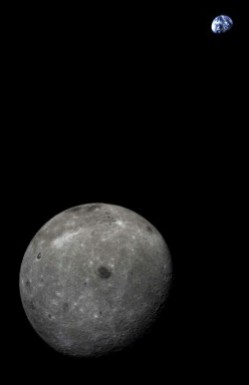
New data confirms and localizes uplifted lunar dust as seen by Apollo astronauts

The uncertainty of science: In a paper released today, scientists reveal the detection of electrostatic dust events on the Moon similar to those observed by Apollo astronauts, and find that these events might not be global but instead confined to craters during twilight. From the abstract:

Lunar horizon glows observed by the Apollo missions suggested a dense dust exosphere near the lunar terminator. But later missions failed to see such a high‐density dust exosphere. Why the Apollo missions could observe so large number of dust grains remains a mystery. For the first time, we report five dust enhancement events observed by the Lunar Dust Experiment on board Lunar Atmosphere and Dust Environment Explorer [LADEE] mission, which happen near a twilight crater with dust densities comparable to the Apollo measurements. Moreover, the dust densities are larger on the downstream side of the crater and favor a higher solar wind temperature, consistent with an electrostatic dust lofting from the negatively charged crater floor. We also check the Apollo observations and find similar twilight craters, suggesting that the so‐called dust exosphere is not a global phenomenon but just a local electrified dust fountain near twilight craters.

The dust clouds the astronauts thought they saw near the horizon have been theorized to be dust uplifted by static electricity. However, all later missions had so far failed to detect this phenomenon, until now. That the result also pinpoints the location and ties it to twilight is important for future missions to the Moon. Astronauts can thus minimize any damage by this dust by shutting down operations during lunar twilight periods.

2 comments

Beresheet-2 will have two landers instead of one

The new colonial movement: SpaceIL, the Israeli non-profit company that built the failed Beresheet-1 lunar lander, yesterday announced its plans to build Beresheet-2, this time with an orbiter and two lunar landers, and launch it by ’24.

The two landers would be much smaller than the first spacecraft — about 260 pounds each, fully fueled, compared with a bit less than 1,300 pounds for Beresheet — and they would land on different parts of the moon. The orbiter would circle the moon for at least a couple of years. The three spacecraft of Beresheet 2 would together weigh about 1,400 pounds.

Even though the designs would be new, they would reuse many aspects of Beresheet, and the founders said they had learned lessons that would increase the chances of success for the second attempt. SpaceIL will again collaborate with Israel Aerospace Industries, a large satellite manufacturer.

SpaceIL is looking for funding from both private and Israeli government sources. It is also looking for funds from other nations, a decision which revealed the most intriguing part of this announcement:

SpaceIL hopes that international partnerships will pay for half of the cost of Beresheet 2. Mr. Damari said the United Arab Emirates, a small but wealthy country in the Persian Gulf that has set up an ambitious space program in recent years, was one of seven nations interested in taking part. He declined to name the other six.

If this flight ends up to be a partnership between Israel and the United Arab Emirates it will send shockwaves through the Arab world, most especially among the supporters of the terrorist leaders ruling the Palestinian territories.

1 comment

Mysterious object in solar orbit identified as upper stage for Surveyor 2

Since August astronomers have been trying to figure out the nature of a mysterious object in solar orbit that did not match their expectations for either a comet or an asteroid. Dubbed 2020 SO, astronomers have now identified it as the upper stage booster used to send the unmanned lunar lander Surveyor 2 towards the Moon in 1966.

Surveyor 2 was a failure when it began tumbling and crashed into the Moon instead of doing a soft landing. Its upper stage meanwhile was sent on a path that would have it miss the Moon and go into orbit around the Sun. That orbit finally brought it back to Earth this year.

2020 SO was captured by Earth’s gravity in November and came within 27,400 miles from Earth on December 1. That’s when Reddy and his colleagues at the IRTF were able to capture the infrared spectrum of another Centaur D rocket booster—this time from a 1971 launch of a communication satellite. When they compared that spectrum to the data gathered about 2020 SO, the spectra matched. 2020 SO is also a Centaur rocket booster, most likely the one used for the Surveyor 2 mission.

2020 SO is now moving away from the Earth and should escape Earth’s gravity within a few months, at which point it will follow a new solar orbit. But astronomers expect it to return to Earth in 2036, and they will be ready to learn even more when it does.

This booster is essentially an early example of space archeology. Someday colonists in space will go and catch it to bring it back to one of their museums on the Moon or Mars, to be studied and admired as a major marker of their own past history.

2 comments

Chang’e-5 ascender sent to crash on Moon

The new colonial movement: Even as the Chang’e-5 orbiter/return capsule awaits its window for leaving lunar orbit, Chinese engineers have separated the ascender capsule that brought the samples from the surface and sent it to crash on the Moon.

This decision makes sense, as lunar orbits tend to be unstable, and to leave the ascender there after the orbiter and return capsule leave could make it a piece of uncontrollable space junk threatening future missions.

The engine burn that will send the orbiter/return capsule back to Earth is expected early December 12th, with the return capsule landing in China on December 16th.

0 comments

Chang’e-5 sample capsule docks with return vehicle in lunar orbit

According to the official Chinese state-run press Chang’e-5’s capsule containing samples from the Moon has successfully rendezvoused and docked with its return vehicle in lunar orbit, the first time an unmanned craft has done such a thing autonomously.

The news report at this point provides no other details, other than to state that the return capsule and orbiter will next separate from the ascent capsule and “wait for the right time to return to Earth.” Earlier reports had suggested an arrival on Earth around December 16, which would suggest an exit from lunar orbit in about a week.

5 comments

LRO snaps picture of Chang’e-5 on Moon

Chang'e-5 on the Moon, taken by LRO
Click for full image.

The science team for Lunar Reconnaissance Orbiter (LRO) late yesterday released an image taken of Chang’e-5 on the surface of the Moon. The image to the right, reduced to post here, is that photo.

China’s Chang’e 5 sample return spacecraft made a safe touchdown on the lunar surface at 10:11 EST (15:11 UTC) 01 December 2020. LRO passed over the site the following day and acquired an off-nadir (13° slew) image showing the lander centered within a triangle of craters.

The LROC team computed the coordinates of the lander to be 43.0576° N, 308.0839°E, –2570 m elevation, with an estimated accuracy of plus-or-minus 20 meters.

If all goes well, the return capsule, which lifted off from the Moon yesterday, will dock with the return vehicle in orbiter later today.

0 comments

Chang’e-5 completes sample collection; lifts off from Moon

UPDATE: The official state-run Chinese press has announced that the ascent capsule with the lunar samples has lifted off from the Moon. The rendezvous and docking is next, which is likely the most difficult technical task for the autonomous unmanned probe. No word yet on when that will occur.

Original post:
——————

The new colonial movement: China’s Chang’e-5 lunar lander has completed its sample collection on the Moon, and is set to lift-off sometime today for a rendezvous and docking with its return vehicle in lunar orbit.

The milestone signaled the start of the mission’s return voyage, which includes an ambitious series of automated maneuvers to blast off from the lunar surface Thursday and rendezvous with an orbiter circling the moon. Chang’e 5 will attempt the first-ever docking between two robotic spacecraft in lunar orbit, then transfer the moon rock container into the return craft.

If all goes according to plan, Chang’e 5’s sample container should re-enter Earth’s atmosphere and parachute to a landing in China’s Inner Mongolia region around Dec. 16.

If successful, this will the ninth spacecraft to bring samples back from the Moon, and the first since the 1970s. It will also firmly establish China as a major space power that is presently competitive to the U.S. and has also bypassed Russia completely. Even though it is likely they stole much of the technology for doing such planetary missions, China’s engineers have done a good job of refining and improving the engineering, as shown by the number of firsts being achieved by this Chang’e-5 mission.

1 comment

First images from Chang’e-5 on the Moon

Panorama of Chang'e-5 landing site
Click for full image.

The new colonial movement: China’s state-run press has now released several images taken by Chang’e-5 on the lunar surface, including movies showing the landing and the ongoing digging operations.

The photo to the right, cropped and reduced to post here, is part of a fisheye panorama of the entire landing site. I have cropped it to show only the central part. Except for the distant mountain, the terrain is very flat, which is not surprising as this is the Ocean of Storms mare.

Note however how deep the landing pad is pressed into the ground. This gives a sense of the dust layer that covers the surface.

The link above, as well as this link, show additional images as well as the two movies.

Take off is next, followed by the autonomous rendezvous and docking in lunar orbit with the craft that will bring the sample capsule back to Earth sometime around December 16.

0 comments

Change’-5 successfully gets sample from drilling

The new colonial movement: According to the state-run Chinese press, Chang’e-5 has successfully obtained its first lunar sample from a 2-meter deep drilled hole.

After making a successful soft landing at 11:00 p.m. BJT on Tuesday, the lander started rolling out its solar panel wings and unlocking some of the payloads onboard to prepare for sample collection.

The lander first drilled a 2-meter-deep hole, digging out soil, and sealed it up at 4:53 a.m. on Wednesday [today]. Next, it will use its robotic arms to scoop up more samples from the lunar surface for backup.

If all goes right, they will collect a second sample from the surface using a scoop, and then the ascent capsule will take off tomorrow. It will then rendezvous and dock with the orbiter and return capsule.

5 comments

LRO looks at Yutu-2

Yutu-2's travels on the Moon through October 2020
Click for full image.

The new colonial movement: The Lunar Reconnaissance Orbiter (LRO) science team today released an update of the travels of China’s Yutu-2 lunar rover, presently operating on the far side of the Moon.

The photo to the right, reduced and annotated to post here, shows the rover’s present position, having traveled about 1,650 feet to the northwest in the 22 months since landing. The goal, according to Yutu-2’s science team, is to get the rover beyond the present ejecta field of debris thrown from a large impact to the north, and reach a basalt covered region about a mile away. At the pace they are setting, about 100 feet per lunar day, it is going to take them about another three years to get there. Whether the rover will last that long is the question, but I suspect they are hopeful, based on the almost two years of operations so far.

If you go to the link you can also see a short movie showing month-by-month where the rover ended up when it shut down for each long lunar night.

0 comments

Chang’e-5 lands on Moon

The new colonial movement: According to official Chinese reports, Chang’e-5 has successfully soft-landed on the Moon in preparation for its gathering of samples to bring back to Earth.

The Chang’e 5 lander began final descent at 09:58 EST (14:58 UTC) with an expected touchdown 15 minutes later at 10:13 EST (15:13 UTC).

All broadcasts of the event were abruptly stopped just before the landing burn was to begin — throwing the mission into question with CCTV in China at first saying landing coverage would resume at 21:00 EST — an 11 hour delay to the landing. Minutes later, official sources — via social media — proclaimed a successful landing.

Blocking a broadcast like this is very typical of totalitarian governments, and totalitarian societies. Think about that the next time Youtube or Google or Facebook or Twitter or an American university silences speech they don’t like.

As for the lander, all other news reports that I have so far found provide no further details. It appears that all we know comes from a single sentence announcement of success from the Chinese press.

5 comments
1 44 45 46 47 48 94