
Update on Chang’e-4 and Yutu-2
Link here. The rover, Yutu-2, has entered a planned safe mode to protect it from the high temperatures of the lunar mid-day, while the lander, Chang’e-4 has been testing and deploying its instruments.
Link here. The rover, Yutu-2, has entered a planned safe mode to protect it from the high temperatures of the lunar mid-day, while the lander, Chang’e-4 has been testing and deploying its instruments.
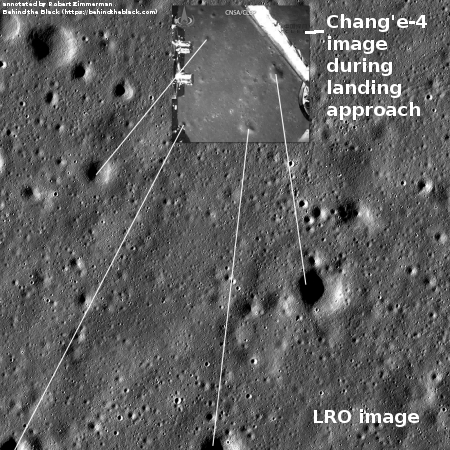
The Lunar Reconnaissance Orbiter (LRO) science team has released a high resolution image from 2010 pinpointing the area on the floor of Von Kármán crater where Chang’e-4 landed. On the right is a reduced and partly annotated version.
They have not actually found the lander/rover, since this image was taken long ago before Chang’e-4 arrived. However, this image, combined with the Chang’e-4 landing approach image, tells us where the lander approximately landed. It also pinpoints where to look for it when LRO is next able to image this region, around the end of January.
By then, Yutu-2 will hopefully have traveled some distance from Chang’e-4, and LRO will be able to spot both on the surface.
The new colonial movement: China’s second lunar rover, Yutu-2, has rolled off of the Chang’e-4 lander and begun its roving.
Yutu will rove within Von Kármán craterand analyse the variations of composition of the lunar surface the Visible and Near-Infrared Imaging Spectrometer (VNIS), while also returning unprecedented images with a panchromatic camera.
The rover’s two offer science payloads, the Lunar Penetrating Radar (LPR) and Advanced Small Analyser for Neutrals (ASAN), the latter developed by the Swedish Institute of Space Physics in Kiruna, will provide insight into the lunar subsurface to a potential depths of hundreds of metres and the space environment and interactions with the surface respectively.
India announced today that it is delaying the January 3, 2019 launch of its second lunar mission, the lander/rover Chandrayaan-2.
They have not announced a new launch date. Nor did they explain the cause of the delay. My suspicion is that K. Sivan, the head of their space agency ISRO, was not happy about some engineering issue, and demanded a review.
Unlike most such administrators, Sivan is an actual engineer who helped design and build India’s two rockets, the PSLV and GSLV. Last year, after the failure of one Indian satellite already in orbit, he recalled another Indian satellite from French Guiana only weeks before launch, had it brought back to India for a careful inspection to make sure it did not have the same problem. The move saved the satellite.
The new colonial movement: China’s Chang’e-4 lander/rover has successfully landed on far side of Moon.
Early reports of a successful landing sparked confusion after state-run media China Daily and CGTN deleted tweets celebrating the mission. China Daily’s tweet said: ‘“China’s Chang’e 4 landed on the moon’s far side, inaugurating a new chapter in mankind’s lunar exploration history.”
Official confirmation of the landing came two hours later via state broadcaster CCTV, which said the lunar explorer had touched down at 10.26am (2.26am GMT). The Communist party-owned Global Times also said the probe had “successfully made the first-ever soft landing” on the far side of the moon.
No reason has been given for the deletion of the tweets, though I suspect they did so because they were simply premature.
Update: More information here, including images.
The new colonial movement: Engineers have adjusted Chang’e-4’s lunar orbit in preparation for landing.on the Moon’s far side.
The probe has entered an elliptical lunar orbit, with the perilune at about 15 km and the apolune at about 100 km, at 8:55 a.m. Beijing Time, said CNSA.
Since the Chang’e-4 entered the lunar orbit on Dec. 12, the ground control center in Beijing has trimmed the probe’s orbit twice and tested the communication link between the probe and the relay satellite Queqiao, or Magpie Bridge, which is operating in the halo orbit around the second Lagrangian (L2) point of the earth-moon system.
The space engineers also checked the imaging instruments and ranging detectors on the probe to prepare for the landing.
They need to time the landing so that it comes down in the Moon’s early morning. This will not only provide better visuals, with shadows to see surface details, but more importantly will give them 14 Earth days before sunset to get settled on the surface and initiate rover operations.
The new colonial movement: Chang’e-4 has successfully established a communications link with its Queqiao relay satellite.
This success puts China one step closer to its January attempt to soft land Chang’e-4’s lander on the far side of the Moon. Once on the surface, Chang’e-4 must be able to communicate with Queqiao in order to relay data to Earth.
The new colonial movement: After five days travel Chang’e-4 successfully entered lunar orbit yesterday.
They will attempt a landing in early January, after assessing the situation and waiting for daylight to arrive at the landing site.
Link here. Lots of nice information, including the fact that Chang’e-3 seems to still be functioning in a limited manner, and that Chang’e-4 is depending not on solar panels but a radioactive thermal electric system, similar I think to the RPGs that NASA uses on its deep space missions. (I am uncertain however about this, based on looking at the video at the link, which seems to show solar panels on Chang’e-4. They could be instead panels to protect the spacecraft from the sun’s heat.)
They enter lunar orbit on December 12, and will likely land in the first week of January.
Using its Long March 3B rocket, China on December 7 successfully launched its Chang’e-4 rover/lander, aimed at being the first probe to land on the Moon’s far side.
It will take the probe five days to reach the Moon and land.
The same day China also launched two Earth observation satellites for Saudi Arabia, using its Long March 2D rocket.
The leaders in the 2018 launch standings:
35 China
20 SpaceX
13 Russia
10 Europe (Arianespace)
China has widened its lead over the U.S. 35 to 32 in the national rankings. China also looks like it is going to come close to meeting its prediction of 40 launches for 2018.
NASA today announced that it has committed $2.6 billion over the next ten years to buy delivery services to the Moon for its unmanned scientific missions, provided from nine different private companies.
The companies selected — Astrobotic Technology, Deep Space Systems, Draper, Firefly Aerospace, Intuitive Machines, Lockheed Martin Space, Masten Space Systems, Moon Express, Orbit Beyond — cover a range of companies from the well established to new companies not yet proven. This announcement essentially permits them all to bid on providing NASA delivery services to the moon for small unmanned probes. The press release states that:
These companies will be able to bid on delivering science and technology payloads for NASA, including payload integration and operations, launching from Earth and landing on the surface of the Moon. NASA expects to be one of many customers that will use these commercial landing services.
More information here. UPDATE: Doug Messier has published the press releases from most of the above companies, describing their individual projects, and I have added links to each.
The program appears modeled after NASA commercial cargo and crew programs, whereby the companies will own and control the orbiters, landers, and rovers they build, allowing them to market them to others for profit. It also appears designed to keep costs low, as did commercial cargo program. NASA is merely the customer.
This is good news. It suggests that the American space industry is continuing to transition away from big government programs, controlling everything, to a robust private industry that is in charge with the government merely one out of many customers.
Capitalism in space: The smallsat company Surrey Satellite Technology is designing a cubesat communications satellite set for launch in 2021 designed to test technology for providing communications in lunar space.
Surrey Satellite Technology Ltd (SSTL) has today announced that it is designing a low cost 35kg lunar communications satellite mission called DoT-4, targeted for a 2021 launch. DoT-4 will provide the communications relay back to Earth using the Goonhilly Deep Space Network, and will link up with a rover on the surface of the Moon. SSTL is currently in discussions with a number of parties for the lunar mission, and expects to disclose further information on mission partners and funding early in 2019.
Sarah Parker, Managing Director of SSTL, said “SSTL has led the way in pioneering the use of small satellites for over 30 years and we are now raising our sights to change the economics of space around the Moon, and beyond.”
DoT-4 will be the pre-cursor mission for a larger lunar communications satellite to follow in the 2023 timeframe which will carry a more robust payload and which will also have the potential for navigation services. SSTL’s ultimate aim is to launch a full constellation of lunar communications satellites offering full service capability to enable new and regular opportunities for science and exploration and economic development of the space environment beyond Earth’s orbit.
It appears that Surrey is trying to grab the market for providing communications services for both NASA’s Gateway project as well as the number of private small lunar rovers that are expected to launch in the coming years.
I should add that this project probably only exists because Surrey and its investors know that it will have affordable access to space, using the new smallsat rockets coming from Rocket Lab, Vector, and Virgin Orbital.