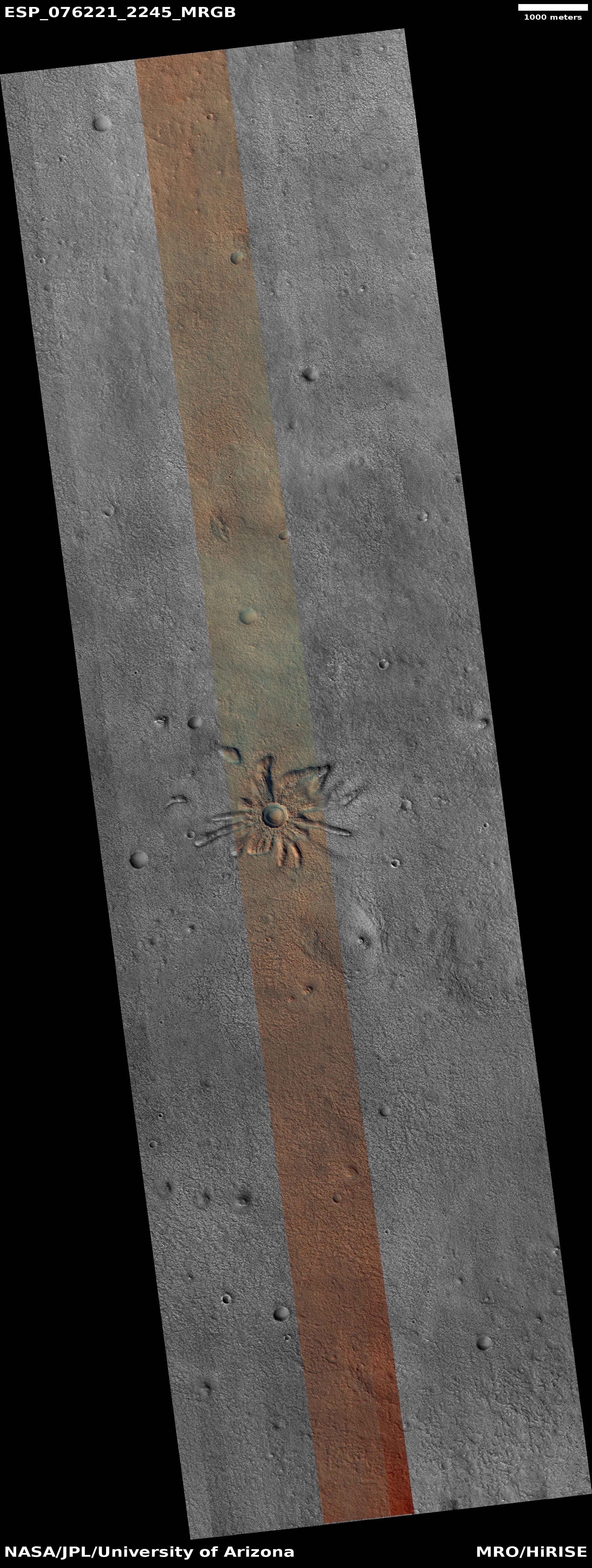
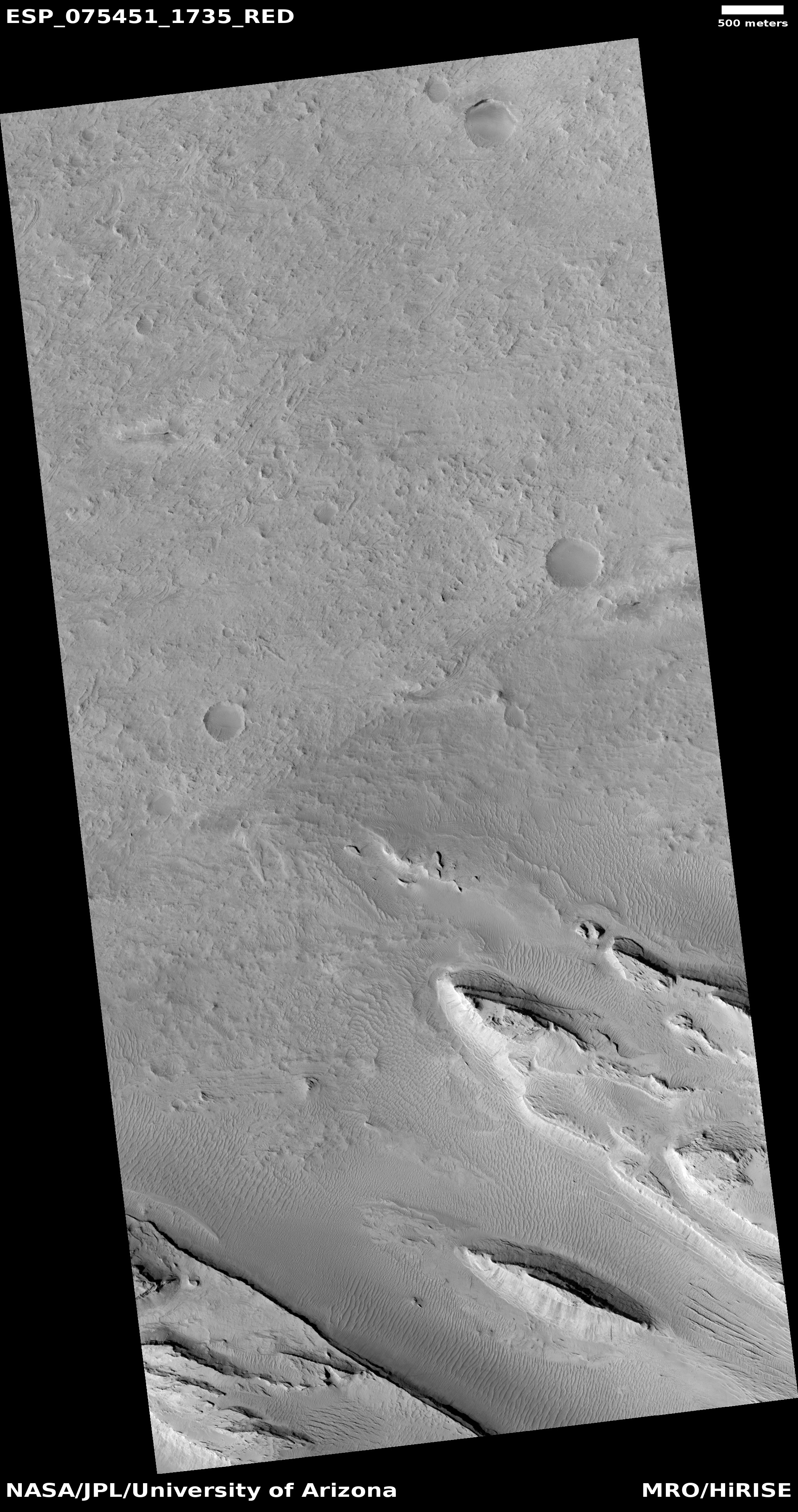
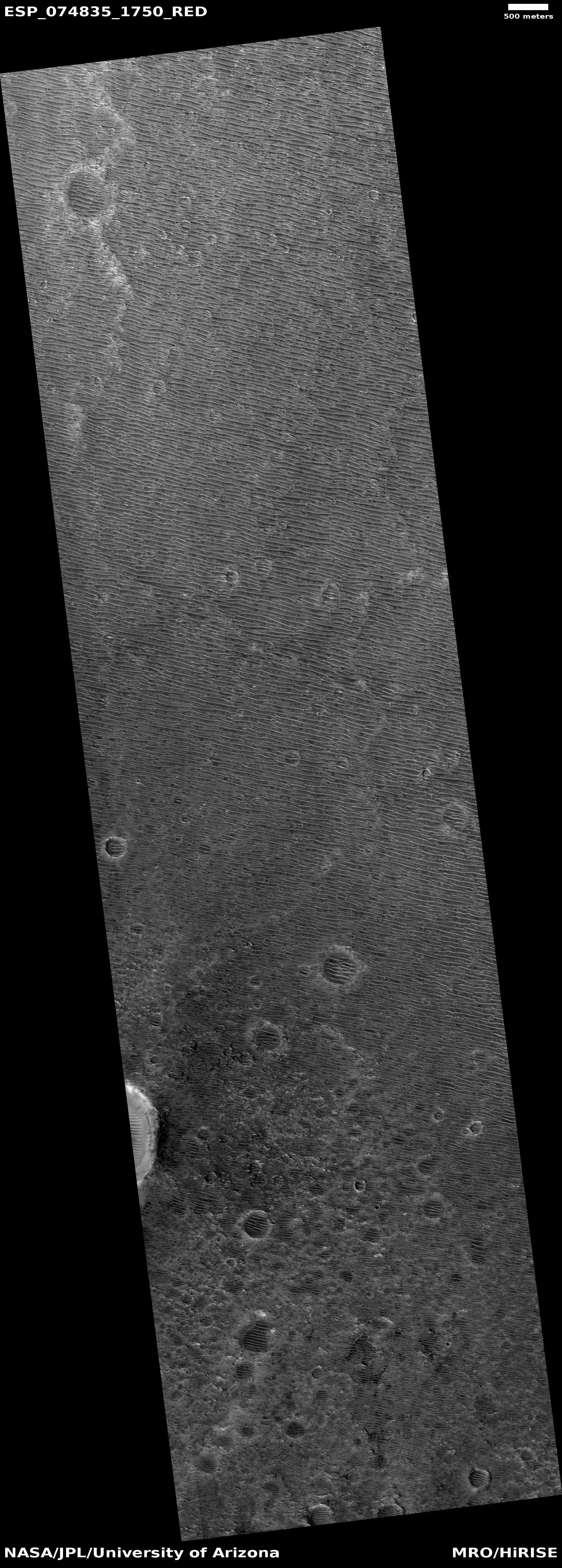
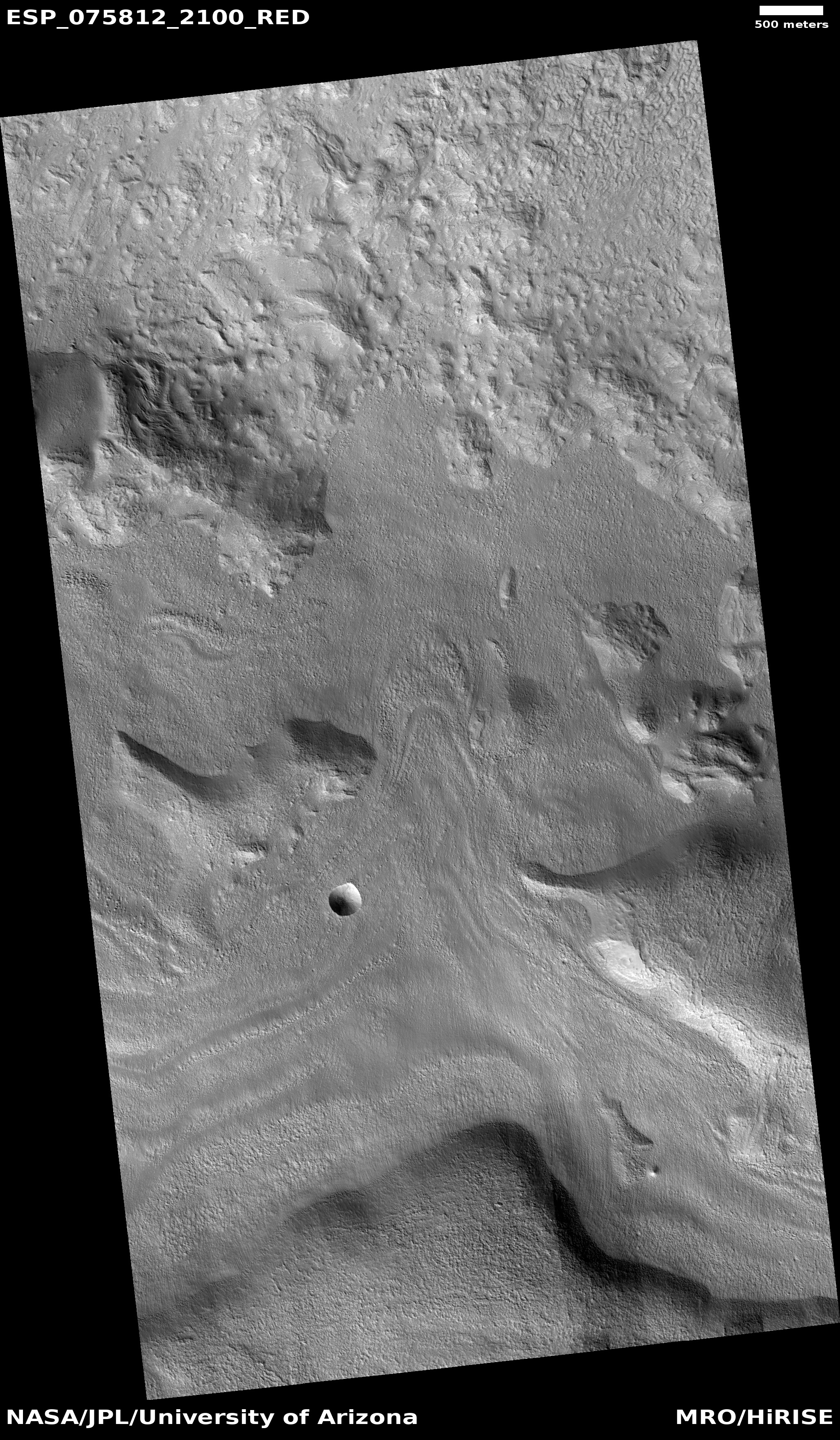
Finding Martian glaciers from orbit

Glacier flow on Mars
Click for full image.

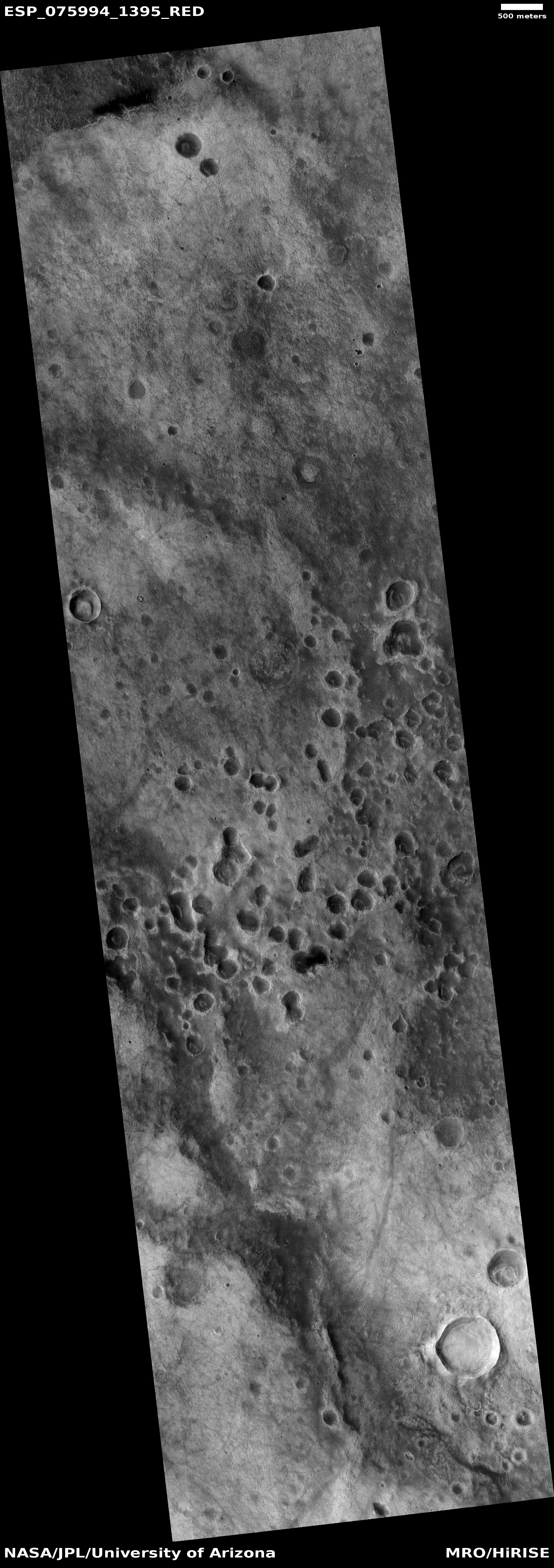
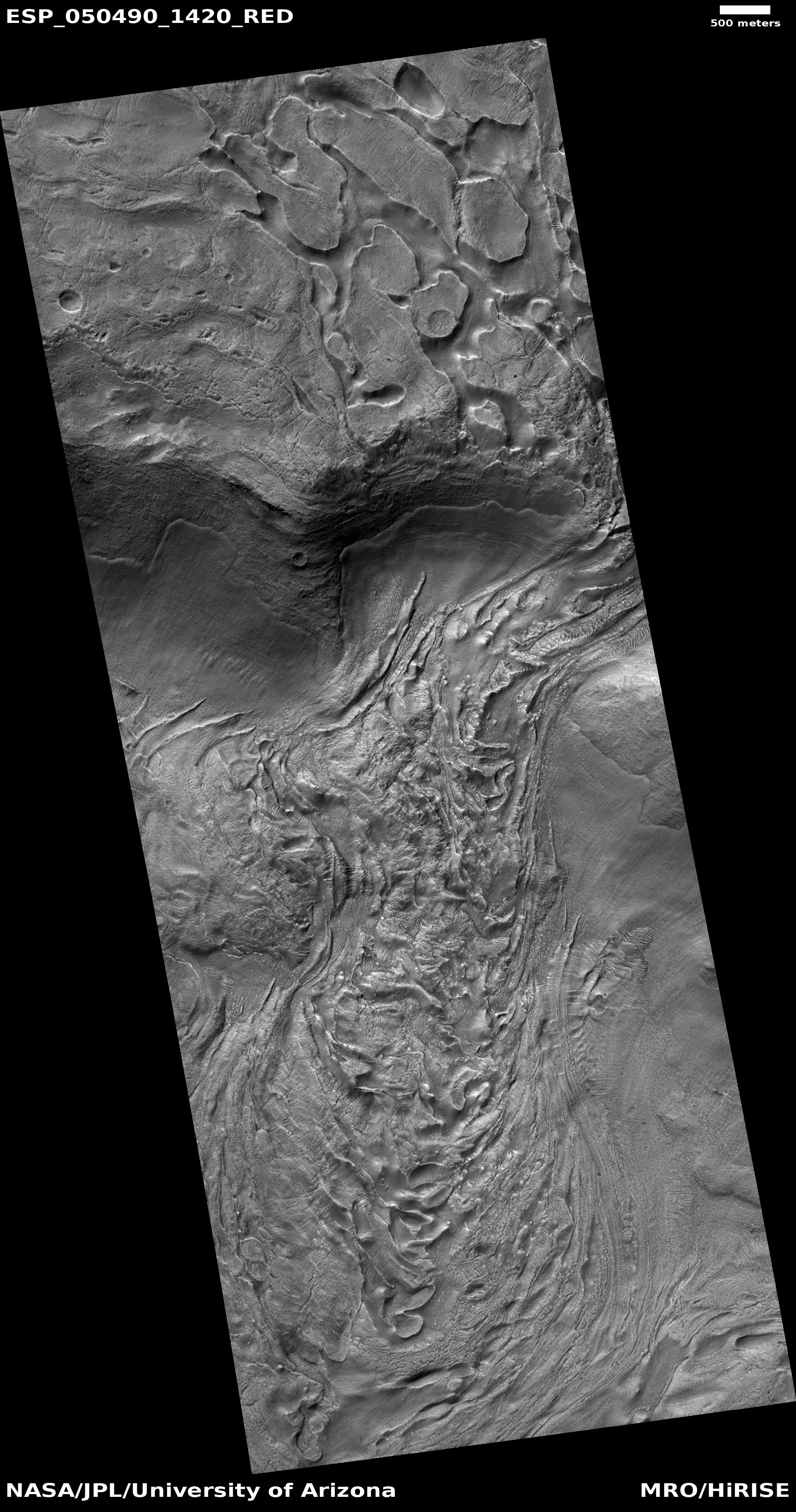
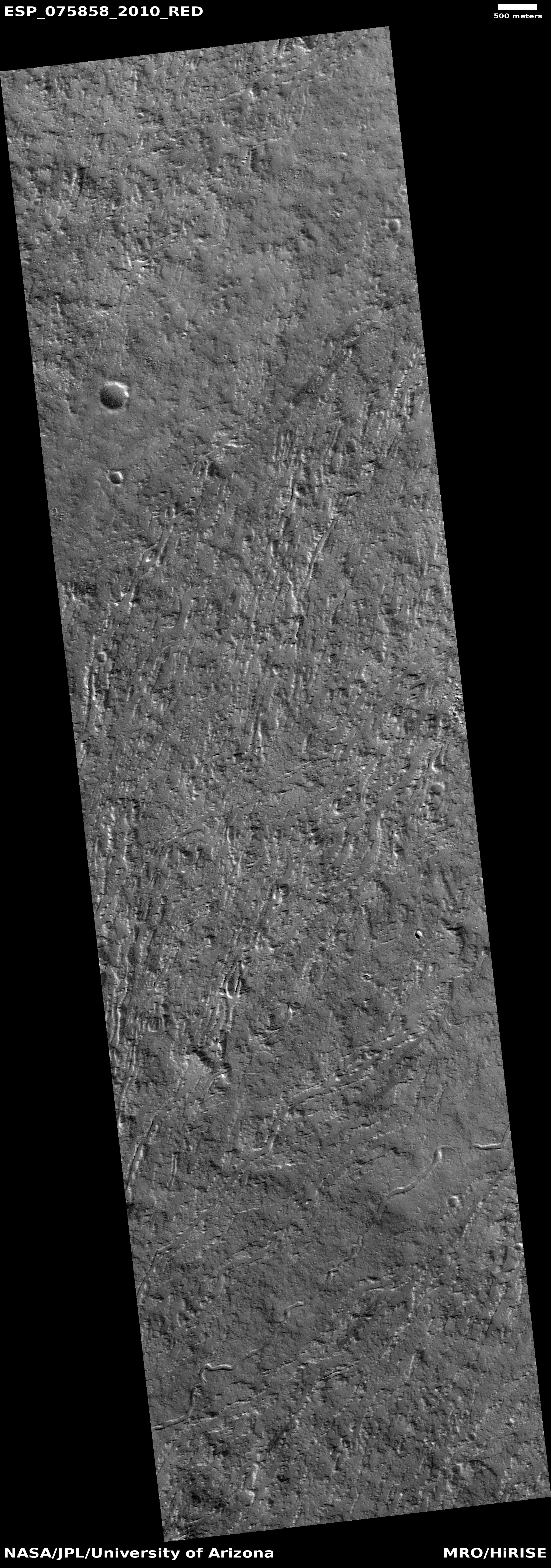
Today’s cool image is a great example of the surprises one can find by exploring the archive of the high resolution pictures that Mars Reconnaissance Orbiter (MRO) has produced since it arrived in Mars orbit back in 2006. The picture to the right, rotated, cropped, and reduced to post here, was taken by MRO’s high resolution camera back on May 4, 2017. I only found it because I had picked out a October 24, 2022 high resolution image that covered a different area of this same flow feature just to the north east. In trying to understand that 2022 picture I dug to see other images had been taken around it, and found the earlier 2017 photo that was even more interesting.

Neither however really covered the entire feature, making it difficult to understand its full nature. I therefore searched the archive of MRO’s context camera, which has imaged the entire planet with less resolution but covering a much wider area per picture. The context camera picture below captures the full nature of this feature.
» Read more

1 comment

Cones, mounds, and layers of Martian ice?

Cones, mounds, and layers of Martian ice?
Click for full image.

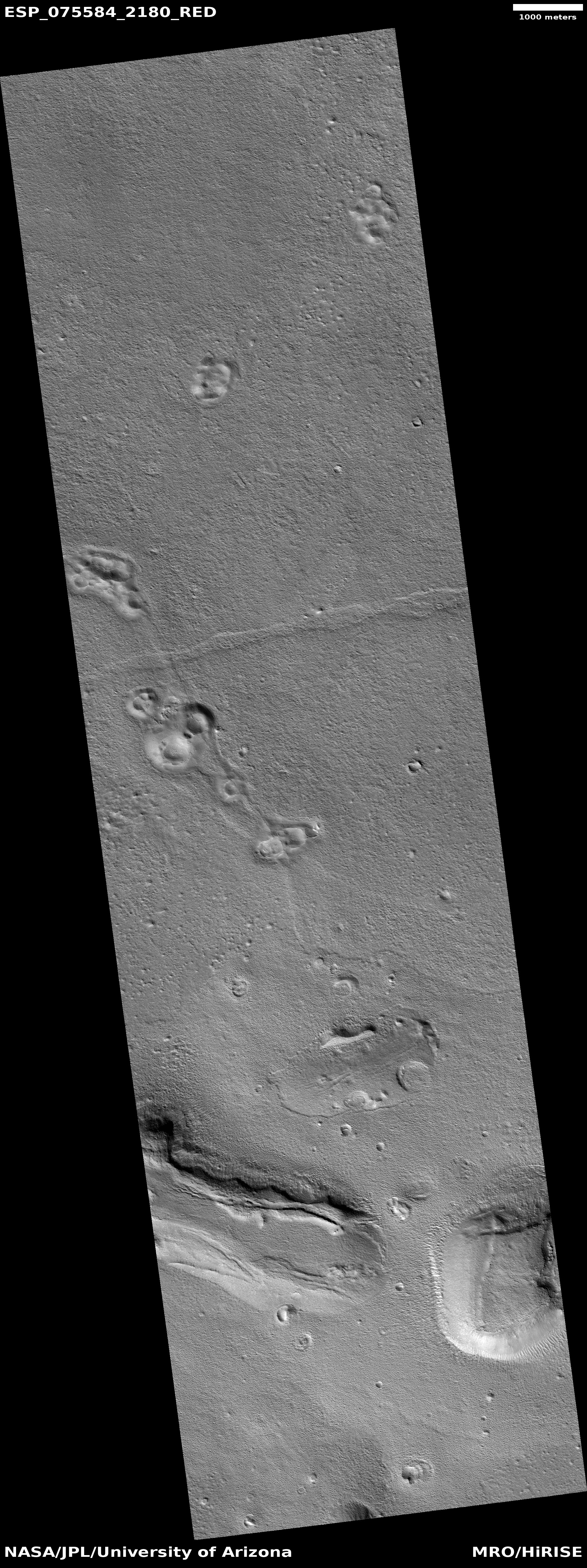
Cool image time! The photo to the right, rotated, cropped, and reduced to post here, was taken on September 10, 2022 by the high resolution camera on Mars Reconnaissance Orbiter (MRO).

The location is at 38 degrees north latitude, in the Martian northern lowland plains. At this latitude in these plains the geological features seen in high resolution pictures almost always invoke near surface ice, including processes that disturb that underground ice layer.

This picture is no different. Not only does it appear that a glacier is flowing down from the top of east-west ridge, the middle mound includes a crater with its southeast rim gone and appears filled with material that suggests ice.

The greater geographic context of this location can be seen in the overview map below.
» Read more

18 comments

Bursting lava bubbles on Mars

Burst lava bubbles on Mars
Click for full image.

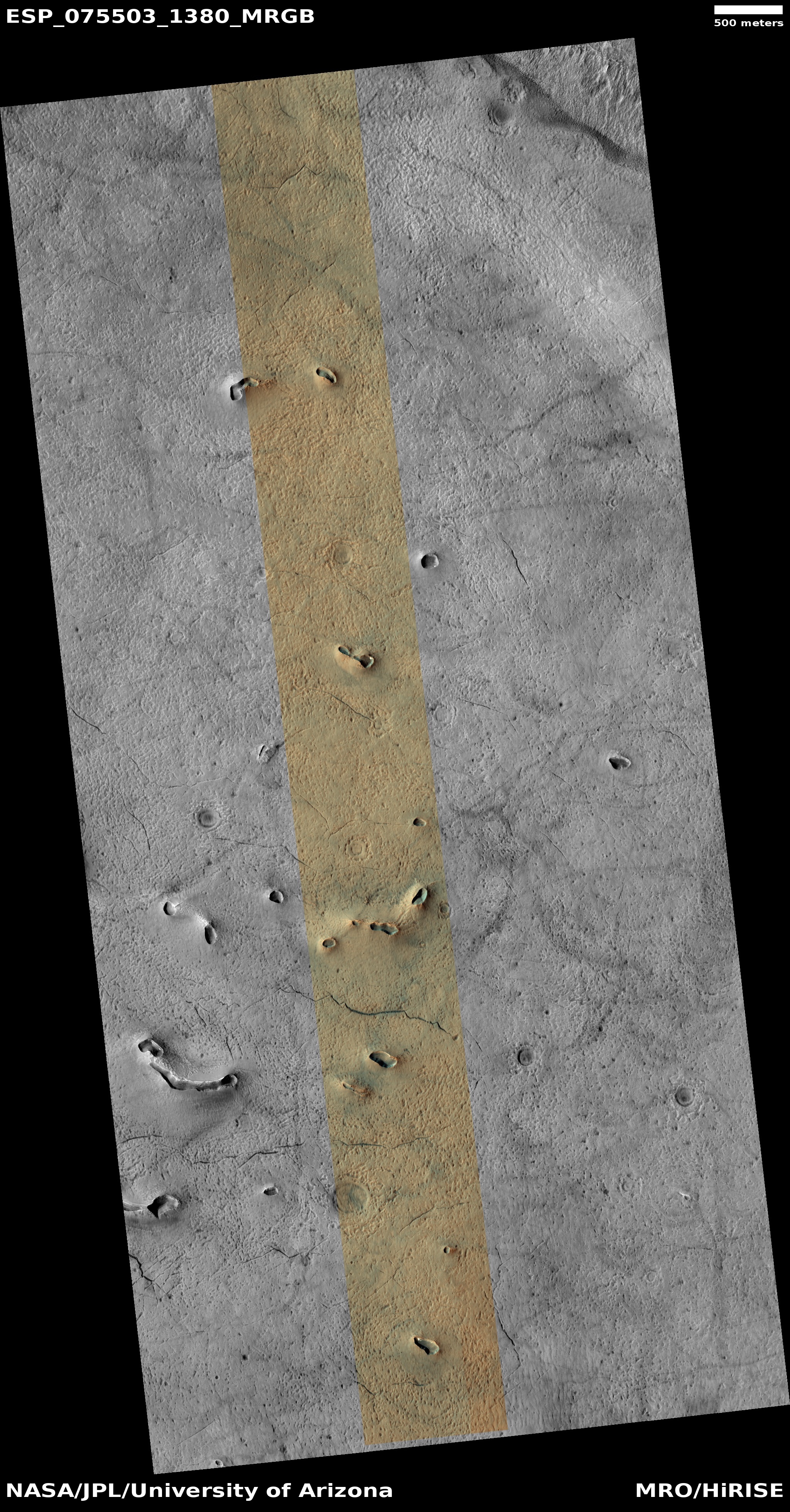
Cool image time! The photo to the right, rotated, cropped, reduced, and sharpened to post here, was taken on September 4, 2022 by the high resolution camera on Mars Reconnaissance Orbiter (MRO).

I really have no idea what caused these distorted cones. My intuition (a dangerous thing to rely on when it comes to science) suggests these are volcanic in nature. Imagine hot lava with gas bubbling up from below. Periodically a gas bubble will burst on the surface releasing the gas. Depending on temperature, that bursting bubble could harden in place.

The overview map below provides some support for my intuition, but it also suggests this first hypothesis could be completely wrong, something that does not surprise me in the least.
» Read more

4 comments

A congregation of Martian dust devils

A congregation of Martian dust devils
Click for full image.

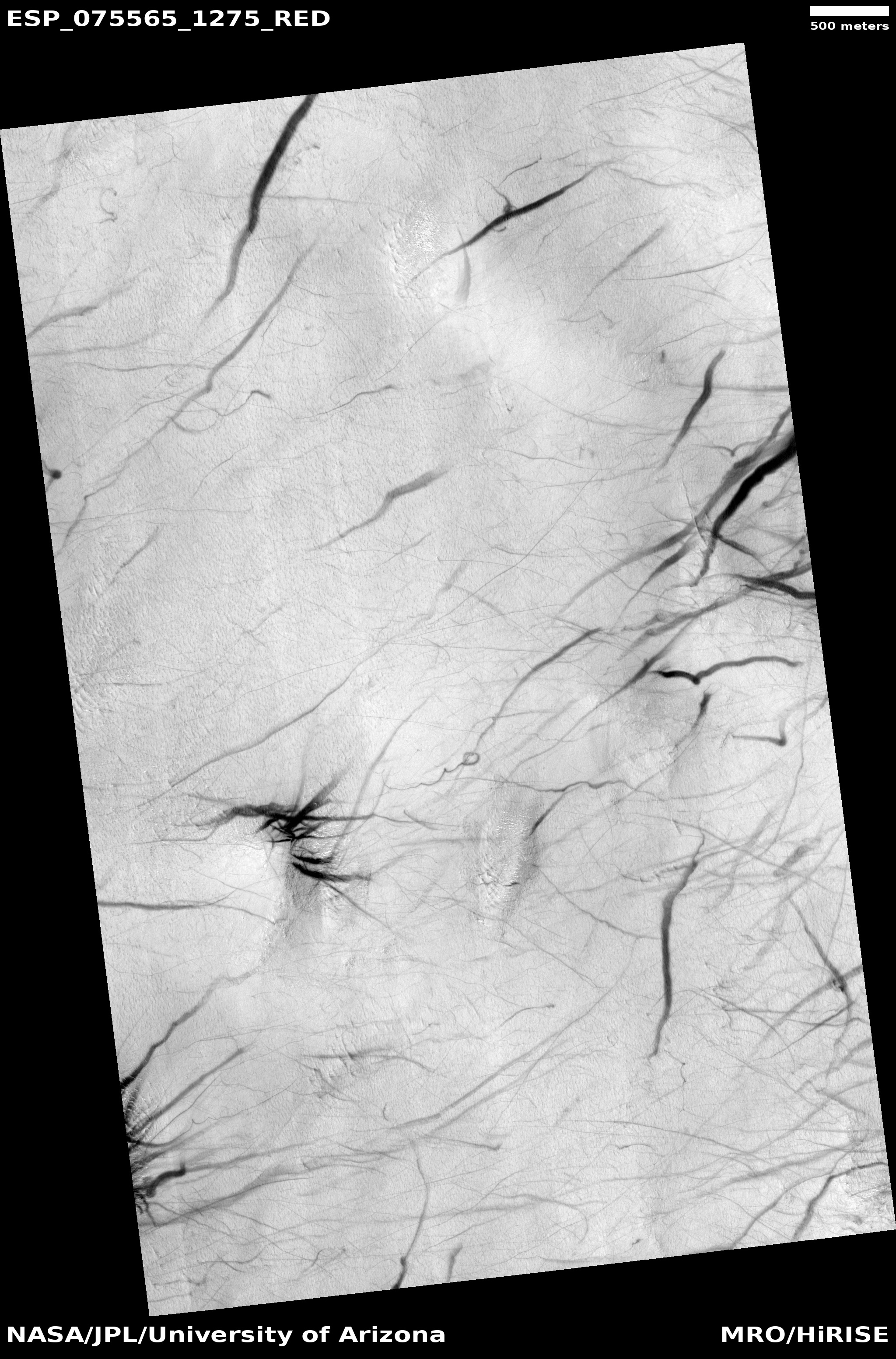
Cool image time! The photo to the right, rotated, cropped, reduced, and sharpened to post here, was taken on September 9, 2022 by the high resolution camera on Mars Reconnaissance Orbiter (MRO). It shows a spot on Mars where, as indicated by the many many tracks, dust devils routinely develop and travel across the surface.

Though this whole region appears to favor dust devils, within it are places that are even more favored. For example, the number of tracks on the northern and eastern slopes of that small hill at center left practically cover the surface, while the hill’s western and southern slopes are almost untouched.

Both the overview map and the global Mars map below provide the full context.
» Read more

2 comments

Big sink near the Martian south pole

Big sink near the Martian south pole
Click for full image.

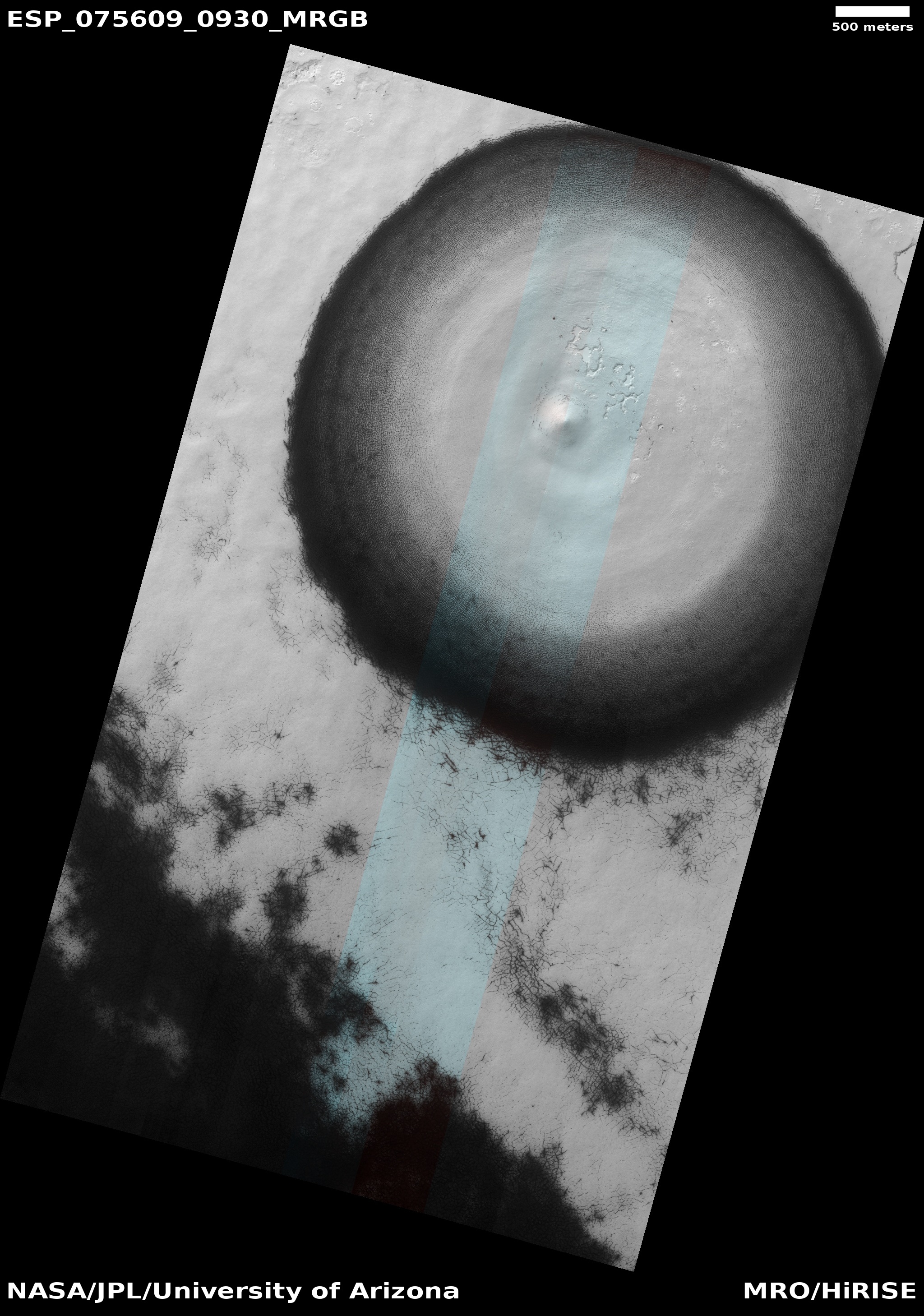
Cool image time! The photo to the right, rotated, cropped, reduced, and sharpened to post here, was taken on September 12, 2022 by the high resolution camera on Mars Reconnaissance Orbiter (MRO). The image is rotated so that south is at the top. The science team labels this a “subsidence feature,” or in plain English, a sinkhole.

Its perfectly circular shape, plus its central peak, strongly suggests we are looking at an impact crater. However, the lack of a raised rim of debris, produced by the ejecta from the impact, raises questions about this conclusion, and is one reason why the scientists think this is a sinkhole instead. Its shape however could be telling us that this sink is simply mirroring the existence of a buried crater.

The overview map below as always provides more context.
» Read more

1 comment

The edge of the Martian south pole ice cap

The edge of the Martian south pole ice cap
Click for full image.

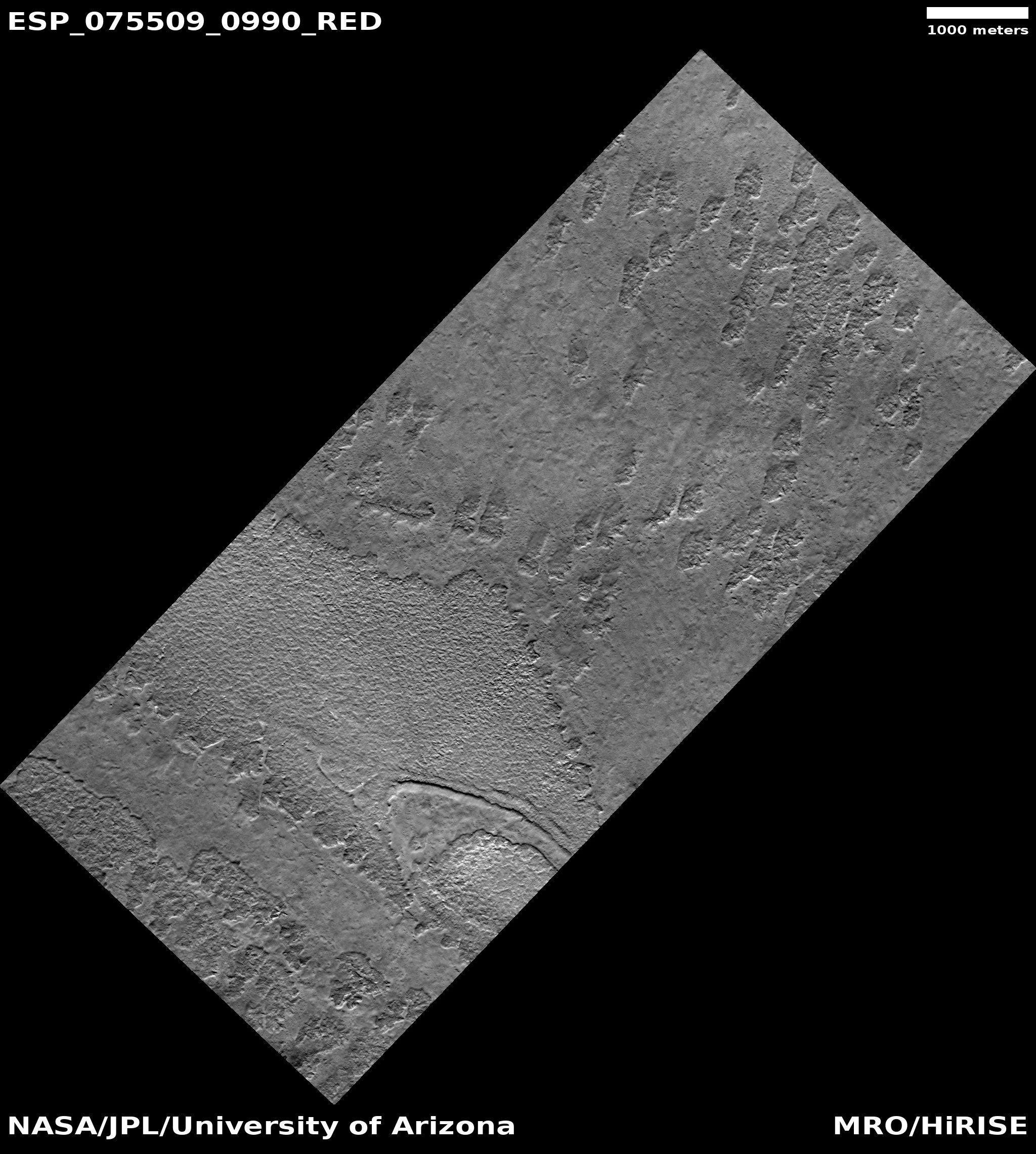
Cool image time! The photo to the right, rotated, cropped, reduced, and sharpened to post here, was taken on September 4, 2022 by the high resolution camera on Mars Reconnaissance Orbiter (MRO). The MRO science team labeled this simply “Diverse Terrain,” an apt description but woefully incomplete.

Though the grade here goes uphill to the south, there are ups and downs along the way. The flat areas near the top as well that band near the bottom appear to be the oldest terrain, with the rough hollows appearing to be places where that flat material has sublimated or eroded away.

This terrain is in the very high southern latitudes. South is to the bottom of this picture, with the south pole of Mars about 380 miles away. Thus, that eroding top layer is likely disappearing because it has either water ice or dry ice within it, and over time it sublimates away.

The picture itself was taken in winter, when the entire surface is likely covered with a thin mantle of dry ice that fell as snow with the coming of colder temperatures. A wider view of this region in the spring, taken by MRO’s context camera, shows that this mantle, now appearing like white frost, appears largely confined to the higher terrain. Apparently, the annual sublimation of this dry ice mantle is linked somehow to the erosion of this flat terrain.

The additional location information provided by overview map below helps explain why this terrain is so diverse.
» Read more

0 comments

Sunken butte on Mars

Collapsed butte in the Martian northern lowland plains
Click for full image.

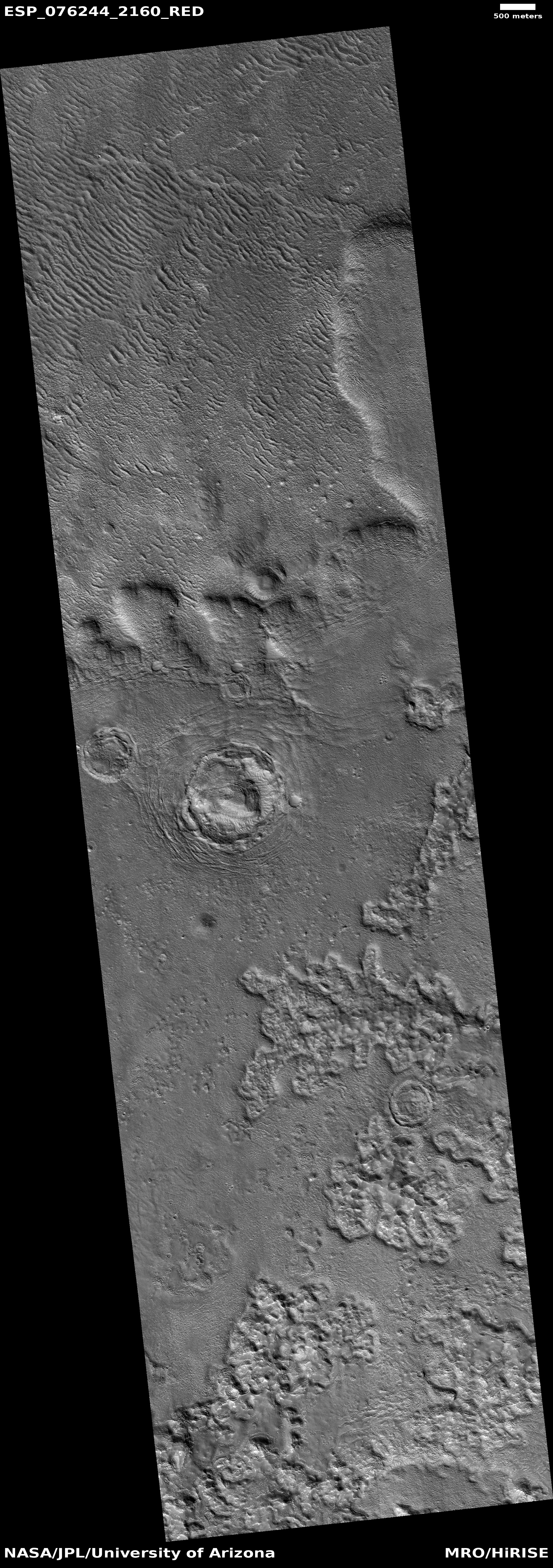
Cool image time! The photo to the right, cropped, reduced, and sharpened to post here, was taken on November 1, 2022 by the high resolution camera on Mars Reconnaissance Orbiter (MRO). It shows what the scientists label a “layered butte.” Like the mesas in the American southwest, those layers, or terraces, mark the geological history of this place, where over time layer upon layer was placed down, and then eroded away except for this mesa.

What makes the mesa even more intriguing and strange, however, are surrounding concentric cracks and the moat at the mesa’s base. These features suggest that at some point the ground below the mesa collapsed so that the entire mesa dropped, as a unit.

What could cause this? The overview map below provides a clue, though certainly not an answer.
» Read more

0 comments

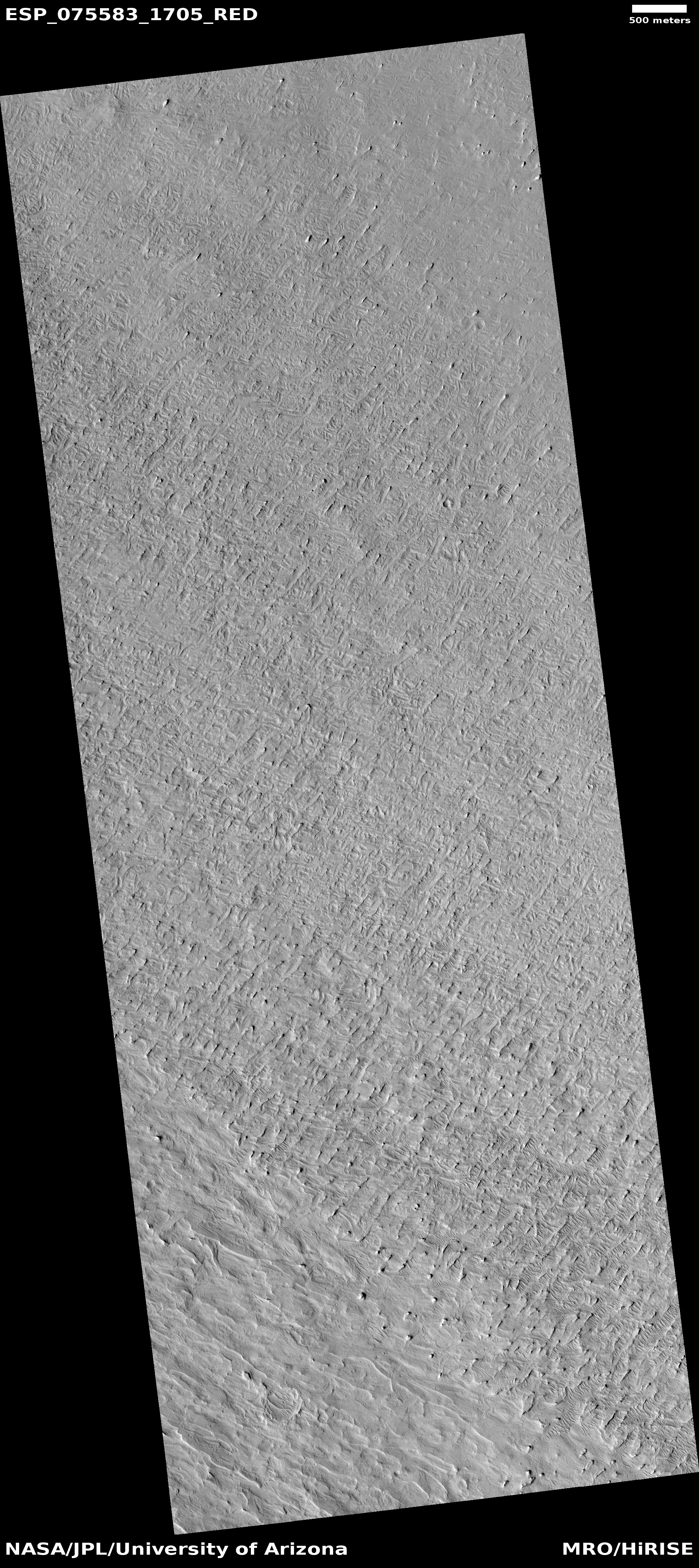
The featureless volcanic ash plains of Mars

The featureless volcanic ash plains of Mars

Cool image time! The photo to the right, cropped, reduced, and sharpened to post here, was taken on September 10, 2022 by the high resolution camera on Mars Reconnaissance Orbiter (MRO). It shows what appears to be a relatively featureless plain with a surface resembling stucco.

At -9 degrees south latitude, this is in the Martian dry equatorial regions. No ice or glaciers here. However, the consistent orientation of the knobs and hills suggest dunes and sand blown by prevailing winds, and that guess holds some truth. This location is deep within the Medusae Fossae Formation, the largest volcanic ash deposit on Mars, covering an area about as big as India, and believed to be the source of most of the red planet’s dust.

We are thus looking at thick layer of ash, its surface shaped over eons by the winds of Mars’ thin atmosphere.
» Read more

1 comment

Strange terrain on the eastern floor of Gale Crater

Strange terrain on the eastern floor of Gale Crater
Click for full image. For the inset, go here.

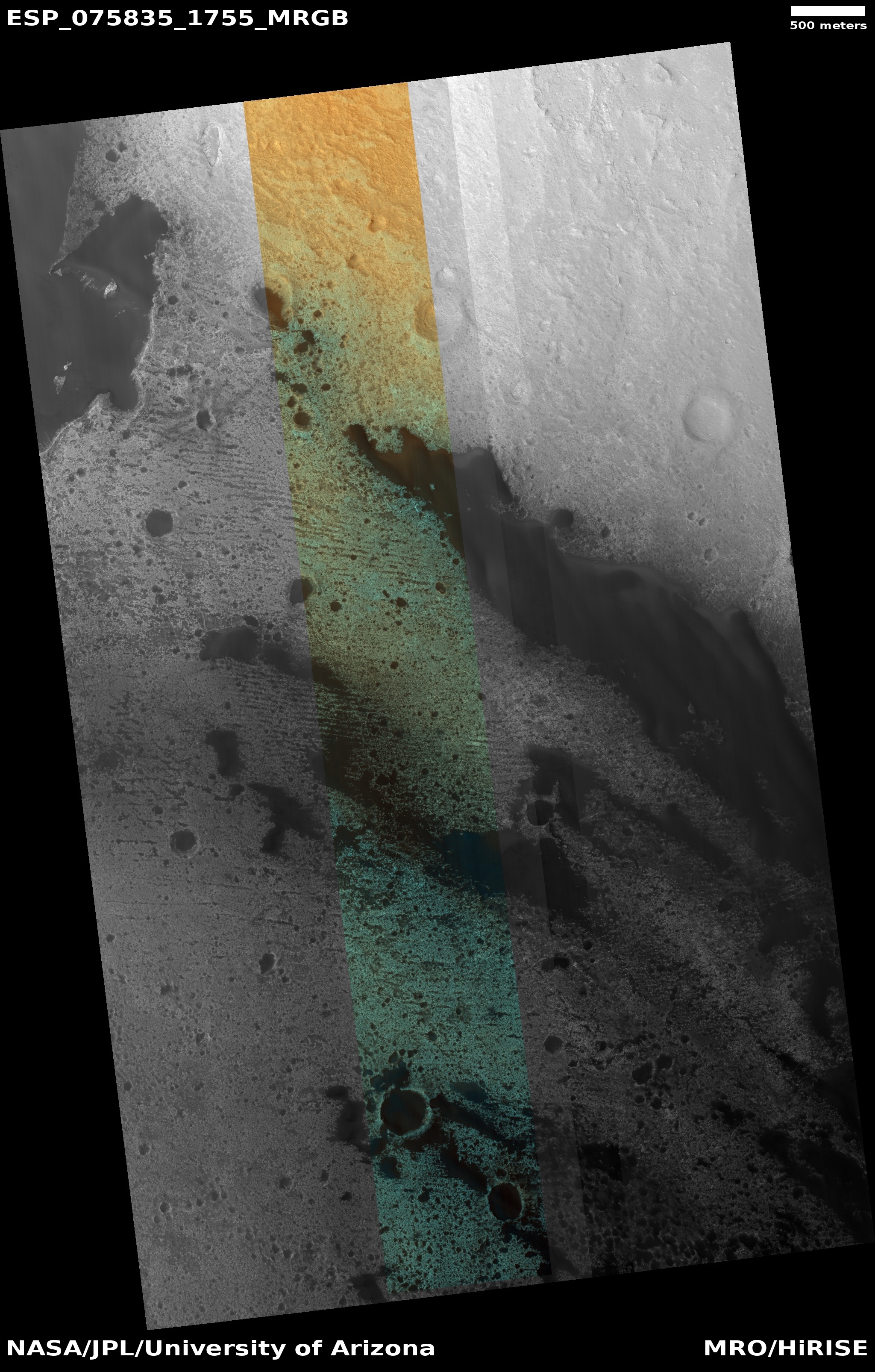
Though today’s cool image on the right, rotated, cropped, and reduced to post here, shows a small section on the floor of 96-mile-wide Gale Crater where Curiosity has been roving for the past decade, this picture looks at a different place. Curiosity landed in the northwest quadrant of the crater, and has been climbing the western slopes of Mount Sharp, which fills much of the crater’s interior. Today’s image looks at the crater’s floor on the east side of Mount Sharp.

The picture was taken on September 30, 2022 by the high resolution camera on Mars Reconnaissance Orbiter (MRO). The dark areas are likely dune seas, while the golden section near the top of the color strip is likely dust, though that is not certain. (This bright yellow is unusual for this particular color filter.) The greenish color suggests coarser materials, such as larger boulders and rocks, though this is also not certain.

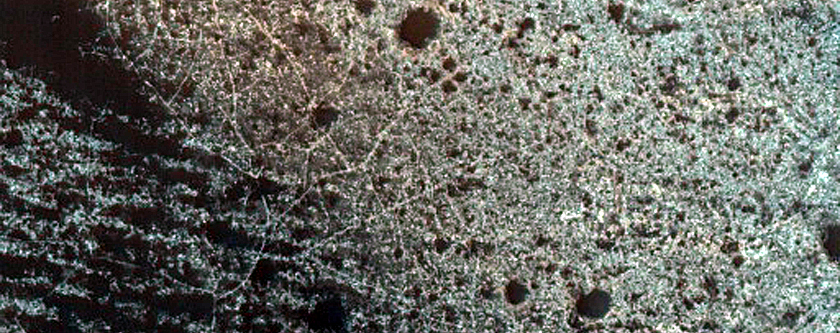
The inset zooms into some unusual polygon lines that cut across the dunes and cratered terrain. Such lines suggest that once, in the far past, the ground here was wet. When it dried out (being now in the very dry equatorial regions of Mars) it formed these cracks, similar in nature to the polygon cracks one sees in drying mud on Earth. Since the data from Curiosity when it was on the crater floor also suggests a lake once existed inside the crater, these cracks add weight to that conclusion.

The overview map below places Gale Crater in the larger context of Mars.
» Read more

0 comments

Ancient lava flows down the flanks of the solar system’s largest volcano

Lava flows on Olympus Mons
Click for full image.

Cool image time! The photo to the right, cropped, reduced, and sharpened to post here, was taken on October 2, 2022 by the high resolution camera on Mars Reconnaissance Orbiter (MRO). It shows what appears to be very old and eroded lava on the northeast flanks of Olympus Mons, the largest volcano on Mars as well as the entire solar system. About 600 miles across, from the edge to its peak, Olympus rises about 54,000 feet, with an actual height relative to Mars’ “sea level” of just under 70,000 feet, more than twice as high as Mount Everest on Earth.

The white arrow show the downward grade. Several different flows can be seen throughout the picture, some confined to a central channel with smooth aprons of overflows on either side. Others are more broken and less coherent, and suggest that either the flows were inherently different, or are much older and have deteriorated with time.
» Read more

0 comments

What a Martian impact looks like on a sheet of slushy ice

Overview map

What a Martian impact looks like on a sheet of ice
Click for full image.

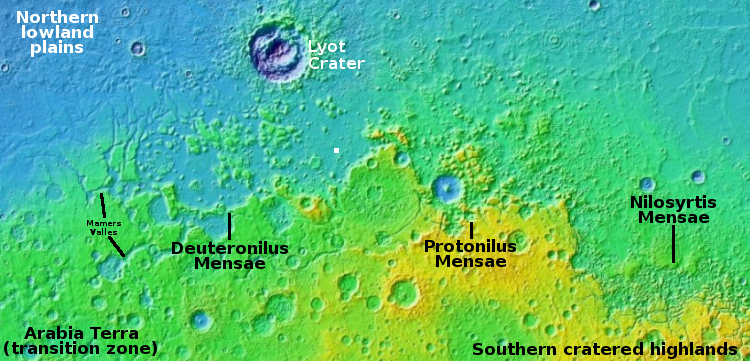
My headline is a bit of a guess, but it is an educated guess for today’s cool image. The photo to the right, cropped, reduced, and sharpened to post here, was taken on October 30, 2022 by the high resolution camera on Mars Reconnaissance Orbiter (MRO).

The location, as indicated by the white dot in the overview map above, puts this impact in a relatively flat area of Deuteronilus Mensae, the westernmost chaos region of the 2,000 mile long mid-latitude strip I call glacier country.

In other words, there is likely a lot of near surface ice here, as this impact makes very plain. If you imagine dropping a pebble into a thick layer of soft ice cream, you might get a crater reminiscent of this. I use for comparison ice cream on Earth because the lighter Martian gravity probably makes Martian ice softer and more slushy.

As I have said many times before, Mars is strange, Mars is mysterious, and above all Mars is alien.

1 comment

A Martian ship’s prow

A Martian ship's prow
Click for full image.

Cool image time! The photo to the right, cropped, reduced, and sharpened to post here, was taken on August 31, 2022 by the high resolution camera on Mars Reconnaissance Orbiter (MRO). It shows what the scientists call “layering” surrounding this pointed mesa, which I roughly estimate to be somewhere between 200 to 400 feet high.

As you approach the mesa you first walk on the dust-covered flat plains. Then you start up a slope of what looks like alluvial fill, material that over time has fallen from the mesa to pile up as an apron at its base. You then reach a series of terraces, each likely marking a different layering major event from sometime in the distance past. Over time, for unknown reasons, the material surrounding this material has eroded away, while the mesa and its layers somehow survived.

The overview map below helps tell us what those past layering events were, as well as the source of the large amount of dust and sand at this location.
» Read more

0 comments

Martian dunes, as far as the eye can see

Martian dunes
Click for full image.

Cool image time! The photo to the right, cropped, reduced, and sharpened to post here, was taken on July 14, 2022 by the high resolution camera on Mars Reconnaissance Orbiter (MRO). It shows the dune filled floor of an unnamed 25-mile-wide ancient and very eroded Martian crater.

These endless dunes — which extend far beyond this photo to cover the entire floor of this crater as well as an overlapping crater to the north that is only slightly smaller — reveal something fundamental about this location: The winds prevail from one direction consistently, from either the north or the south. Closer inspection would likely resolve which way, but I don’t have the knowledge or access to the data to do so.

The overview map below, provides context, and also further information about why these dunes are here.
» Read more

0 comments

Martian glaciers below 30 degrees latitude

A Martian glacier below 30 degrees north latitude
Click for full image.

Cool image time! The picture to the right, cropped, reduced, and sharpened to post here, was taken on September 28, 2022 by the high resolution camera on Mars Reconnaissance Orbiter (MRO). While it shows what looks like a somewhat typical Martian glacial flow pushing through a gap between hills, this glacial flow is not typical. It sits at just under 30 degrees north latitude, closer to the equator than almost any glacial feature on Mars. Moreover, the younger impact crater on top suggests this glacier has been here for some time. Though the impact is younger than the crater, it is not that young, as the dark streaks normally seen in the first years after impact are gone.

Thus, this glacier suggests that not only can near surface Martian ice exist closer than 30 degrees latitude from the equator, it can survive there for a considerable amount of time.

Nor is this glacial flow, so close to the equator, unusual for this region of Mars.
» Read more

0 comments

Expanded craters in Martian ice

Expanded craters in Martian ice
Click for full image.

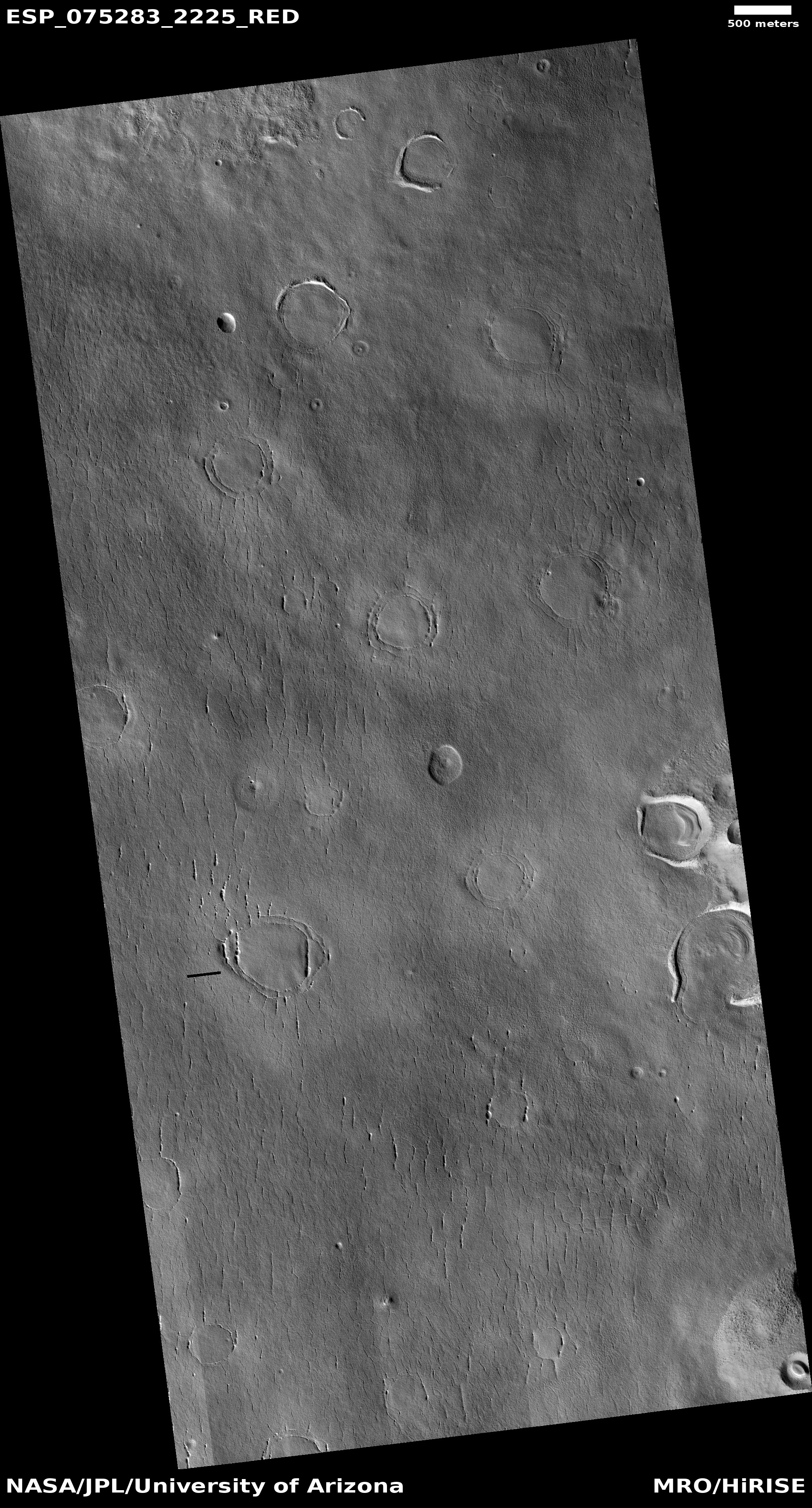
Cool image time! The photo to the right, rotated, cropped, reduced, and sharpened to post here, was taken on August 18, 2022 by the high resolution camera on Mars Reconnaissance Orbiter (MRO). It includes a wide variety of geology related to sublimating ice, including expansion cracks as well as several different examples of what scientists call “expanded craters,” impacts that occurred in near surface ice and have been reshaped by the ice’s melting and sublimation at impact and then later. It also shows some obvious glacial fill in the two distorted craters at the center right.

A 2017 dissertation [pdf] by Donna Viola of the University of Arizona outlines nicely what we know of Martian expanded craters. As she notes in her conclusion:
» Read more

0 comments

Scientists: Viking-1 might have landed on a field of Martian tsunami debris

The geological history of the Viking-1 Mars landing site

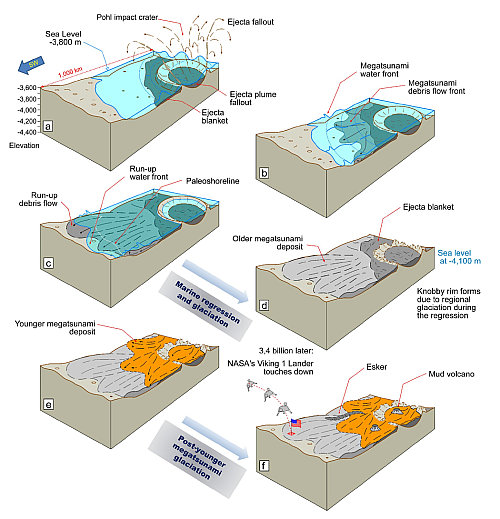
As outlined in their new paper [pdf], a team of scientists now hypothesize that the features that surrounded Viking-1 when it landed on Mars in 1976 were caused by two past Martian tsunamis. Each tsunamis occurred due to an impact in the theorized ocean that is believed to have existed in this part of Mars’ northern lowland plains several billion years ago.

The graphic to the right, figure 8 from the paper, shows the hypothesized sequence of events. From the caption:

(a) Pohl crater forms within a shallow marine environment, (b) triggering tsunami water and debris flow fronts. (c) The wave fronts extensively inundate the highland lowland boundary plains, including a section ~ 900 km southwest of the impact site. (d) The ocean regresses to ~ − 4100 m, accompanied by regional glacier dissection, which erode the rims of Pohl and other craters. (e) The younger tsunami overflows Pohl and parts of the older tsunami. Glaciation continues, and mud volcanoes later source and emerge from the younger tsunami deposit. (f) ~ 3.4 billion years later, the Viking 1 Lander touches down on the edge of the older tsunami deposit.

The overview map below provides the larger context.
» Read more

4 comments

A Martian knife mesa with terraces

A Martian knife mesa with terraces
Click for full image.

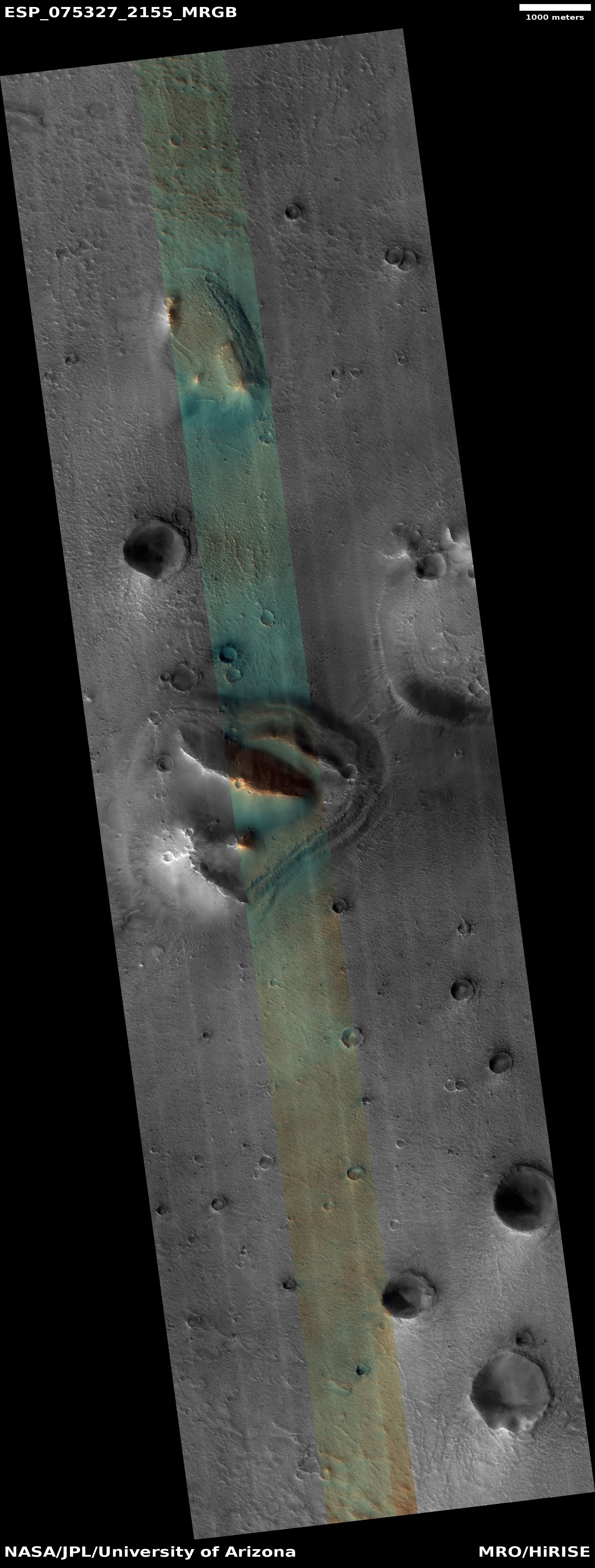
Cool image time! The photo to the right, rotated, cropped, reduced, and sharpened to post here, was taken on August 21, 2022 by the high resolution camera on Mars Reconnaissance Orbiter (MRO). It shows what the scientists label as a “layered mound.” It also shows a plethora of geological mysteries, all of which relate to the as yet not quite understood geological history of Mars.

First, note the different colors north and south of the ridgeline. According to the science team’s understanding of what these colors mean [pdf], the orange-red to the north suggests dust, while the bluish-green to the south suggests coarser materials, such as rocks and sand. Though frost and ice are generally bluer, such things are generally found on the pole-facing slopes where there is less sunlight. Thus the bluish-green material to the south is unlikely to be ice or frost, though this is not impossible, as the picture was taken in the winter and the latitude is 35 degrees north.

Why however is there such a dichotomy of rocks, sand, and dust between the north and south slopes? And if frost and ice, why is it more prominent to the south, when it should instead be more prominent to the north?

Other mysteries: Is the circular depression on the ridgetop an impact crater or a caldera? If the latter, this suggests the mound is some kind of volcano, likely mud, though lava is not excluded. If so, however, why is there no caldera on top of the ridge to the south?

The location, as shown in the overview map below, reveals other puzzles.
» Read more

1 comment

Monitoring the tiger stripes on Martian dunes

Dunes with tiger stripes
Click for full image.

Today’s cool image takes us back to a previous cool image, from December 2020. The photo to the right, rotated, cropped, reduced, and enhanced to post here, was taken on August 22, 2022 as part of a regular monitoring program of these worm-shaped and tiger-striped dunes in 42-mile-wide Kunowsky Crater, located in the northern lowland plains of Mars at the high mid-latitude of 57 degrees north.

The tiger stripes appear to be the northern hemisphere’s version of what are called “spiders” in the south, where each spring the mantle of dry ice that settles on the surface in winter begins to sublimate away, from the bottom up. The trapped gas eventually escapes at the mantle’s weak points where it cracks.

When the gas escapes it spews dust onto the surface, creating the dark patches. In the southern hemisphere, the ground is generally stable, and the gas travels and escapes along the same routes each year, creating relatively permanent spider-like tributary patterns. In the north the ground is less stable, so the dark streaks form more randomly from year to year.

This monitoring campaign, first begun in 2008, is looking to see how these seasonal changes might change these northern dunes. The white rectangle in the image shows an area shown in close-up below, comparing 2020 with 2022 to see what changes might have occurred.
» Read more

0 comments

Frozen glacial eddies on Mars?

Overview map

Frozen glacial eddies on Mars?
Click for full image.

Cool image time! The photo to the right, cropped, reduced, and enhanced to post here, was taken on August 26, 2022 by the high resolution camera on Mars Reconnaissance Orbiter (MRO). Though the science team labels this image vaguely as showing “Features in Mamers Valles,” the features are likely glacial ice since this location is at the western end of the 2,000-mile-long northern mid-latitude strip I dub glacier country, where glacial features are seen everywhere.

The white dot marks this picture’s location in Mamers Valles, as shown on the overview map above. This particular Martian channel, that meanders in a wildly random manner (including a few sharp ninety degree turns), is theorized [pdf] by some scientists to have formed not by surface flows but by a subterranean drainage that created voids. On the surface the voids caused sagging, collapses, and the eventual formation of the surface channel.

Under such conditions, any ice in the channel would not necessarily have a clear flow direction, thus providing an explanation (though hardly certain) of the eddy-like shape of these features.

1 comment

Colliding glaciers

Overview map

Colliding glaciers

For today’s cool image we return once again to glacier country in the northern mid-latitudes of Mars. The picture to the right, rotated, cropped, reduced, and enhanced to post here, was taken on August 28, 2022 by the high resolution camera on Mars Reconnaissance Orbiter (MRO). It shows a spot where I think glacial flows coming from the north and south have collided at a low point. The white dot in the box on the overview map above marks its location, with the inset showing the mesas to the north and south that suggest this flow pattern.

What makes these colliding flows especially cool is the source of the northern flow. It appears that came out of the impact heat from that crater, which caused the ice on the downhill side to flow. You can also see the same phenomenon a short distance to the east, with a much smaller crater, likely a secondary impact from the first.

Note also the glacial fill inside the larger crater. This impact happened on top of older glaciers, but later climate cycles caused more ice to be deposited within the crater afterward. That this glacial fill appears terraced and thus layered also suggests that there were several if not many such later climate cycles.

1 comment
1 23 24 25 26 27 54