NASA is considering two options for getting Perseverance’s Mars samples to Earth

The previous plan for Mars Sample Return

In a press briefing today, NASA officials announced it is considering two options for getting Perseverance’s Mars samples to Earth sooner and what it hopes will for less money.

In the first option, NASA would use already available and operational rockets to launch a larger rover to Mars, landing using a sky crane similar but larger than the one used successfully by both Curiosity and Perseverance. This rover would also have nuclear power system used by those rovers, as well as an arm similar to theirs, simplifying the design process. Under this option it appears NASA is abandoning the use of a helicopter for retrieval, as had previous been considered.

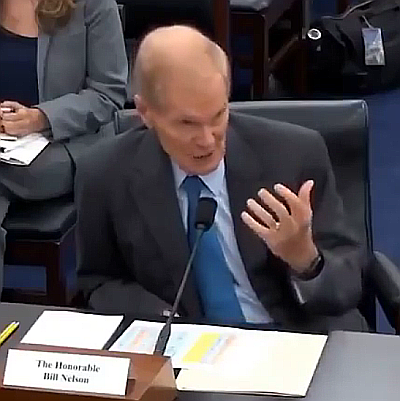
In the second option, NASA would rely on what administrator Bill Nelson called “the heavy-lifte capability of the commercial sector.” He specifically mentions SpaceX’s Starship/Superheavy and Blue Origin’s New Glenn, but added that they are looking at the capabilities of the entire private sector right now.

In both operations, the retrieval rover would clean on Mars the outside of the cores to prevent them from contaminating Earth with Martian particles. Previously that cleaning process was to take place in space on the way back. They claim this change also simplifies things.

The final decision on which option to choose is now scheduled for 2026. NASA likely wishes to see more progress with getting Starship/Superheavy as well as New Glenn operational before deciding.

Note that at this press conference very little was said about the Mars ascent rocket, presently supposedly being built by Lockheed Martin. This is essentially building a full scale rocket only slightly less powerful that Earth-based rockets by a company that has never done it before. It seems the second option is likely going to include other options and other rocket companies for this task. The lack of mention suggests NASA was uncomfortable with mentioning this possibility.

In general, this project still feels incomplete and poorly thought out. Major components — such as the ascent vehicle — have not been worked out properly. The officials claimed these changes would make it possible to bring the samples back in the ’35-’39 time frame but I don’t believe it. What it does do is guarantee a large cash influx to NASA, something administrator Bill Nelson lobbied for during the conference, for the next decade-plus. And I think that was the real goal.

11 comments

Toyota invests in rocket startup

In a positive sign that Japan’s rocket industry is beginning to join the private sector, Toyota yesterday announced that it is investing $44 million in the rocket startup Interstellar Technologies.

Interstellar had been more visible about five years ago, and then disappeared. I figured it had died having run out of cash. It appears it is coming back now in Japan.

2 comments

The members of Trump’s NASA transition team

We now have the names of the individuals that are reviewing NASA’s future under the Trump administration:

  • Charles Miller: A member of the first Trump administration’s transition team, Miller is a former NASA official who is now the chairman of Lynk, a direct-to-device satellite company that is struggling to go public through a merger with a SPAC backed by baseball star Alex Rodriguez.
  • Greg Autry: A longtime advocate for commercial space, Autry is a professor at the University of Central Florida who also worked on the 2016 Trump NASA transition and was nominated to serve as NASA’s CFO, though Congress failed to approve his nomination. He’s signing his emails “DOGE/NASA Transition.”
  • Ryan Whitley: A NASA engineer who was detailed to the National Space Council during Trump’s previous term, Whitley last worked on the Artemis HLS program before spending just over a year at ispace, the Japanese lunar company.
  • Lorna Finman: A Stanford PhD who worked on the Star Wars program at Raytheon back in the day, Finman’s LinkedIn says she has been advising the Heritage Foundation on space policy since 2023.
  • Jim Morhard: The NASA deputy administrator during Trump’s first term, Morhard was a longtime GOP senate staffer.

All appear to have deep roots in either Washington or academic, but all also appear to have deep roots in the conservative side of the political spectrum. Several have even moved from NASA positions to the private sector. That latter fact explains the radical changes at NASA that this team has been considering, including canceling SLS and Orion and re-orienting the entire Artemis program using the private sector. In addition they are considering consolidating several NASA centers as well shrink staffing at NASA headquarters.

5 comments

China completes its first launch in 2025

SpaceX is no longer the only entity that has launched a successful orbital launch this year. Early today China successfully placed an “experimental” satellite into orbit, its Long March 3B rocket lifting off from the Xichang spaceport in southwest China.

No word on where the rocket’s lower stages, using very toxic hypergolic fuels crashed within China. As for the satellite, China’s state run press merely said that it “was built by its subsidiary Shanghai Academy of Spaceflight Technology and is tasked with verifying orbital refueling and life-extension technologies.”

The 2025 launch race:

2 SpaceX
1 China

2 comments

Trump administration considering major positive changes at NASA

According to a report two weeks ago by Eric Berger at Ars Technica and reviewed today by Mark Whittington at The Hill, the transition team for the Trump administration is reviewing a number of very major positive changes at NASA. The transition team has set up a five-person committee to review the following:

  • canceling the costly Space Launch System rocket and possibly the Orion spacecraft
  • Redesigning the entire Artemis program to make it more cost effective
  • Set a new goal to put humans on the Moon by 2028
  • consolidating three NASA centers into one to reduce overhead
  • Reducing the size of NASA headquarters

The first two recommendations would be doing what I have been recommending since 2011. SLS is an over-priced boondoggle that is too cumbersome and expensive. It can never do the job of establishing a lunar base, NASA’s prime goal. The same applies to Orion, which NASA for years touted as an interplanetary spaceship, an utter lie. It is merely an overweight ascent/descent capsule, nothing more.

The third recommendation is mostly for photo op purposes, since it is unlikely a manned landing can occur that quick, especially if the entire Artemis program is redesigned, replacing NASA’s the SLS rocket with SpaceX’s Starship/Superheavy. At the same time, if Trump shuts down the FAA’s red tape, we might be seeing many test flights of this rocket in the next two years, accelerating its development considerably.

The last two recommendations match the only recommendation from my 2017 policy paper, Capitalism in Space [free pdf here] that NASA has not yet embraced. I had recommended NASA reduce its overhead and bureaucracy, since it widely known in the business that its many agencies do relatively little for their cost. The rumored proposal under consideration is to consolidate the Goddard center in Maryland, the Ames center in California with the Marshall center in Alabama, with the new combined center in Alabama.

Getting this done however remains difficult. The centers exist because elected officials want them in their states and congressional districts. Expect strong resistance in Congress.

That the Trump administration is considering it anyway suggests these big changes are coming, regardless. And if so, I say Hallelujah!

17 comments

Italy’s military negotiating with SpaceX to use its Starlink constellation for communications

In what would be a five year deal costing $1.56 billion, Italy’s military is presently negotiating with SpaceX to use its Starlink constellation for communications, rather than wait for the European Space Agency’s (ESA) IRIS2 constellation, which is years from launch and likely to experience delays, as do all of ESA’s projects.

By negotiating a five-year deal with SpaceX, Italy may be aiming to bridge the gap until Europe’s IRIS2 system becomes operational. With the ongoing war in Eastern Europe, the country’s Armed Forces likely view secure military communications as an urgent priority. However, critics may argue that the €1.5 billion price tag represents 14.15% of the total IRIS2 budget for just five years of service. For context, Italy is the third-largest contributor to the European Union, with its €18.6 billion contribution in 2023 accounting for roughly 10% of the EU’s total budget.

This story illustrates the good business sense of Elon Musk. He moved to get Starlink in orbit ahead of anyone else, and now is reaping the cash awards because he can provide services while others cannot.

0 comments

ISRO delays its unmanned docking in orbit two days

India’s space agency ISRO today announced that it has decided to delay the attempted unmanned autonomous docking of its two orbiting Spadex spacecraft two days, from January 7 to January 9.

“The docking process requires further validation through ground simulations based on an abort scenario identified today (Jan 6),” Isro said Monday. Multiple sources told TOI that “there was nothing concerning” with the Space Docking Experiment (SpaDeX) satellites and that the additional simulations are being carried out to validate the docking process.

This follows the pattern at ISRO since its present head, S. Somanath, took over in 2022. He pushes hard to get missions launched, but simultaneous demands caution and testing along the way to make sure the mission is a success. For example, when he took over he quickly added a number of unmanned test flights for India’s Gaganyaan manned capsule, to take place before the manned mission.

0 comments

FBI investigating reports of an effort to bomb SpaceX’s Boca Chica Starship facility

According to news stories from several sources tonight, the FBI is investigating a reported threat to bomb SpaceX’s Boca Chica Starship facility.

The source to the story comes from a local.

The report was made by Calvin Wehrle of Galveston, who frequently camps along Texas 4 near the Starship launch site.

In an interview Friday, he said he was there on the afternoon of Christmas Eve when an SUV pulled up with five male passengers who rolled down their windows to converse. They said they were from the Middle East. “I said something like, ‘What are y’all here for? ’ and the driver said, ‘Oh, we’re here to blow (Starship) up,’ ” Wehrle said. “I just went stone cold, and he said, ‘Oh, I got you. I was joking.’ ”

As the conversation went on, though, Wehrle’s visitors said at least three times they were in South Texas to attack Starship. He reported the incident to SpaceX and the sheriff’s office and said he was contacted later by an investigator.

This could be nothing, or it could be serious. The location of the Starship/Superheavy facilities is right along the road at Boca Chica, and it is very easy for anyone to get quite close. In fact there have been several incidences where people were caught trespassing.

Considering that SpaceX is gearing up for the seventh orbital test flight of Starship/Superheavy on January 10, 2025, the risks are now higher. The tank farm there, also not far from public access, is going to be filled with oxygen and methane, and will be an ideal target for attack.

And we can thank Joe Biden and his Democratic Party for allowing millions of illegals to enter the country un-vetted over the past four years, including tens of thousands who the evidence suggests could be potential terrorists. And we can also thank the Biden administration for sucking the quality out the FBI, making it incapable of doing its real job while it was used for political purposes harassing and persecuting Trump, many Republicans, and many ordinary conservatives.

Hat tip to BtB’s stringer Jay.

10 comments

Scientific American is looking for a new and “diverse” editor-in-chief!

Scientific American, where discrimination and bigotry thrive!
Scientific American, where discrimination and
bigotry thrive!

Scientific American needs a new editor-in-chief, but right off the bat I must warn qualified white men they needn’t bother to apply. They won’t get the job.

More on why later. First we must give the background. In November Scientific American’s editor-in-chief, Laura Helmuth, resigned, claiming it was time for her “to take some time to think about what comes next (and go birdwatching).”

In truth, it was time for her to go. She had disgraced herself repeatedly by posting some very ugly posts condemning Trump and insulting his supporters in a most emotional and irrational manner. But those posts weren’t the real reason she need to leave.
» Read more

23 comments

FAA cancels one of three public meetings on the Starship/Superheavy environmental reassessment

The FAA today announced that it has canceled one of three meetings that it plans to hold in the Brownsville region next week to obtain public feedback on SpaceX’s request to increase its Starship/Superheavy launch rate at Boca Chica to 25 launches per year.

The FAA was scheduled to hold in-person public meetings on January 7th and 9th, 2025. However, due to the designation of January 9, 2025 as a National Day of Mourning to honor the late former President Jimmy Carter, the January 9th meetings are now cancelled.

The meeting schedule is now as follows:

  • In-person meeting: Tuesday, January 7, 2025; 1:00 PM–3:00 PM & 5:30 PM–7:30 PM CDT at the Texas Southmost College, Jacob Brown Auditorium, 600 International Boulevard, Brownsville, TX 78520
  • Virtual on-line meeting: Monday, January 13, 2025; 5:30 PM–7:30 PM CDT Registration Link here. Dial-in phone number: 888-788-0099 (Toll Free), Webinar ID: 879 9253 6128, Passcode: 900729

As I noted in November when the new environmental reassessment and these meetings were announced, it is practically certain that the fringe anti-Musk activists groups SaveRGV, Sierra Club, the Friends of Wildlife Corridor, and the fake Indian Carrizo/Comecrudo Nation of Texas (which never existed in Texas) are organizing to be there in force, demanding SpaceX’s Boca Chica operations be shut down.

If the rest of the public, which is the vast majority of the Brownsville community, does not show up to counter these fringe activists, it will make it much easier for the bureaucrats who hate Musk at the FAA to take action against SpaceX. It is essential that the business community at least make an appearance, as the arrival of SpaceX has brought billions of dollars and tens of thousands of jobs to Brownsville.

0 comments

India and SpaceX announce their planned launch goals for 2025

We now have predictions from both India and SpaceX on the number of times each will attempt orbital launches in 2025.

In a tweet from India’s space agency ISRO today, the agency announced it plans ten launches in 2025. This count includes one launch of its man-rated Heavy Lift Vehicle-Mark 3 (HLVM3) rocket in March, testing its unmanned Gaganyaan manned capsule, one launch of its slightly smaller LVM3 rocket, four launches of its older GSLV rocket, three of its even smaller PSLV rocket, and one of its smallest new rocket, the SSLV. The last two the Indian government hopes to transfer to the private sector. (Note: The tweet says nine launches, but the graphic shows ten.)

This prediction does not include any additional orbital launches that India’s two private rocket startups, Agnikul and Skyroot, might attempt. Both have said they hope to do their first launches in 2025.

SpaceX meanwhile is hoping to smash its own record in 2024. According to comments made by the company’s CEO Gywnne Shotwell in mid-December (comments that I missed at the time), the company is planning 175 to 180 launches in 2025. This increase will likely come from two sources. First, it is my understanding that the company is adding another drone ship to its recovery fleet, allowing for more Falcon 9 launches. Second, it is probably going to be able to conduct Starship/Superheavy launches much more frequently, because the Trump administration is almost certainly going to eliminate much of the FAA regulatory red tape that has stymied the entire American rocket industry these last four years.

In the coming weeks I expect more nations and companies will announce their intended launch targets for 2025.

6 comments

Sunspot update: Is this sunspot maximum over, or will it become another doubled peaked maximum?

Well, after almost fifteen years it had to happen at last. In preparing to do my monthly sunspot update today, which I had done every month since I started Behind the Black in 2010, I discovered that I had completely forgotten to do the update in December. Sorry about that.

No matter, the changes from month-to-month are not often significant, and fortunately that turned out to be the case in November and December of 2024. Since my last update at the beginning of November 2024, sunspot activity on the Earth-facing hemisphere of the Sun has been relatively stable, based on NOAA’s monthly graph tracking that activity. In November the activity dropped slightly, only to recover a small amount in December.
» Read more

2 comments
1 83 84 85 86 87 838