XRISM X-ray space telescope functioning despite closed “aperture door”

XRISM, a joint X-ray space telescope built by NASA and Japan’s space agency JAXA, is collecting data despite the failure on one instrument of an aperture door to open.

In January, project scientists said that XRISM was working well except for an aperture door, also called a gate valve, for the Dewar on its imaging instrument, Resolve, which failed to open. The instrument can still operate with the door closed, although the door, made of beryllium, does attenuate some X-rays at lower energies.

At the time, efforts were underway to try and open the gate valve. However, speaking at a May 7 meeting of the National Academies’ Board on Physics and Astronomy, Mark Clampin, director of NASA’s astrophysics division, said those efforts were on hold for the next year and a half.

Instead, the science team decided to proceed with science operations, since the telescope has two other working instruments, and can get data even from this hindered third.

XRISM is a replacement of a previous JAXA X-ray telescope that launched in 2016 but failed immediately.

0 comments

The left begins recognizing Biden is going to lose

Frankly, for the Joe Biden campaign these numbers are an absolute disaster
“Frankly, for the Joe Biden campaign these numbers
are an absolute disaster.” Click for full video.

The conservative press this past weekend went gaga over a number of CNN reports that were shockingly negative about Joe Biden’s chances of winning re-election as president.

First CNN’s Fareed Zakaria reviewed the overall situation and bluntly concluded, “The trendlines are not working in Biden’s favor.” Then CNN had several reports outlining Biden’s very bad polling numbers:

The right saw these reports as confirmation from the left — which CNN represents as an operative of the leftist Democratic Party — that the campaign is not going well for Joe Biden, that the momentum right now is for Donald Trump.

What I see is something even more fundamental. The left, for the first time in almost a decade, is accepting the possibility of defeat, and these reports are an almost unprecedented effort by the left to process this possibility.
» Read more

21 comments

A detailed look, using satellite imagery, of North Korea’s coastal spaceport

North Korea

Link here. The article, written by analysts at the Center for Strategic and International Studies in Washington, describes in detail the work being done in the past few years at North Korea’s Sohae spaceport on that nation’s western coast, as shown on the map to the right.

This work allowed North Korea to complete its first successful orbital satellite launch of its Chollima-1 rocket in November, after two previous failures.

As North Korea releases almost no information, the analysis depended entirely on high resolution orbital data.

While construction of the coastal launch pad is largely complete and work on refurbishing the original launch pad is largely suspended, work is now concentrated on constructing a large new processing/assembly building and an associated underground facility. Several smaller construction projects are also being pursued.

Overall it appears that North Korea is very serious about developing a full spaceport for both satellite and missile launches.

0 comments

ISRO to land its Chandayaan-4 lunar sample return mission near where Chandrayaan-3 landed


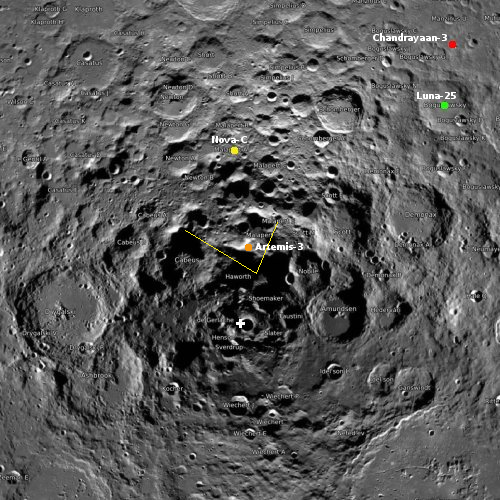
Click for interactive map. To see the original
image, go here.

India’s space agency ISRO announced on May 11, 2024 that the landing site for its Chandayaan-4 lunar sample return mission will be in the same area where its Chandrayaan-3’s Vikram lander touched down, carrying the Pragyan rover.

The map to the right shows that location, at about 69 degrees south latitude. The mission will require two launches, and will have five components, a propulsion module, a transfer module, a lander module, an ascender module and a re-entry module. The two rockets will use India’s LVM-3 and PSLV rockets.

The actual mission concept, including which modules will be launched with which rocket as well as whether they will dock in Earth or lunar orbit, has not yet been released. This most recent tweet however mentioned that the lander will only operate for one lunar day, which means it will land, grab its samples quickly, and send the ascender capsule up, all within an Earth week.

A launch timeline for the mission also remains unclear.

0 comments

China today launches “experimental” satellite

China today successfully launched what it called an “experimental” satellite designed to “monitor the space environment”, its Long March 2C rocket lifting off from its Jiuquan spaceport in the northwest of China.

The state-run press provided no other information. Nor did it tell us where the rocket’s lower stages, which use toxic hypergolic fuels, crashed inside China.

The leaders in the 2024 launch race:

49 SpaceX
21 China
6 Russia
5 Rocket Lab

American private enterprise still leads the world combined in successful launches, 56 to 33. SpaceX by itself now leads the rest of the world, including other American companies, 49 to 40.

0 comments

Significant water found in samples from China’s Chang’e-5 Moon mission

According to a new paper published in late April, scientists analyzing the samples returned from the Moon by China’s Chang’e-5 Moon mission in 2021 have found more water embedded in the topsoil than expected. From the paper’s conclusions:

[O]ur results indicate that a considerable [solar wind]-derived water is stored within at least the uppermost meter (down to 0.8 meters) of the regolith beneath the lunar surface. This type of water represents a valuable potential resource for future in situ exploration of the Moon, as it not only has higher contents than indigenous water (up to several wt.% vs. <50 ppm) but could also be extracted by heating.

We are still not talking about a lot of water, but this result suggests there is more than earlier reports from Chang’e-5’s samples. This result also could explain the hydrogen signature across much of the Moon’s surface by Chandrayaan-1.

7 comments

Serbia joins China’s lunar base project

Serbia this week signed an agreement with China to become the eleventh nation to join its International Lunar Research Station (ILRS) lunar base project.

China’s project now has eleven partner nations (Azerbaijan, Belarus, Egypt, Nicaragua, Pakistan, Russia, Serbia, South Africa, Thailand, Turkey, and Venezuela) and eleven academic or governmental bureaucracies.

Except for China and Russia, the other partners are very minor players in space, and will likely contribute relatively little to the lunar base other than providing China some shallow positive PR.

Nonetheless, the two competing alliances in settling the solar system are becoming clear. On one side you have the alliance led by the U.S. under the Artemis Accords, while on the other you have an alliance led by China, under its lunar base project. Both right now appear only interested in establishing government power in space.

In the middle will be ordinary people, dreaming of building new societies to live in on other worlds. Sadly it increasingly appears they will be crushed between these two big government alliances. Though the U.S. alliance was initially established to foster private property and ownership so that those settlers could have as free and as prosperous a life as the Americans who settled the United States, it no longer seems interested in that goal.

4 comments

FAA and Air Force initiate new environmental impact statements for Starship/Superheavy launchpads in Florida

We’re here to help you! Really! Late yesterday, in a typical Friday story dump just before the weekend to reduce any notice, the FAA announced it has begun a new environmental impact statement (EIS) of SpaceX’s Starship/Superheavy launchpad infrastructure being built in Florida, working in parallel with a similar environmental impact statement now being conducted by the Air Force.

The EIS will be the second environmental review involving SpaceX’s plans to use LC-39A for Starship launches. NASA completed an environmental assessment (EA) in 2019 of the company’s plans at the time to build launch infrastructure at LC-39A for Starship, finding it would have no significant impact. At the time SpaceX was planning up to 24 Starship launches from that pad annually. A new EIS, the FAA concluded, is needed because of changes in the design of Starship and its operations since the 2019 assessment.

The FAA claims a new assessment is needed because SpaceX is now planning as many as 44 launches. The Air Force has not said why its new assessment is needed. That EIS, which began in March, covers a launchpad previously used by the Saturn-1B and Delta-4 rockets from 1964 to 2022, another pad use by the Air Force’s Titan rocket from 1965 to 2005, as well as a new pad, dubbed SLC-50.

LC-39A meanwhile has been used for launches since the 1960s. The Saturn-5, the space shuttle, and the Falcon 9 all launched from this pad.

The dishonest absurdity of these impact statements can not be overstated. There is zero reason to do new assessments. All the pads have been in use for decades, with all kinds of rockets, some comparable to Superheavy/Starship. The environment and the wildlife refuge at Cape Canaveral have both thrived.

Moreover, to force completely new impact statements because the design and plans for Superheavy/Starship have changed somewhat (but not fundamentally) is even more stupid. This is a new rocket, being developed day-by-day and launch-by-launch. Will the FAA and the Air Force require new EIS’s every time SpaceX changes anything? It seems so.

This is clearly lawfare against Elon Musk and SpaceX by the White House and the administration state. It doesn’t like Musk, and it is now searching at all times for ways to block or damage him.

I confidently predict that neither statement will be completed by the end of 2025. Based on the timeline of most EIS’s, which when politics are involved are almost always slowed by the legal action of activists, the earliest either will be approved will be mid-2026, though likely later.

What is not clear is whether the FAA and Air Force will stop all work while this red tape is being unwound. If so, then the first operational launches of Superheavy and Starship cannot happen out of Cape Canaveral until well into 2027, which means NASA entire Artemis program will be seriously delayed. My previous prediction that the first manned lunar landing can’t happen before 2030 is becoming increasingly too conservative.

And remember this: If Joe Biden and the Democrats remain in power after November, all bets are off. At that point they are certain to ramp up the lawfare against those they see as political enemies, even if their targets are doing great things for the nation and the American people.

11 comments

Pentagon: SpaceX effectively blocking Russian illegal use of Starlink

According to one Pentagon official, SpaceX has effectively blocked Russia’s illegal use of captured or illegally purchased Starlink terminals.

Plumb declined to elaborate on what tactics, techniques or procedures are being used to stem Russia’s use of the highly portable communications terminals that connect to SpaceX’s fleet of low-orbiting satellites. Ukrainian government officials had no immediate comment.

Starlink terminals continue to be advertised for sale in Russia on platforms such as e-commerce site Ozon. Their sellers say they function through subscriptions taken out in the name of residents of European countries where the technology is licensed, and they say that connections work — not within Russia’s heartlands but near border regions such as Ukraine’s occupied territories.

This week, however, users complained of unprecedented connectivity issues. On the messaging app Telegram one of the sellers recommended transferring onto a more expensive global service plan. Bloomberg hasn’t been able to independently verify whether those workarounds restore connectivity for illicit Starlink use in Russia.

The official tried to make it sound as if the Pentagon was an equal partner with SpaceX in accomplishing this work, but that’s absurd. The military is without doubt helping SpaceX anyway it can, but the bulk of the technical work is almost certainly being done by SpaceX.

3 comments

Biden abandons Israel to appease student rioters and help Hamas survive

Joe Biden, allied with Hamas
Joe Biden, appeaser to Hamas and student rioters

The mask is off: President Joe Biden has now made it clear that if Israel moves into the southern Gazan city of Rafah in order to destroy Hamas’s last batallion of soldiers as well as its leadership, he will stop sending Israel major shipments of ammunition and bombs.

President Joe Biden said for the first time Wednesday he would halt some shipments of American weapons to Israel – which he acknowledged have been used to kill civilians in Gaza – if Prime Minister Benjamin Netanyahu orders a major invasion of the city of Rafah. “Civilians have been killed in Gaza as a consequence of those bombs and other ways in which they go after population centers,” Biden told CNN’s Erin Burnett in an exclusive interview on “Erin Burnett OutFront,” referring to 2,000-pound bombs that Biden paused shipments of last week.

“I made it clear that if they go into Rafah – they haven’t gone in Rafah yet – if they go into Rafah, I’m not supplying the weapons that have been used historically to deal with Rafah, to deal with the cities – that deal with that problem,” Biden said.

Let’s distill the real significance of Biden’s decision:
» Read more

12 comments

Proposed private GPS-type satellite constellation raises $19 million

Capitalism in space: Xona, a company that wants to build a commercial GPS-type satellite constellation, has now raised $19 million in private investment capital.

The round was led by Future Ventures and Seraphim Space. New investors NGP Capital, Industrious Ventures, Murata Electronics, Space Capital, and Aloniq also joined the round.

Xona is developing a commercial positioning, navigation and timing (PNT) service through a constellation of low-Earth orbit satellites. The company plans to offer the service as an alternative or backup to the Global Positioning System.

It appears the commercial users of GPS want more than one American-owned system in operation in case the government’s present constellation goes out, either because of an attack, jamming, or a major technical failure, and are willing to pay for it. Xona’s constellation, once built, could initiate the full transfer of GPS responsibility from the government to the private sector.

3 comments

A French rocket startup enters the competition

A new French rocket startup, Hyprspace, has assembled the engine and body of a first stage demonstrator, dubbed Terminator, to be used to test that new engine in preparation for the first suborbital test launch.

On 4 May 2024, the company shared the first glimpse of the Terminator demonstrator at its facility in Le Haillan, France. According to the update, teams had worked through double shifts over a three-week period to prepare the demonstrator for its test firing. The test will be conducted at a Direction générale de l’armement missile test facility in Gironde, France. HyPrSpace has not yet revealed when the test is expected to take place.

This engine will eventually be used in the company’s planned orbital Baguette-1 rocket for launching smallsats.

We now have at least five European rocket startups, three in Germany (Rocket Factory Augsburg, Isar, Hyimpulse), one in Spain (PLD), and one in France (Hyprspace). We also have Avio in Italy taking over ownership from Arianespace of its Vega family of rockets. That company is about to begin static fire testing a Vega-C upper stage, its engine nozzle completely redesigned following a launch failure. It hopes to resume flying by the end of the year.

4 comments
1 130 131 132 133 134 988