SpaceX’s decision to build launchpad with Starship tanks proves the rocket will be cheapest ever built

Capitalism in space: The decision by SpaceX’s to build the tank farm for its Starship/Super Heavy launchpad at Boca Chica using Starship tanks, rather than inexpensive off-the-shelf storage tanks, strongly suggests that the company’s manufacturing facility for building those tanks makes them very inexpensive, and also suggests that the final rocket will be as cheap to launch as SpaceX has promised.

SpaceX is effectively taking identical rocket parts, slightly tweaking a handful of those parts, and turning what could have been a rocket into a propellant storage tank. This is significant because relative to all other rockets in history, even including SpaceX’s own Falcon 9 and Heavy, building storage tanks with unchanged rocket parts on a rocket assembly line would be roughly akin to hiring Vincent van Gogh to paint lane lines.

Ever since Elon Musk made the radical decision to switch from composite structures to stainless steel, Starship has always aimed to be radically different than any large rocket before it. Crucially, by using commodity steel, the CEO imagined SpaceX would be able to build Starships fairly easily and for pennies on the dollar next to even SpaceX’s exceptionally affordable Falcon 9. In the last 18 months, it’s become apparent that SpaceX has built a factory capable of churning out one or two massive steel rockets per month and is willing to consign at least four or five of those Starship prototypes to all-but-guaranteed failures for the sake of data-gathering and iterative improvement.

Technically, the most logical conclusion would be that Musk was right and that SpaceX has quickly developed the ability to build steel rockets larger than any other launch vehicle on Earth for perhaps just $5M or less apiece.

The analysis at the link is detailed and worth reading. If correct, this decision by SpaceX proves that Starship and Super Heavy will be the cheapest rocket ever flown, even though it will be the largest ever flown, and also completely reusable.

11 comments

Russia’s first private space tourism company shuts down

Capitalism in space? Russia’s first private space tourism company has been forced to close before it even launched its first rocket because of the obstacles placed before by Russia’s government.

Kosmokurs’ operations will cease due to “insurmountable difficulties” in coordinating with local authorities on the cosmodrome project as well as the company’s “inability to obtain needed regulatory documents from the Defense Ministry” for the design of a suborbital tourist rocket, its CEO Pavel Pushkin told RIA Novosti.

However, the government-run Roscosmos, which controls the rest of Russia’s aerospace industry, has graciously announced it will hire Kosmokurs’ fifty employees.

Do you see a pattern? I do. Kosmokurs was cutting into Roscosmos’s territory. That could not be tolerated, and so the government moved to sabotage it. Now that it is dead, the government can absorb it to try to build its rocket and make money using it.

This kind of mob rule by the Russian government is why that country’s space industry is failing to compete with the new commercial industry coming out of the U.S. and elsewhere. It does not tolerate free competition, only top-down control by the government. The result is that while Russia might eventually fly its own space tourism rockets, it will have only one, and it will likely not be as efficient or as competitive. The only cost advantage it will likely have is Russia’s low wages.

5 comments

Rocket startup ABL Space gets giant Lockheed Martin launch contract

Capitalism in space: Smallsat rocket startup ABL Space, which has yet to launch its first test rocket, has won a gigantic launch contract from Lockheed Martin for as many as 58 launches through 2029.

Under terms of the block-buy agreement between ABL Space Systems and Lockheed, the aerospace giant will purchase “up to” 26 launches through 2026 and as many as 32 additional launches through 2029. If the terms are fulfilled, this would come to 58 launches over the next eight years for ABL Space. In an industry where even a single launch contract often produces a news release, a contract for five dozen launches is unprecedented for a private company.

…The partnership will allow Lockheed, which builds large numbers of satellites for commercial customers, frequent and low-cost access to space. It is perhaps not a surprise that Lockheed selected ABL Space for its small launch needs, as Lockhead was an early investor in the launch company during a seed phase in 2019 and has continued to participate in additional rounds of fundraising. ABL has raised a total of $219 million to date.

Though Lockheed Martin is not ABL’s biggest investor, by being an early investor it has been involved in the development of ABL’s RS1 rocket from the start, which also means that Lockheed Martin was essentially buying its own rocket company to place the satellites it makes into orbit.

In fact, this decision falls into line with what appears to be Lockheed Martin’s long term corporate strategy. In 2017 the company opened its satellite-making factory with the satellites designed with standardized structures so that customers could pick and choose the design of their liking.

In 2018 it was revealed that the company was a key investor in Rocket Lab, while also participating in the creation of the United Kingdom’s first spaceport in Sutherland, Scotland.

It then decided to become a major investor in ABL, probably taking advantage of what it learned from Rocket Lab to improve the design. Now it plans to use that new rocket to launch a large number of the smallsats it is building in its factory.

Lockheed Martin is essentially copying SpaceX’s vertical integration strategy, whereby it owns or builds all aspects of its launch business. This allows it to reduce costs while controlling construction entirely. You cut out the middle man, and make your satellites cheaper to sell to others.

The first launch of ABL’s RS1 rocket was originally scheduled for the first half of this year, but has now been pushed back to the third quarter. If successful the company says it will follow it with two more launches before the end of the year, and very ambitious schedule.

2 comments

Colorful mesa in the Martian northern lowland plains

Colorful mound in Martian northern lowland plains
Click for full image.

Cool image time! The photo to the right, rotated and cropped to post here and taken on January 15, 2021 by the high resolution camera on Mars Reconnaissance Orbiter (MRO), shows the colorful top of a small mesa in the northern lowland plains of Mars and about 300 miles north of the planned landing zone for Europe’s Franklin rover, scheduled to launch in 2022.

What makes this mesa stand out is the bright and colorful areas on its slopes. The colors are false, but they indicate [pdf] certain things. The yellow is likely dust covered rock. The pinkish rock is also likely dust-covered, but made up of coarser material. The bluish strip running along the mesa’s northern slope is possibly frost or ice, not unlikely as this mound is at 25 degrees north latitude and was taken during winter. The slope faces north, which would put it in shadow much of the time during winter.

The colors however only hint at what is there.
» Read more

0 comments

Methane tank leak caused Starship #11 failure

Capitalism in space: According to Elon Musk, a small leak of methane from one tank caused the failure of the eleventh Starship prototype. From Musk’s tweet:

Ascent phase, transition to horizontal & control during free fall were good.

A (relatively) small CH4 leak led to fire on engine 2 & fried part of avionics, causing hard start attempting landing burn in CH4 turbopump.

This is getting fixed 6 ways to Sunday.

Meanwhile, prototype #15 is getting prepped for rollout to the launchpad (Numbers 12-14 were scrapped), and the first prototype of first stage Super Heavy is being assembled to testing. It is presently unclear when either will take place, though the company still has a target date of July for its first orbital launch. According to Musk, the first orbital prototypes of Starship will be those numbered 20 or higher.

“Those ships will be orbit-capable with heat shield & stage separation system,” Musk tweeted. “Ascent success probability is high. However, SN20+ vehicles will probably need many flight attempts to survive Mach 25 entry heating & land intact.”

Knowing those first orbital ships will likely not land properly raises the question as to where they will be aimed to come down. SpaceX now owns two retired floating oil platforms, and is preparing them for use by Starship/Super Heavy. It could very well be that test flights of prototype #20+ will take place to and from those pads, out in the ocean, so as to minimize any risk to populated areas. Doing so will also allow SpaceX to hone its procedures for moving these big spaceships to and from the platforms.

21 comments

Resilience successfully moves from one ISS docking port to another

With four astronauts on board the Dragon capsule Resilience tonight successfully undocked from one docking port on ISS and redocked to a different port.

This was the first time an American spacecraft had accomplished this task. It was necessary to clear the docking port that the next Dragon capsule, Endeavour, will use to bring its crew to ISS, presently set for launch on April 22nd.

Russian astronauts have piloted Soyuz spacecraft between different ports numerous times, both on ISS and on Russia’s earlier space stations. Tonight’s transfer by Resilience however was done entirely on autopilot. The American astronauts could have taken over manually at any time, but the spacecraft did the entire maneuver on its own.

There is a certain irony in how the Russians have always done this maneuver, manually, and how Resilience did this, without any human intervention. From the 1960s through the entire space shuttle program Americans and all its astronauts strongly demanded that their spacecraft be piloted, by the humans on board, rather than being controlled by software or ground control. The Russians instead insisted, at least initially, that while their astronauts had the capability of doing all maneuvers manually, their software or mission control should run things. This difference seemed to nicely symbolize the down-up nature of America versus the top-down culture of Russia.

Things are now reversed. I wonder if that tells us anything about the two cultures today.

8 comments

More leaks found in Russian Zvezda module on ISS

Earlier this week Russian astronauts located and patched three more leaks in the 20+ year old Russian Zvezda module on ISS.

Prior to this week’s discovery, the recent patching done by Russian astronauts had reduced the air loss by about half. They need to do another seal test of Zvezda to see if these newer patches have reduced it further.

The report at the link from Russia is as usual very vague. No photos of any of the leaks have been released, by either Russia or NASA. No cause either has been described. This lack of information suggests that the leaks represent a more systemic problem, possibly related to stress fractures from age and wear. If so, it also suggests that Zvezda is nearing its pull-date. How this central module will be replaced from the station remains a major mystery.

Above all, this puts some urgency to the launch of newer modules, such as those being built by the private company Axiom.

9 comments

Ingenuity released from Perseverance

Ingenuity on the ground
Click for full image.

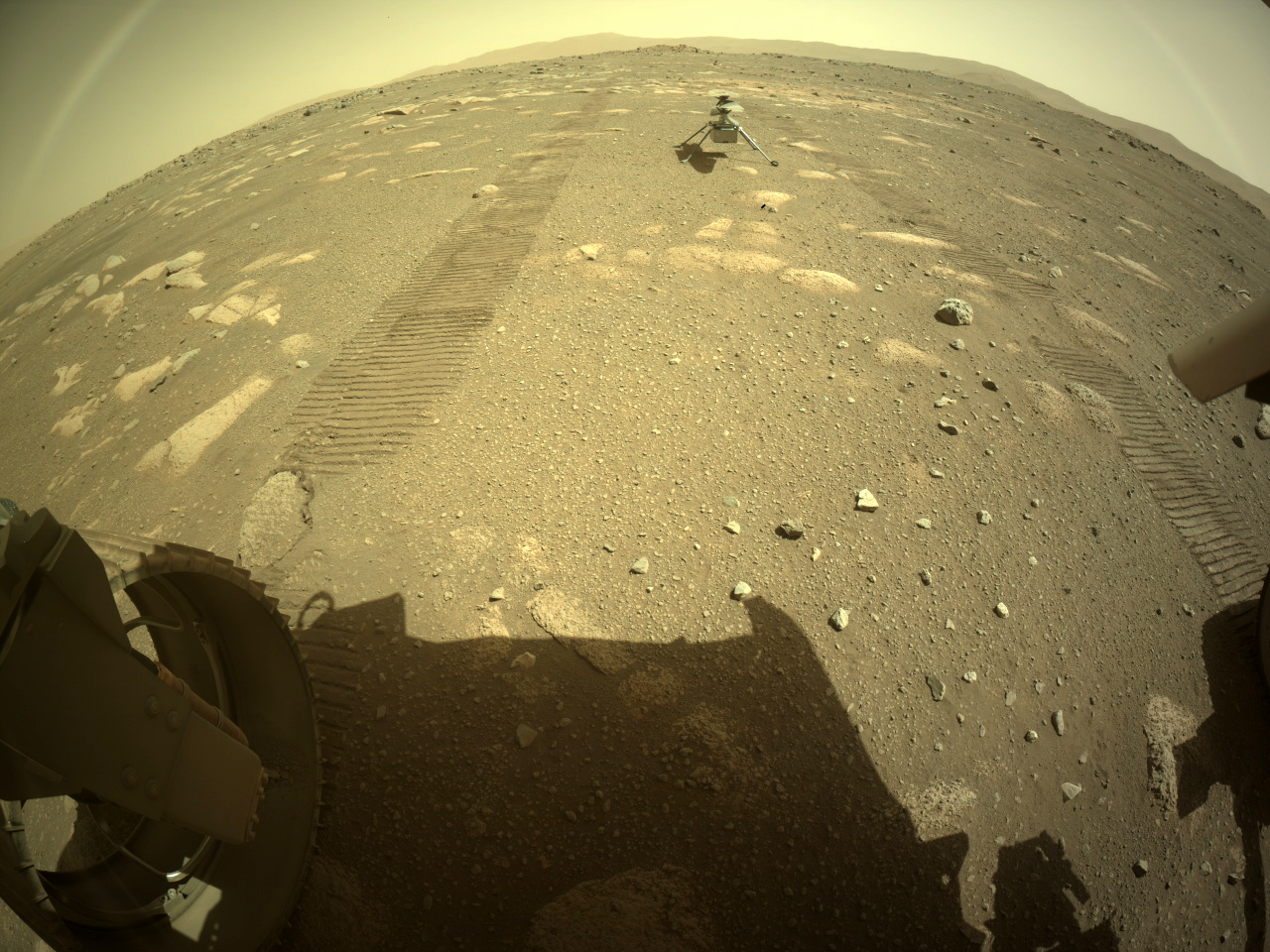
Perseverance engineers have now confirmed that the Ingenuity helicopter was successfully released below the rover earlier today, and the rover immediately moved away to expose the helicopter to sunlight so that its solar panels can charge its batteries.

The photo to the right, cropped to post here, was taken by one of Perseverance’s rear hazard avoidance cameras, shortly after the release and move. They will now begin about a week of check-outs to make sure Ingenuity is functioning properly, even as they drive Perseverance a distance away to a lookout point where it can safely observe the helicopter’s test flight on Mars, presently targeted for April 11th. If successful this will be the first powered flight ever achieved on another world.

13 comments

Sunspot update: Higher than predicted activity continues

The uncertainty of science: Time for our monthly update of the Sun’s on-going sunspot cycle. Below is NOAA’s April 1, 2021 monthly graph, showing the Sun’s sunspot activity through the end of March 2021. I have annotated it as always to show the previous solar cycle predictions.

The higher than expected sunspot activity that has been occurring almost from the moment the ramp up to solar maximum began in 2020 continued in March. The numbers weren’t as high as they were in December and January, but they were still higher than the predicted sunspot number.

» Read more

5 comments

Falcon 9 upper stage debris lands on Washington farm

Falcon 9 helium pressure tank
Click for full image.

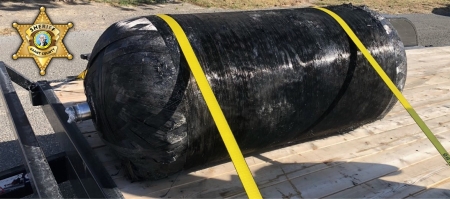
When a Falcon 9 upper stage broke up over the Pacific northwest last week apparently one of its interior helium pressure tanks, used to help push the fuel or oxidizer from the larger tank during launch, fell on a Washington farm and has since been recovered.

The image to the right is that tank, in what appears to be remarkable shape. From the article:

Composite-overwrapped pressure vessels, or COPVs, are standard components in Falcon 9 rockets. They’re designed to hold the helium gas that’s used to pressurize propellant tanks. COPVs are likely candidates to survive re-entry because they’re relatively lightweight and heat-resistant.

The tank has been returned to SpaceX, which I am sure is going to be very interested in studying its condition very thoroughly.

23 comments

Russian gov’t okays extension of U.S cooperative space treaty to ’30

The Russian government yesterday officially approved an extension to 2030 of the cooperative space treaty with the United States that was initially signed in 1992.

According to the TASS article at the link, the U.S. government has already approved this extension. The original agreement was for U.S. flights to the Russian space station Mir. It has been renewed four times since to cover the deal to build and use ISS.

This could very well be the last extension of this deal. By 2030 private commercial American stations should be operational, and the age of some of the oldest sections of ISS will likely need replacement. At that point the U.S. will probably decide to retire its half of ISS.

What the Russians will do is uncertain. The government doesn’t have the cash to build its own station. Nor has that government allowed a private commercial space industry to thrive and thus be financially able to build private commercial stations. Russia may separate its part of ISS and attempt to keep it aloft, but some of their modules are the oldest, and have shown signs of that age.

4 comments

Two pits at opposite ends of Mars’ big volcanoes

Overview map

Regular readers of Behind the Black know that since 2018 I have regularly documented all the images of pits taken by the high resolution camera on Mars Reconnaissance Orbiter (MRO). (See my last pit post in January for a full list of these previous articles.) The black dots on the map to the right shows the location of all the pits near the volcanoes Arsia and Pavonis Mons that have so far been highlighted here.

The two white dots are the two most recent MRO pits, and are the subject of today’s cool image. They also happen to be the farthest north and south pits so far documented. The southernmost pit, which I am saving till last, is the most interesting.
» Read more

2 comments
1 90 91 92 93 94 126