NASA in contact with China to get the orbital data of its Tianwen-1 Mars Orbiter

Though by law NASA and the scientists cannot exchange data or communications with China due to security concerns, NASA and Chinese officials did exchange communications recently in order to coordinate the orbits of their orbiters presently circling Mars.

Jurczyk noted that NASA’s knowledge of China’s space program is largely limited to publicly available information because of restrictions placed by federal law on its interactions with Chinese organizations. Those restrictions do allow NASA to engage with China if approved by Congress. “Most recently, we had an exchange with them on them providing their orbital data, their ephemeris data, for their Tianwen-1 Mars orbiting mission, so we could do conjunction analysis around Mars with the orbiters,” he said.

In a brief statement to SpaceNews late March 29, NASA confirmed it exchanged information with the China National Space Administration (CNSA), as well as other space agencies that operate spacecraft at Mars. “To assure the safety of our respective missions, NASA is coordinating with the UAE, European Space Agency, Indian Space Research Organisation and the China National Space Administration, all of which have spacecraft in orbit around Mars, to exchange information on our respective Mars missions to ensure the safety of our respective spacecraft,” the agency said. “This limited exchange of information is consistent with customary good practices used to ensure effective communication among satellite operators and spacecraft safety in orbit.”

Such limited communications are actually permitted under the law that Congress passed, as long as they do not involve any exchange of technical information. There has been a push, however, in the planetary community for years to increase direct communications with China, allowing the transfer of all kinds of information, both scientific and technical. Until the law gets changed none of this should happen.

Of course, what matters laws these days? I will not be surprised if the Biden administration, rather than demanding a change in the law, instead begins expanded communications between NASA and China, in complete and utter contempt for the law, with no one objecting.

1 comment

Congress taking aim at SpaceX and Starship testing

They’re coming for you next: The Democratic Party leaders on the House committee that normally does not overseer the FAA’s commercial space office have now raised their concerns about the recent test flights of SpaceX’s new rocket, Starship, in particular demanding an investigation into the flight of prototype #8, which the FAA claims had occurred despite one FAA issue.

The latest version of SpaceX’s FAA launch license for the Starship suborbital test flight program, issued March 12, allows those test flights to take place “only when an FAA Safety Inspector is present at SpaceX’s Boca Chica launch and landing site.”

The change stemmed from an investigation into SpaceX’s violation of that launch license during the SN8 test flight in December. SpaceX proceeded with the flight despite the FAA determining that the flight profile exceeded the maximum allowed risk to the uninvolved public for “far field blast overpressure” in the event of an explosion. While the SN8 vehicle exploded upon landing, there were no reports of damage outside of the SpaceX test site.

FAA directed SpaceX to investigate the incident, delaying the flight of the next Starship prototype, SN9. That investigation included “a comprehensive review of the company’s safety culture, operational decision-making and process discipline,” the FAA said in a Feb. 2 statement.

The FAA cleared SpaceX to proceed with launches, with SN9 and SN10 launching and landing — and both exploding upon or shortly after landing — on Feb. 2 and March 3, respectively. Neither caused any damage outside of the SpaceX test site.

The FAA’s response to SpaceX’s launch license violation, including the lack of any penalties beyond the investigation, prompted criticism from two key members of Congress. In a March 25 letter to FAA Administrator Steve Dickson, Reps. Peter DeFazio (D-Ore.) and Rick Larsen (D-Wash.) sought to “register our concerns” with the incident. DeFazio is chair of the House Transportation Committee and Larsen the chair of its aviation subcommittee.

Much of these claims about the flight of prototype #8 however only appeared to become a significant concern after the Biden administration and the Democrats took power in January. Prior to that the FAA did not seem very troubled by that flight. In fact, the so called risk, “far field blast overpressure,” seems very contrived, especially since we have now had four Starship crashes on its landing pad, with no evident damage to even SpaceX’s own equipment nearby. Prior to January 20th the FAA was untroubled. After January 20th it suddenly became a deadly issue requiring stricter supervision by the government, though what that FAA inspector on sight can do or even know about the launch is baffling.

What these Democrats really don’t like is that someone is freely accomplishing something without their supervision or control. Like mobsters looking to exhort money, they are essentially telling SpaceX, “Nice business you got here. Sure would be a shame if something happened to it.”

With today’s fourth Starship crash, expect the Demorats in Congress now to swarm like flies over manure, all aimed at shutting down the most innovative new American space company in decades.

21 comments

Starship prototype #11 crashes at landing

Capitalism in space: The fourth prototype of Starship to fly, #11, experienced another failure at landing early this morning, crashing onto its launchpad.

Below is SpaceX’s live feed, cued to begin at T-10 seconds. The video cuts out at T+5:49, just before landing. I have reviewed other live feeds and all that I can find so far were obscured by the cloudy conditions at landing.

Musk later tweeted the following:

‘At least the crater is in the right place!”

“Looks like engine 2 had issues on ascent & didn’t reach operating chamber pressure during landing burn, but, in theory, it wasn’t needed. Something significant happened shortly after landing burn start. Should know what it was once we can examine the bits later today.”

The next Starship prototype will be #15 (numbers 12-14 pulled when they decided to redesign based on the earlier flights).

27 comments

Martian glaciers flowing off interior walls of Renaudot Crater

Overview map

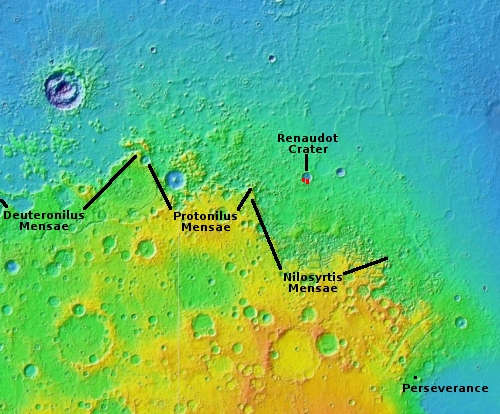
Cool image time! In the March 1st image release from the high resolution camera on Mars Reconnaissance Orbiter (MRO) were two pictures covering sections of the interior rim of 40-mile-wide Renaudot Crater, located in the northern lowland plains of Mars north of the region I dub Mars’ glacier country.

The map to the right provides the context. The two red boxes in Renaudot Crater show the location of the two images below, with the first being the one to the left. Located at about 42 degrees north latitude, we should expect to see evidence of ice and glacial features here, and that is exactly what both photos show.
» Read more

0 comments

Deployment process of Ingenuity begins

Ingenuity on the bottom of Perseverance
Click for full image.

Ingenuity vertical under Perseverance
Click for full image.

The photo to the right, cropped and reduced to post here, shows the Ingenuity helicopter attached to the base of the Perseverance rover, with its left end (the white box in the middle) now lowered. Previously the helicopter was stored horizontal against the rover’s base.

This photo was taken yesterday by Perseverance’s Watson camera, which provides images of the rover’s bottom and wheels.

The deployment process has only begun. They need to get that white box vertical and on the ground, then unfold the blades that are attached above it. I suspect as the base is dropped the two blades to the left will remain attached to Perseverance, thus partly unfolding them. I also suspect that full deployment of all four blades (the right two blades are what looks like a post with a bulbous end on the right of the base) will not occur until Ingenuity is fully detached and Perseverance has moved away. My error. I mistook the helicopter’s landing legs for its blades. Two of the legs (on the left) appear deployed, while two (on the right) remain in their stored position.

UPDATE: Ingenuity is now vertical, underneath Perseverance, as shown by the second image to the right.

These images are from yesterday, so these are actions that the rover and helicopter are doing autonomously. It appears from later images that the second set of legs began deploying next.

5 comments

Another launch attempt for Starship #11 today

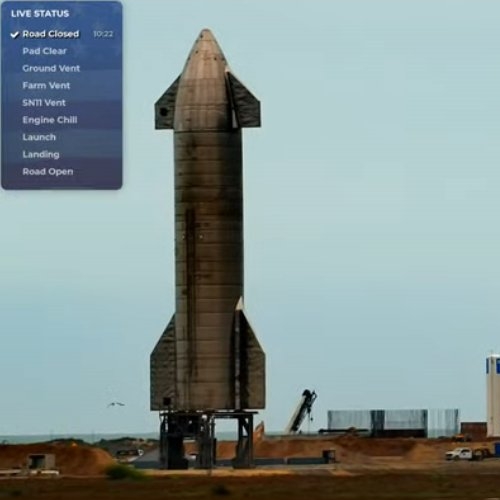
Starship #11 on launchpad, March 28, 2021
Screen capture from LabPadre Nerdle camera live stream,
taken at 10:27 am (Central).

UPDATE: Launch scrubbed because an FAA official was unable to get to the launch site today. Next attempt set for tomorrow.

Gee, launching rockets his hard. For government officials, however, getting on an airplane and arriving on time seems far more difficult.

Original post:
————————–
SpaceX is going to make another launch attempt today with its eleventh Starship prototype. The following live streams are presently available if you wish to watch:

When SpaceX adds its own live stream I will embed it below.

The screen capture on the right shows the status for the launch in that left column. When I captured the image they had only closed the road, which means the launch is still probably two hours away, at the least.

11 comments

South Korea’s leader announces his nation’s goals in space

The new colonial movement: Moon Jae-in, South Korea’s president since 2017, on March 25th gave his first speech focused on his nation’s goals in space, outlining plans to encourage private enterprise as well as achieving an unmanned mission to the Moon by 2030.

His speech listed three main programs. First, they are developing their own home-built rocket, dubbed the KSLV-2, which they hope to launch on its first orbital test flight by October of this year.

Second, he touted a project to send a probe to the asteroid Apophis in 2029. I described this probe in my November 2020 report on a science conference focused entirely on Apophis. If all goes well, they hope to have the probe fly in formation with the asteroid as it makes its close approach that year.

Third, he committed his nation to landing an unmanned lander on the Moon by the end of this decade. (Sound familiar?)

While much of this was the typical photo-op stuff that politicians love, designed mostly to enhance their public image, Moon did make it clear their goals are also to foster a new private aerospace industry that would compete in the emerging new space market.

Moon underscored the role of the private sector in enhancing Korea’s space development capabilities. To that end, he said, the government will step up efforts to build an “innovative industrial ecosystem that nurtures global space companies such as SpaceX.”

Another issue he put forth was strengthening international competitiveness of made-in-Korea satellite systems, in the lead-up to the introduction of 6G wireless networks, self-driving vehicles, and other products and services enabled or enhanced by satellites.

All-in-all, it is actually surprising that up to now South Korea has not made its presence felt in space. This announcement suggests they now intend to change that.

6 comments

Bigelow sues NASA for $1 million

The commercial space station company Bigelow Aerospace has now sued NASA for $1 million, claiming that the agency has refused to pay it for work done.

Bigelow Aerospace said it entered into an agreement with NASA on the B330 project in August 2016 to perform and complete a certain long-term pressure leak test on its prototype. The purpose of the test was to demonstrate that the B330 meets NASA’s standards of construction and reliability.

According to the lawsuit, Bigelow Aerospace was required to perform a leak test on its module and “provide certain periodic test reports” to NASA. The reports were scheduled and were required to summarize the results of the test, specifically whether the B330 had met certain standards set by NASA. “Importantly, the Contract contains no requirement that Bigelow Aerospace had to provide NASA with continuous and/or raw” data, the lawsuit alleges.

Bigelow Aerospace said NASA breached its contract with the agency by refusing to pay the full amount to the company. The company said that its damages are in excess of $1 million because it had to hire attorneys to bring the lawsuit forward.

According to the suit, multiple attempts were made between January and February to demand payment. The lawsuit said that NASA’s attorney requested raw test data from Bigelow’s testing carried out under the contract as a prerequisite of being paid the amount owed. “However, this requirement was not a term of the Contract, and was an attempt by NASA to place additional requirements on Bigelow Aerospace that had not been part of the parties’ agreement,” according to the lawsuit.

Until 2016, when Bigelow’s prototype BEAM module was installed on ISS, this company seemed the world’s unmatched leader in the construction of private commercial space station modules. It had already flown two prototypes successfully, and then built BEAM for NASA in only two years for a mere $17 million.

Since then it seems Bigelow has been stalled by Washington politics and some insider maneuvering at NASA. In January 2020 NASA picked Axiom to build the first commercial operational private modules to be attached to ISS, not Bigelow. I wondered then why Bigelow had been bypassed by a company that had never built anything. Noting how Axiom had numerous NASA insiders in its management, many with links to Boeing, I concluded:
» Read more

25 comments

Baffling ridges on Mars

Baffling ridges on Mars
Click for full image.

Today’s cool image is one of my “what the heck?” photos. The picture to the right, cropped and reduced to post here and taken on September 3, 2020 by the high resolution camera on Mars Reconnaissance Orbiter (MRO), shows a strange dune field of many parallel long dunes, cross-cut by larger ridges.

Are the larger ridges dunes? Or are they some form of volcanic or tectonic ridge, which is also very typical of this region, called Tempe Terra and located in the transition zone between the southern cratered highlands and the northern lowland plains?

Or are they eskers, ridges frequently found in places that were once covered by glaciers? At 35 degrees north latitude, it would not be surprising to see glacial features here, but as far as I can tell, the full image has no obvious such features.
» Read more

4 comments

Radar images of Apophis during its March close approach of Earth

Apophis as seen by radar March 9, 2021
Click for full image.

Using two radar dishes, Green Bank in West Virginia and Goldstone in California, astronomers were able to produce radar images of the asteroid Apophis during its most recent close fly-by of Earth on March 10th.

The image to the right, cropped and reduced to post here, shows Apophis on March 9th. If you go to the full image you can also see the March 10th and 11th images, which appear to show the asteroid in different orientations as it rotated.

These images represent radar observations of asteroid 99942 Apophis on March 8, 9, and 10, 2021, as it made its last close approach before its 2029 Earth encounter that will see the object pass our planet by less than 20,000 miles (32,000 kilometers). The 70-meter radio antenna at the Deep Space Network’s Goldstone Deep Space Communications Complex near Barstow, California, and the 100-meter Green Bank Telescope in West Virginia used radar to precisely track Apophis’ motion. At the time of these observations, Apophis was about 10.6 million miles (17 million kilometers) from Earth, and each pixel has a resolution of 127 feet (38.75 meters).

The data obtained has firmly removed any chance Apophis will impact the Earth in the next 100 years. However, it still could hit us late in the 22nd century.

These observations were originally planned to also include data from the Arecibo Observatory, but that telescope was destroyed in December when its instrument platform collapsed. If it had been operational, these radar images would have had much better resolution.

2 comments

Redwire to go public

Capitalism in space: Redwire, the space company created when it merged with Made in Space in exchange for providing it a large influx of capital, is now going public, merging with another investment capital SPAC.

Redwire, a firm that has acquired several space technology companies in the last year, announced March 25 that it will go public by merging with a special-purpose acquisition corporation (SPAC). Redwire said it will merge with Genesis Park Acquisition Corp., a SPAC that went public in November 2020. The merger will provide Redwire with $170 million in capital, valuing the company at $615 million. The companies expect the deal to close by the end of the second quarter of this year, at which point Redwire will be publicly traded on the New York Stock Exchange.

…Redwire [is] unique among space companies going public through SPACs in that it has both revenues and profits. The company reported $119 million in revenue in 2020, with adjusted earnings before interest, taxes, depreciation, and amortization (EBITDA) of $13 million.

This company now joins Momentus, Rocket Lab, Astra, and a number of other new commercial space startups that have recently announced the decision to go public.

0 comments

Firefly’s 1st Alpha rocket almost ready for launch

Capitalism in space: According to Firefly’s CEO Tom Markusic, the company’s first Alpha rocket almost ready for launch, and should fly this year, with one or two commercial flights to quickly follow.

Alpha is “ready to go,” but two other major issues delayed its launch, Markusic said. The first involved an avionics flight termination system piece from an external vendor (whom Markusic did not name), which had qualification issues that created delays.

Also, Markusic said, “we didn’t put enough focus on the launch site.” Upgrading the United Launch Alliance Delta II facilities Firefly inherited at Vandenberg proved to be “more challenging than anticipated,” he added, but “we’re literally weeks away from being done.”

Based on the interview at the article, it sounds like launch is less than a couple of months away, which is still a delay from their previously announced launch date in March, a date that has now passed.

0 comments
1 92 93 94 95 96 126