InSight detects additional 3+ magnitude quakes on Mars

Martian quake map as seen by InSight

According to a JPL press release today, the seismometer on the Mars lander InSight detected two new 3+ magnitude quakes in March, both coming from the Cerberus Fossae region, the same region where the bulk of seismic activity has so far been pinpointed on Mars.

The map to the right was presented several weeks ago at the 52nd Lunar and Planetary conference, and could possibly include one of these two new quakes. The timing however of these March quakes is significant:

The new quakes have something else in common with InSight’s previous top seismic events, which occurred almost a full Martian year (two Earth years) ago: They occurred in the Martian northern summer. Scientists had predicted this would again be an ideal time to listen for quakes because winds would become calmer. The seismometer, called the Seismic Experiment for Interior Structure (SEIS), is sensitive enough that, even while it is covered by a dome-shaped shield to block it from wind and keep it from getting too cold, wind still causes enough vibration to obscure some marsquakes. During the past northern winter season, InSight couldn’t detect any quakes at all.

They are beginning to use the lander’s scoop to cover the seismometer and its communications tether with sand to protect both from the wind and temperature fluctuations. Once done they hope to be able to detect quakes during the entire Martian year, though this ability will be further limited by a reduction in power.

Despite the winds that have been shaking the seismometer, InSight’s solar panels remain covered with dust, and power is running lower as Mars moves away from the Sun. Energy levels are expected to improve after July, when the planet begins to approach the Sun again. Until then, the mission will successively turn off the lander’s instruments so that InSight can hibernate, waking periodically to check its health and communicate with Earth. The team hopes to keep the seismometer on for another month or two before it has to be temporarily turned off.

1 comment

Tianwen-1’s engineers set mid-May for rover landing on Mars

The new colonial movement: The science team for China’s Tianwen-1 orbiter are now targeting mid-May for when they will release and land the as-yet unnamed rover for its landing on Mars.

Wang Chi, director of the National Space Science Center at the Chinese Academy of Sciences, said March 23 that Tianwen 1’s lander and rover are scheduled to touch down on Mars in May.

“The first Chinese Mars mission, Tianwen 1, is now orbiting Mars, and we are landing in the middle of May,” Wang said in a presentation to the National Academies’ Space Studies Board. “We are open to international cooperation, and the data will be available publicly soon.” [emphasis mine]

Though China has generally released the scientific data of its lunar probes eventually, they have done it slowly. In the case of Tianwen-1, they released so far practically nothing, with the only images released being two hi-resolution ground images and a handful of distant global pictures of Mars.

0 comments

Very peculiar flow features on Mars

Peculiar flows on Mars
Click for full image.

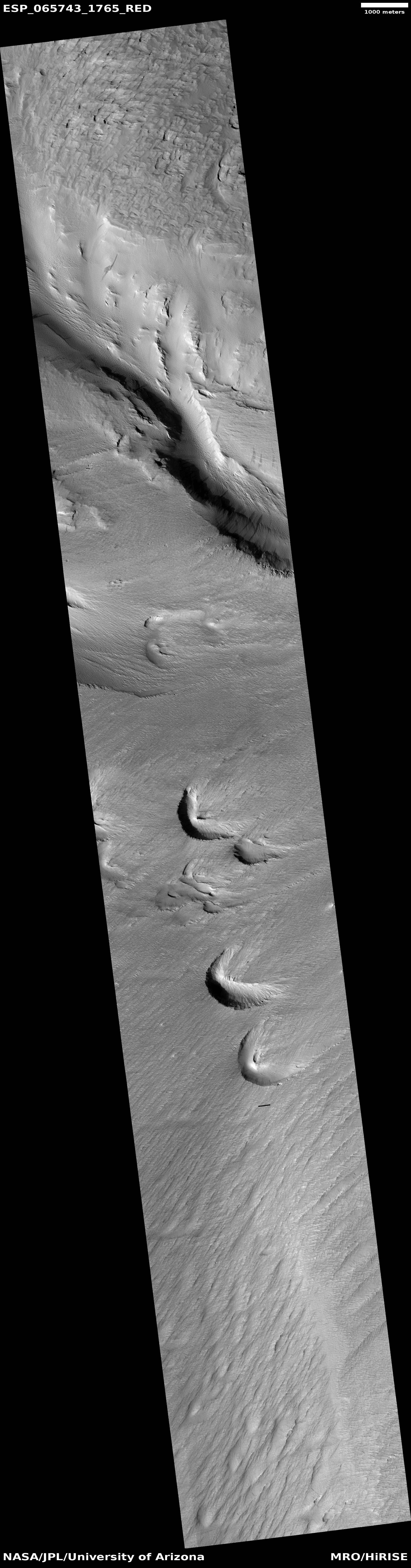
Today’s cool image focuses on one of the weirdest flow features I have yet seen on Mars. The first photo to the right, rotated and cropped to post here, comes from a January 27, 2021 picture by the high resolution camera on Mars Reconnaissance Orbiter (MRO). This cropped section focuses on the middle of three such weird features, two close flows heading downhill on the interior rim of very eroded 28-mile-wide crater. For some reason the flows also have depressions on their crowns. The depressions almost look like someone carved them out with a spackling spatula. In fact, the MRO science team agrees, labeling this image as “Spatulate Depressions with and without Upslope Gullies.”

The second image to the right shows a wider crop of the same picture, and explains the reason for the last half of that label.
» Read more

3 comments

Ingenuity unfolded and ready for placement on ground

Ingenuity unfolded
Click for full image.

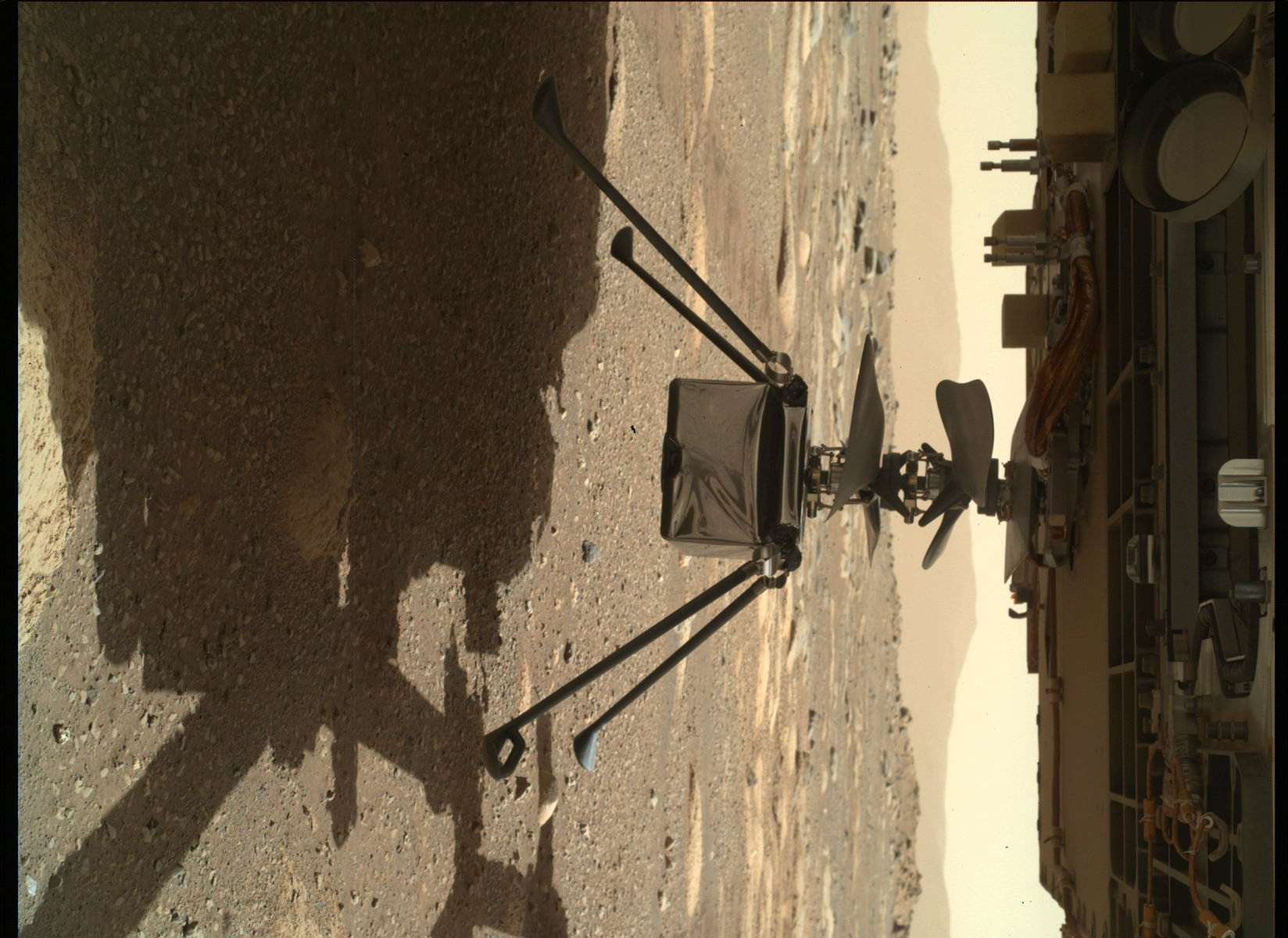
The photo to the right, taken yesterday, shows Perseverance’s Ingenuity helicopter now vertical with its legs deployed, hanging from the bottom of the rover and ready for placement on the ground.

The next step will be drop Ingenuity those last few inches. Once released Perseverance will quickly drive away, as it will no longer be providing power to the helicopter and will instead be blocking its solar panels from sunlight.

Perseverance will then proceed to its lookout post while engineers check out Ingenuity to make sure all is working.

The targeted flight date remains April 8th.

UPDATE: JPL just announced that it is delaying Ingenuity’s flight to April 11th. The announcement was done by a tweet, so provided no explanation as to why JPL decided to delay three days.

11 comments

Sierra Nevada will build space stations and a manned version of Dream Chaser

Sierra Nevada's proposed LIFE space station
Artist conception of Sierra Nevada’s LIFE space station

Capitalism in space: Sierra Nevada announced today that it will not only build a manned version of its Dream Chaser reusable mini-shuttle, it now intends to use that shuttle as a ferry to its own space station, made up of inflatable modules.

They have dubbed their proposed station LIFE, and describe as follows:

The LIFE habitat is a three story, 27-foot large inflatable fabric environment that launches on a conventional rocket and inflates on-orbit. The LIFE habitat is undergoing a NASA soft-goods certification this year and the full size ground prototype developed under NASA’s NextSTEP-2 contract is in the process of being transferred from Johnson Space Center in Texas to Kennedy Space Center in Florida for further testing on short-and long-term habitation. SNC’s Astro Garden® system also provides fresh food within the habitat.

Making a manned version of Dream Chaser was always expected. Adding the company’s own station makes complete sense. Except for the rocket to launch a Dream Chaser spacecraft, Sierra Nevada will be able to provide a full service experience to, in, and from space.

9 comments

Industry group representing big tech demands Starlink be blocked in India

They’re coming for you next: An industry group representing a number of big tech companies like Amazon and Google has written India’s governmental agencies that regulate broadband and space and demanded that they block SpaceX’s Starlink internet service in India.

An industry body representing the likes of Amazon, Hughes, Google, Microsoft and Facebook has written to the Telecom Regulatory Authority of India (Trai) and the Indian Space Research Organisation (Isro) asking them to stop SpaceX from pre-selling the beta version of its Starlink satellite internet services in India. It claimed SpaceX didn’t have licence or authorisation from the government to offer such services in the country. “We request you to urgently intervene to protect fair competition and adherence to existing policy and regulatory norms,” Broadband India Forum president TV Ramachandran said in the letters, seen by ET.

I could have filed this story under my series, “Today’s Blacklisted Americans”. These big tech companies have made it very clear in numerous earlier stories that they do not believe in competition or free speech. They are now demonstrating it again in India. Both Amazon and Hughes are direct competitors with Starlink. Neither also has a product that can compete with it (Amazon appears years from deploying its system and Hughes’ system has latency issues that make it much slower than Starlink). So, they team up with their leftist buddies Google, Microsoft, and Facebook to demand the Indian government do their dirty work for them, shutting down their competition.

It is unlikely that India’s Modi government, which is very much in favor of private enterprise, will do what these thugs want, but you never know. Politicians are like whores, they do what you pay them. If India does move to block SpaceX however I also expect there to be an outcry in that country, as it has many rural areas that can only be served by the kind of service Starlink is offering.

4 comments

Ice under Mars’ biggest volcanic ash field, at the equator?

Wind eddies on Mars
Click for full image.

According to new data obtained from the radar instruments on Mars Reconnaissance Orbiter (MRO) and Mars Express, scientists now think that the Medusae Fossae Formation, Mars’ biggest volcanic ash field and thought by some to be the source of most of the planet’s dust, might have an underground layer of ash that is also ice-rich. From their abstract:

The Medusae Fossae Formation (MFF) on Mars covers a vast area along the boundary between the rugged southern highlands and the smooth northern plains. While the MFF appears to be thick sediments or volcanic ash slowly eroding in the martian winds, how this material was emplaced remains mysterious. Most intriguing is evidence suggesting that some areas of the MFF may contain water ice. In this work we use sounding radar data from the SHARAD instrument on the Mars Reconnaissance Orbiter to probe up to 600 m below the surface and measure the electrical properties of the MFF material. The results suggest that the shallow parts of the MFF deposits are very porous and compress readily under their own weight. To match deeper probing by the Mars Advanced Radar for Subsurface and Ionosphere Sounding instrument on Mars Express requires a second layer of either vast porous deposits or ice‐rich material protected from sublimation by the dry sediments.

The MRO image above, originally posted here in November 2020, shows one example of the typical wind erosion found in the Medusae ash field. Apparently the ground-penetrating radar from orbit now suggests the possibility that there is an ash layer rich in ice, at depths beginning somewhere between 1,000 to 2,000 feet below the surface.
» Read more

4 comments

X-rays from Uranus detected for the 1st time

Composite Uranus image of X-ray and optical data

Astronomers using the Chandra X-ray Observatory in orbit have for the first time detected X-rays coming from the planet Uranus.

In the new study, researchers used Chandra observations taken in Uranus in 2002 and then again in 2017. They saw a clear detection of X-rays from the first observation, just analyzed recently, and a possible flare of X-rays in those obtained fifteen years later. The main graphic [posted to the right] shows a Chandra X-ray image of Uranus from 2002 (in pink) superimposed on an optical image from the Keck-I Telescope obtained in a separate study in 2004. The latter shows the planet at approximately the same orientation as it was during the 2002 Chandra observations.

What could cause Uranus to emit X-rays? The answer: mainly the Sun. Astronomers have observed that both Jupiter and Saturn scatter X-ray light given off by the Sun, similar to how Earth’s atmosphere scatters the Sun’s light. While the authors of the new Uranus study initially expected that most of the X-rays detected would also be from scattering, there are tantalizing hints that at least one other source of X-rays is present.

One explanation could be that the X-rays could be coming from Uranus’s rings, as such X-rays do from Saturn. This is not confirmed as yet however. More data will be needed.

0 comments

FAA says it will “lead” investigation into Starship #11 crash yesterday

They’re coming for you next: The Federal Aviation Administration (FAA) announced today that it will “oversee” the investigation into the crash at landing yesterday by SpaceX’s eleventh Starship prototype.

The Federal Aviation Administration, which had an inspector at SpaceX’s facilities to observe the test flight, said in a statement that the FAA will oversee the company’s investigation into the “prototype mishap.” The FAA has conducted similar mishap investigations after previous Starship test flights. “The [Starship] vehicle experienced an anomaly during the landing phase of the flight resulting in loss of the vehicle,” an FAA spokesperson said. “The FAA will approve the final mishap investigation report and any corrective actions SpaceX must take before return to flight is authorized.”

The FAA noted that it will also work with SpaceX to identify reports of light debris in the area, saying that there have yet to be any reported injuries or damaged to public property.

What will really go on here is that an FAA official will observe closely as SpaceX conducts the investigation. That official might have some background in space engineering, but he or she will be completely unprepared to actually lead the investigation. Thus in the end the FAA will really only be able to rubber stamp SpaceX’s conclusions, though it might as all governments do, demand its own pound of flesh before issuing that stamp.

Up to now the FAA has tried very hard to work with the new commercial space companies, especially SpaceX, doing as little as it can to impede their progress. There are strong signs however that this might now change with the Democrats in control of the White House and Congress. If so, expect the FAA to cause SpaceX some grief during this investigation, grief that could significantly delay further test flights.

17 comments

Last two passengers on 1st entirely private manned spaceflight revealed

Capitalism in space: The last two passengers for the first entirely private commercial manned spaceflight, dubbed Inspiration4 and paid for by businessman Jared Isaacman, were announced yesterday, along with a launch date no earlier than September 15, 2021.

Isaacman bought the mission partly to fly in space, but also to raise money for St. Judes Children’s Research Hospital. Both Isaacman and Haley Arceneaux, a former St. Judes cancer patient, will fly. Their two new crew members are both experienced in aviation or spaceflight operations, though neither is a professional astronaut with any training in that field.

[Sian] Proctor describes herself as a scientist turned artist and an “analog astronaut” where people live in environments to simulate long-duration spaceflight. She has done four analog missions including NASA’s Hawai’i Space Exploration Analog and Simulation (HI-SEAS) Habitat to simulate a trip to Mars. She is a pilot, scuba diver, “and loves geoexploring our world.” Born in Guam while her father was working at a NASA tracking station there during the Apollo program, she has a B.S. in environmental science, an M.S. in geology, and a Ph.D. in Curriculum and Instruction: Science Education. She was a finalist in NASA’s 2009 astronaut selection.

While a U.S. Space Camp counselor, [Chris] Sembroski conducted simulated space shuttle missions and supported STEM-based education. He served in the Air Force maintaining a fleet of Minuteman III ICBMs and served in Iraq. After leaving the Air Force in 2007, he earned a B.S. in Professional Aeronautics from Embry-Riddle Aeronautical University. He now works for the aerospace industry in Seattle, although he did not specify what company.

Their spacecraft will be Resilience, the Dragon capsule that flew the first operational manned commercial crew to ISS, and is presently docked to the station. For the Inspiration4 flight however SpaceX is going to install a large domed window at the capsule’s nose, replacing the docking port that will not be needed.

0 comments

China’s Long March 4C launches Earth observation satellite

China today used its Long March 4C rocket to successfully place another Earth observation satellite into orbit.

The article at the link also gives a short update on the status of China’s space station, with its first module Tianhe-1 presently scheduled for launch on April 29th, using their biggest rocket, the Long March 5B.

The leaders in the 2021 launch race:

9 SpaceX
7 China
5 Russia
2 Rocket Lab

The U.S. still leads China 13 to 7 in the national rankings.

0 comments

Al-Amal reaches science orbit

Cerberus Fossae, as seen by Al-Amal
Click for full image.

Elysium Mons and Cereberus Fossae

The new colonial movement: The United Arab Emirates (UAE) Al-Amal (Hope) Mars Orbiter has now reached its science orbit, and will begin its two years of observations (one full Martian year) of the Martian atmosphere on April 14th.

The photo to the right, cropped to post here, is part of a much larger image covering a good portion of the 600-mile-long fissures dubbed Cerberus Fossae and located Elysium Planitia, the vast lava plains located between the giant volcanoes Elysium and Olympus Mons, where most of the Martian quakes have so-far been detected by InSight. The context map below provides a wider context (the red boxes indicating high resolution Mars Reconnaissance Orbiter images). I think the area covered by this section of Al-Amal’s picture is near the western end of Cerberus Fossae.

The image was posted today in the image gallery for Al-Amal. Unfortunately there is no separate webpage for this particular post, so that link will take a long time to load, as apparently all the images there are large, not thumbnails. From their text:

On 15 March 2021, the Emirates eXploration Imager (EXI) captured a monochromatic image of the Cerberus Fossae, a fracture system that stretches for more than 1,000 km across the Martian surface, with a spatial scale of approximately 180 meters/pixel. The Emirates Mars Mission transitioned from the capture orbit to its science orbit with the successful completion of a 510-second burn of its thrusters. The Hope Probe is now in its final orbit of Mars and ready for its two-year science data gathering – the core aim of the mission. The science phase will commence on 14 April 2021.

The goal of Al-Amal is to study the atmosphere. This camera will provide wide shots, mostly for the purpose of observing the coming and going of cloud features. Nonetheless, this is a nice wide view of Mars.

0 comments
1 91 92 93 94 95 126