Flow channels on Mars

Flow channels on Mars
Click for original image.

Cool image time! The picture to the right, rotated, cropped, reduced, and sharpened to post here, was taken on May 13, 2023 by the high resolution camera on Mars Reconnaissance Orbiter (MRO). It shows what the scientists call a “channel and depression”, though to my eye everything looks like flow channels, descending to the east.

The drop from the narrow northern channel to wider southern channel is about 200 feet, with the small crater on the left sitting about halfway between. To our Earthbound eyes, something clearly flowed downhill from that northern channel into the wider channel. What we don’t know now is what the material was that did the flowing?

Was it liquid water? Glaciers? The overview map below provides some context, though it doesn’t actually provide an answer.
» Read more

0 comments

Both Vikram and Pragyan functioning as planned on the Moon

Pragyan on the Moon
Click to see full movie.

According to tweets from India’s space agency ISRO, both the Vikram lander and the Pragyan rover are functioning as planned on the lunar surface, with the rover successfully activating its two science instruments.

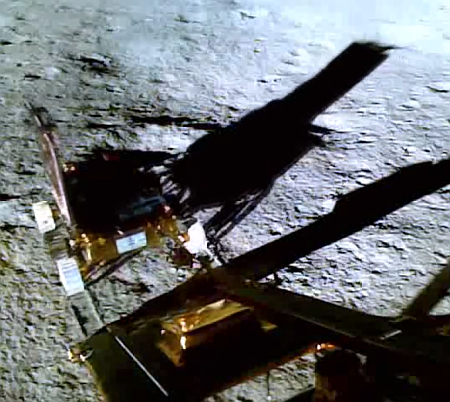
The image to the right, taken by Vikram, shows the rover as it completed its roll down the ramp onto the lunar surface. This is a screen capture from a movie showing that roll down, which you can see by clicking on the picture. Since then it has moved another 26 feet from the lander.

I must add once again that Vikram did not land “on the south pole”, as too many so-called news organizations have been falsely claiming. It landed at about 69 degrees south latitude, quite a distance from that pole, in a flat region with no permanently shadowed craters. It is not specifically looking for water, though its instruments might help explain the orbital data that suggests there are areas on the surface of the Moon where hydrogen is somehow present.

If so many news outlets can’t seem to get these very basic facts about this mission correct, one must ask what else do they get wrong routinely? I don’t ask, because I always assume their information is wrong, check it constantly, and find repeatedly that they get numerous basic facts incorrect, especially when it comes to reporting on politics.

6 comments

Big mountains everywhere inside Valles Marineris

Big mountains in Valles Marineris
Click for original image.

While the giant canyon Valles Marineris on Mars is known best as the biggest known canyon in the solar system — large enough to cover the continental United States several times over — that size tends to diminish the mountainous nature of its interior. Today’s cool image attempts once again (see for example these earlier posts here, here, here, here, and here) to illustrate that stupendous and mountainous nature.

The picture to the right, rotated, cropped, reduced, and sharpened to post here, was taken on May 15, 2023 by the high resolution camera on Mars Reconnaissance Orbiter (MRO). The goal of the picture was to get a better view of the numerous layers of this terraced cliff wall. What I see, however from my tourist’s perspective, is a steep wall that descends almost 4,500 feet from the high to the low point in just over three miles. This is as steep if not steeper than the walls of the Grand Canyon.
» Read more

2 comments

India’s Pragyan rover has successfully been deployed on the lunar surface


Click for interactive map.

According to a tweet from India’s space agency ISRO late yesterday, the Pragyan rover has successfully rolled down its ramp and is now deployed on the lunar surface.

No further updates have yet been released. According to ISRO’s mission webpage the instruments on both Vikram and Pragyan are as follows:

Lander payloads: Chandraโ€™s Surface Thermophysical Experiment (ChaSTE) to measure the thermal conductivity and temperature; Instrument for Lunar Seismic Activity (ILSA) for measuring the seismicity around the landing site; Langmuir Probe (LP) to estimate the plasma density and its variations. A passive Laser Retroreflector Array from NASA is accommodated for lunar laser ranging studies.

Rover payloads: Alpha Particle X-ray Spectrometer (APXS) and Laser Induced Breakdown Spectroscope (LIBS) for deriving the elemental composition in the vicinity of landing site.

Pragyan’s two spectroscopes are likely similar to instruments on Curiosity and Perseverance on Mars, and allows some good surface analysis. Without a scoop however there will be no analysis of anything below the ground, unless the rover can upend a rock using its wheels.

2 comments

Where the Martian landscape begins to dry out

Where Mars begins to dry out
Click for original image.

Today’s cool image to the right, cropped, reduced, and sharpened to post here, provides us a glimpse at the lower mid-latitudes of Mars where the terrain is beginning to dry out as we move south. The picture was taken on April 29, 2023 by the high resolution camera on Mars Reconnaissance Orbiter (MRO), and shows what the scientists label “large linear features.”

The main north-south ridge is only about 20-25 feet high, and its meandering nature (which can be seen more clearly in the full image) suggests it is possibly an inverted channel, formed when the bed of a former canyon gets compressed by the water or ice that flows through it, and when the surrounding terrain gets eroded away that channel bed becomes a ridge.

These ridges however could also possibly be volcanic dikes, where magma had pushed up through fractures and faults to form these more resistant ridges.
» Read more

0 comments

India successfully lands Vikram on the Moon


Click for interactive map.

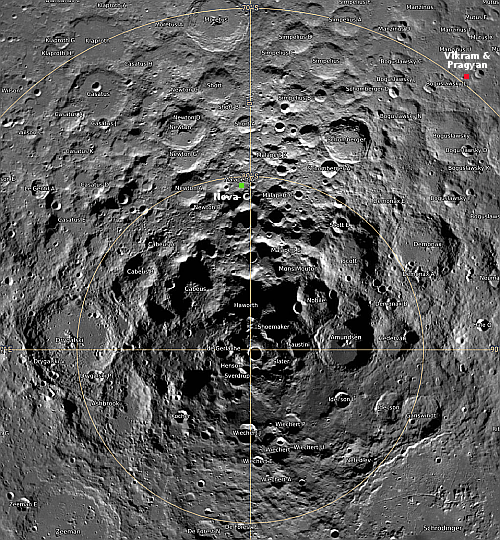
India this morning successfully placed its Vikram lander, carrying its Pragyan rover, on the surface of the Moon in the high southern latitudes.

I have embedded the live stream below, cued to just before landing.

The next challenge is getting Pragyan to roll off Vikram, and spend the next two weeks exploring the nearby terrain. The mission of both it and Vikram is only planned to last through the daylight portion of the 28-day-long lunar day, so it is not expected for either to survive the lunar night. Both will make observations, but the main purpose of this mission has already been accomplished, demonstrating that India has the technological capability to land an unmanned spacecraft on another planet. That the landing was in the high southern latitudes added one extra challenge to the mission.

» Read more

4 comments

I will NOT wear a mask, part two

Here we go again! When the first panic over COVID arrived in 2020 and government thugs and their leftist minions in the culture began demanding that everyone wear a mask, I wrote the following:

It apparently has not been enough that they have successfully destroyed a thriving economy, put millions out of work, destroyed the airline, entertainment, sports, and restaurant industries, over a disease that, at best is nothing more than a slight blip in the overall death rate, and at worst will be comparable to similar past epidemics that we lived through without government-imposed panic or economic disaster.

No, destroying millions of lives has not been enough. They need to do more. They need to find more ways to squelch our freedom, nullify the Constitution and the Bill of Rights, and, to paraphrase Orwell, stamp a boot down on our faces, forever.

And in this case, they mean to do this, almost literally.

They are now beginning to demand that we wear masks at all times in public, in the mindless and stupid belief that this will somehow stop COVID-19 from spreading.

I also declared unequivocally that I would not wear a mask, “and if you demand it of me you will have a revolution on your hands.”
» Read more

21 comments

The very tip of a thousand-mile-long crack on Mars

The very tip of a 1000-mile-long Martian crack
Click for original image.

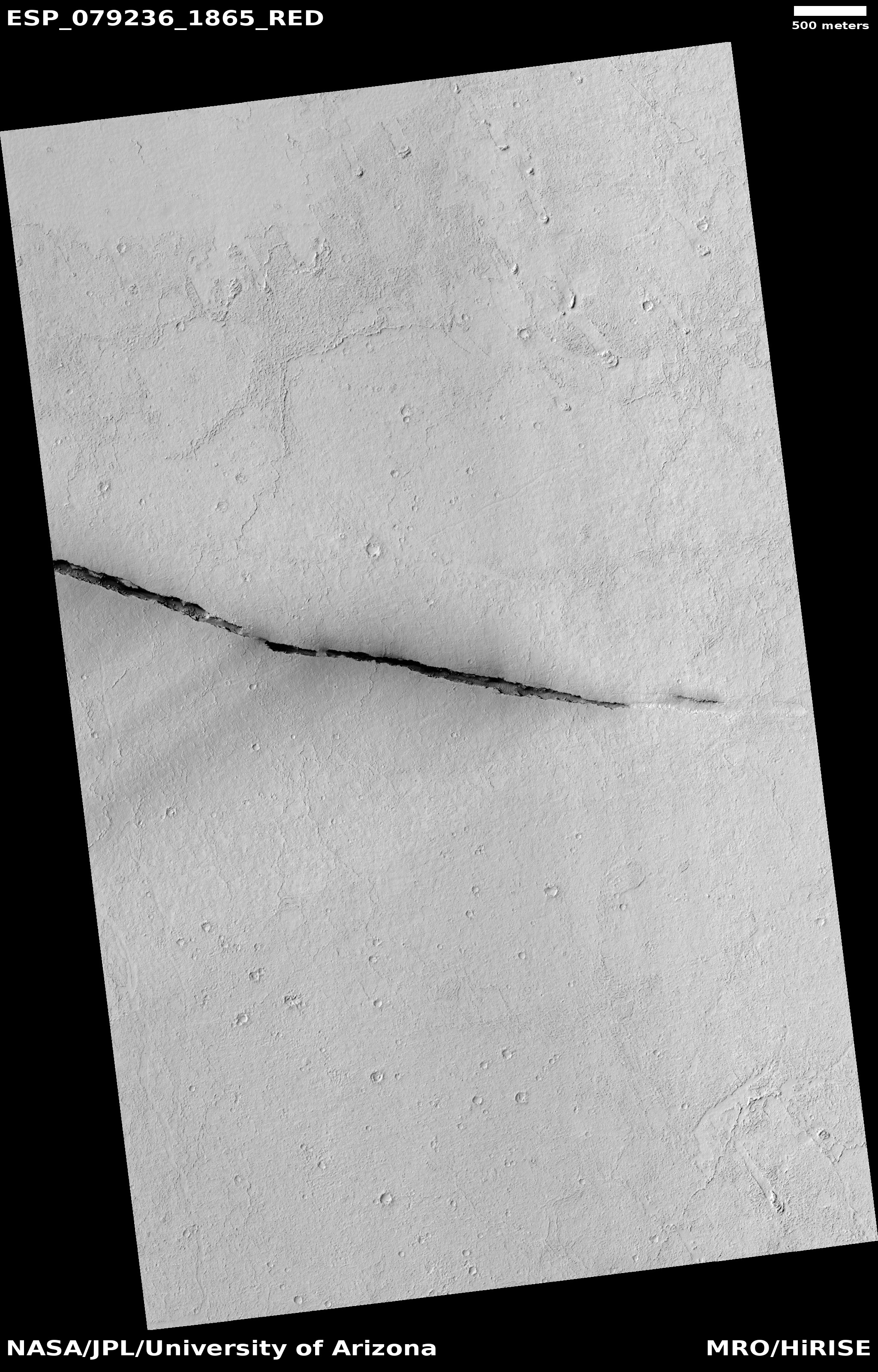
Cool image time! The picture to the right, rotated, cropped, reduced, and sharpened to post here, was taken on June 22, 2023 by the high resolution camera on Mars Reconnaissance Orbiter (MRO). It shows what the scientists label as “The tip of Cerberus Fossae,” a thousand-mile-long crack in the surface of Mars formed when the ground was pulled apart by underground forces.

If you look closely at the picture’s right edge, you can see that beyond the end of the fissure it actually continues but appears filled with material. In the full picture this however is the end of the crack. Beyond this point the ground is as smooth and as generally featureless as seen within the picture itself, and as also shown in this MRO context camera view of the same area.

Cerberus Fossae is actually three parallel cracks, with this the northernmost one. The eastern tip of the middle crack was previously highlighted in a cool image in July 2022.
» Read more

0 comments

Russian engineers pinpoint approximate crash site of Luna-25

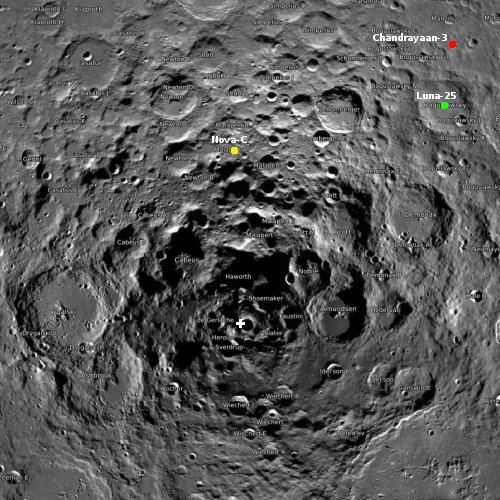
Russian engineers have pinpointed the approximate crash site of Luna-25 on the Moon as the 42-mile-wide crater Pontecoulant G, located at about 59 degrees south latitude, 66 east longitude.

Researchers from the Russian Academy of Sciencesโ€™ Keldysh Institute of Applied Mathematics have simulated the trajectory of the Luna-25 mission, figuring out where and when it crashed into the moonโ€™s surface, the institute said in a statement on Telegram. “The mathematical modeling of the trajectory of the Luna-25 spacecraft, carried out by experts from the Ballistic Center of the Russian Academy of Sciencesโ€™ Keldysh Institute of Applied Mathematics, made it possible to determine the time and place of its collision with the moon,” the statement reads.

According to the institute, the spacecraft fell into the 42-kilometer Pontecoulant G crater in the southern hemisphere of the moon at 2:58 p.m. Moscow time on August 19.

The planned landing site, in Boguslawsky Crater at 73 degrees south latitude and 43 degrees east longitude, was many miles away.

3 comments

It is time to devalue the software research of climate models

When the table of contents of the most recent issue of the American Geophysical Union’s (AGU) Geophysical Research Letters was released on August 16, 2023, I could not help noticing it contained a string of papers repeatedly showing that the models used to prove the coming fire of global warming continue to remain untrustworthy and unreliable. All of the following papers indicated biases and uncertainties of both climate models as well as the data they used, and each did so in their titles:

All of these papers considered the models valid for future research, and were instead focused on refining and increasing the accuracy of the models. All however showed once again how little we should trust these models.

What makes the publication of these papers significant is that it was the AGU that published them, even though the AGU has a decidedly biased editorial policy in favor of global warming. Despite the AGU’s insistence that “realistic and continually improving computer simulations of the global climate predict that global temperatures will continue to rise as a result of past and future greenhouse gas emissions,” it still cannot avoid publishing papers that repeatedly disprove that conclusion.
» Read more

14 comments

A Martian wedding cake surrounded by brain terrain

Brain terrain surrounding a Martian wedding cake
Click for original image.

Of all many cool images I’ve posted, today might take the cake (pun intended) for the best illustration of the alien nature of Mars. The picture to the right, cropped, reduced, and sharpened to post here, was taken on June 28, 2023 by the high resolution camera on Mars Reconnaissance Orbiter (MRO), and shows what the scientists simply label as “flow features.”

I personally don’t see any obvious flow features in the full image, unless one wants to call the brain terrain that covers this entire plain a flow feature. Brain terrain is a feature unique to Mars whose origin remains a mystery to geologists. As noted by scientists in captioned MRO image in 2019:

You are staring at one of the unsolved mysteries on Mars. This surface texture of interconnected ridges and troughs, referred to as โ€œbrain terrainโ€ is found throughout the mid-latitude regions of Mars.

…This bizarrely textured terrain may be directly related to the water-ice that lies beneath the surface. One hypothesis is that when the buried water-ice sublimates (changes from a solid to a gas), it forms the troughs in the ice. The formation of these features might be an active process that is slowly occurring since HiRISE [MRO’s high resolution camera] has yet to detect significant changes in these terrains.

The wedding cake inside the small crater to the upper right only adds to the alienness of this terrain.
» Read more

1 comment

Watch the landing attempt of Chandrayaan-3’s Vikram lander on August 23, 2023


Click for interactive map.

After separating from its Chandrayaan-3 propulsion module on August 17, 2023, India’s Vikram lunar lander has been slowly making orbital adjustments in preparation for its landing attempt on August 23rd.

I have embedded the live stream of that landing attempt below. As it is scheduled for 6:04 pm (India time), in India, in the U.S. that landing will occur in the early morning hours of August 23rd.

Following the failed crash on the Moon of Russia’s lunar lander Luna-25 yesterday, this landing attempt is likely to garner a lot more interest. It is also India’s second attempt, having failed in 2019 when its Vikram lander ran out of fuel before landing and crashed.
» Read more

4 comments
1 113 114 115 116 117 729