Scientists decide propaganda and commercials are better than good research results

The on-going dark age: In a new study scientists have discovered that — instead of depending on hard research that is repeatedly confirmed by others — if they simply use a trusted spokesman in commercials promoting their work they can get people to accept their conclusions, at face value.

This momentous discovery occurred when some researchers decided to find out if putting Trump in a 30-second commercial asking people to get the COVID jab would encourage them to do so. This is what the test learned:

A creative effort to use former President Donald Trump to persuade people to get a COVID-19 vaccine shot appears to have paid off. An online advertisement created by a team of political scientists and economists that featured Trump recommending COVID-19 shots led to increased uptake of the vaccines in U.S. counties that had low vaccination rates, concludes a new analysis.

“We were so thrilled,” says Marc Hetherington, a political scientist at the University of North Carolina, Chapel Hill, who helped create the ad and co-authored the study. “How often do political scientists and economists do anything that helps the world? The answer is, like, 0% of the time.”

…The results highlight that “health communication needs to come from trusted messengers and to meet people where they are,” says behavioral scientist Katherine Milkman of the University of Pennsylvania, who was not involved in the study. [emphasis mine]

Hetherington’s highlighted quote was intended to imply that this research proved that political scientists and economists sometimes do do something that helps the world. I think it only proves that they never do.

Using advertising to sell a scientific conclusion is without doubt the most corrupt and idiotic method for selling a scientist’s work. It only proves the work itself, in this case the COVID shots, have questionable aspects that need propaganda to convince people of their value.

Other quotes from different scientists at the link also illustrate how divorced from actual research and data these scientists are. To their minds, the doubt that many people have of the COVID shots can only be attributed to an “antivaccine ecosystem” touting its own political agenda. The extensive research and data that suggests the shots carry risks while appearing possibly useless is either ignored by these scientists, or they are willfully ignorant of it.

11 comments

Europe to put instrument on Japanese rover being launched and landed on the Moon by India

The new colonial movement: The European Space Agency (ESA) has signed an agreement with Japan’s space agency JAXA to put a science instrument on a Japanese rover that will be launched by India to the Moon and landed there on an Indian lander.

Under the deal, ESA would provide instruments for the Japanese rover, which would be used in the exploration of the Moon’s south pole under the mission targeted for 2024. … The lunar endeavour between the Indian Space Research Organisation (ISRO) and JAXA is called the Lunar Polar Exploration Mission (LUPEX) which aims to launch an Indian lander and a Japanese rover to the Moon.

In the next three years a lot of landers and rovers are planning to land on the Moon, most built by private American companies flying NASA and private payloads, but also joined by probes being sent by Russia, China, and now this Japanese-Indian-European mission. Even if only half succeed, the exploration of the lunar surface will still be quite busy.

0 comments

Astronomers discover a solar twin whose sunspot cycle changed into a grand minimum

Astronomers studying the sunspot cycle of several dozen stars that are twins of our Sun have identified for the first time a star whose 17-year cycle suddenly ceased, going into an extended grand minimum.

Comparing these stars to the Sun enables astronomers to better determine how typical – or not – the Sun is as a star. The Sun’s magnetic activity is defined by its 11-year sunspot cycle. Of the 59 stars that Baum’s team surveyed, 29 appeared to also have starspot cycles, and the period of those cycles could be measured for 14 of them.

“Of these 14 stars, the average length of their cycle is just under 10 years, which is similar to the Sun’s 11-year cycle,” Baum tells Physics World. However, not all the stars adhered to this time frame. One star that was surveyed has a cycle lasting less than four years, while another star, HD 166620, had a cycle 17 years long.

Note the past tense. Sometime between 1995 and 2004, HD 166620’s starspot cycle simply stopped.

When or if the star’s sunspot activity resume is unknown. The Sun’s last grand minimum, dubbed the Maunder Minimum, lasted 70 years during the 1600s.

No one yet understands why stars do this. This discovery however now shows that the Sun is not unique in this behavior.

2 comments

Ingenuity completes its 24th flight on Mars

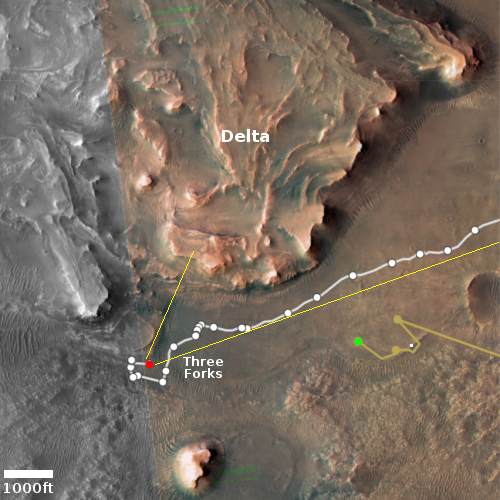
Overview map
Click for interactive map.

Ingenuity today completed its 24th flight on Mars, traveling a short 33 feet for 69.5 seconds in order to place it in a good position for an upcoming record-setting 25th flight.

With Flight 24 in our log book, it is now time to look forward to our upcoming effort that charts a course out of Séítah. Flight 25 – which was uplinked yesterday – will send Ingenuity 704 meters to the northwest (almost 80 meters longer than the current record – Flight 9). The helicopter’s ground speed will be about 5.5 meters per second (another record) and we expect to be in the rarefied Martian air for about 161.5 seconds.

The red dot on the map to the right indicates Perseverance’s present position. The green dot shows where Ingenuity landed today. The tan dashed lines indicate the planned routes for both. Ingenuity’s next flight will take it out of the rough terrain of Seitah and much closer to Three Forks.

0 comments

Looking down into a Jupiter hurricane

Looking down into a Jupiter hurricane
Click for full image.

Cool image time! The photo to the right, cropped and reduced to post here, was created by citizen scientists Kevin Gill and Navaneeth Krishnan from a raw image taken by Juno during its 40th close fly-by of Jupiter in February 2022.

I don’t have a scale, but I would guess that this storm is at least a thousand miles across. The depth is harder to measure, but we looking down into a deep whirlpool for sure.

To bring out the details Gill and Krishnan enhanced the colors significantly. The original is quite bland in comparison, with this storm being the faint dark spot just below the center near the photo’s left edge.

10 comments

UAE wants to prioritize private enterprise for its space effort

Capitalism in space: According to officials of the United Arab Emirates (UAE) space agency, that nation is working to encourage the growth of a private space industry, funded initially using government money, in its effort to become a major world player in space.

“We’ve spent well over Dh1.5 billion ($408 million) on building capacity within the space industry over the last eight years and we’re more than doubling that over the next decade.”

Laws and regulations, including permits, which would allow interested companies to set up base in the UAE, are already available through a space law passed in 2019.

Companies would also have access to funding from a new initiative launched by the space agency, called Space Analytics and Solutions, which has a budget of Dh20 million. The programme aims to help start-ups build space-based applications that focus on food security, climate change, infrastructure and the oil and gas industry.

The space agency hopes that as these companies progress, they would become less reliant on government funding.

While the UAE’s Al-Amal Mars orbiter was mostly built and launched by foreign companies, it hopes its next major mission, to send an unmanned probe to seven asteroids, will be built almost entirely by companies run by UAE citizens, something they claim they have achieved with an upcoming smallsat Earth observation satellite.

The article also mentioned as an aside that the UAE has ended its 2019 agreement with Virgin Galactic to allow it to launch from the UAE. Instead, it is negotiating with Blue Origin “to set up spaceports.”

0 comments

Astronomers directly image the orbital motion of Jupiter protoplanet 531 light years away

AB Aurigae B's motion over thirteen years
Click for original image.

Astronomers, using a number of ground- and space-based telescopes, have now directly photographed the orbital motion of a Jupiter protoplanet orbiting a star 531 light years away over a thirteen year time span.

The image to the right, cropped to post here, shows images produced by two Hubble instruments. The caption:

Researchers were able to directly image newly forming exoplanet AB Aurigae b over a 13-year span using Hubble’s Space Telescope Imaging Spectrograph (STIS) and its Near Infrared Camera and Multi-Object Spectrograph (NICMOS). In the top right, Hubble’s NICMOS image captured in 2007 shows AB Aurigae b in a due south position compared to its host star, which is covered by the instrument’s coronagraph. The image captured in 2021 by STIS shows the protoplanet has moved in a counterclockwise motion over time.

From the paper’s abstract:

Using the Subaru Telescope and the Hubble Space Telescope, we find evidence for a Jovian protoplanet around AB Aurigae orbiting at a wide projected separation (~93 au), probably responsible for multiple planet-induced features in the disk. Its emission is reproducible as reprocessed radiation from an embedded protoplanet.

The accretion disk around AB Aurigae happens to lie face on to our line of sight, which facilitates these observations. The data also shows two additional potential proto-planets farther from the star.

0 comments

The most valuable real estate on the Moon

The most valuable real estate on the Moon
Click for full image.

Cool image time! The photo to the right, reduced and annotated to post here, is an oblique view of the terrain near Shackelton Crater and the Moon’s south pole, taken by Lunar Reconnaissance Orbiter (LRO) and released today.

Shackleton-de Gerlache ridge, about 9 miles long, is considered one of the prime landing sites for both a manned Artemis mission as well as the unmanned Nova-C lander from the commercial company Intuitive Machines. To facilitate planning, scientists have created a very detailed geomorphic map [pdf] of this region. As explained at the first link above,

Going back to time-proven traditions of the Apollo missions, geomorphic maps at a very large scale are needed to effectively guide and inform landing site selection, traverse planning, and in-situ landscape interpretation by rovers and astronauts. We assembled a geomorphic map covering a candidate landing site on the Shackleton-de Gerlache-ridge and the adjacent rim of Shackleton crater. The map was derived from one meter per pixel NAC image mosaics and five meters per pixel digital elevation models (DEM) from Lunar Orbiter Laser Altimeter (LOLA) ranging measurements.

Such geology maps guide planning and exploration, but actual images tell us what the first explorers will see. Below is a close-up overhead view of small area at the intersection of the ridge and the rim of Shackleton.
» Read more

5 comments

Sunspot update: Sunspot activity continues to outpace predictions

It is the first of the month, and NOAA has once again updated its monthly graph showing the long term trends in the Sun’s sunspot activity. As I do every month, I post it below, annotated with additional data to provide some context.

In March the Sun continued its unexpected high activity since the end of the solar minimum in 2020. The number of sunspots once again rose steeply, while also exceeding the predicted count for the month. The actual sunspot count for March was 78.5, not 34.1 as predicted. The last time the count was that high for any month was September 2015, when the Sun was just beginning its ramp down from solar maximum.
» Read more

2 comments

Strange terrain at the Martian equator

Strange terrain at the Martian equator
Click for full image.

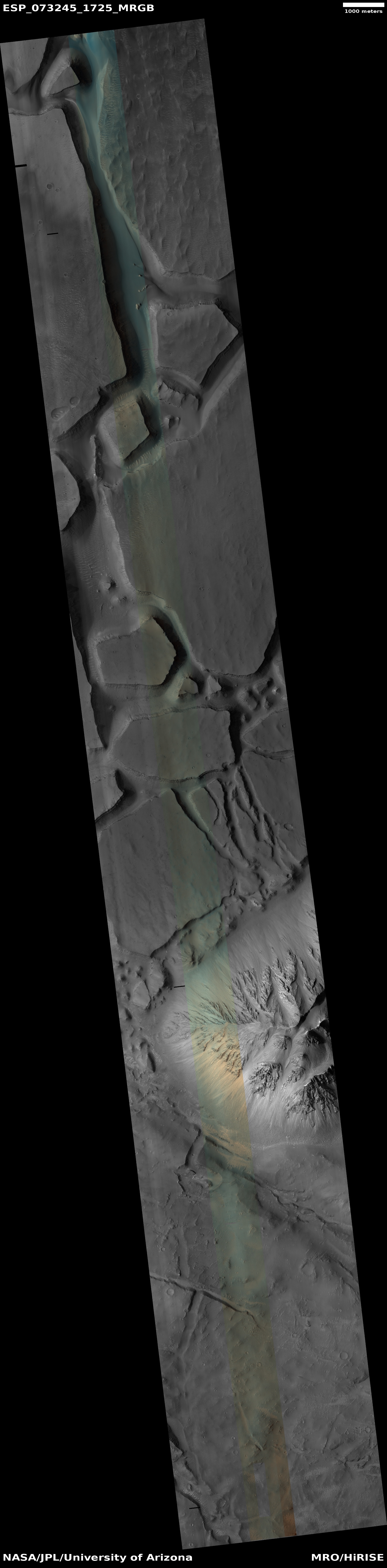
Cool image time! The photo to the right, cropped to post here, was taken on January 29, 2022 by the high resolution camera of Mars Reconnaissance Orbiter (MRO). It shows a small portion of the floor of 41-mile-wide Tuskegee Crater, sitting at the Martian equator on the rim of the outlet to the giant canyon Valles Marineris.

I have purposely focused on a section of the color strip, because of its strange green color. Most MRO images are reddish (indicating dust) or blue (indicating coarse rocks or ice). Green seems to me to be rare, and in fact is not even mentioned in the MRO science’s team explanation [pdf] of the colors the instrument produces. Since green is neither dust nor ice, this suggests some form of hard bedrock, with a mineralogy that produces that color.

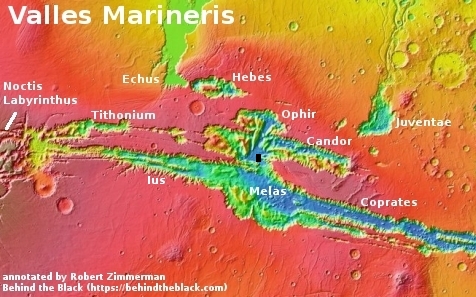
The overview map below gives some context.
» Read more

4 comments

A large Martian river basin with delta

Map of Hypanis Valles river basin on Mars
Click for full image.

Cool map time! The map to the right, reduced to post here, is figure 1 in a new paper outlining the known geology of what appears to be a large ancient and now dry river basin with delta on Mars, found north of Valles Marineris and draining into the northern lowland plain dubbed Chryse Planitia where both Viking-1 and Mars Pathfinder landed, in 1976 and 1997 respectively.

The river basin itself is called Hypanis Valles. The white splotch at the river basin’s outlet is dubbed the Hypanis Deposit, and is thought by some scientists to be a delta of material that was placed there when the river was active 3.6 billion years ago and poured into what some scientists believe was an intermittent ocean in Chryse Planitia. From the paper’s conclusion:

As proposed in prior works, Hypanis may have formed subaqueously as a delta, and may record a water level drop of about 500 m[eters, or about 1,600 feet] as a shoreline retreated to the northeast. We identified kilometer-sized cones and mounds which appear to have erupted onto the surface. Characteristics of these features more closely resemble those of outgassing, sedimentary diapirism, and mud volcanism rather than of igneous volcanism.

The intermittent ocean theory has problems however. For this delta to have formed underwater that ocean would have to have been much much larger than estimated based on the present known data, extending out to cover almost all of Chryse Planitia, in some places to a very great depth.

Some scientists have hypothesized that the ocean need not have been that large because a land dam would have confined it to a smaller region at the river’s outlet. This research however found no evidence of such a dam. However, the paper also noted that “Further work could examine the role of ice or glaciers in the formation of Hypanis and determine if an ice dam would be plausible.”

And of course there remains the more fundamental mystery of liquid water on the Martian surface, which makes the river basin itself a puzzle. No generally accepted model allowing for surface liquid water on Mars presently exists. The possibility that ice and glaciers could have done the job comes to mind again. Though the geology in this region reveals what looks like to our Earth eyes to be a very large river system, now dry, this is not Earth but an alien planet. Tributary systems like this might form from different and as yet not understood processes on Mars, some of which might involve glaciers.

0 comments

Scientists: On Mars surface elevation doesn’t matter that much in terms of radiation protection

In a paper published in February, scientists determined from models and data that the thickness of Martian cave ceilings required to protect you from radiation is not that much different whether you are on top of Olympus Mons (the Mount Everest of Mars), or at the bottom of Hellas Basin (Mars’ Death Valley).

From the paper’s conclusion:

Overall, the atmospheric thickness is not a dominant parameter for the required shielding. However, at a low-altitude crater where the surface pressure is above 1,000 Pa, the required subsurface shielding is about 10–20 cm [4 to 8 inches] less than at the top of high mountains where the pressure is below 100 Pa. Moreover, solar activities which determine the GCR flux arriving at Mars play an role. To reduce the annual effective dose to be below 100 mSv, the required shielding is 1.5–1.6 m [about 5 feet] during solar minimum and 0.9–1.1 m [a little more than 3 feet] during solar maximum. For a threshold of 50 mSv, the required shielding is 2.1–2.2 m [about 7 feet] during solar minimum and 1.7–1.9 m [about 6 feet] during solar maximum.

Essentially, what this research suggests is that to properly shield any underground facility, you need to cover it with at least seven feet of material, or be in a cave where the ceiling is that thick. It really doesn’t matter how much atmosphere is above you. Even at its thickest at the lowest elevation, Mars’ atmosphere doesn’t provide much protection.

0 comments

Astronomers think they have detected the most distant star ever

The most distant star ever detected?
Click for full image.

The uncertainty of science: Using the Hubble Space Telescope astronomers now think they have detected the most distant single star ever located, the light of which is estimated to have come from a time only less than a billion years after the Big Bang itself.

The star, nicknamed Earendel by astronomers, emitted its light within the universe’s first billion years. It’s a significant leap beyond Hubble’s previous distance record, in 2018, when it detected a star at around 4 billion years after the big bang. Hubble got a boost by looking through space warped by the mass of the huge galaxy cluster WHL0137-08, an effect called gravitational lensing. Earendel was aligned on or very near a ripple in the fabric of space created by the cluster’s mass, which magnified its light enough to be detected by Hubble.

The arrow in the image, cropped and reduced to post here, points to the theorized star. Note the arc that tiny dot lies along. This arc is the result of the gravitational lensing, and illustrates quite bluntly the large uncertainties of this discovery. We are not seeing the star itself, but the distorted light after it passed through the strong gravitational field of the cluster of galaxies. The scientists conclusion that this dot is thus a single star, must be view with great skepticism.

Nonetheless, the data is intriguing, and will certainly be one of the early targets of the James Webb Space Telescope, which could confirm or disprove this hypothesis.

4 comments

Active volcanoes on Pluto?

Elevation map of Wright Mons on Pluto

The uncertainty of science: According to new research published yesterday, scientists now posit that there might be recent volcanic activity on Pluto, based on data and images sent back by New Horizons during its fly-by of the planet in 2015.

You can read the paper here. From its abstract:

The New Horizons spacecraft returned images and compositional data showing that terrains on Pluto span a variety of ages, ranging from relatively ancient, heavily cratered areas to very young surfaces with few-to-no impact craters. One of the regions with very few impact craters is dominated by enormous rises with hummocky flanks. Similar features do not exist anywhere else in the imaged solar system. Here we analyze the geomorphology and composition of the features and conclude this region was resurfaced by cryovolcanic processes, of a type and scale so far unique to Pluto. Creation of this terrain requires multiple eruption sites and a large volume of material (>104 km3) to form what we propose are multiple, several-km-high domes, some of which merge to form more complex planforms. The existence of these massive features suggests Pluto’s interior structure and evolution allows for either enhanced retention of heat or more heat overall than was anticipated before New Horizons, which permitted mobilization of water-ice-rich materials late in Pluto’s history. [emphasis mine]

The image to above is Figure 10 in the paper’s supplementary material [pdf]. It shows the volcano-like appearance of Wright Mons on Pluto, a mound approximately 3,000 feet high with a central depression equally deep, with a volume “similar in magnitude to that of the Hawaiian volcano Mauna Loa.”

These conclusions are quite tantalizing, but the amount of data is sparse, and thus it is wise not to take them too seriously. For example, the scientists have no idea how Pluto could presently have any form of liquid or active volcanism. Another mission to Pluto — studying it over a long time from orbit — will be required to determine how active the planet really is, or if it is active at all.

2 comments

Scientists: Ice layers in Burroughs Crater confirm Martian orbital climate cycles

Layering in the west side of Burroughs Crater
Click for full image.

According to a new paper published today, scientists have used the ice layers inside Burroughs Crater on Mars to confirm the theory that the Red Planet has undergone numerous climate cycles during the past four million years, caused by the swings in the planet’s rotational tilt and eccentric orbit. From the press release:

Previously, Martian climate scientists have focused on polar ice caps, which span hundreds of kilometers. But these deposits are old and may have lost ice over time, losing fine details that are necessary to confidently establish connections between the planet’s orientation and motion and its climate.

Sori and his colleagues turned to ice mounds in craters, just tens of kilometers wide but much fresher and potentially less complicated. After scouring much of the southern hemisphere, they pinpointed Burroughs crater, 74 kilometers wide, that has “exceptionally well-preserved” layers visible from NASA HiRISE [Mars Reconnaissance Orbiter’s high resolution camera] imagery, Sori said.

The researchers analyzed the layers’ thicknesses and shapes and found they had strikingly similar patterns to two important Martian orbital dynamics, the tilt of Mars’ axis and orbital precession, over the last 4 to 5 million years.

The photo above of those layers was taken by Europe’s Trace Gas Orbiter on March 13, 2019, cropped and reduced to post here.

This research greatly strengthens the theory that the ice on Mars gets distributed to different latitudes in cycles, depending on the cyclical fluctuations in the planet’s orbit and tilt. However, it does not yet confirm these cycles apply to the glaciers found in craters in lower latitudes. Burroughs Crater is at 72 degrees south latitude, near the southern polar ice cap, well south of the band of glaciers scientists have discovered in the mid-latitudes down to 30 degrees latitude. Nonetheless, this research strongly suggest the same cycles apply in those lower latitudes.

5 comments

Ice sheets on Mars below 30 degrees latitude?

Cracks in Ice on Mars?
Click for full image.

Cool image time! The photo to the right, cropped and reduced to post here, was taken on November 29, 2021 by the high resolution camera on Mars Reconnaissance Orbiter (MRO). It shows a collection of scattered thin surface fractures, grouped in clusters of parallel lines with the orientation of the clusters all somewhat random to other clusters.

The fractures, as well as the material inside the craters, appears to resemble glacial features, suggesting that these fractures are the result of either the past motion of the glacial sheet, or the sublimation of the buried ice, which causes it to crack and shrink as it slowly dissipates away.

The problem with that hypothesis is the location, as shown by the overview map below.
» Read more

0 comments

Curiosity presently traveling over broken sandstone from an ancient dune field

Gator-back terrain on Mars
Click for full image.

According to a new paper, scientists now think that the rough and broken cap layer of the Greenheugh pediment that Curiosity is presently traveling across was originally a dune field periodically washed by water runoff, which with time eventually hardened into sandstone.

That broken terrain, dubbed “gator-back terrain” by the Curiosity science team, is shown clearly in the image to the right, taken on March 20, 2022. From the paper’s abstract:

The Greenheugh pediment is capped by a unit of broadly uniform thickness which represents the remains of the Stimson dune field that existed <2.5 Ga (mid- to late-Hesperian). ChemCam geochemical data shows that the sands deposited at the Greenheugh capping unit were sourced from a nearby olivine-rich unit. Surface waters then cemented the windblown sand deposits, ponding at the unconformity with the underlying mudstone unit, creating concretions towards the base. Episodes of groundwater circulation did not affect the rocks at Greenheugh as much as they did at other Stimson localities with the exception of acid-sulfate alteration that occurred along the unconformity. These results suggest that the ancient Stimson dune field was a dynamic environment, incorporating grains from the surrounding geological units on Mt Sharp. Furthermore, liquid water was stable at the surface in the Hesperian and was available for multiple diagenetic events along bedrock weaknesses.

In other words, material from Mount Sharp formed the dune fields, all of which were reshaped by groundwater circulation, with the dunes higher on the mountain seeing less groundwater.

The biggest uncertainty of these findings is explaining how surface liquid water could exist on Mars. Scientists have yet to develop an accepted model that would allow it. Another possibility would be the recent data that suggests Gale Crater was filled with glaciers. If so, scientists would need to figure out how the interaction of a Martian glacier might have geologically changed those dunes in a manner similar to groundwater.

2 comments

Solar Orbiter takes closest image of Sun so far

Solar Orbiter's closest image of the Sun, so far
Click for full interactive image, where you can zoom in, a lot.

Cool image time! The European Space Agency (ESA) yesterday released several new images from its Solar Orbiter probe, taken when the spacecraft made its most recent closest approach of the Sun.

One of the images, taken by the Extreme Ultraviolet Imager (EUI) is the highest resolution image of the Sun’s full disc and outer atmosphere, the corona, ever taken.

Another image, taken by the Spectral Imaging of the Coronal Environment (SPICE) instrument represents the first full Sun image of its kind in 50 years, and by far the best one, taken at the Lyman-beta wavelength of ultraviolet light that is emitted by hydrogen gas.

The images were taken when Solar Orbiter was at a distance of roughly 75 million kilometres, half way between our world and its parent star. The high-resolution telescope of EUI takes pictures of such high spatial resolution that, at that close distance, a mosaic of 25 individual images is needed to cover the entire Sun. Taken one after the other, the full image was captured over a period of more than four hours because each tile takes about 10 minutes, including the time for the spacecraft to point from one segment to the next.

The photo to the right, reduced to post here, is the EUI photo.

Solar Orbiter has been in its science orbit since November, though that orbit over time will slowly be adjusted to swing the spacecraft into a higher inclination so that it can make the first close-up observations of the Sun’s polar regions. It is also working in tandem with the Parker Solar Probe, which observes the Sun from even closer distances using different instruments.

3 comments

Ingenuity completes 23rd flight on Mars

Overview map
Click for interactive map.

JPL announced tonight in a tweet that Ingenuity today completed its 23rd successful flight on Mars.

23 flights and counting! #MarsHelicopter successfully completed its 23rd excursion. It flew for 129.1 seconds over 358 meters [1,175 feet].

The overview map to the right was taken from the “Where is Perseverance?” webpage and annotated by me to show the planned future routes of both Perseverance and Ingenuity. The white dotted line shows Perseverance’s path, now having almost circled the rough ground on its way to the delta and Three Forks. The tan dotted line indicates Perseverance’s future route. The dashed pink and green lines indicate two possible future flight paths for Ingenuity.

The green dot marks the position the science team marked on the map for where Ingenuity landed after today’s flight. They have not yet calculated the actual flight path, which is why it is shown by the tan dashed line. This also means there is as yet some uncertainty about this landing spot.

Originally, the plan had been to get to this spot in one flight. For reasons not yet explained, when the helicopter took off on its 22nd flight during the March 19-20th weekend, it stopped after only about 100 feet. Today’s flight apparently completed the plan, putting the helicopter where it was supposed to be.

3 comments

Today’s blacklisted American: Forbes terminates journalist for documenting Fauci’s salary

Adam Andrzejewski, journalist banned for doing good journalism
Adam Andrzejewski, journalist banned for doing good
journalism

The new dark age of silencing: Adam Andrzejewski, a long time journalist for Forbes magazine, was fired when the magazine was pressured by NIH to stop him from documenting accurately the large income that Anthony Fauci and his wife derived from their government jobs.

As Andrzejewski concludes in outlining his blackballing by Forbes:

Two directors, two bureau chiefs, and two top PR officers [from NIH] didn’t send an email to the Forbes’ chief on a Sunday morning because they wanted to correct the record about Fauci’s travel reimbursements. They sent that email to subliminally send a message: We don’t like Andrzejewski’s oversight work, and we want you to do something about it.

Unfortunately, Forbes folded quickly. Within 24 hours of the NIH email to Randall Lane, my regular Forbes editor called and announced new rules. Forbes barred me from writing about Fauci and mandated pre-approval for all future topics.

Then, Forbes went silent and terminated my column roughly 10 days later on January 28.

On the day Forbes cancelled me, the editors bent the knee. A new piece on Fauci published: “Fauci’s Portrait Will Soon Hang In The Smithsonian.”

The shameful part of this story was the way a news organization took the side of government agents, rather than their own journalist. The press is not supposed to be a state-run organization, but a free press intent on uncovering government malfeasance. The people who run Forbes apparently don’t understand this, and are quite willing to become panting toadies to the federal government.

Andrzejewski however understands his role as a journalist far better. In 2011 he founded Open The Books, a non-profit focused on documenting government spending precisely, at all levels from the smallest school district to the largest agency in the federal government. To do this the organization has filed almost 50,000 Freedom of Information requests. As he noted at the link above,
» Read more

8 comments
1 115 116 117 118 119 438