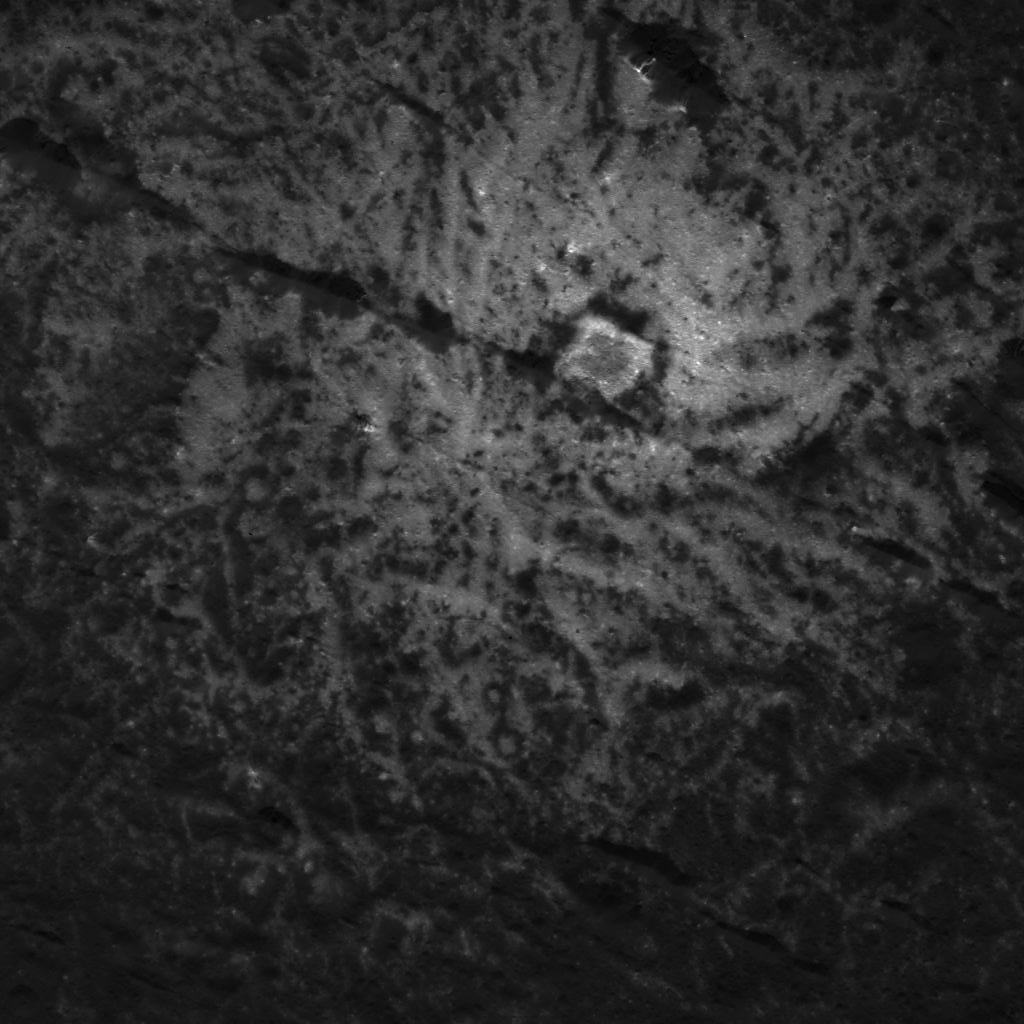
Ancient fossil river in the very dry equatorial regions of Mars

Inverted Channel on Mars
Click for full image.

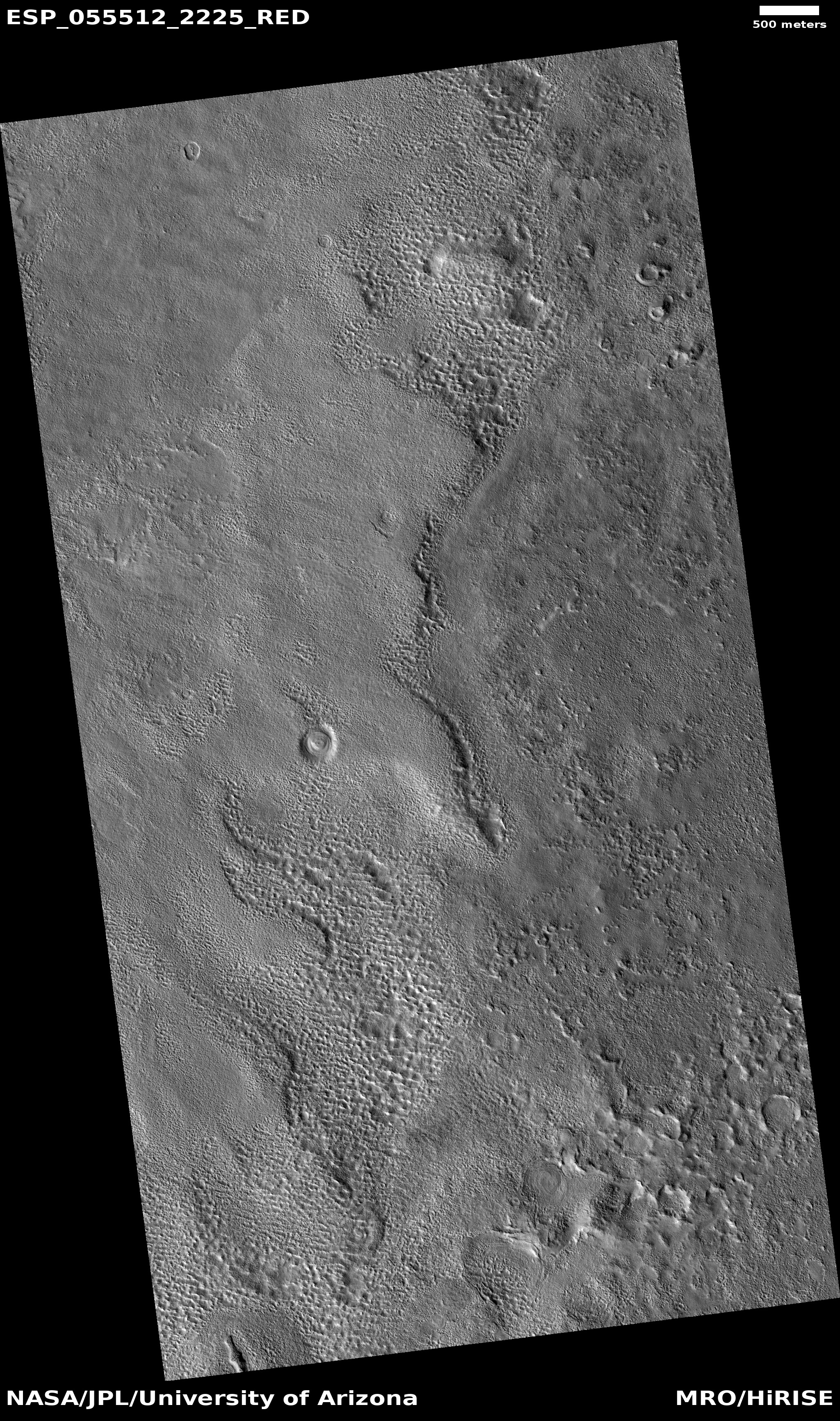
Cool image time! The photo to the right, rotated, cropped, and reduced to post here, was taken on August 29, 2021 by the high resolution camera on Mars Reconnaissance Orbiter (MRO). It shows what the scientists label an “inverted channel in Arabia Terra,” a small example of the more than 10,000 miles of fossilized rivers in this region on Mars that scientists have identified using MRO.

They are made of sand and gravel deposited by a river and when the river becomes dry, the channels are left upstanding as the surrounding material erodes. On Earth, inverted channels often occur in dry, desert environments like Oman, Egypt, or Utah, where erosion rates are low – in most other environments, the channels are worn away before they can become inverted. “The networks of inverted channels in Arabia Terra are about 30m high and up to 1–2km wide, so we think they are probably the remains of giant rivers that flowed billions of years ago. [emphasis mine]

Since this fossilized river is located at 11 degrees north latitude, smack in the middle of the dry equatorial regions of Mars, it has certainly been a dry desert for a very long time. You can see how barren the terrain appears by looking at the wider view afforded by MRO’s context camera below.
» Read more

4 comments

As expected, Pluto’s atmosphere is freezing as its orbit takes it from the Sun

Data from ground-based telescopes has now confirmed that Pluto’s nitrogen atmosphere has begun it annual winter freeze out as the planet’s somewhat elliptical 248-year-long orbit takes it away from the Sun.

For about 25 years, Pluto has been moving farther and farther away from the sun, so its surface temperature has been going down. And with these recent observations, the researchers found evidence showing that Pluto’s atmosphere is actually refreezing back onto its surface as the dwarf planet gets colder and colder. Pluto is so far from the sun that, as time goes on, it will get distinctly farther away (and colder) before getting closer to the sun in other regions of its immense orbit.

The astronomers were able to detect this refreezing by observing the planet as it eclipsed a star in 2018.

7 comments

Data from Perseverance confirms Jezero Crater once held a lake

figure 5 from paper showing ancient lake in Jezero Crater

According to a newly published paper, the data obtained by the rover Perseverance has confirmed and refined what orbital data has suggested, that Jezero Crater once held a lake. From the abstract:

We analyze images taken by the rover in the three months after landing. The fan has outcrop faces that were invisible from orbit, which record the hydrological evolution of Jezero crater. We interpret the presence of inclined strata in these outcrops as evidence of deltas that advanced into a lake. In contrast, the uppermost fan strata are composed of boulder conglomerates, which imply deposition by episodic high-energy floods. This sedimentary succession indicates a transition, from a sustained hydrologic activity in a persistent lake environment, to highly energetic short-duration fluvial flows.

In other words, the crater first held a lake, which as it slowly dried out was periodically renewed by flash floods. The distinct delta of material that made Jezero Crater the prime landing site was apparently formed during the period when the lake existed. The conditions that caused the subsequent flash floods is as yet not been determined, though it likely is related to the red planet’s long term evolution.

The image above, figure 5 from the paper, shows the inferred lake in that early history. The red cross marks Perseverance’s landing site.

This data reinforces the fundamental scientific mystery of Mars. It shows evidence that liquid water once flowed on the surface of Mars, even though other long term data of the planet’s history says the Martian atmosphere has been too thin and too cold to allow that to happen. There is evidence that the atmosphere might have once been thicker, but no computer model or theory has been able to produce a time when it was warm enough.

3 comments

Chang’e-5 lunar samples youngest ever found

The uncertainty of science: The lunar samples returned to Earth by China’s Chang’e-5 lander have been found to be the youngest ever found, about two billion years old and a billion years younger than any other previous sample, with a composition that confirms the material in this area was also the youngest volcanism so far found on the Moon.

Collecting young lunar rocks was one of the main objectives for the Chang’e-5 mission, which sent a lander to the Moon in December 2020. The craft grabbed 1.7 kilogram (4 pounds) of lunar regolith from the vast volcanic plain of Oceanus Procellarum and flew back to Earth within the month. Observations from lunar orbit had identified this mare to be younger than other areas by its paucity of craters, which suggested that the lava there had flowed more recently. By dating the samples returned to Earth, the scientists confirm that volcanism occurred later in Oceanus Procellarum than other areas of the Moon.

Many news stories are claiming that the young age of these samples is a surprise, but this isn’t true. It was expected, as the quote above indicates.

However, the composition of the rocks did not match what was expected. Though created by volcanism, it appears the material did not have kind of composition seen in other lunar volcanic rocks. This is now a new puzzle for scientists.

1 comment

Today’s blacklisted American: Woman denied kidney transplant in Colorado because she is unvaccinated

The unvaccinated denied healthcare in Colorado
No healthcare in Colorado permitted for the unvaccinated. Let them die!

Persecution is now cool! A woman who has stage 5 renal failure was suddenly told by UCHealth (University of Colorado Health) — just before her kidney transplant operation — that she was banned from the hospital because both she and her donor are unvaccinated.

“Here I am, willing to be a direct donor to her. It does not affect any other patient on the transplant list,” Jaimee Fougner, Leilani Lutali’s kidney donor, told CBS4. “How can I sit here and allow them to murder my friend when I’ve got a perfectly good kidney and can save her life?”

Lutali said she received a letter from Colorado health system UCHealth at the end of September explaining that she and Fougner have 30 days to begin the vaccine process. They would be removed from the kidney transplant list if they refuse the shots. “I said I’ll sign a medical waiver. I have to sign a waiver anyway for the transplant itself, releasing them from anything that could possibly go wrong,” said Lutali. “It’s surgery, it’s invasive. I sign a waiver for my life. I’m not sure why I can’t sign a waiver for the COVID shot.”

According the article, when they first scheduled the surgery in August they were told by the hospital that being unvaccinated was not a problem. This changed suddenly in late September, at the last moment.
» Read more

11 comments

The wavy and beautiful edge of the northern ice cap of Mars

The scarp of the north pole icecap on Mars
Click for full image.

Cool image time! The photo to the right, cropped and reduced to post here, was taken on August 7, 2021 by the high resolution camera on Mars Reconnaissance Orbiter (MRO). It shows the many layered scarp that forms the edge of the northern polar ice cap on Mars, probably more than 2,000 feet high.

Those layers are significant, as they indicate the many climate cycles that scientists think Mars has undergone over the eons as the red planet’s rotational tilt, or obliquity, rocked back and forth from 11 degrees inclination to as much as 60 degrees. At the extremes, the ice cap was either growing or shrinking, while today (at 25 degrees inclination) it appears to be in a steady state.

Why the layers alternate light and dark is not known. The shift from lighter colors at the top half and the dark bottom half marks the separation between the top water ice cap and what scientists label the basal unit. It also marks some major change in Mars’ climate and geology that occurred about 4.5 million years ago.
» Read more

4 comments

Sunspot update: The boom in sunspots returns!

It is time for my monthly sunspot update, based on the most recent NOAA monthly graph, showing the changes in the Sun’s sunspot activity during September. That graph is below, annotated to show the previous solar cycle predictions and thus provide context.

In September sunspot activity boomed once again, producing the most sunspots in a month since 2016 and ending the slight drop in activity in August to return to the pattern the Sun has exhibited since the end of solar minimum. Consistently the number of sunspots on the visible hemisphere of the Sun since 2020 has exceeded the April 2020 prediction of the NOAA scientist panel, as indicated by the red curve in the graph.

» Read more

19 comments

Land of Martian slope streaks

Land of Martian slope streaks
Click for full image.

Cool image time! The photo to the right, cropped and reduced to post here, was taken on May 21, 2021 by the high resolution camera on Mars Reconnaissance Orbiter (MRO). It shows a typical example of the many slope streaks found in the rough and very broken region north of the Martian volcano Olympus Mons, the largest in the solar system.

See this May 2019 post for a detailed explanation of slope streaks. While they appear to be avalanches, they do not change the topography of the ground, sometimes flow over rises, and appear to be a phenomenon entirely unique to Mars. While no theory as yet explains them fully, the two most favored postulate that they are either dust avalanches or the percolation of a brine of chloride and/or perchlorate in a thin layer several inches thick close to the surface. In both cases the streak is mostly only a stain on the surface that fades with time.

The location of this cool image however tells us something more about them.
» Read more

1 comment

BeppiColombo’s first images of Mercury

Mercury by BebiColomo
Click for full image.

This past weekend the European/Japanese duel-orbiter mission made its first flyby of Mercury, taking its first images of that planet.

The photo to the right is one example, cropped and reduced slightly to post here. It was taken by the spacecraft’s monitoring cameras, designed for engineering purposes, which means the resolution is not very high and the camera is positioned so that parts of the spacecraft were visible in each shot. For example, the white strut in the lower right is the spacecraft’s magnetometer boom, which also was used to gather data during the flyby.

Still, the photos demonstrated that the spacecraft is pointing correctly and on course. It will complete five more Mercury fly-bys before going into orbit in 2025.

The next flyby will occur in June ’22.

1 comment

Inactive volcano vent on Mars

Inactive volcanic vent on Mars
Click for full image.

Overview map

Cool image time! The photo to the right, cropped, reduced and annotated to post here, was taken on July 30, 2021 by the high resolution camera on Mars Reconnaissance Orbiter (MRO). The left image shows a pit that the scientists label a “vent” near the giant volcano Pavonis Mons. The right image is identical, except that I have brightened it considerably to bring out the details in the shadowed area.

As you can see, this pit is filled, and does not appear to have any existing openings into more extensive underground passages.

The white dot on the overview map on the right shows this vent’s location, to the south of Pavonis Mons, and in line with the giant crack that splits three of Mars’ four largest volcanoes. The vent is even aligned the same as that crack, from the northeast to the southwest. The black dots mark the locations of the many cave pits found in this region.

Was this a volcanic vent? If you look at the full image you will see that this pit aligns with a shallower pit to the southwest, with a depression linking the two. Visually this suggests this is a faultline which in turn makes for a good outlet point for lava flow.

Though the data suggests this is a volcanic vent, that supposition is as yet unproven. The full image does not show much evidence of a flow from the pit, which suggests instead that we are merely looking at a spot where the ground cracked along fault lines.

0 comments

Two nearby asteroids found with more precious metals than Earth’s entire global supply

The precious metals on asteroid 1986 DA, compared to the world's reserves

Capitalism in space: Astronomers have now identified two metal-rich asteroids in orbit near the Earth, with one having a precious metal content that likely exceeds the Earth’s entire reserves.

From the paper’s conclusion:

We estimated that the amounts of Fe, Ni, Co, and the PGM present in 1986 DA could exceed the reserves worldwide. Moreover, if 1986 DA is mined and the metals marketed over 50 yr, the annual value of precious metals for this object would be ∼$233 billion.

The graphic to the right, figure 13 from the paper, illustrates the amount of precious metals available in asteroid 1986 DA, compared to the world’s entire reserves (FE=iron, Ni=nickel, Co=cobalt, Cu=copper, PGM=platinum group metals, Au=gold). From this single metal asteroid a mining operation could literally double the metal that had been previously mined on Earth.

In estimating the value of these metals, the paper tries to account for the certain drop in price caused by the flooding of so much material into the market. It is a guess however. What is clear is that this asteroid could easily serve as a supply house not for Earth but for all future colonies in space. While expensive for Earth use, for colonies already in space the material would be relatively easy to reach and mine. The colonies will already have the transportation infrastructure, since they couldn’t exist without rockets and interplanetary spacecraft. And mining and processing this asteroid material will be far easier and cheaper than trying to find it on Mars and then process it.

Asteroid 1986 DA is estimated to be about 1.7 miles across, based on radar data obtained during a close Earth fly-by in 2019. The second asteroid, 2016 ED85, appears to have a similar content from spectroscopy, but no radar data has as yet been obtained of it, so much less is known.

42 comments
1 212 213 214 215 216 729