Don McMillan – Comedy for scientists
An evening pause: I wonder how many of my readers will get that last joke.
Hat tip Tom Biggar. And a great weekend to all.
An evening pause: I wonder how many of my readers will get that last joke.
Hat tip Tom Biggar. And a great weekend to all.
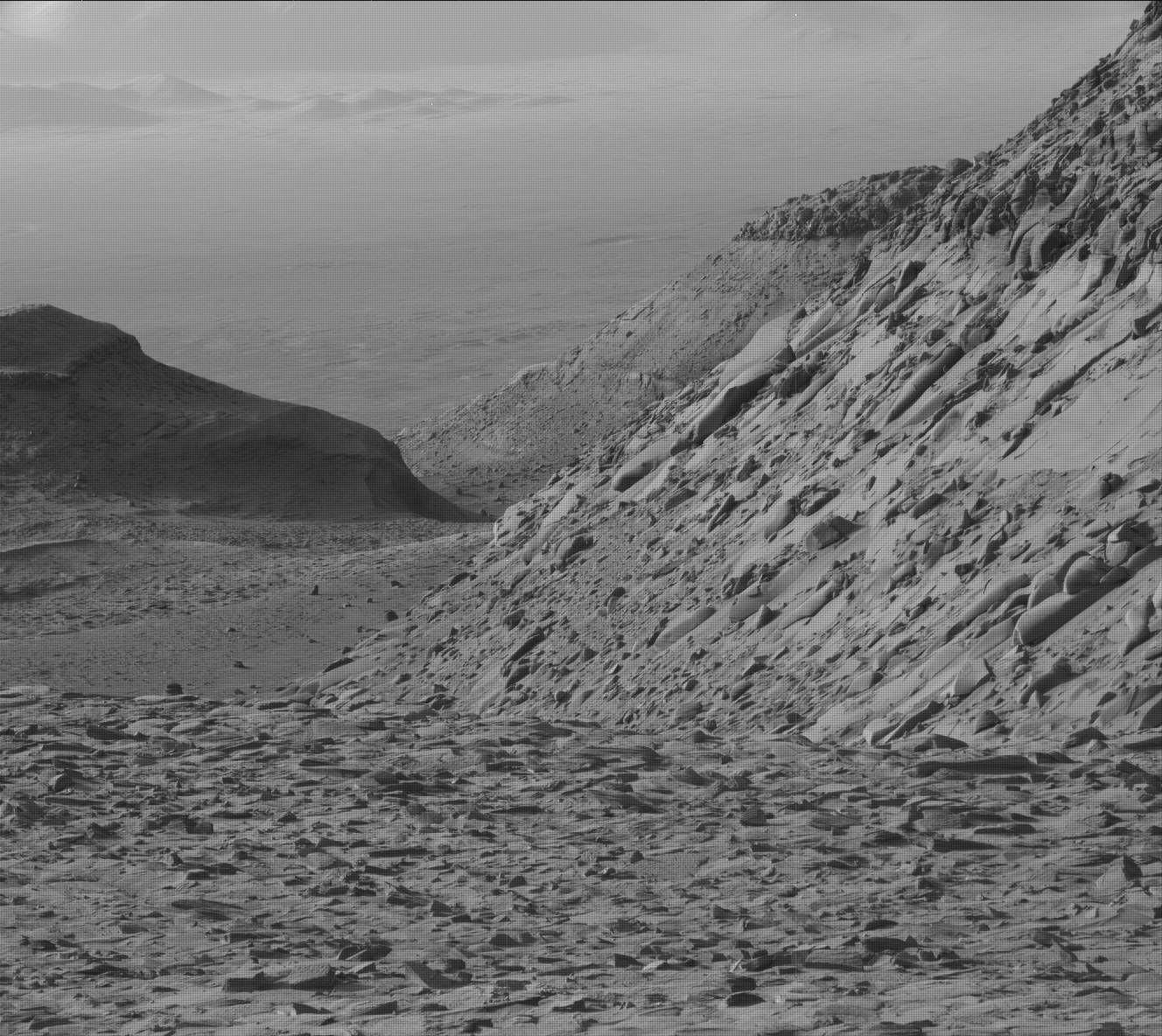
Today’s cool image from Mars is not so much unique visually as it is unique in terms of its location. The picture to the right, rotated, cropped, reduced, and sharpened to post here, was taken on January 31, 2023 by the high resolution camera on Mars Reconnaissance Orbiter (MRO). It shows the northern rim of a small crater, with its floor filled with an intriguing mound of material.
The picture was labeled a “terrain sample”, which suggests it wasn’t taken as part of any specific research project by instead to fill a gap in the camera’s schedule. To maintain the camera’s proper temperature, it is necessary to take pictures regularly, and when the camera team finds a gap that is too long, they fill it by choosing some almost random target in that gap that might be interesting. Sometimes it is, sometimes not.
In this case I strongly suspect this target was hardly random. The picture title also mentions MRO’s now retired radar CRISM instrument, which was used to detect evidence of underground ice. My guess is that the camera team thus likely decided to image this crater in high resolution because that radar data suggested the presence of underground ice.
This guess is strongly confirmed by a context camera picture taken of this crater on September 1, 2008. The crater appears surrounded by the typical splash apron one routinely sees around impact craters in the mid- and high-latitude northern lowland plains, where there is a lot of near surface ice.
The bumpy mound seen in high resolution on the floor of this crater could very well be buried glacial ice, as it mimics similar features in the many craters in the mid-latitudes of Mars. But is it buried ice? The location says otherwise.
» Read more
The smallsat engineering test lunar orbiter Capstone has now successfully ended its primary mission, completing six months of operation in the near-rectilinear halo orbit that NASA’s Lunar Gateway manned space station intends to fly.
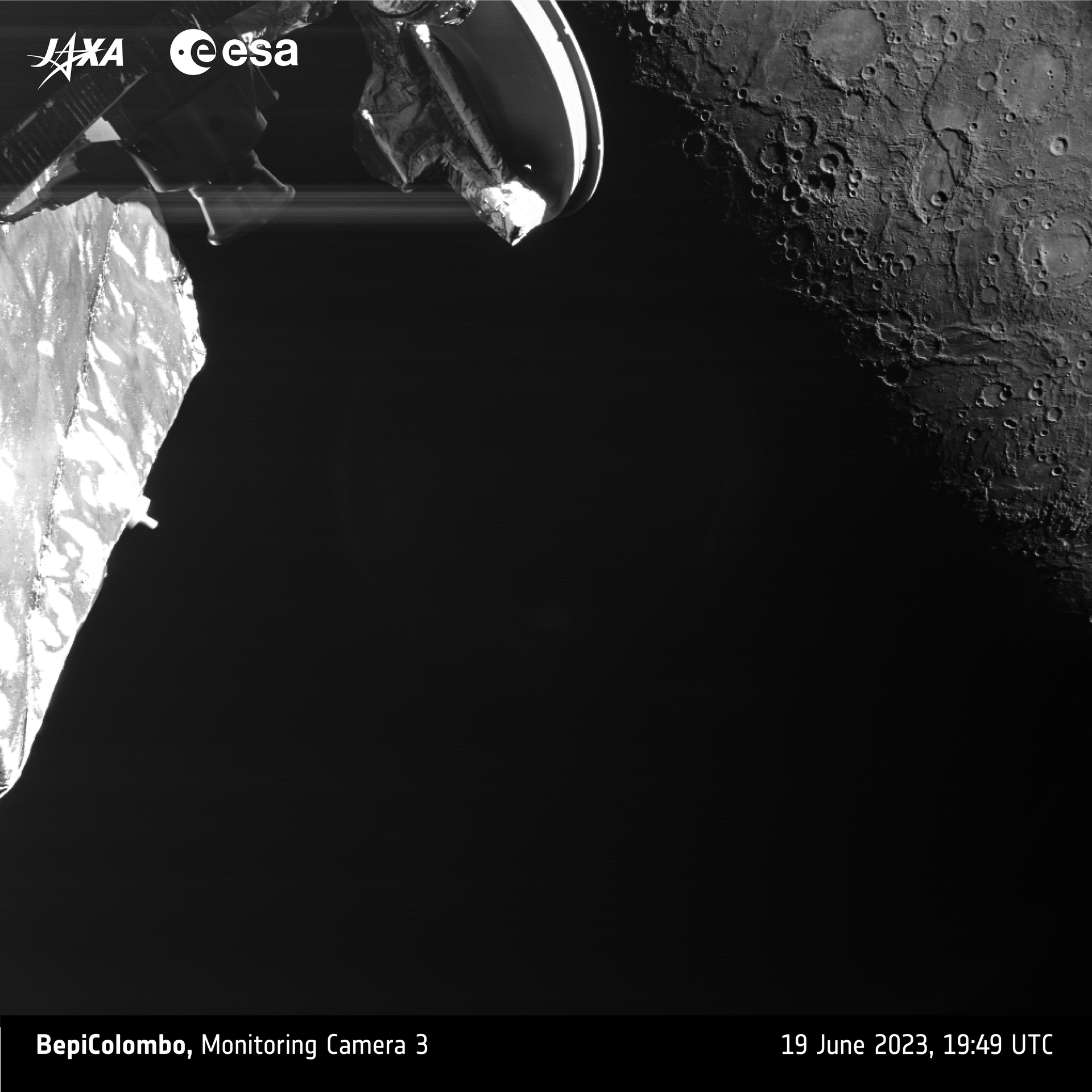
To put a final touch on that main mission, in May mission managers at the private company Advanced Space also completed two additional experiments. On May 3, 2023 they performed a close-fly of the Moon, using the spacecraft’s camera for the first time to take the picture of the Moon to the right.
Then, on May 9 Capstone successfully tested navigation technology in conjunction with NASA’s Lunar Reconnaissance Orbiter (LRO), also in orbit around the Moon.
During the May 9 experiment, CAPSTONE sent a signal to LRO designed to measure the distance and relative velocity between the two spacecraft. LRO then returned the signal to CAPSTONE, where it was converted into a measurement. The test proved the ability to collect measurements that will be utilized by CAPS software to determine the positioning of both spacecraft. This capability could provide autonomous onboard navigation information for future lunar missions.
The mission now enters its extended mission, planned to last at least a year.

Lucy’s route through the solar system
The asteroid probe Lucy on May 9, 2023 fired its engines to successfully make a minor course correction in preparation for a fly by of the asteroid Dinkinesh, located in the main asteroid belt between Mars and Jupiter.
Even though the spacecraft is currently travelling at approximately 43,000 mph (19.4 km/s), this small nudge is enough to move the spacecraft nearly 40,000 miles (65,000 km) closer to the asteroid during the planned encounter on Nov. 1, 2023. The spacecraft will fly a mere 265 miles (425 km) from the small, half-mile- (sub-km)-sized asteroid, while travelling at a relative speed of 10,000 mph (4.5 km/s).
Dinkinesh, the white dot inside the main asteroid belt in the lower left of the map to the right, is the first of eight asteroids Lucy will fly past.

An artist’s concept of Blue Moon
NASA today announced that it has chosen the partnership led by Blue Origin to build a second manned lunar lander for its Artemis program.
Blue Origin will design, develop, test, and verify its Blue Moon lander to meet NASA’s human landing system requirements for recurring astronaut expeditions to the lunar surface, including docking with Gateway, a space station where crew transfer in lunar orbit. In addition to design and development work, the contract includes one uncrewed demonstration mission to the lunar surface before a crewed demo on the Artemis V mission in 2029. The total award value of the firm-fixed price contract is $3.4 billion.
The other partners in the contract are Draper, Astrobotic, and Honeybee Robotics.
This is NASA’s second contract for a lunar lander, with SpaceX’s Starship the first. The idea is to have two landers available from competing companies for both competition and redundancy, similar to the approach the agency has used for its manned ferry service to ISS, using SpaceX and Boeing. I wonder if NASA’s experience on the Moon will be similar to that ferry service, whereby only SpaceX so far has been able to deliver. The track record of Blue Origin suggests it will do about as poorly as Boeing has with Starliner.
Today’s cool image takes us to a part of the cratered southern highlands of Mars that I have not featured much previously. The picture to the right, rotated, cropped, and reduced to post here, was taken on March 7, 2023 by the high resolution camera on Mars Reconnaissance Orbiter (MRO). It shows what appears to be a collection of rough hills and mesas surrounded by a sea of smooth ground that at the base of the cliffs seems to end abruptly.
The smooth ground is probably mantled by a layer of dust and debris. Since this location is at 36 degrees south latitude, there is also probably near surface ice under that layer. The abrupt edges likely indicate where the increasing slope next to the mesas and mounds caused that ice to be exposed and thus sublimate away.
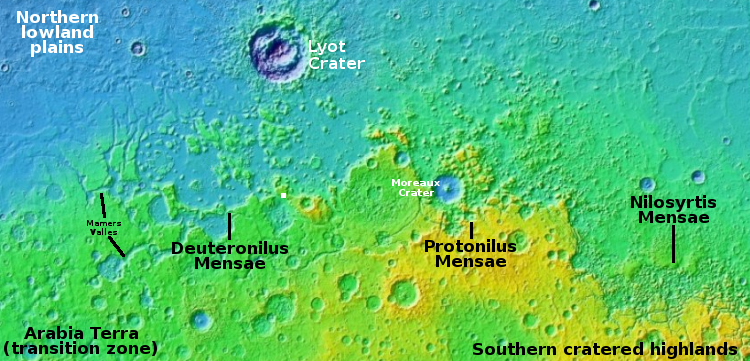
As for the location, we must go to the overview map.
» Read more
Using data from a variety of space- and ground-based telescopes astronomers have discovered Earth-sized exoplanet orbiting a red dwarf star 90 light years away.
The exoplanet is dubbed LP 791-18 d, and is thought to be slightly bigger than the Earth. Its orbit, close to the star, causes it to be tidally-locked, with one hemisphere always facing the star. In addition, the presence of another much larger exoplanet in the system causes other tidal effects.
Astronomers already knew about two other worlds in the system before this discovery, called LP 791-18 b and c. The inner planet b is about 20% bigger than Earth. The outer planet c is about 2.5 times Earth’s size and more than seven times its mass.
During each orbit, planets d and c pass very close to each other. Each close pass by the more massive planet c produces a gravitational tug on planet d, making its orbit somewhat elliptical. On this elliptical path, planet d is slightly deformed every time it goes around the star. These deformations can create enough internal friction to substantially heat the planet’s interior and produce volcanic activity at its surface. Jupiter and some of its moons affect Io in a similar way.
The press release makes a big deal about the volcanism, even suggesting it could produce an atmosphere that, because the exoplanet sits on the inner edge of the habitable zone, could make the exoplanet habitable. These speculations are silly, considering the uncertainties, the exoplanet’s evolving orbit, and the star it orbits, and are being pushed mostly because the press office thinks this will be the only way the public will have any interest in the discovery.
While there is an infinitesimal chance there could be life here, a more likely scenario is that it is a lifeless volcano world like Jupiter’s moon Io. Even more probably however is that it is completely different than anything we have yet observed, in ways we can’t yet predict. To find out however we would need close-up observations that will likely not be possible without an interstellar mission.
Engineers at India’s space agency ISRO have begun the installation of the payloads onto its lunar lander/rover, Chandrayaan-3, which is still targeting a mid-July launch.
The map shows the landing location (red dot) near the Moon’s south pole (indicated by the cross). Nova-C is Intuitive Machines private lander, now aiming for a late summer launch at the earliest. Luna-25 is Russia’s first lunar lander since the 1970s, and is also targeting a launch in July.
India’s first attempt, Chandryaan-2, to land a rover at this spot on the Moon failed in 2019. This new mission is essentially a re-do, except that it does not include an orbiter, since the orbiter from Chandrayaan-2 is still operational and can do the job.
All in all, it increasingly looks like the next six months will see a lot of new landing attempts on the Moon.
Cool image time! The picture to the right, cropped to post here, was taken on February 17, 2023 by the high resolution camera on Mars Reconnaissance Orbiter (MRO), and shows what the science team labels “regularly textured ground on Pavonis Mons.”
The arrow in the picture indicates the downhill trend. If you look at the full image, you will see that this texture pattern extends in all directions for a considerable distance, both uphill and down, and even covers the entire floor of a depression that appears to contour along the grade instead of going downhill.
The latitude here is very close to the equator. So, even though the elevation is high, being on the slopes of a giant volcano, there is probably no near surface ice here.
» Read more
The uncertainty of science: Using a variety of telescopes, astronomers have not only made the first radio observations of key type of supernova, they have also detected helium in the data, suggesting that this particular supernova of that type was still atypical.
This marks the first confirmed Type Ia supernova triggered by a white dwarf star that pulled material from a companion star with an outer layer consisting primarily of helium; normally, in the rare cases where the material stripped from the outer layers of the donor star could be detected in spectra, this was mostly hydrogen.
Type Ia supernovae are important for astronomers since they are used to measure the expansion of the universe. However, the origin of these explosions has remained an open question. While it is established that the explosion is caused by a compact white dwarf star that somehow accretes too much matter from a companion star, the exact process and the nature of the progenitor is not known. [emphasis mine]
The highlighted sentences are really the most important take-away from this research. Type Ia supernovae were the phenomenon used by cosmologists to detect the unexpected acceleration of the universe’s expansion billions of years ago. That research assumed these supernovae were well understood and consistently produced the same amount of energy and light, no matter how far away they were or the specific conditions which caused them.
This new supernovae research illustrates how absurd that assumption was. Type Ia supernovae are produced by the interaction of two stars, both of which could have innumerable unique features. It is therefore unreasonable as a scientist to assume all such supernovae are going to be identical in their output. And yet, that is what the cosmologists did in declaring the discovery of dark energy in the late 1990s.
It is also what the scientists who performed this research do. To quote one of the co-authors: “While normal Type Ia supernovae appear to always explode with the same brightness, this supernova tells us that there are many different pathways to a white dwarf star explosion.”
Forgive me if I remain very skeptical.
The uncertainty of science: Though astronomers have long believed that the Milky Way galaxy is a barred spiral galaxy, defined as having a major straight arm coming out in two directions from its nucleus with other spiral arms surrounding it, determining the exact structure has been difficult because of our presence within the galaxy.
The image to the right, taken from a paper just published, shows three different types of barred spirals. On the left is one where the surrounding spiral arms hardly exist. In the center the central bar is surrounded by multiple arms. On the right is a barred spiral with just one major spiral arm.
Though it has been generally accepted that the Milky Way belongs in the center category, astronomers remain unsure about the actual spiral structure. Previous work had suggested the galaxy actually had four major arms, not two as seen by most barred spirals. As noted in the paper, “If that is the case, the [Milky Way] may be an atypical galaxy in the universe.”
The research from the new paper however now proposes that the Milky Way is actually not atypical, but instead more resembles the center image, with two main arms and multiple segmented arms beyond. From the abstract:
Using the precise locations of very young objects, for the first time, we propose that our galaxy has a multiple-arm morphology that consists of two-arm symmetry (the Perseus and Norma Arms) in the inner parts and that extends to the outer parts, where there are several long, irregular arms (the Centaurus, Sagittarius, Carina, Outer, and Local Arms).
The astronomers cheerfully admit that this conclusion is uncertain, and will need many further observations for confirmation.
After three years of upgrades, the engineers running Italy’s Virgo gravitational wave detector have decided to delay its restart later this month due to unexplained noise issues found inside some older components.
Getting to these parts to find the cause of the noise however will not be simple, as they are housed inside a vacuum chamber.
[According to Virgo spokesperson Gianluca Gemme. “Until we break the vacuum and open the towers to check the interferometer components directly, we cannot be one hundred percent sure what the problem is. … We therefore decided to take action now to resolve the technical issue that is slowing down the interferometer’s sensitivity growth. These are operations that, apart from the work we will have to do, involve time to remove and then restore the ultra-high vacuum conditions.
Once this work is completed it will then require further testing to make sure all is well. It is therefore unclear when Virgo will resume observations.
Meanwhile, the two detectors in the United States plan to resume operations as scheduled later this month. Without Virgo working in tandem, however, the resolution for any detections will be reduced.
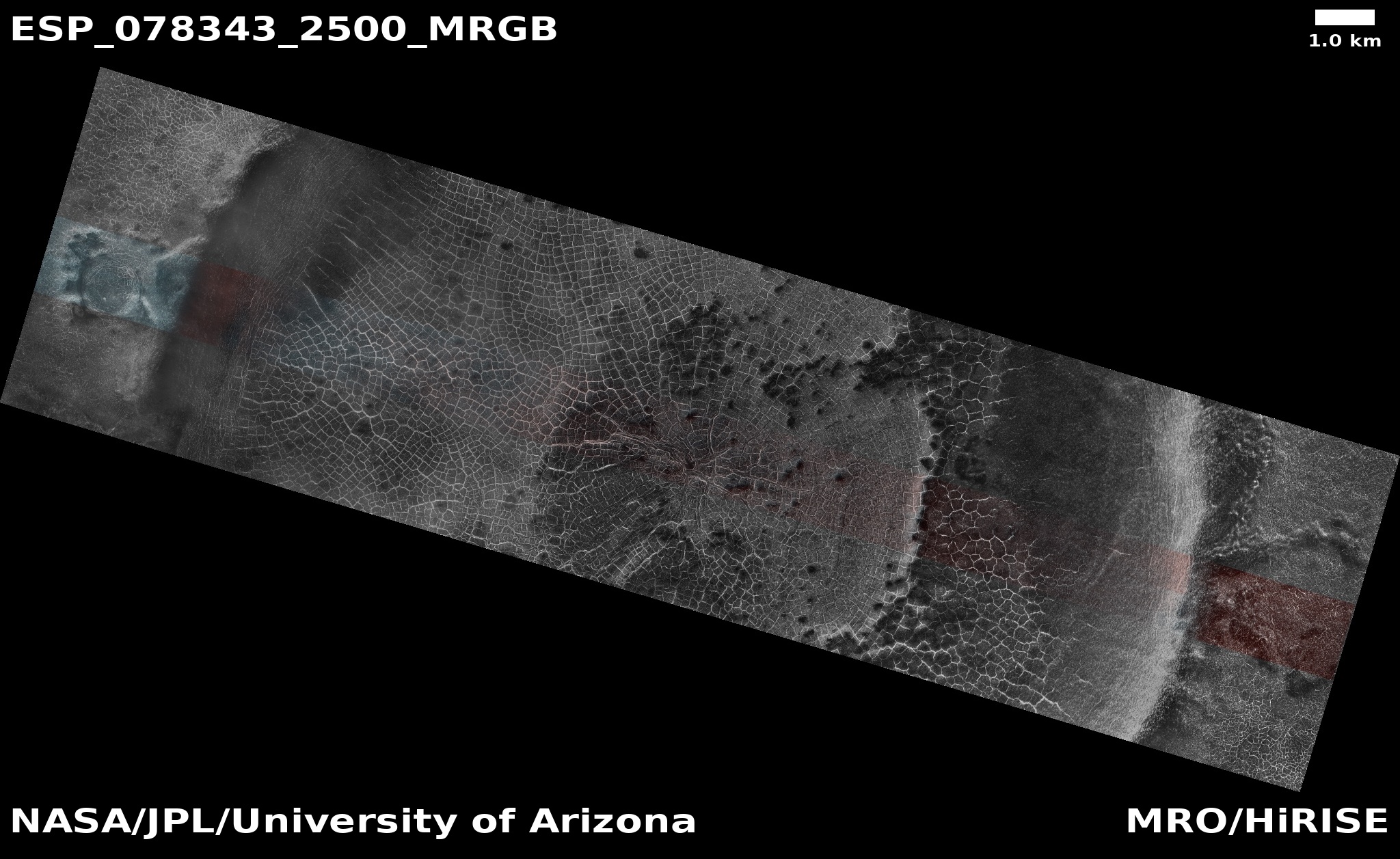
Cool image time! The picture to the right, cropped, reduced, and sharpened to post here, was taken on March 10, 2023 by the high resolution camera on Mars Reconnaissance Orbiter (MRO).
As I noted in a cool image only two weeks ago, brain terrain is a geological feature wholly unique to Mars that planetary geologists still do not understand or can explain. They know its knobby interweaving nodules (resembling the convolutions of the human brain) are related to near surface ice and its sublimation into gas, but no one has much confidence in any of the theories that posit the process that forms it.
In this case the brain terrain not only fills the crater, it appears to surround it as well, but only appearing at spots where a smooth top layer has begun to break apart. Moreover, the crater appears to be a pedestal crater, whereby much of the less dense surrounding terrain has vanished, leaving the compacted crater sitting higher.
» Read more
The private rocket company Rocket Lab has now completed construction on the Photon transport spacecraft that the private company Varda has purchased to maneuver and then de-orbit its private returnable space capsule in which it plans to manufacture pharmaceuticals while in orbit and then return to Earth for sale.
Rocket Lab made the spacecraft at its Long Beach manufacturing site to provide power, communications, propulsion and attitude control to a capsule that will produce pharmaceutical products in microgravity. In addition to providing support during the in-space phase of Varda’s mission, the Photon will put Varda’s capsule carrying finished pharmaceuticals on a return trajectory to Earth.
This is the first of four Photon spacecraft that Varda has purchased from Rocket Lab. Varda appears to be attempting to continue the pharmaceutical work that McDonnell-Douglas did on the space shuttle, and was on the verge of flying a full-scale production mission for profit, when the Challenger accident occurred in 1986 and ended all further commercial work on the shuttle.

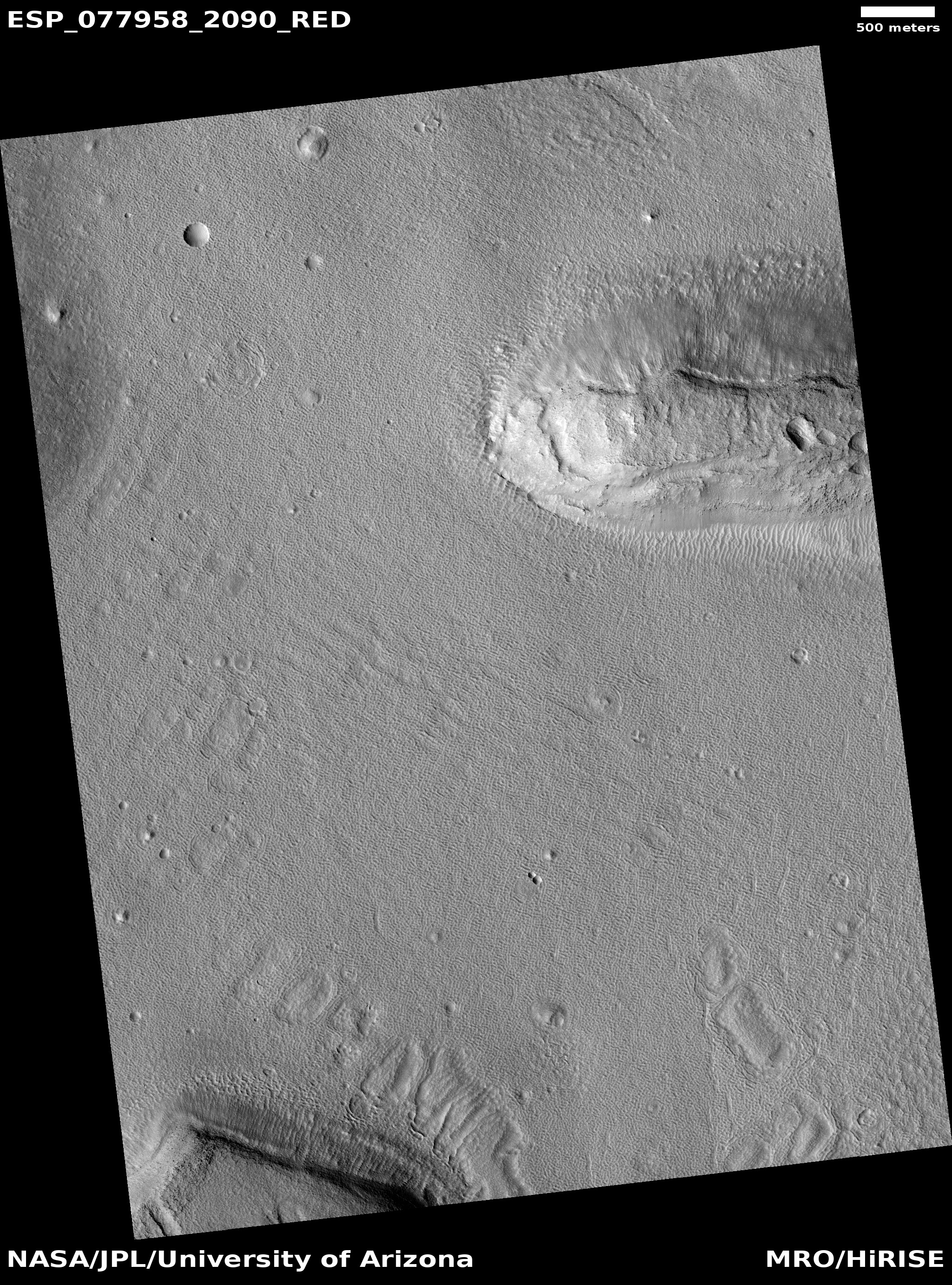
Cool image time! The picture to the right, cropped to post here, was taken on February 21, 2023 by the high resolution camera on Mars Reconnaissance Orbiter (MRO). This is a terrain sample image, which means it was snapped not as part of any specific research project but to fill a gap in the schedule in order to maintain the camera’s proper temperature. As usual, the camera team tried to pick something of interest, and I think they succeeded.
The two large depressions in the center of the picture do not resemble impact craters. They have no rim of ejected material and their shape is very distorted. Instead, both appear to be places where a top layer of ice/debris has sublimated away into gas, exposing a lower layer of glacial material that itself is sublimating away to form the bumpy mounds that fill the floor of the depressions.
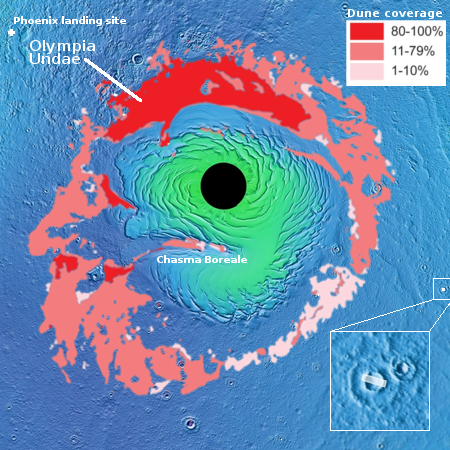
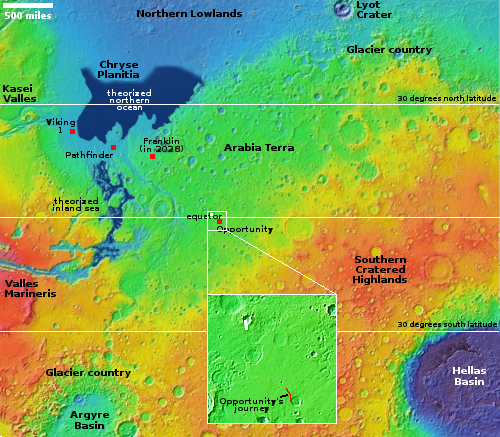
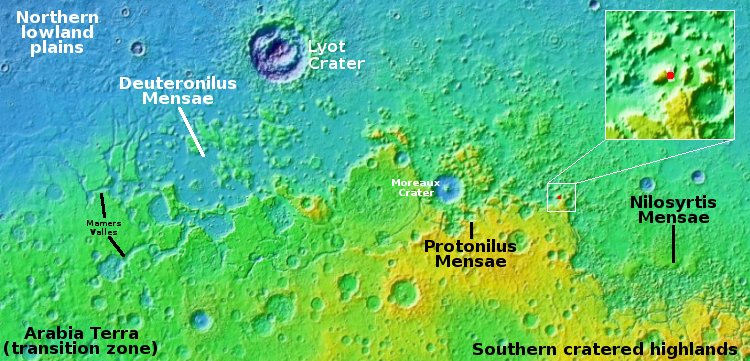
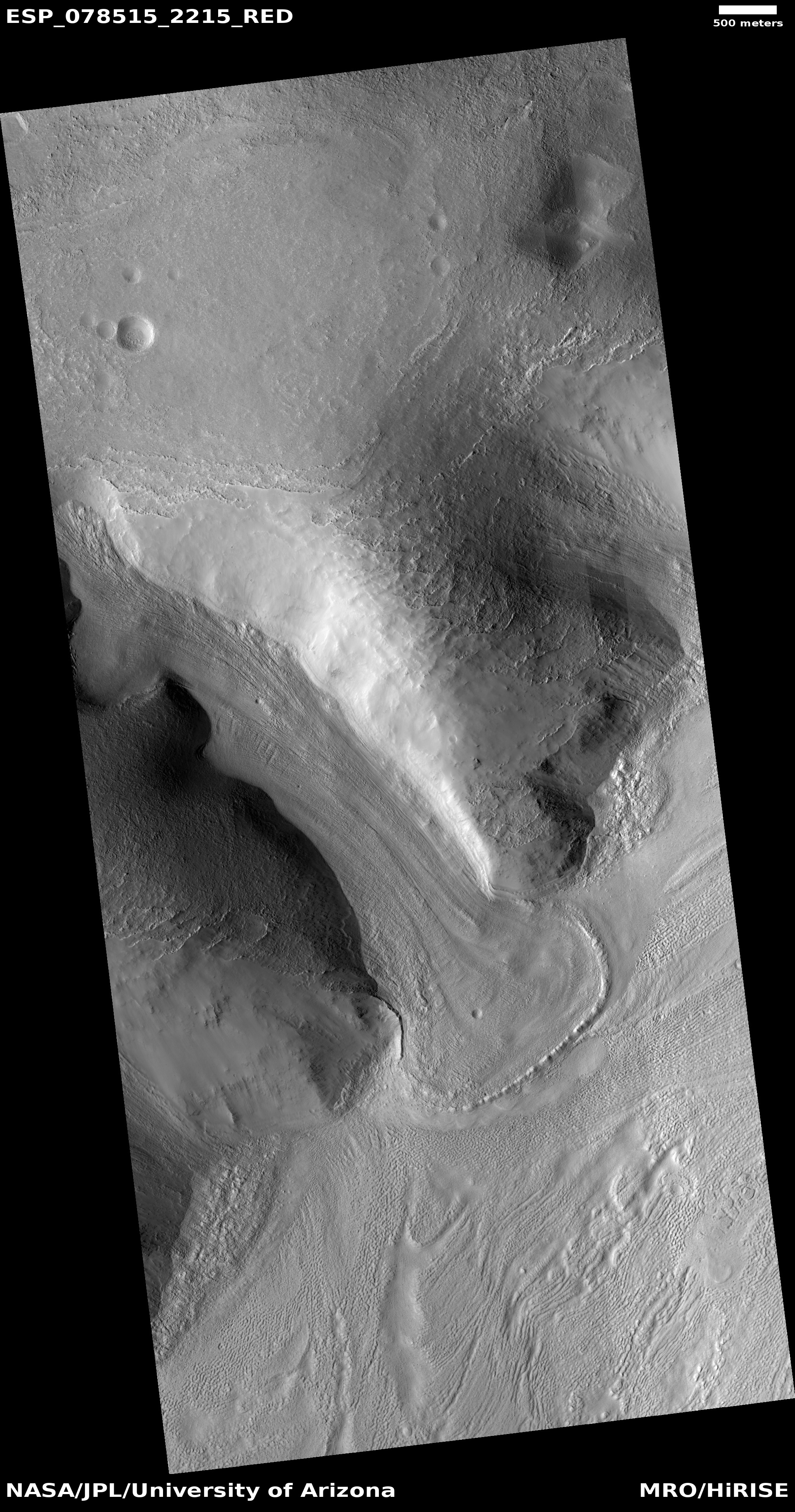
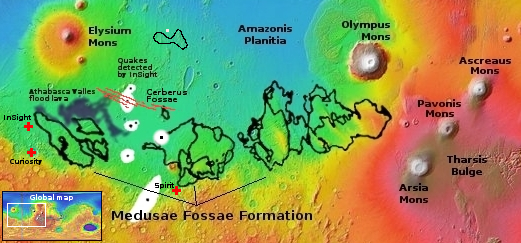
The white dot inside the inset box on the overview map above marks this location, just south of the northern wall of a large 30-mile-wide canyon, with its northern floor even more depressed, as if the material in that raised middle a flat pile of glacial debris flowing to the southwest after leaving the gap in the crater to the northeast. An MRO context camera picture taken on January 6, 2016 gives a wider view, showing that there are a lot of these type depressions on the surface of this wide middle upraised floor, as well as some obvious impact craters.
This location is in the mid-latitude band where many glacial features are found. In this part of the southern cratered highlands there is also a lot of evidence of top layers sublimating away, as if the glacial material is a large buried ice sheet that is beginning to disappear at places where it has been exposed by impacts or shifting motion. The depression in the picture above appears to be an example.
After only a day and a half after launch NASA’s second super pressure balloon, this time carrying a detector for studying cosmic rays, developed a leak that forced its controllers to terminate the mission.
The scientific balloon launched from Wānaka Airport, New Zealand, May 13, 12:02 p.m. NZST (May 12, 8:02 p.m EDT). The balloon was in flight for 1 day, 12 hours, and 53 minutes before termination over the Pacific Ocean May 14 at 12:54 UTC (8:54 a.m. EDT). The launch was the second and final for NASA’s 2023 New Zealand balloon launch campaign.
During flight, the SPB began experiencing a leak and teams attempted to troubleshot by dropping ballast to maintain the balloon’s altitude. The determination was made to safely terminate over the Pacific Ocean. NASA will investigate the cause of the anomaly.
Meanwhile, the first balloon, dubbed SuperBIT, continues to fly, presently on its fourth circumnavigation of Antarctic while its telescope takes high resolution images of celestial objects.
Scientists using data from Cassini, which orbited Saturn from 2004 to 2017, have confirmed earlier research that said Saturn’s rings are much younger than the planet, only about 400 million years old.
From 2004 to 2017, the team used an instrument called the Cosmic Dust Analyzer aboard NASA’s late Cassini spacecraft to analyze specks of dust flying around Saturn. Over those 13 years, the researchers collected just 163 grains that had originated from beyond the planet’s close neighborhood. But it was enough. Based on their calculations, Saturn’s rings have likely been gathering dust for only a few hundred million years.
Though I cannot cite the earlier research, I distinctly remember a study from about a decade ago that posited the rings being young, only a few hundred million years old. This research confirms this conclusion, and likely firms up the theory considerably.
Intuitive Machines officials revealed during their quarterly report that the first mission of its Nova-C lunar lander has been delayed from June to late August or September.
The company announced in February plans for a June landing at Malapert A, a crater near the south pole of the moon. That date was a slip from a previously scheduled March launch, which the company said was linked to NASA’s decision to move the landing site to Malapert A.
Altemus said the company made “significant progress” in testing of the lander in recent months, such as structural tests to confirm the vehicle could handle the stresses of launch and cryogenic tanking demonstrations. “We have some functional testing” still to do on the lander, he said, but did not elaborate on the nature of those tests or their schedule ahead of shipping to Cape Canaveral for its Falcon 9 launch.
Two private companies have so far attempted and failed to land on the Moon, Israel’s SpaceIL and Japan’s Ispace. Two American companies, Intuitive Machines and Astrobotic, are both racing to achieve this goal in the coming months. This delay now puts Astrobotic in the lead, with its launch now targeting the summer.
Engineers have successfully freed the 52-foot wide radar antenna on the Juice probe to Jupiter, shaking it enough to release a pin that was blocking deployment.
The pin was freed by employing “back-to-back jolts”. Imagine when you roll your car back and forth to get it freed from mud or snow. It appears this is what they did with the pin.
Juice will arrive in Jupiter orbit in 2031, where it will make numerous fly-bys of Europa, Calisto, and Ganymede, and then settle into an orbit around Ganymede alone. The radar antenna was essential for probing the ice content of these worlds, below the surface.
Hat tip to reader Mike Nelson.
Using ground-based images analyzed in a new way, astronomers have discovered an additional 62 small moons orbiting Saturn, giving the ringed gas giant a total of 145 known moons.
The data used by the team was collected between 2019 and 2021 in three-hour spans by the Canada-France-Hawaii Telescope (CFHT) on top of Maunakea in Hawaii. It allowed the astronomers to detect moons around Saturn as small as 1.6 miles (2.5 kilometers) in diameter. That’s about two-thirds the length of Hollywood’s Walk of Fame.
Though some of the moons had been spotted as early as 2019, it takes more than sighting an object close to a planet to confirm it is a moon and not an asteroid making a brief close passage to that planet. To change these objects from “suspected moons” to “confirmed moons” of Saturn, the astronomers had to track them for several years to ensure each is actually orbiting the gas giant.
Performing a painstaking process of matching objects detected on different nights over the course of 24 months, the team tracked 63 objects that they ended up confirming as moons. One of these satellites was revealed back in 2021, with the remaining 62 moons gradually announced over the past few weeks.
To a certain extent, this declared number of moons around Saturn is utterly irrelevant. Think about it. Every single object in its rings should be defined as a moon, totaling hundreds of thousands. At some point the question of what defines a moon becomes the relevant question.