Shocker! Scientists tried and failed to infect people with COVID who had natural immunity

Modern scientists discover the obvious: In a experiment to see the impact of COVID on people who had previously gotten sick with the virus, scientists have discovered something called “natural immunity,” a phenomenon once known to doctors and ordinary people for centuries but purposely forgotten in 2020 when an election was coming up and the leftists who controlled most universities, health departments, and science organizations wanted a panic to prevent Donald Trump from getting reelected.

Researchers use challenge trials to understand infections and quickly test vaccines and therapies. In March 2021, after months of ethical debate, UK researchers launched the world’s first COVID-19 challenge trial. The study identified a minuscule dose of the SARS-CoV-2 strain that circulated in the early days of the pandemic that could infect about half of the participants, who had not previously been infected with the virus (at that time, vaccines weren’t yet widely available).

In parallel, a team led by Helen McShane, an infectious-disease researcher at Oxford, launched a second SARS-CoV-2 challenge study in people … who had recovered from naturally caught SARS-CoV-2 infections, caused by a range of variants. The trial later enrolled participants who had also been vaccinated.

…When nobody developed a sustained infection, the researchers increased the dose by more and more in subsequent groups of participants, until they reached a level 10,000 times the initial dose. A few volunteers developed short-lived infections, but these quickly vanished.

…“We were quite surprised,” says Susan Jackson, a study clinician at Oxford and co-author of the latest study. “Moving forward, if you want a COVID challenge study, you’re going to have to find a dose that infects people.”

This article in the science journal Nature is written in a very clunky manner, almost as if the writer and editors wanted to obscure these findings.

The bottom line however is no surprise to anyone who kept their heads during the 2020 COVID panic. This virus was not the plague, but merely comparable to a new strain of the flu, though apparently artificially created by a Chinese lab in Wuhan that was partly funded by American federal funds from the NIH. And like all such diseases, once you caught it your own immune system naturally figured out how to protect you from it in the future.

And like the flu, if you were young and healthy it was incapable of killing you. The quicker the general population had gotten infected and immune, the quicker the epidemic would have died out, making it impossible for the virus to harm many of the sick and old. That was the standard response to epidemics until 2020.

Instead, the health establishment went nuts, forgot basic science, and did exactly the opposite, thus killing many more of the old and sick than necessary.

12 comments

Hubble out of safe mode and resumed science observations

According to the Hubble website, engineers have corrected the gyro issue that put the Hubble Space Telescope into safe mode on April 23, 2024.

On April 30, 2024, NASA announced it restored the agency’s Hubble Space Telescope to science operations April 29. The spacecraft is in good health and once again operating using all three of its gyros. All of Hubble’s instruments are online, and the spacecraft has resumed taking science observations.

No other information was released. The safe mode was initiated by faulty readings from one of those gyros. Was the problem in the gyro itself, or were the readings merely incorrect? This matters because when one of those gyros finally fails, the telescope will go to one-gyro mode, saving its second gyro in reserve. At that point Hubble will no longer be able to take sharp images, though it will still be able to some science.

2 comments

Lava land on Mars

Lava land on Mars
Click for original image.

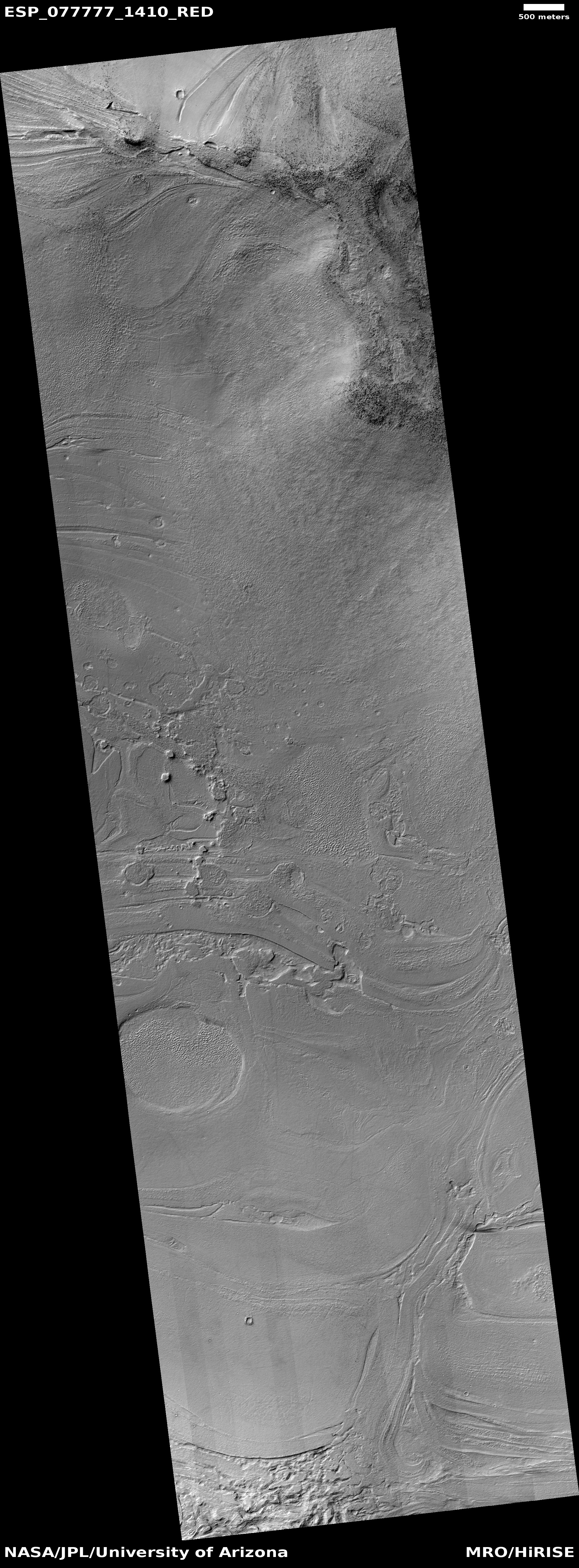
Cool image time! The picture to the right, cropped, reduced, and sharpened to post here, was taken on March 2, 2024 by the high resolution camera on Mars Reconnaissance Orbiter (MRO). It shows what the scientists label as “platy fractures.”

The ridges likely align with cracks that developed over time on this lava field, which then formed the ridges when magma oozed up from below. It is also possible that these events were closely linked, that the pressure from the magma below cracked this lava field, with the magma immediately oozing out. Because the pressure was evenly applied across the whole surface, it caused a network of cracks and plates, not a single vent or caldera. The even distribution of the pressure also caused only a small amount of lava to leak out to form the ridges.
» Read more

0 comments

Webb maps the global temperature and water vapor of a hot exoplanet

The uncertainty of science: Using detailed infrared data from the Webb Space Telescope, scientists have mapped the temperature swings and atmospheric water vapor across the entire global of a tidally locked “hot Jupiter” exoplanet about 284 light years away that orbits its star every 19.5 hours.

The team used Webb’s MIRI (Mid-Infrared Instrument) to measure light from the WASP-43 system every 10 seconds for more than 24 hours. “By observing over an entire orbit, we were able to calculate the temperature of different sides of the planet as they rotate into view,” explained Bell. “From that, we could construct a rough map of temperature across the planet.”

The measurements show that the dayside has an average temperature of nearly 2,300 degrees Fahrenheit (1,250 degrees Celsius) – hot enough to forge iron. Meanwhile, the nightside is significantly cooler at 1,100 degrees Fahrenheit (600 degrees Celsius). The data also helps locate the hottest spot on the planet (the “hotspot”), which is shifted slightly eastward from the point that receives the most stellar radiation, where the star is highest in the planet’s sky. This shift occurs because of supersonic winds, which move heated air eastward.

…To interpret the map, the team used complex 3D atmospheric models like those used to understand weather and climate on Earth. The analysis shows that the nightside is probably covered in a thick, high layer of clouds that prevent some of the infrared light from escaping to space. As a result, the nightside – while very hot – looks dimmer and cooler than it would if there were no clouds.

The data also found water vapor on both the day and night sides of the exoplanet, but surprisingly no evidence of methane, suggesting that atmosphere has high winds exceeding 5,000 miles per hour that mixes that atmosphere globally. Any methane that was expected to exist on the night side gets blown to the day side where the heat destroys it.

This data, while excellent, is also very coase and even more uncertain. While Webb can get good infrared spectroscopy from almost 300 light years away, we must take the interpretations of that data with great skepticism.

0 comments

Webb takes an infrared look at the mane of the Horsehead Nebula

Context images
Click for original image.

The mane of the Horsehead Nebula, seen in infrared
Click for original image.

The cool infrared image to the right, cropped, reduced, and sharpened to post here, was taken by the Webb Space Telescope and released today. The three pictures above provide the context, with the rectangle inside the rightmost image indicated the area covered by the close-up to the right.

Webb’s new images show part of the sky in the constellation Orion (The Hunter), in the western side of a dense region known as the Orion B molecular cloud. Rising from turbulent waves of dust and gas is the Horsehead Nebula, otherwise known as Barnard 33, which resides roughly 1,300 light-years away.

The nebula formed from a collapsing interstellar cloud of material, and glows because it is illuminated by a nearby hot star. The gas clouds surrounding the Horsehead have already dissipated, but the jutting pillar is made of thick clumps of material and therefore is harder to erode. Astronomers estimate that the Horsehead has about five million years left before it too disintegrates. Webb’s new view focuses on the illuminated edge of the top of the nebula’s distinctive dust and gas structure.

In the close-up, note the many distant tiny galaxies, both above the mane as well as glowing throught it.

2 comments

Martian dunes with frost and a sublimating dry ice mantle

Martian dunes surrounded by frost
Click for original image.

Cool image time! The picture to the right, cropped to post here, was taken on March 16, 2024 by the high resolution camera of Mars Reconnaissance Orbiter (MRO). It was released today as a captioned picture from MRO’s camera team. As noted in the caption, written by the camera’s principal investigator Alfred McEwen:

This image shows a field a sand dunes in the Martian springtime while the seasonal carbon dioxide frost is sublimating into the air. This sublimation process is not at all uniform, instead creating a pattern of dark spots.

In addition, the inter-dune areas are also striking, with bright frost persisting in the troughs of polygons. Our enhanced-color cutout is centered on a brownish-colored inter-dune area.

Each winter the carbon dioxide in the Martian atmosphere falls as snow, mantling the surface in the latitudes above 60 degrees with a clear coat of dry ice. When spring arrives the sunlight passes through the mantle to heat the ground below, which in turn causes the base of the dry ice mantle to sublimate into gas. When the pressure builds enough, the gas breaks through the mantle at its weak points, spewing out and bringing with it dust from below, which stains the mantle with the dark spots.
» Read more

0 comments

Scientists: computer modeling suggests one lunar crater is the origin of a nearby asteroid

The uncertainty of science: Using computer modeling some scientists now suggest that the nearby asteroid 2016 HO3, also known as Kamo’oalewa, that has a solar orbit that periodically flips around the Earth, came from an impact a million years ago that created the Giordano Bruno crater on the moon’s far side.

According to the simulations, it would have required an impactor of at least 1 kilometer (0.6 mile) in diameter to launch a large fragment like Kamo’oalewa beyond the moon’s gravitational pull. According to the group’s model, the impact would have dug up Kamo’oalewa from deep beneath the moon’s surface, leaving behind an impact crater larger than 10 to 20 kilometers (6-12 miles) in diameter. Additionally, the crater would have to be younger than the average lifetime for near-Earth objects, which spans about 10 million to 100 million years, a very short and recent period in the history of the solar system.

While the lunar surface is riddled with thousands of craters from impacts spanning the moon’s 4.5 billion year-history, only Giordano Bruno with its 14-mile diameter and estimated 4 million years of age fits the bill in terms of size and age, making it the most probable source of Kamo’oalewa’s origin. The team also showed that this scenario is feasible from an impact dynamics perspective.

To say that this conclusion is uncertain is an understatement of monumental proportions. However, the possibility is real. A Chinese asteroid mission, dubbed Tianwen-2, will likely found out, as it is planning to bring samples back from this asteroid by 2027.

1 comment

NASA: first launch of New Glenn is targeting a September 29, 2024 launch date

According to a presentation given by a NASA official at a conference in London yesterday, the first launch of Blue Origin’s New Glenn rocket is now targeting a September 29, 2024 launch.

In a presentation at a meeting of a planetary protection committee of the Committee on Space Research (COSPAR) in London April 24, Nick Benardini, NASA’s planetary protection officer, listed a Sept. 29 date for the launch of Escape and Plasma Acceleration and Dynamics Explorers (ESCAPADE) mission, a pair of smallsats that will go into orbit around Mars to measure the interaction of the planet’s magnetosphere with the solar wind.

NASA selected Blue Origin’s New Glenn rocket to launch ESCAPADE, awarding the company a $20 million task order through the agency’s Venture-Class Acquisition of Dedicated and Rideshare contract in February 2023 for the mission. The award at the time mentioned only a late 2024 launch, with the expectation that ESCAPADE would be on one of the first, if not the first, flight of the rocket.

Benardini mentioned ESCAPADE in his COSPAR presentation to discuss how the mission was complying with planetary protection requirements, intended to prevent any contamination of Mars, during the assembly of the spacecraft and launch preparations at Cape Canaveral. “They’re slated to be launching Sept. 29 with Blue Origin,” he said.

This is the first time any source at NASA or Blue Origin has revealed a specific launch date. The rocket was originally supposed to fly its first orbital test flight four years ago, but numerous delays, mostly related to the BE-4 engine used by the rocket’s first stage as well as decisions by the company’s former CEO, Bob Smith, to slow all development, pushed that launch back repeatedly. With Smith leaving late last year, the company has suddenly come back to life, with many indications that it was pushing for a launch this year.

3 comments

Hubble in safe mode

Barred galaxy
Click for original image.

The Hubble Space Telescope has gone into safe mode, pausing science observations on April 23, 2024 when its computer detected problems with one of its three working gyroscopes.

This particular gyro caused Hubble to enter safe mode in November after returning similar faulty readings. The team is currently working to identify potential solutions. If necessary, the spacecraft can be re-configured to operate with only one gyro, with the other remaining gyro placed in reserve . The spacecraft had six new gyros installed during the fifth and final space shuttle servicing mission in 2009. To date, three of those gyros remain operational, including the gyro currently experiencing fluctuations. Hubble uses three gyros to maximize efficiency, but could continue to make science observations with only one gyro if required.

If they cannot recover that gyro and are forced to resume science operations in one-gyro mode, it will mean the end of sharp images such as the one to the right, released today of the barred galaxy NGC 2217, located about 65 million light years away. Three gyros stablize the telescope in all three dimensions. One gyro can stablize it, but not in all three dimensions. Sharpness will suffer. We will no longer have a fully capable general purpose optical telescope in orbit, no plans in the U.S. to replace it.

6 comments

Numerous layers in the interior slopes of Argyre Basin on Mars

Numerous layers on Mars
Click for original image.

The cool image to the right, cropped, reduced, and enhanced to post here, was taken on February 22, 2024 by the high resolution camera on Mars Reconnaissance Orbiter (MRO). It gives us another example the many-layered geological history of Mars, seen in numerous locations across the entire Martian surface.

This example shows many thin layers, going downhill about 450 feet from the mesa near the bottom of the picture to the low point near the picture’s top. At this resolution there appear to be roughly two dozen prominent layers in that descent, but a closer look suggests many more layers within those large layers. Like the terrain that Curiosity is traversing on Mount Sharp, the closer one gets the more layers one sees. And each layer signifies a different geological event, possibly even marking the annual seasons, each either adding or removing a layer of dust or ice, or placing down a new layer of lava.
» Read more

0 comments

China reveals its rough plans for building its manned moon base.

At a conference in China this week, the chief designer of China’s lunar exploration program, Wu Weiren, outlined roughly the plans for building China’s International Lunar Research Station (ILRS) on the Moon.

According to Wu, the first phase of the ILRS construction project will see a basic station built by 2035 in the lunar south pole region. This basic station will have comprehensive scientific facilities with complete basic functions and supporting elements to carry out regular scientific experiments, and develop and utilize resources on a limited scale.

The second phase will see expansion of the station, set for completion by 2045, with a moon-orbiting space station as the hub and facilities featuring complete functions, considerable scale and stable operation. It will carry out comprehensive lunar-based scientific research and resource development and utilization, and conduct technical verification as well as scientific experiments and research for a manned landing on Mars.

This schedule contradicts other recent government statements that suggested the first phrase would be completed by 2030. Either way, we now have a rough timeline which, based on China’s past announcements, should be a reasonably accurate measure of what it now plans to do.

The timeline however is very long, and many other events outside of this program, such as war with Taiwan or sudden changes in the leadership of the ruling communist party, could change it drastically.

4 comments

China releases new geological atlas of the Moon

China's geologic map of the Moon

The map above is one low resolution example of a new detailed geological atlas that Chinese scientists have created and just released, using data obtained from all of China’s recent lunar missions, both orbiters and landers.

More information here.

The Chinese Academy of Sciences (CAS) has released the highest-resolution geological maps of the Moon yet. The Geologic Atlas of the Lunar Globe, which took more than 100 researchers over a decade to compile, reveals a total of 12,341 craters, 81 basins and 17 rock types, along with other basic geological information about the lunar surface. The maps were made at the unprecedented scale of 1:2,500,000.

…The CAS also released a book called Map Quadrangles of the Geologic Atlas of the Moon, comprising 30 sector diagrams which together form a visualization of the whole Moon.

The map has been released in both Chinese and English.

3 comments
1 79 80 81 82 83 729