NASA requests space stations bids from industry
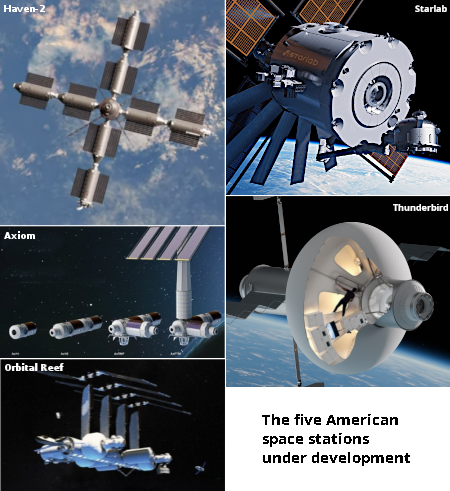
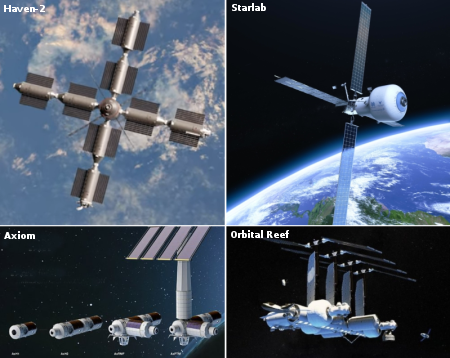
The American space stations under development

Having abandoned its short-lived NASA-built core module concept due to industry opposition, NASA is now requesting new proposals from the private sector for its space station program to replace ISS.

Based on industry’s input, NASA will proceed with its original plan to procure commercial services through FAR-based contract(s) awarded via full and open competition. Industry has indicated there is significant capital investment behind this approach and expressed high confidence in their ability to attract additional capital investment and expand future market opportunities after NASA makes an award.

NASA intends to award firm-fixed-price, multi-award, indefinite-delivery/indefinite-quantity contracts supporting development, certification, and services. This approach would allow NASA to select two or more contractors through early development, followed by a competitive task order for final design, test, evaluation, as well as certification and services from one or more contractors. [emphasis mine]

The deadline for submission is July 27, 2026. From these proposals NASA will proceed with its original plan to award construction contracts to build at least one new space station. The highlighted words above however suggest a significant change in the program. Under the original plan, NASA said it could only afford to finance one private station, something NASA administrator Jared Isaacman found unsatisfactory. NASA officials also did not believe there was sufficient private investment capital to make up the difference if NASA spread the money around to more than one station.

It looks like the industry has changed his mind. It now appears NASA will entertain multiple station proposals, and could conceivably award as many as three contracts. Of the five stations being built (see my list below), three are very robust at this point — Vast, Starlab, and Axiom — with a lot of private investment, a slew of customers, and some construction completed. Choosing one or two of these would be difficult, and possibly counter-productive, as all three have viable plans.

While I am speculating wildly, it looks to me that this NASA request for proposals is laying the groundwork for awarding at least three space station contracts, with these three stations in the lead. The amount of money in NASA’s space station budget might not be sufficient to finance all three, but it appears it might be enough once supplemented with the private capital all three stations have on hand.

Stay tuned. Some very exciting developments might very well be in the offing.

My updated ranking of the five American space stations presently under development:
» Read more
2 comments

Vast has apparently reconfigured and scaled down its proposed Haven-2 full space station

Vast's scaled down Haven-2 station
Click for original animation.

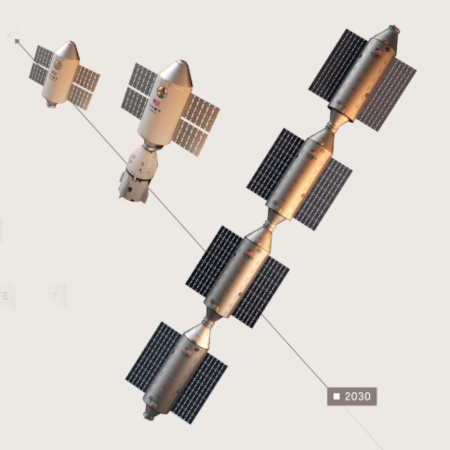
In a X tweet in early May that I only saw today, the space station startup Vast touts its series of orbital missions, beginning with its Haven demo test satellite that flew last year, followed by its Haven-1 single module station that will launch in 2027, and finally its proposed full multi-module Haven-2 station targeting a 2030 launch date.

The screen capture to the right shows Haven-1 (unmanned and manned with a docked Dragon capsule) and the Haven-2 station, comprising four Haven-1 modules attached in a single line.

What makes this newsworthy to me is that it is a major simplification and reduction in size for Haven-2. Until recently the company had planned to build Haven-2 with a central docking hub with eight modules attached in a cross, two for each arm (See the graphic here).

It appears the company has scaled down Haven-2 in anticipation of reduced funding from NASA. The original plan was to win a big contract allowing the company to build the full Haven-2 station. This smaller Haven-2 appears to recognize that even if Vast gets a contract from NASA, it won’t be enough to build the full station. This smaller design can serve NASA’s needs, while also serving the needs of Vast’s other private customers, which include foreign nations who want to send their astronauts to space and a number of companies that want to use Haven-2 to manufacture pharmaceuticals and other products for sale back on Earth.

This configuration also allows the company some flexibility. Because it uses those Haven-1 modules, it can always add that docking hub later, and add or shift modules to recreate the full original design.

5 comments

Vast signs deal with Lithuania

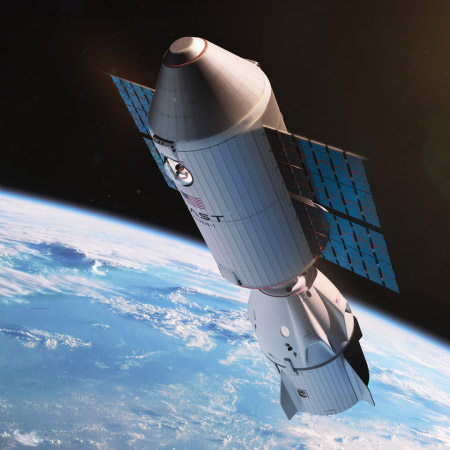
Haven-1 with docked Dragon capsule
Artist rendering of Haven-1 with docked
Dragon capsule

The space station startup Vast earlier this week signed an agreement with Lithuania to work together on future space missions, either to ISS or its Haven-1 single-module station scheduled for launch next year.

Under the agreement, Vast and Innovation Agency Lithuania will explore opportunities for joint scientific research activities either in the International Space Station National Lab or Haven-1, scheduled to be the world’s first commercial space station, launching in 2027. The partnership also includes plans to further develop educational programs in Lithuania and deepen engagement with local industry.

This deal is similar to Vast’s earlier deals with the European Space Agency, the Czech Republic, Colombia, Uzbekistan, Japan, and the Maldives. All are structured so that should Haven-1 reach orbit and be proven operational and safe for occupancy, these countries could consider sending their own astronauts on missions there. All thus show there is an international market for a private space station, a market that Vast is working hard to capture.

In other space station news, Voyager Technologies, the lead company building the Starlab station, released its 2026 first quarter fiscal report, indicating a solid financial position resulting from its diversification into military-based space applications. Though the report notes that “Starlab does not generate revenue today, nor is expected to generate revenue in the near term,” the company’s overall strength lays a strong foundation for that station’s eventual construction.

In my rankings below of the five stations under development, these two stations remain essentially tied for first place, with Axiom a close third.
» Read more

3 comments

The space station startups: NASA’s new space station plan is mistaken

The American space stations under development

At a conference event this week officials from three of the five American space station startups expressed strong disagreement with NASA’s new space station plan.

The new plan would have NASA build and launch its own new core module, dock it with ISS, and have the new stations attach their first modules to it prior to flying freely. NASA proposed this plan because it does not believe there is enough market to sustain the stations independently and NASA doesn’t have the budget to fully fund them.

The officials repeatedly disagreed about the market issue.

“We believe not only we can be ready by 2030” when the International Space Station is slated to be retired, “but we also believe that we can be profitable on the current market, not waiting for the future market we all will develop and will be successful at,” said Max Haot, CEO of Vast [building the Haven-1 and Haven-2 stations].

…Haot and executives from Axiom Space and Starlab Space said their responses to NASA’s request for information — which were due April 8 — show otherwise. “We put in 390 pages of independent analysis, research studies, datas, contracts, those types of things,” said Marshall Smith, CEO of Starlab Space, which is targeting 2029 for its station to be on orbit. “We’re being very clear and what we can do and how that works.”

One prominent revenue stream the panelists pointed to is other space agencies and nations eager to send their astronauts and payloads to space. “We’ve flown 12 people to space that paid us money to do that,” said Jonathan Cirtain, CEO of Axiom Space, referring to the four private astronaut missions it’s conducted to ISS. “We’ve flown 166 payloads today. All of those are paying payloads that generate revenue for the company.” The Texas company plans to begin operating in 2028 when its first two station modules are slated to be in orbit, then gradually grow the station to five modules.

The officials also said the core module idea would actually slow things down. NASA would have to first build and launch it, and would be starting from scratch to do so. It takes years to build such a thing, and it will certainly not be ready by 2030, when ISS is presently supposed to be retired. Moreover, forcing them to dock to this module would force them all to completely change their own plans, something they all find counter-productive.

In announcing NASA’s core module plan, NASA administrator Jared Isaacman also stated that he was open to industry feedback. I suspect that his core module proposal is going to die, and be replaced with the more direct transition from ISS to these private stations, the approach these companies favor.

I should add that the three startups that spoke up at this conference are also the three that are in the lead to build their stations, according to my rankings below. As far as I can tell, they are all tied for first place, with their station development very robust and well financed.
» Read more

26 comments

Voyager Technologies and Max Space team up to develop inflatable planetary structures

The station designs as of the end of 2025

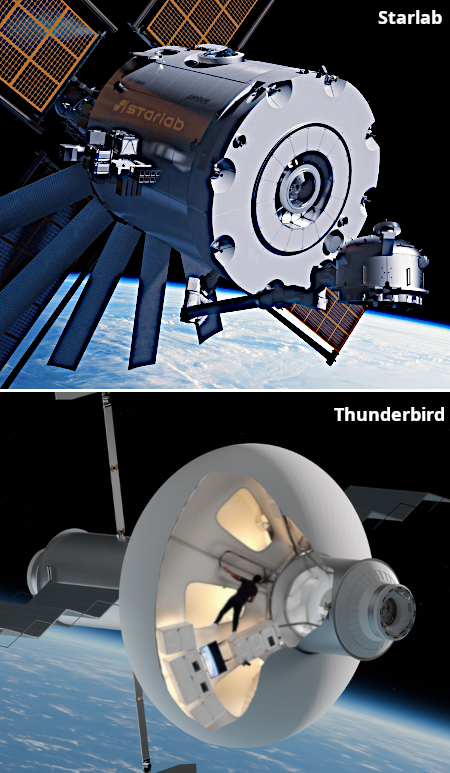
The space station startups Voyager Technologies, which is leading the consortium developing Starlab, and Max Space, which is developing its own inflatable Thunderbird station, have now partnered to use their combined talents to develop inflatable planetary structures for habitation and cargo.

In terms of their space stations, they are similar but different. Voyager’s Starlab station will be a single giant module launched on Starship. The consortium building this module had hired the interior decoration company Journey to design the interior, and yesterday showed off a mock-up of that interior.

Max Space’s Thunderbird is an equally large single module but because it uses inflatable technology it will launch on a Falcon 9. The company plans to launch a smaller demo module in ’27 to prove this technology.

Both companies will now use their skills together to begin design work on inflatable habitats that both NASA and SpaceX could use on the planned lunar and Mars colonies.

The phased development path includes ground validation and in-space demonstrations later this decade, with the goal of enabling operational lunar and Mars capabilities aligned with NASA’s exploration timelines. The partnership emphasizes early risk retirement, interoperability and commercial scalability as guiding principles.

In other words, these companies are expanding their business model to sell their products across a wider range of uses. This deal does not change my rankings of the five space stations currently under development, as shown below, but it is an interesting data point that suggests the technology of these space stations can be marketed in many other space-related areas.
» Read more

2 comments

Haven-1 launch delayed until 2027

Haven-1 with docked Dragon capsule
Artist rendering of Haven-1 with docked
Dragon capsule

According to Vast’s CEO, Max Haot, the launch of its single module Haven-1 space station has now been pushed back to the first quarter of ’27.

Last Saturday (January 10) we reached the key milestone of fully completing the primary structure, and some of the secondary structure; all of the acceptance testing occurred in November as well. Now we are starting clean room integration, which starts with TCS (thermal control system), propulsion, interior shells, and then moving on to avionics. And then final close out, which we expect will be done by the fall, and then we have on the books with NASA a full test campaign at the end of the year at Plum Brook. Then the launch in Q1 next year.

Until recently the company had been targeting a launch in the first half of 2026. This is a delay of almost a full year, and suggests the previous launch date has not been a serious target for quite some time.

Haot at the article at the link provides some new details about the manned missions to the station. It will launch unmanned, and after check-out in orbit that could last two weeks or longer, a professional SpaceX Dragon crew will fly a two-week mission there to do further check-outs.

After this up to three more two-week missions are planned, with Vast already having a deposit for the first. It also is willing to do more during Haven-1’s three year lifespan.

More and more it appears to me that in my rankings below of the five commercial space stations presently under development, the top three space stations are practically tied. And of the five stations, three are hoping to begin launching modules in the ’27-’28 time frame.
» Read more

6 comments

Axiom has delayed the launch of its first space station module to ’28

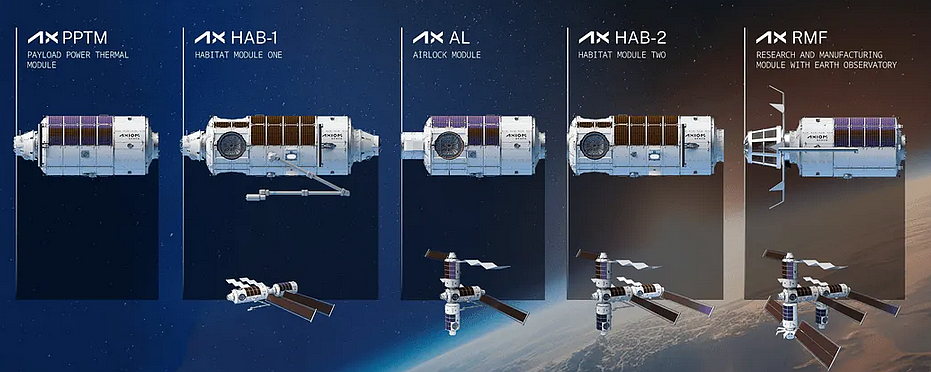
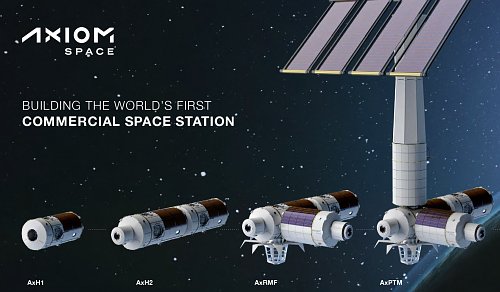
Axiom's module assembly sequence
Axiom’s module assembly sequence

When Axiom announced in September 2025 that Redwire would be building the solar panels for the first module of its space station, dubbed the PPTM, it also said that module would launch in late 2027, which was a delay of one year from the original launch date of 2026.

That schedule has now apparently been delayed again. In an interview yesterday, the company’s vice president of human spaceflight, former NASA astronaut Peggy Whitson, indicated the launch was now targeting 2028.

Plans call for the initial Axiom Station to be comprised of two modules, the PPTM — short for Payload Power Thermal Module — and a habitat module. The PPTM, which is to be shipped shortly to Houston for final assembly and integration, is slated to be launched in early 2028, with the second module following just months later. From there, Axiom aims to swiftly begin welcoming crew, Peggy Whitson, the company’s vice president of human spaceflight, told me in an interview.

This schedule almost guarantees that the Axiom station will not detach from ISS as quickly as originally intended. PPTM has a large hatch opening connecting it to ISS, allowing for the easy transfer of much of the research racks held on ISS. Before Axiom can become a free-flying station that ISS equipment must be moved, a process that will take time, likely months. To get it done the company will probably have to also attach its second habitation module so that crews can arrive and begin this transfer process.

In other words, Axiom’s schedule margins for getting its station launched, docked to ISS, loaded with ISS equipment, and then separated before ISS retires in 2030 are shrinking. It can ill afford further delays.

Below are my rankings of the five American space stations presently under development. Note that I now consider Axiom and Starlab tied for second.
» Read more

12 comments

Axiom gets $100 million of investment capital from Hungarian company

Axiom's new module assembly sequence
Axiom’s assembly sequence for its planned station, initially attached to ISS but subsequently detached

The space station startup Axiom has now obtained a $100 million investment by the Hungarian communications provider 4iG.

The company said Dec. 19 it has committed to invest $30 million in Axiom by the end of 2025, followed by an additional $70 million by March 31, 2026.

In October, 4iG announced a non-binding commitment letter to evaluate a potential $100 million investment in Axiom Space. The agreement outlined a separate $100 million framework for cooperation on the development of orbital data center systems over the next five years. 4iG said in a news release that the Axiom investment would provide Hungary with an opportunity to secure a long-term role in orbital data centre programs and space-based data processing and storage, but did not provide details.

In 2024 there were rumors the company had a serious cash shortage, though since then construction of its first two modules has proceeded as planned, with a launch of the first module still set for sometime in 2026. This new infusion of cash should shore up Axiom’s station construction considerably.

My rankings of the commercial space stations now under development:

» Read more

36 comments

Update on Vast’s first planned space station, Haven-1

Haven-2
Haven-2 station once completed

Link here. The article essentially puts together a number of X links that Jay has provided Behind the Black previously in his daily Quick Space Links reports to provide an overall picture. Two aspects stand out however.

One, the demo Vast launched this weekend on SpaceX’s bandwagon mission is expected to fly for about six months, and has successfully deployed its solar panels. During its flight the company will “test out key capabilities, such as Reaction Control Systems (RCS), power systems, and propulsion, in preparation for Haven-1”, which it hopes to launch in the spring.

Two, Haven-1’s planned mission remains unchanged. The company still intends to fly four crewed missions to it during its three-year mission, though who will make-up the crew and passengers remains unknown. This single module station is aimed at proving Vast’s capabilities at space station design and operation to convince NASA to award it a much larger contract to build its much larger Haven-2 multi-module station.

Max Haot [Vast’s CEO] described Haven-1 as the “minimum viable product”. With its one docking port and reliance on a SpaceX Crew Dragon for key life support systems, the station will enable the company to test out capabilities needed for larger stations in the future. The Dragon spacecraft requires a daily change of its CO2 scrubber; therefore, the station will launch with the necessary amount needed for 30-40 days on station for four astronauts.

All in all, Vast appears to be strongly demonstrating its capabilities, on schedule, making my listing it number one as most likely to win that big NASA contract increasingly correct. That ranking is made even more reasonable with the decision by NASA to now award several of those contracts, at smaller amounts, in a step-by-step process that matches milestones. Below is my updated rankings of the four commercial stations under development:
» Read more
0 comments

Belgium company joins Starlab space station consortium

Starlab design in 2025
The Starlab design in 2025. Click
for original image.

The Starlab consortium, proposing to build its single-module large Starlab space station that will be launched on Starship, has now added the Belgium company Space Applications Services (SpaceApps) as both a partner and investor.

SpaceApps contributes deep experience in space systems, mission operations and payload integration with capabilities that include avionics, payload development, the end-to-end International Commercial Experiment Cubes (ICECubes) service, as well as mission integration and operations control software. The company also works closely with the European Space Agency and international partners, broadening Starlab’s access to global markets and research communities.

The Starlab consortium already includes the American companies Voyager Space and Northrop Grumman and the European company Airbus. It also has a partnership agreement with the European Space Agency. This new Belgium partnership further cements its place as Europe’s potential future space station after ISS is retired.

This deal is only one of several news stories in the past week signaling progress by this consortium. It has signed the American company Vivace to build the station’s main structure and its partner Northrop Grumman has successfully tested the rendezvous and docking technology its Cygnus cargo capsule will use to dock with Starlab. All in all this station appears to be assembling the pieces its needs.

Below is my updated rankings of the four commercial stations under development:
» Read more

0 comments

Space station startup Vast endorses NASA’s new strategy that no longer requires a continuous human presence in space

The American space stations under construction
The American space stations under development

Officials from the space station startup Vast revealed at a conference last week that they endorse NASA’s new strategy that, not only no longer requires the commercial stations to immediately establish a continuous human presence in space, will also award multiple development contracts to the commercial stations.

Speaking Sept. 11 at the Global Aerospace Summit, Max Haot [chief executive of Vast] endorsed NASA’s new strategy, announced more than a month ago, that calls for multiple Space Act Agreements to support development leading to a four-person, 30-day demonstration mission. “We think it’s really the right direction,” he said, noting it accelerates the award timeline. NASA said in a draft solicitation this month it expects to award multiple funded agreements by April 2026, months sooner than under earlier plans.

The original plan had been to choose at most two, but likely only one of the four consortiums/companies that are developing station proposals. The winner would have gotten a big contract that would have also required it to push hard for continuous full time occupation, from day one.

The new plan will instead award smaller development contracts to as many as three of the four station projects, aimed at getting them off the ground and operating, even if astronauts only fly in them intermittently. Eventually the hope is that their capabilities will expand quickly to permanent occupation, especially if they start earning revenue from the private sector, outside NASA. In fact, the smaller government contracts will force them to seek investment and profits elsewhere.

The four commercial stations under development, ranked by me based on their present level of progress:
» Read more

0 comments

Space Force awards development contracts to eight startups

The Space Force’s commercial office, dubbed SpaceWERX, announced March 8, 2025 that it has awarded development contracts to eight startups totaling $440 million.

Each STRATFI agreement is worth up to $60 million, with SpaceWERX and several defense agencies contributing up to $30 million per project. Private investors provide matching funds to scale innovations that have already demonstrated viability through prototype development.

The winners — Albedo, Beast Code, CesiumAstro, Gravitics, LeoLabs, Rise8, Umbra and Xona — were announced March 8 at an event at the Capital Factory in Austin, Texas.

Of these companies, Gravitics is probably the most interesting, as it is attempting to become a major American provider of space station modules. It already has a $125 million contract with Axiom to build a small module for that company’s station. This new contract from the Space Force suggests the Pentagon is considering launching its own space station, or possibly attaching a Gravitics module to one of the four private stations presently being built. Below is my present ranking of these four stations:

  • Haven-1, being built by Vast, with no NASA funds. The company is moving fast, with Haven-1 to launch and be occupied in 2026 for a 30 day mission. It hopes this actual hardware and manned mission will put it in the lead to win NASA’s phase 2 contract, from which it will build its much larger mult-module Haven-2 station..
  • Axiom, being built by Axiom, has launched three tourist flights to ISS. There are rumors it is experiencing cash flow issues, but it is also going to do a fourth ISS tourist flight this spring, carrying passengers from India, Hungary, and Poland.
  • Orbital Reef, being built by a consortium led by Blue Origin and Sierra Space. Though Blue Origin has apparently done little, Sierra Space has successfully tested its inflatable modules, including a full scale version, and appears ready to start building the station’s modules for launch.
  • Starlab, being built by a consortium led by Voyager Space, Airbus, and Northrop Grumman. It recently had its station design approved by NASA.
2 comments

Starlab space station wins $15 million grant from Texas

the proposed Starlab space station

Among the grants awarded last week by the new Texas Space Commission, the consortium building the Starlab space station received a $15 million grant to build a facility in Texas.

The Systems Integration Lab will include two labs, the main SIL and a Software Verification Facility. The SIL will house flight-like hardware for testing. In this environment, engineers and astronauts can check systems designed for the Starlab space station, catching any potential issues in advance and ensuring efficient and effective operations in space. The SVF will contain a simulated station environment with flight computers and serve as the primary software integration and requirements verification facility.

Starlab is one of four space stations presently being developed. Starlab had already received a $217.5 million design contract from NASA, as part of the agency’s phase one program to eventually develop two private commercial space stations to replace ISS. NASA also awarded similar development contracts, to Axiom for its Axiom station that will initially be docked to ISS, and to the Orbital Reef station proposal, led by a consortium of companies that includes Blue Origin and Sierra Space.

A fourth company, Vast, did not compete for that phase 1 contract. Instead, it has privately funded its first single modular station, Haven-1, which it is now aiming for a spring 2026 launch. All four station projects are competing to win NASA’s much larger phase 2 contract awards, which will only go to two of these four proposals. At present, this is how I rank their chances:

  • Haven-1, being built by Vast, with no NASA funds. The company is moving fast, with Haven-1 to launch and be occupied in 2026 for a 30 day mission. It hopes this actual hardware and manned mission will put it in the lead to win NASA’s phase 2 contract, from which it will build its much larger mult-module Haven-2 station..
  • Axiom, being built by Axiom, has also launched three tourist flights to ISS. There are rumors it is experiencing cash flow issues, but it is also going to do a fourth ISS tourist flight this spring, carrying passengers from India, Hungary, and Poland.
  • Orbital Reef, being built by a consortium led by Blue Origin and Sierra Space. Though Blue Origin has apparently done little, Sierra Space has successfully tested its inflatable modules, including a full scale version, and appears ready to start building the station’s modules for launch.
  • Starlab, being built by a consortium led by Voyager Space, Airbus, and Northrop Grumman.

Of all these projects, Starlab appears to have cut the least amount of hardware, which is why I rank it last. At the same time, this grant from Texas is some positive news. In addition, it has partnered aggressively with the European Space Agency (ESA), and appears to have its support for making the station Europe’s ISS replacement. If so, even if it doesn’t win NASA’s phase 2 award it might instead get ESA to fund it. That Europe’s biggest aerospace company Airbus is now one of its major partners clearly helps.

2 comments

Ranking the four private space stations under construction

the proposed Starlab space station

Yesterday NASA posted an update on the development of Starlab, one of the four private space stations under development or construction, with three getting some development money from NASA. According to that report, the station had successfully completed “four key developmental milestones, marking substantial progress in the station’s design and operational readiness.”

As is usual for NASA press releases, the goal of this announcement was to tout the wonderful progress the Starlab consortium — led by Voyager Space, Airbus, and Northrop Grumman — is making in building the station.

“These milestone achievements are great indicators to reflect Starlab’s commitment to the continued efforts and advancements of their commercial destination,” said Angela Hart, program manager for NASA’s Commercial Low Earth Orbit Development Program. “As we look forward to the future of low Earth orbit, every successful milestone is one step closer to creating a dynamic and robust commercialized low Earth orbit.”

I read this release and came to a completely opposite conclusion. » Read more

14 comments

Sierra Space signs deal using its Dream Chaser mini-shuttles for in-space manufacturing

Sierra Space's family of planned LIFE modules
Sierra Space’s family of planned LIFE modules. Click for original

Sierra Space has now signed agreements with two different startups, Astral Materials and Space Forge, to use its Dream Chaser mini-shuttles for in-space manufacturing.

Astral Materials leverages the microgravity environment of space to grow ultra-high quality semiconductor crystals for advanced chip technologies. Space Forge harnesses free flying manufacturing facilities to produce next-generation materials for commercial industries, national security and research.

Up to now, Sierra’s only customer has been NASA, which wants to use Tenacity, the first Dream Chaser mini-shuttle, to hauling cargo to and from ISS. These new deals illustrate that there are other profit opportunities for the company’s reusable shuttle outside of government. As the startup Varda has already demonstrated with its own returnable capsule, there is money to be made manufacturing products in weightlessness that cannot be produced in the gravity of Earth.

The press release however has one additional tidbit that is intriguing. Sierra is a partner in the Blue Origin-led Orbital Reef commercial space station. It also appears to be the only partner that is actually building anything for that station, specifically its LIFE inflatable modules. The press release mentions that both these agreements include options for Astral and Space Forge to provide “input on Sierra Space’s future space stations.” That this press release does not refer to Orbital Reef here suggests once again that Sierra Space is somewhat dissatisfied with the output of its Blue Origin partner, and is thus creating options for it to build its own space station using those LIFE modules (shown above), should Blue Origin not deliver.

At a minimum, Astral and Space Forge will certainly be interested in doing manufacturing within those LIFE modules, should they end up being part of Orbital Reef.

1 comment

Sierra Space announces plans to build a second Dream Chaser cargo spaceplane

With the first launch of Sierra Space’s first Dream Chaser reusable unmanned cargo mini-shuttle, Tenacity, now scheduled for May 2025, the company has announced that it is beginning work on a second cargo spaceplane, dubbed Reverence, along with a mission control center to operate its fleet in orbit.

Sierra Space spokesperson Alex Walker shared the new May 2025 estimate and said work on Reverence, also known as DC-102, will resume once the team returns to Colorado — but declined to clarify when that would happen. At that point, Walker said, it will likely be another 18 months before the second spaceplane is complete. In addition to the fleet of cargo-carrying craft, Sierra Space is also working on a crewed variant of the vessel, labeled the DC-200 series, and a national security DC-300 variant.

Company officials say each mini-shuttle is good for 15 flights, so having both vehicles gives the company a total of 30 flights to sell to various space station and orbital customers.

Selling to others outside NASA may be necessary, because Tenacity is four-plus years behind schedule. By the time it begins flying ISS will already be approaching retirement in only a few short years.

The company intends these new Dream Chaser projects to work in tandem with its LIFE inflatable modules, which are presently being developed as part of the Blue Origin-led Orbital Reef space station. And while much of work on the rest of that station appears moribund, it appears that Sierra is developing everything needed for its own space station. We should therefore not be surprised if Sierra decides to bid on NASA’s next space station funding round independent entirely of the Orbital Reef partnership.

It certainly is assembling all the pieces needed for a station, without any help from Blue Origin.

6 comments

Review of the four private space stations presently under construction

Link here. The review provides a nice summary of the status of all four stations, being built by Axiom, Vast, and consortiums led by Blue Origin (Orbital Reef) and Voyager Space (Starlab).

The article included one piece of new news, based on recent stories suggesting major financial issues at Axiom:

As a result of these issues, the Axiom Station is believed to have been downsized to two modules from the originally planned four. There will be a reduced research capability from this arrangement compared to what was expected. However, it remains to be seen if additional capability can be added after the station becomes operational.

The original plan had been to separate the station from ISS once all four modules were launched. Whether it will be able to do so, flying independent of ISS’s systems with only two modules is unclear.

3 comments

Vast unveils its proposed full space station concept

Haven-2
Haven-2 station once completed

After revealing the layout planned for its first single module space station dubbed Haven-1 last week, the startup Vast today unveiled its proposed full space station concept, dubbed Haven-2.

The graphic to the right is a screen capture from the video describing the step-by-step assembly of this larger station. Initially it will be comprised of four modules, linked together in a straight line. This confirguration is aimed at winning a space station contract from NASA when it announces the winners in the second phase of its commercial space station program in mid-2026. If picked, Vast then intends in the expand that four-module station to the eight modules illustrated in the graphic.

Between 2030 and 2032, Vast will add a larger 7m diameter core module and four more Haven-2 modules, fully realizing the next-generation commercial space station capable of meeting the needs of international partners, NASA, commercial researchers & manufacturers, and private astronauts.

Key features of the completed station include an unprecedented 3.8m diameter cupola window, external payload hosting capabilities, a robotic arm, visiting vehicle berthing capabilities, external payload airlock, and an extravehicular activity (EVA) airlock to support customers’ needs. Each module will also feature two Haven-1-like 1.1m dome windows, totaling 16 windows by 2032.

Vast’s design is projected to surpass all other proposed on-orbit space stations in terms of volume, functionality, and operational efficiency.

Vast’s overall plan is quite ambitious, but well thought out. If all goes as planned, just as NASA is about to decide on the winners in phase 2 of its space station program, Vast plans to launch in 2026 its Haven-1 station and immediately fly a manned 30-day mission to it, using SpaceX rockets and Dragon capsules. If successful, that private mission will do wonders in convincing NASA to pick Vast.

9 comments

Japanese company proposes building a module to add to Axiom’s space station

Axiom's space station assembly sequence
The assembly sequence for Axiom’s space station while attached to ISS.
Click for original image.

The Japanese company Mitsui has now proposed building a module — based on Japan’s HTV cargo freighter that did several missions to ISS — and sell it to the commercial space stations now under construction.

Mitsui has created a subsidiary called LEO Shachu to develop the module. What makes this project very likely to happen is that Mitsui is also an investor in Axiom’s space station, and according to the article at the link, a Axiom official who is also a retired Japanese astronaut who flew to ISS has expressed interest in it.

This story also helps outline the international landscape of the future stations. While Voyager Space’s Starlab station has been partnering extensively with Europe and Airbus, Axiom appears to be partnering more closely with NASA and Japan. The third station that has obtained NASA money, Blue Origin’s Orbit Reef, had made an earlier deal with Mitsubishi, but appears to have obtained few other outside partners, and that Mitsubishi deal only involved “development work,” not specific hardware. Moreover, Mitsubishi later made a new deal with the Starlab station, suggesting it had broken up with Blue Origin.

A fourth station, being built by the private company Vast with no NASA money, has partnered with SpaceX and ESA. It is also likely to be the first to launch its first module in August 2025, followed soon thereafter by a 30 day 4-person Dragon mission.

2 comments
1 2