Arianespace successfully completes the last launch of Avio’s Vega rocket

Tonight the last launch of the Vega rocket, built by the Italian company Avio and managed by Arianespace, successfully lifted off from French Guiana, placing a European Earth observation satellite into orbit.

The launch was delayed several years because of a failure during a previous launch that required a major redesign of an engine. Further delays took place when Avio literally lost the tanks for the rocket’s upper stage, and had to improvise a solution (which has never been explained fully).

The rocket will now be replaced by the Vega-C, which after several more launches will be entirely owned and managed by Avio, which will market it to satellite customers without any significant participation of the government middleman Arianespace.

This was only the second launch by Europe in 2024, so the leader board of the 2024 launch race does not change.

86 SpaceX
37 China
10 Rocket Lab
9 Russia

American private enterprise still leads the rest of the world combined in successful launches 101 to 56, while SpaceX by itself leads the entire world, including American companies 86 to 71.

0 comments

A channel of ice, water, or lava?

A channel of ice, water, or lava?
Click for original image.

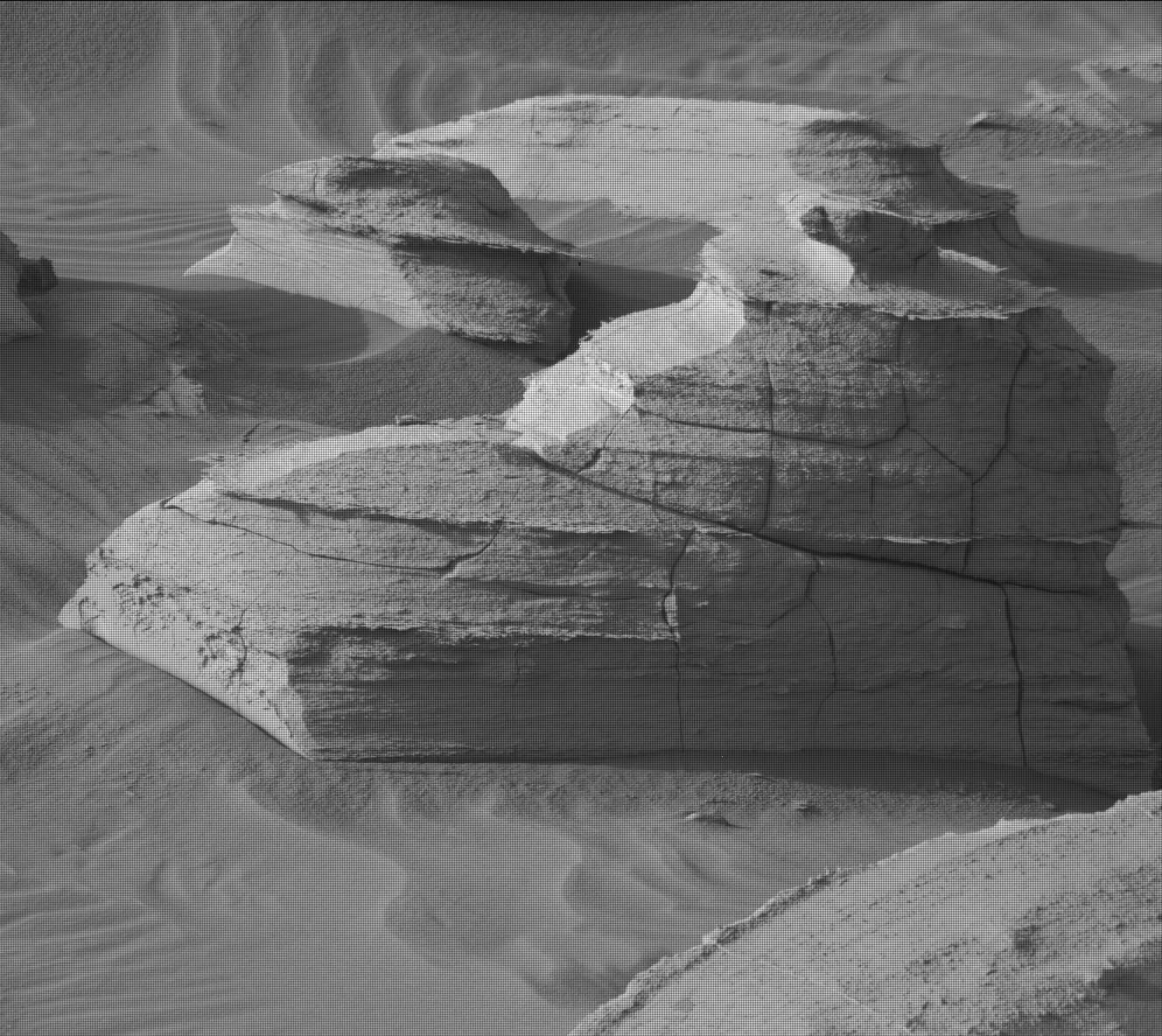
Cool image time! The picture to the right, rotated, cropped, reduced, and sharpened to post here, was taken on July 16, 2024 by the high resolution camera on Mars Reconnaissance Orbiter (MRO). It shows one small section of a Martian canyon approximate 750 miles long and dubbed Elysium Fossae.

The canyon walls at this spot rise about 3,300 to 3,800 feet from the canyon floor. The canyon itself is thought to be what geologists call a graben, initially formed when the ground was pulled apart to form a large fissure.

That’s what happened at this location, at least to start. This canyon is on the lower western flank of the giant shield volcano Elysium Mons. The cracks, which radiate out outward from the volcano’s caldera, likely formed when pressure from magma below pushed upward, splitting the surface.

That formation process however does not fully explain everything.
» Read more

0 comments

European rocket startup Maiaspace to begin tests of upper stage engine in ’25

The European rocket startup Maiaspace, a subsidary of ArianeGroup, has announced it will begin static fire tests of the upper stage engine for its Maia rocket in 2025, with a planned first launch before the end of that year.

The first stage of Maia is intended to be reuseable, and has been under development by ArianeGroup for the European Space Agency (ESA) for years.

The rocket’s first stage will essentially be the Themis reusable booster demonstrator, which is also being developed by ArianeGroup under an ESA contract. Initial hop tests of the Themis demonstrator had been expected to begin this year at the Esrange Space Center in Sweden. However, the first test of the demonstrator is now not expected until 2025. MaiaSpace will, as a result, have very little wiggle room in its schedule if it is to conduct an inaugural launch attempt next year.

Transitioning this first stage to a wholly private operation will certainly speed up its development, but the transition will take time.

0 comments

Sierra Space completes acoustic testing of Shooting Star cargo module that will fly on first Dream Chaser launch

Sierra Space today announced that it has successfully completed acoustic testing of the Shooting Star cargo module that will fly on first ISS mission of its Tenacity Dream Chaser mini-shuttle.

During the Direct Field Acoustic Test (DFAN), the test team placed stacks of purpose-built loudspeakers – each one a highly-engineered acoustic device – in 21-ft-tall columns surrounding the spacecraft. Their goal was to test whether the structural elements of Shooting Star could withstand the acoustic environment of a launch on a Vulcan Centaur rocket. Over a four-day period, test engineers blasted the spacecraft with a controlled sound field that was 10,000x higher intensity than the volume of a typical rock concert, recreating the sonic intensity of a launch. Shooting Star withstood acoustic levels greater than 140 dB for several minutes at a time, proving its flight worthiness.

The press release however made no mention as to when the launch will actually take place. Sierra first got the contract to build Dream Chaser in 2016, and was supposed to make its first flight in 2020. That launch has been repeatedly delayed, and is now four years behind schedule. Supposedly it was to take place this year on the second launch of ULA’s Vulcan rocket in the spring of 2024, but was removed from that launch because of delays in preparing Tenacity for launch.

As of today, no new launch date has been announced, and though Sierra says Tenacity will be ready for launch by the end of this year, don’t expect it to happen before 2025.

3 comments

Private company launches small test rocket from privately run sea-based platform

The rocket startup Evolotion Space on August 31, 2024 successfully launched a small test rocket from privately run sea-based platform operated by the Spaceport Company, a startup in itself.

The launch itself did not appear to reach space, but was instead designed to test both the rocket and the sea platform’s operation.

The experiment occurred approximately 30 miles south of Mississippi in the Gulf of Mexico. The test served to validate The Spaceport Company’s sea-based launch equipment and ground support equipment, said the company’s CEO and founder Tom Marotta. “Emerging hypersonic technologies require additional and larger test ranges to accommodate higher cadence testing campaigns,” he said. “With this new commercial facility, we will alleviate the burdens on government ranges and enable at-sea test environments that existing land-based ranges are unable to provide.”

The solid-fueled rocket meanwhile is being developed by Evolution to initially do hypersonic testing for the military.

0 comments

NASA asks space industry for proposals on using the shelved Janus probes on mission to Apophis

NASA has now put out a request for proposals from the space industry for refitting the two Janus planetary probes, whose asteroid mission was shelved when its launch as a secondary payload was delayed due to problems with the Psyche primary payload, as a mission to the asteroid Apophis in connection with its April 13, 2029 close approach to the Earth.

NASA has been studying this new mission goal since early 2023, but apparently had failed to come up with a plan. It is now asking the private sector for suggestions on getting it done, including finding the funding for any plans.

3 comments

Russia claims its next unmanned Moon mission, Luna-26, is on schedule

Phase I of China/Russian Lunar base roadmap
The original phase I plan of Chinese-Russian lunar
base plan, from June 2021.

According to Russia’s state-run press, its next unmanned Moon mission, Luna-26, is on schedule for a planned launch in 2027, though that press also claims the launch may happen in 2026 instead.

The problem with this claim is that Russia had for years said that this lunar orbiter would launch by 2025. As expected, the mission has not launched on time, as have all of Russia’s 21st century lunar exploration plans. For example, the previous lunar mission, the Luna-25 lunar lander, was originally supposed to land on the Moon in 2021, was not launched until 2023, and ended up crashing on the Moon when the spacecraft did not function properly during a engine burn in lunar orbit.

In the first phase of the so-called China-Russian partnership to explore the Moon, is shown by the 2021 graph to the right, China continues to do all the heavy lifting, and do so pretty much on the schedule predicted. Russian meanwhile continues to do what I predicted back in 2021, get nothing done on time and when launched have problems.

0 comments

A frozen Martian splash

A frozen Martian splash
Click for original image.

Cool image time! The picture to the right, rotated, cropped, and enhanced to post here, was taken on July 11, 2024 by the high resolution camera on Mars Reconnaissance Orbiter (MRO). It shows the southeast quadrant of a three-mile-wide unnamed crater that is surrounded on all sides by a dramatic but frozen splash apron of material, created when this impact occurred.

The rim rises between 200 to 400 feet from the surrounding plains, while the crater floor drops 700 feet to sit below those plains by 300 to 500 feet. In other words, that splash apron contains the material that was thrown up when the bolide drilled into the plain at impact, leaving behind this deep hole.

Why such a dramatic splash apron? Its existence suggests that the ground here was muddy, with a lot of water ice likely present. The location and wider context helps confirm this guess.
» Read more

0 comments

Two-lobed asteroid imaged by radar

Two-lobed asteroid
Click for original image.

During the August 18, 2024 first close fly-by of a potentially-dangerous asteroid only discovered back in May, astronomers used the Goldstone dish in California to produce the high resolution radar images shown in the picture to the right, reduced and sharpened to post here.

The images were captured when the asteroid was at a distance of 2.8 million miles (4.6 million kilometers), about 12 times the distance between the Moon and Earth.

Discovered by the NASA-funded Catalina Sky Survey in Tucson, Arizona, on May 4, the near-Earth asteroid’s shape resembles that of a peanut – with two rounded lobes, one lobe larger than the other. Scientists used the radar images to determine that it is about 980 feet (300 meters) long and that its length is about double its width. Asteroid 2024 JV33 rotates once every seven hours.

Asteroids formed as contact binaries, once considered the stuff of science fiction, have now been found to be relatively common, comprising about 14% of the near Earth asteroids larger than 700 feet across that have been radar-imaged. The refined orbital data suggests this asteroid might be a dead comet, though that conclusion is unconfirmed. That orbital data also tells us that though this object has the potential of hitting the Earth, it will not do so “for the foreseeable future.”

4 comments

Largest corporate investor in rocket startup Rocket Factory Augsburg finalized deal to go private

The German company OHB, the largest corporate investor in the German rocket startup Rocket Factory Augsburg, has finalized its deal with the investment company KKR to go private and delist OHB from the German stock market.

OHB announced in August 2024 the deal where KKR would buy shares not owned by the Fuchs family for 44 euros ($48.70) per share. Under the deal, the Fuchs family will maintain its controlling 65.4% ownership of OHB while KKR owns 28.6%. That combined 94% ownership will allow OHB to delist from the exchange, effectively taking the company private.

It appears that both companies are committed to OHB’s investment in Rocket Factory, and by getting OHB delisted it gives them greater flexibility in doing so. It also appears that Marco Fuchs, the CEO of OHB, had decided in the last few years that for rocket startups being a public company was counter-productive in many ways.

“We saw all these SPACs fail. We see very different valuations out there. So, it’s not a good place to be, in the public market, especially in the core business model of doing space projects,” he said at the Space Tech Expo Europe conference. “It’s not exactly what capital markets appreciate.”

In a sense, this deal appears to be a show of support for Rocket Factory, even though its first launch is seriously delayed due to a recent failed static fire test of its first stage that destroyed the stage.

0 comments

That sonar-type sound heard on Starliner’s speakers was simply feedback

In a short post today NASA noted that the mysterious sonar-type sound heard on Starliner’s speakers over the weekend was nothing more than simple feedback caused by an “audio configuration between the space station and Starliner” and that the sound stopped when that configuration was adjusted.

The space station audio system is complex, allowing multiple spacecraft and modules to be interconnected, and it is common to experience noise and feedback. The crew is asked to contact mission control when they hear sounds originating in the comm system. The speaker feedback Wilmore reported has no technical impact to the crew, Starliner, or station operations

In other words, this is not a rare event, and from the beginning was not considered by the astronauts, ground engineers, or NASA management to be a matter of concern. The fix was apparently simple and straightforward, and is part of the work done whenever any new vehicle gets docked and tied into ISS’s systems.

It appears however to have caused many in the news media and in the space world to go nuts simply because it was linked to Starliner and Boeing. This is similar to the recent pattern of assigning all blame to Boeing whenever any Boeing-built plane has technical problems, even if that plane had been purchased by the airline decades earlier and its maintenance was solely the responsibility of the airline for that long.

Boeing is definitely a company in trouble, on many levels. We shouldn’t however look for problems there in the company when they clearly don’t exist.

29 comments

China launches “remote-sensing satellites” test satellites

China today successfully placed a classified “group” of “remote-sensing satellites” into orbit to test “new technologies of low-orbit constellations,” its Long March 4B lifting off from the Xichang spaceport in the southwest of China.

That is all the information that China’s state-run press released. No word was released as to where
in China the lower stages crashed. As to the number of satellites launched, according to this independent site, the launch had nine payloads, which suggests but does not confirm nine satellites.

The leaders in the 2024 launch race:

86 SpaceX
37 China
10 Rocket Lab
9 Russia

American private enterprise still leads the rest of the world combined in successful launches 101 to 55, while SpaceX by itself leads the entire world, including American companies 86 to 70.

0 comments
1 199 200 201 202 203 1,327