MOXIE instrument on Perseverance sets new record for oxygen production

The MOXIE instrument on Perseverance this month doubled its last record for producing oxygen from the thin Martian atmosphere of carbon dioxide.

“This was the riskiest run we’ve done,” [Michael Hecht, MOXIE’s principal investigator] told Space.com in an exclusive interview. “This could have gone wrong,” he said, and could have led to minor damage to the instrument, but it didn’t. The milestone setting Mars run took place on June 6, operating during the Martian night, and lasted 58 minutes, Hecht said.

The requirements for MOXIE were to produce 6 grams of oxygen an hour, a rate that was eventually doubled. “We rolled the dice a little bit. It was ‘hold your breath and see what happens,'” Hecht said.

Informally dubbed by Hecht and his team as “the last hurrah,” MOXIE delivered the goods on its 15th run on Mars since first gulping up Martian atmosphere within Jezero Crater on April 20, 2021.

Producing twelve grams of oxygen per hours is a very big deal. A person requires about 20 grams per hour, so this demonstration instrument has shown it can produce more than half that. Build a larger version designed to work continuously, and you easily will create enough oxygen on Mars to sustain a colony.

This means the first humans to arrive on Mars will not need to bring oxygen, only enough Moxies. More important, the oxygen supply will be infinite, putting no limit to their stay.

6 comments

Redwire gets new contract to build two more replacement solar panels for ISS

Redwire has gotten a new contract from NASA, through its main contractor Boeing, to build two more Roll-Out Solar Arrays (IROSA) for ISS that are being installed to replace the stations aging original solar panels.

Since 2021, a total of six Redwire-built arrays have been developed, delivered, and deployed on the ISS, augmenting its critical power supply. Each wing provides an additional 20+ kW of power once deployed, and all eight IROSA wings combined will provide more than 160 kW for over 10 years.

These roll out arrays are installed during a space walk, and then roll out on top of the old panels. They are small but more power efficient.

0 comments

Perseverance spots a doughnut-shaped rock

Doughnut-shaped rock in Jezero Crater
Click for original image.

The Mars rover has spent the last few months exploring just beyond the western rim of half-mile-wide Belva crater, which sits on top of the delta that eons ago flowed into 30-mile-wide Jezero Crater. During that time the science team has been using its various cameras to study the surrounding terrain.

One of those cameras is the SuperCam Remote Micro Imager. This camera is a variation of Curiosity’s ChemCam, designed initially to look very closely at nearby objects. The Curiosity team however discovered they could also use ChemCam to look at distant objects, and in this case the Perseverance team was doing the same with SuperCam, gazing outward at more remote features.

The result was the picture to the right, cropped, reduced, brightened, and sharpened to post here. It was taken on June 23, 2023, and shows what appears to be a several-foot-wide rock with a hole in its center. According to the SETI Institute’s tweet that publicized the picture, the rock might be “a large meteorite alongside smaller pieces.”

If this was Curiosity I would be certain the science team would take the rover close to the rock. The Perseverance team however seems to have different goals, mostly centered on finding drill spots for obtaining its core samples for later return to Earth. It has not therefore been as exploratory as Curiosity. It seems to have rarely diverged from its planned route, and when it has it has not done so to look at singular features like this. We shall see what they finally decide.

8 comments

Sierra Space says first Dream Chaser will be ready for launch by December

In a presentation at an investor conference on June 27, 2023, a Sierra Space official provided an update on the status of its first Dream Chaser reusable mini-shuttle, dubbed Tenacity, stating that they expect it to be ready for launch by December, with the main question whether its ULA Vulcan launch rocket will also be ready.

The launch is supposed to be the second for Vulcan, but the first launch was just delayed for an undetermined amount of time so ULA can make modifications to the rocket’s Centaur upper stage. Once Tenacity is flying Sierra has a contract with NASA for seven cargo flights to ISS, with plans beyond.

The company is also working on a second version that can carry both crew and cargo. Vice said that version will have 40% greater cargo capacity than the first version and can support a six-person crew.

The ability of Dream Chaser to glide back to Earth in a runway landing, rather than splash down in the ocean, is a key selling point to customers, he argued. โ€œWe just think that landing at runways around the world is a huge differentiator: low-g landing back on a runway for both time-critical cargo and science, but also just the way people are going to want to fly back and land.โ€

The official also indicated that this human-rated version is being designed to work with the private Orbital Reef space station that Sierra Space is building in partnership with other companies. The company also said it is planning its own free flying version of its Orbital Reef LIFE module that the company hopes to launch by the end of 2026, ahead of Orbital Reef. If so, that would make this the sixth independent private space station planned by American companies.

Because much of this presentation was designed to impress potential investors, we should take it with a touch of skepticism. Nonetheless, that the company is considering launching its own station, independent of the Blue Origin-led Orbital Reef station, suggests it has its own doubts about whether that project will ever take off as planned, and has thus decided to make its own contingency plans.

Hat tip to Jay, BtB’s stringer.

7 comments

Another tourist site for future Starship passengers on Mars

Another tourist site for future Starship passengers on Mars
Click for original image.

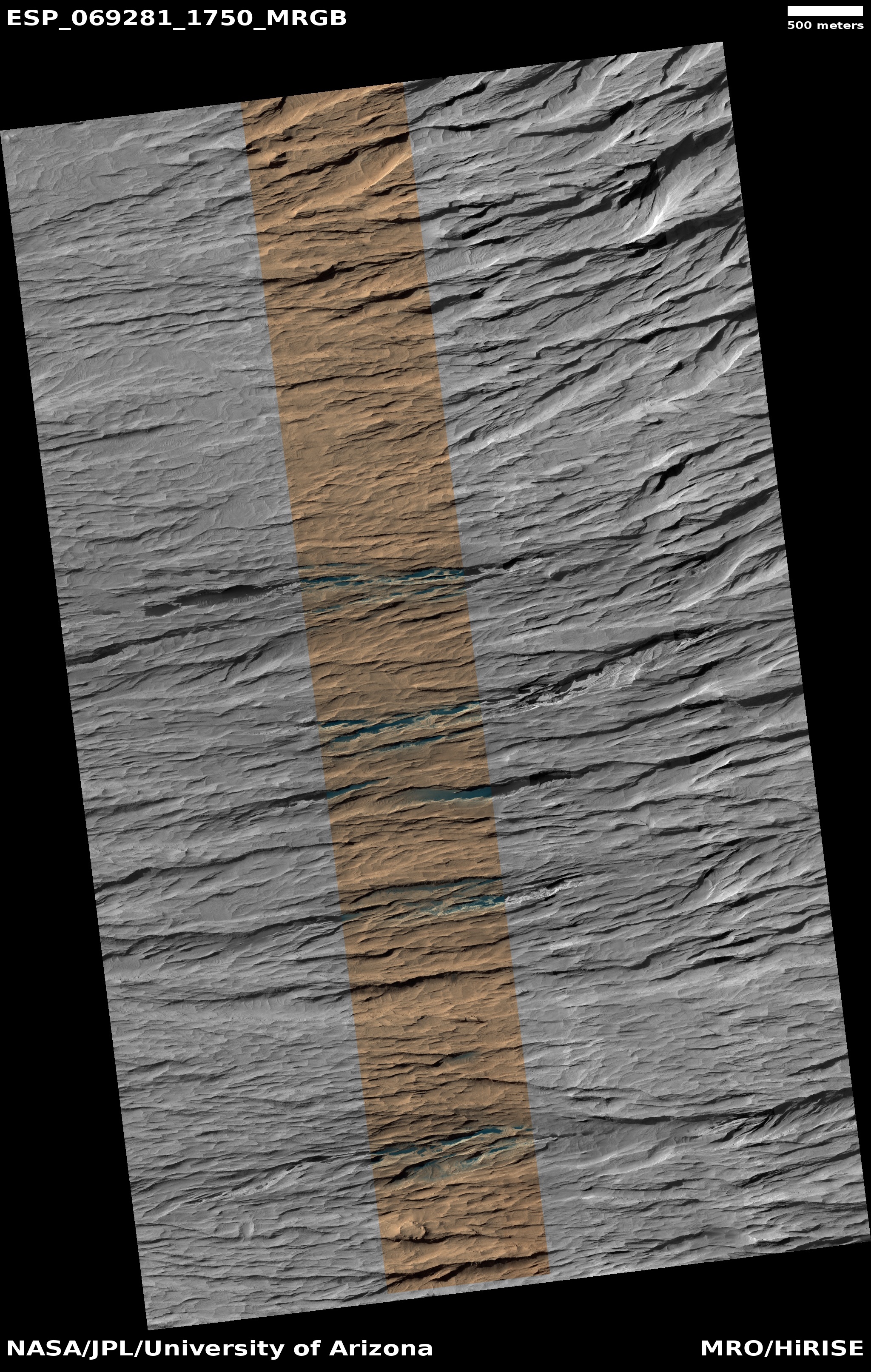
Cool image time! The picture to the right, rotated, cropped, reduced, and sharpened to post here, was taken on April 11, 2023 by the high resolution camera on Mars Reconnaissance Orbiter (MRO). It shows the northwest quadrant of a 7-mile-wide crater whose western rim was smashed by the later impact that created a smaller 2.8-mile-wide crater.

What makes this location interesting is what fills both craters, and how that material appears to flow through a gap in the smaller crater. The color strip suggests the peaks of the rim and small knobs are dust-covered, while the flat materials below are either “coarser-grained materials” that might also have elements of frost or ice within them. The science team thinks ice is involved, having labeled this picture “Ice Flow Features between Craters.”
» Read more

1 comment

Host galaxies for two quasars in early universe detected for the first time

Quasar and host galaxy
One of the quasars, with its light subtracted on the right,
revealing the host galaxy. Click for original image.

The uncertainty of science: Using data from both the infrared Webb Space Telescope and the Subaru optical telescope in Hawaii, astronomers have observed for the first time the host galaxies of two quasars that formed less than a billion years after the Big Bang.

Just a few months after JWST started regular operations, the team observed two quasars, HSC J2236+0032 and HSC J2255+0251, at redshifts 6.40 and 6.34 when the universe was approximately 860 million years old, both of which were discovered using Subaru Telescopeโ€™s deep survey program. The relatively low luminosities of these quasars made them prime targets for measuring the properties of their host galaxies.

The images of the two quasars were taken at infrared wavelengths of 3.56 and 1.50 microns with JWSTโ€™s NIRCam instrument, and the host galaxies became apparent after carefully modeling and subtracting glare from the accreting black holes. The stellar signature of the host galaxy was also seen in a spectrum taken by JWSTโ€™s NIRSPEC for J2236+0032, further supporting the detection of the host galaxy.

Photometric analyses found that these two quasar host galaxies are massive, measuring 130 and 34 billion times the mass of the Sun, respectively. Measuring the speed of the turbulent gas in the vicinity of the quasars from the NIRSPEC spectra suggests the black holes that power them are also massive, measuring 1.4 and 0.2 billion times the mass of the Sun. The ratio of the black hole to host galaxy mass is similar to those of galaxies in the more recent past, suggesting that the relationship between black holes and their hosts was already in place 860 million years after the Big Bang. [emphasis mine]

Normally, quasars are so bright the host galaxy is obscured. Computer modeling that subtracted the quasar’s light produced the host galaxy image on the right.

The highlighted sentence raises intriguing questions again about the Big Bang. Webb is once again finding evidence that the early universe quickly became like today’s universe, much faster than expected by cosmologists.

3 comments

Las Vegas developer touts spaceport plan

A Las Vegas developer is publicizing his plan to build a spaceport for rockets and spaceplanes on his 240 acre lot, with launches taking place within five to seven years.

He is also building a hotel/casino at this location, and I suspect the spaceport proposal’s purpose has more to do with publicizing that casino than actually launching rockets. He claims he will have a spaceport permit in two years, but for him to get such a thing for this land-based site is questionable.

The developer is also proposing to include a space-focused engineering school at the site, as well as fly zero-gravity planes from there, both of which are far more feasible.

3 comments

Europe successfully tests rocket engine to be used in its first reusable rocket

The European Space Agency (ESA) on June 22, 2023 successfully completed a 12-second static fire test of the Prometheus rocket engine it plans to use in its first reusable rocket.

The engine, like SpaceX’s Raptor-2 engine for Starship/Superheavy, uses methane as its fuel. The plan is to use it in a future rocket to replace or upgrade the Ariane-6 rocket, still being developed, with the ability to vertically land and reuse the first stage. The plan after this first round of static fire tests is complete is to begin to do short vertical hop tests next year, similar to the Grasshopper tests SpaceX did as it developed the Falcon 9.

However, the following quote from the article indicates their are some limitations to the engine:

According to CNES, the new engine will be reusable up to five times and can deliver variable thrusts of up to 100 tonnes.

SpaceX builds its Merlin and Raptor engines with the goal of many more reuses than this. Possibly this number is simply a conservative estimate that will change once the engine is operational. If all goes as planned, ESA hopes to have this new reusable rocket flying by 2026, at the earliest.

2 comments

Spring near the Martian north pole

Spring near the Martian north pole
Click for original image.

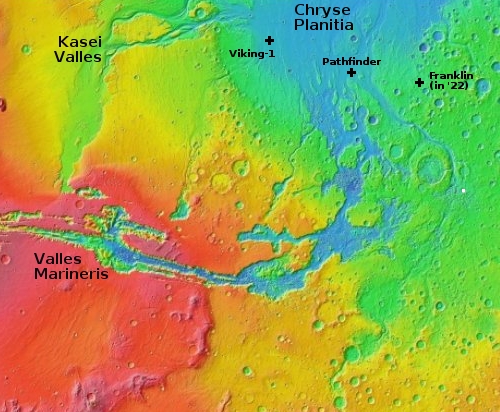
Overview map

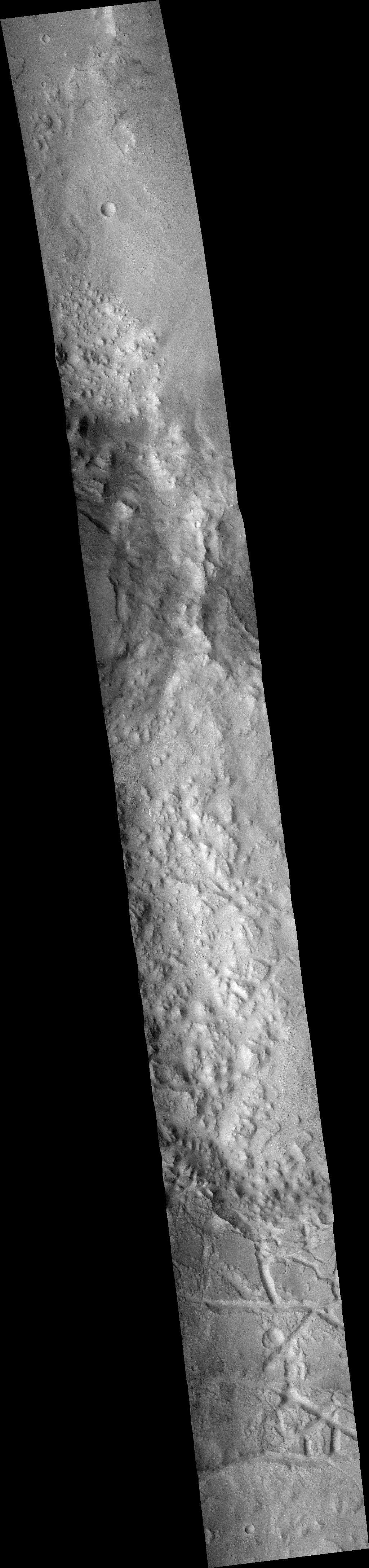
Cool image time! The picture above, rotated, reduced, and brightened slightly to post here, was taken on April 13, 2023 by the high resolution camera on Mars Reconnaissance Orbiter (MRO). It cuts a swath across an eleven-mile-wide crater only about 500 miles from the edge of Mars’ north pole ice cap.

The overview map to the right marks its location, as indicated by the white dot on the right edge of the map. The inset shows the soft and likely icy nature of the surface in which this impact occurred. The crater resulted in a secondary outside ripple, that quickly hardened after impact.

The image was taken during spring, shortly after the sun’s light hit this crater. The cracks in the ice indicate long term sublimation that is slowly reducing the amount of water ice inside the crater. Like mud cracks in the desert after a puddle has evaporated, the ice here is cracking to produce polygon fractures.

It is also very likely that everything here is coated with a thin mantle of clear dry ice, deposited as snow from the atmosphere in the winter and then sublimating away with the coming of spring. That spring dry ice sublimation is likely ongoing, and this picture is probably an attempt by scientists to detect that process.

Why the surface colors shift from aquablue to orange might have to do with that sublimation process, or it might be revealing areas covered with dust (orange). That the northern parts of the strip is blue and the southern parts orange suggests the former. Or not. I don’t have enough information to answer this question with any confidence.

0 comments

Zhurong data shows very weak magnetic field at landing site

Using data accumulated by Zhurong while it was still rovering on Mars, Chinese scientists have determined that the weak Martian magnetic field at Utopia Basin where the rover landed was very weak, much weaker than expected.

Results from NASA’s Mars’ lander InSight, which landed about 2,000 km southeast of Zhurong, have revealed that the crustal magnetic field at InSight’s landing site was an order stronger than that inferred from orbital measurement. Measurements from Zhurong, however, revealed the opposite result, with the average intensity an order less than that inferred from orbit.

The weak field suggests that the crust under Utopia Basin was never magnetized, or was demagnetized by some large later impact.

Meanwhile, no word on Zhurong itself, which either remains in hibernation or has died due to lack of power caused by the dusty Martian winter.

0 comments

Surprise! The cost for the Mars Sample Return mission is ballooning!

According to NASA, the cost for the Mars Sample Return mission could possibly rise to as high as $8 to $9 billion, more than double the $3.8 billion to $4.4 billion estimated by a 2020 review.

NASA itself has recently become very silent about the project’s expected cost.

NASA officials have been careful not to give any estimates of costs for MSR in recent presentations, stating that it will wait until a formal confirmation review for the program, scheduled for the fall, before providing an official cost and schedule baseline. That will come after a series of preliminary design reviews and a review by a second independent board led by Orlando Figueroa, a former director of NASAโ€™s Mars exploration program.

Those earlier numbers were never realistic, based on NASA’s recent track record. The cost of its big projects — Webb, SLS, Orion, Roman Telescope — always grows exponentially, once the project gets going.

This cost increase however is a serious political problem for NASA and this sample return mission, as the House is demanding major real cuts in the budgets of almost all federal agencies. While I expect NASA to survive these cuts without great harm, a program that shows out-of-control budget growth might become a target by the House, which is likely why NASA scheduled its review of the sample return mission to occur in the fall, after the House approves its next budget. Better to announce bad news as late as possible.

15 comments

The last Ariane-5 launch scheduled for July 4th

Arianespace has now scheduled the last Ariane-5 launch for July 4, 2023, after a delay caused by a problem with “the pyrotechnic transmission lines” on the rocket, requiring their replacement.

The replacement happened faster than originally expected. The launch will place a French military communications satellite into orbit as well as a German experimental communications satellite.

After this launch, Europe will temporarily be without any method for launching its own payloads, for the first time this century. Its Vega-C rocket is presently grounded due to a launch failure in December 2022, and the Ariane-6 rocket that was to replace the Ariane-5 is years behind schedule, and not expected to fly until 2024. The original plan was for there to be an overlap between the two rockets, but the delays ended that plan.

2 comments
1 339 340 341 342 343 1,328