Isar Aerospace signs deal to launch from French Guiana

Capitalism in space: The German smallsat rocket startup Isar Aerospace has now signed a deal with the French space agency CNES to use one of its launchpads in French Guiana for launches of its new Spectrum rocket.

The Diamant pad was built more than a half-century ago for the French rocket of the same name, but has been dormant for decades. CNES is now working to convert the facility into a multi-user site for small launch vehicles, and Isar is the first company the agency selected in an open competition to use the site.

Isar also has a deal to launch from Norway. As recently as seven months ago the company was claiming its first test launch would occur there before the end of ’22. All told, Isar has three different launch contracts and has raised almost $200 million in investment capital.

0 comments

Draper wins NASA contract to put a lander on the Moon’s far side

Capitalism in space: NASA yesterday awarded a $73 million contract to the space company Draper to place a lander on the Moon’s far side by 2025.

The lander, called SERIES-2 by Draper, will deliver to Schrödinger Basin three experiments to collect seismic data, measure the heat flow and electrical conductivity of the lunar subsurface and measure electromagnetic phenomena created by the interaction of the solar wind and plasma with the lunar surface.

The mission is the eighth NASA has awarded to date as part of CLPS, but the first to go to the lunar farside. The only mission by any country to land on the far side of the moon is China’s Chang’e-4 mission, which successfully landed in Von Kármán Crater in January 2019 and deployed the Yutu 2 rover that remains operational today.

With this award, there are presently five American companies with contracts to put landers on the Moon, Intuitive Machines, Astrobotic, Firefly, and Masten. Masten however shut down operations recently. This new contract to Draper for almost the exact same amount that had been awarded to Masten appears to replace Masten in the program.

2 comments

SpaceX launch aborted 46 seconds before launch

Capitalism in space: In what has become a rare event for SpaceX, the company was forced to abort a launch of a Falcon 9 rocket today carrying 46 Starlink satellites only 46 seconds before launch.

The company has scrubbed a few launches in the past three years due to weather, but I think this is the first launch abort apparently due to a technical issue in several years.

No details were given for the abort, but whatever the issue was, it was apparently not serious, as the launch team immediately announced that they have recycled the launch to its back-up date tomorrow.

4 comments

Perseverance spots a string on Mars!

A piece of string on Mars
Click for full image.

According to the Perseverance science team, they believe the strange spaghetti-like object to the right, taken by one of the rover’s hazard avoidance camera’s on July 12, 2022, is actually a piece of string that fell here during the rover’s landing in February 2021.

The string could be from the rover or its descent stage, a component similar to a rocket-powered jet pack used to safely lower the rover to the planet’s surface, according to a spokesperson for the Perseverance mission at NASA’s Jet Propulsion Laboratory in Pasadena, California. Perseverance had not previously been in the area where the string was found, so it’s likely the wind blew it there, the spokesperson said.

The string, which appears to be a few inches across, was apparently gone four days later, when another hazard avoidance picture was taken of the same spot

An official description from the scientists is expected in a week or so.

6 comments

The earliest galaxy so far seen?

Earliest galaxy?

Scientists using the James Webb Space Telescope now think they have identified a galaxy formed only 330 million years after the Big Bang.

The red smudge in the centre of this image [to the right] is thought to be a galaxy with a redshift of around z=13, as seen by the NIRCam instrument on the James Webb Space Telescope. This redshift estimate is based on photometry so the object remains a candidate rather than a confirmed high-redshift galaxy, but if confirmed spectroscopically this would be the highest-redshift galaxy yet observed.

You can read the research paper itself here [pdf]. The galaxy is actually very young, and its nature, along with a second also described by the research, appears to contradict expectations. From the paper’s abstract:

These sources, if confirmed, join GNz11 in defying number density forecasts for luminous galaxies based on Schechter UV luminosity functions, which require a survey area > 10× larger than we have
studied here to find such luminous sources at such high redshifts. They extend evidence from lower redshifts for little or no evolution in the bright end of the UV luminosity function into the cosmic dawn epoch, with implications for just how early these galaxies began forming. This, in turn, suggests that future deep JWST observations may identify relatively bright galaxies to much earlier epochs than might have been anticipated. [emphasis mine]

In other words, this early data from Webb suggests that galaxies formed much faster than expected after the Big Bang. This either means all the theories describing the Bang are wrong, or that it might not have even happened.

16 comments

Northrop Grumman delays next Cygnus cargo mission

Northrop Grumman officials have now revealed that it has been forced to delay the next Cygnus cargo mission to ISS from August to October because of “supply chain issues.”

What these supply chain issues were the company did not specify. However, the Antares rocket that launches Cygnus uses Russian engines attached a Ukrainian first stage. Northrop Grumman presently only has enough engines and stages for two more flights. While there are indications that the Ukrainian war has not yet prevented the delivery of future Ukrainian first stages, the Russians have blocked all further engine sales.

A new American rocket engine company, Ursa Major, is building a new engine capable of replacing the Russian engines, but the engine won’t be ready until ’25.

The delay could be Northrop Grumman’s effort to stretch out the schedule of its last two Antares launches in the hope that the Russians will lift their embargo, which might happen based on the firing by Putin of Dmitry Rogozin as head of Roscosmos. Rogozin had been the person who imposed the embargo. His removal suggests that Putin is trying to ease the tensions between the west and Russia, at least in the area of space.

5 comments

Axiom signs deal with Hungary

Capitalism in space: Axiom yesterday announced a new agreement with Hungary aimed at launching that nation’s first astronaut to ISS.

Tthe plan is to have Axiom launch the astronaut on one of its planned tourist missions using a Dragon capsule. Whether the mission will happen before or after Axiom begins launching its own modules to ISS is not clear, since no launch schedule was revealed.

Axiom now has deals with Hungary and the UAE to fly their astronauts, and deals with Italy and a UK company to add their own modules to its station. There is thus good financial pressure for it to get its station launched an operational, first as a section of ISS and then flying independently.

1 comment

NASA sets tentative launch date for SLS

NASA yesterday announced that it is targeting August 29, 2022 for the first unmanned launch of its SLS rocket.

NASA is tentatively targeting Aug. 29 for the long-awaited maiden flight of the agency’s huge Space Launch System moon rocket, officials said Wednesday. But they cautioned major challenges remain for the oft-delayed rocket and an official date will not be set until later.

As it stands, the launch processing schedule is extremely tight and depends on successful checkout of a repaired hydrogen line fitting, good results from end-to-end pre-flight checks of the rocket’s myriad other systems and getting everything done in time to haul it back out to the launch pad by around Aug. 18.

If any delays occur, this launch window extends until September 6th. If they can’t make that date, the next launch window opens on September 19th.

The mission, to send the Orion capsule around the Moon and back, would last 42 days and if launched as planned would return October 10th.

The announcement also slipped in this tidbit:

If the initial test flight goes well, NASA plans to launch four astronauts atop the second SLS rocket for an around-the-moon shakedown flight in 2024 — Artemis 2 — before sending the first woman and the first person of color to a landing near the moon’s south pole in 2025 or 2026 as part of the Artemis 3 mission. [emphasis mine]

This I think is the first time NASA officials have hinted that the launch might be delayed to ’26. It is no surprise, but as they have always done with SLS, they give these hints softly, prepping the press so that it doesn’t make news.

As for the disgraceful unseemly focus on race and sex, it appears that NASA is now an apartheid state. The make-up of missions will no longer be determined by skill and experience, but by ethnic considerations, with favoritism always given to minorities or women.

7 comments

Rogozin’s order banning Russian astronauts from using European robot arm cancelled

A planned spacewalk tomorrow to configure the new European robot arm on the Russian section of ISS essentally proves that the order by the recently fired head of Roscosmos, Dmitry Rogozin, forbidding the station’s Russian astronauts from doing any work with that European robot arm has now been cancelled.

A Russian cosmonaut and an Italian astronaut are finalizing preparations for a spacewalk on Thursday to configure the International Space Station’s third and newest robotic arm. As the pair was being assisted by two cosmonauts the rest of the Expedition 67 crew ensured ongoing advanced space research was proceeding full speed ahead aboard the orbiting lab.

Station Commander Oleg Artemyev of Roscosmos and Flight Engineer Samantha Cristoforetti of ESA (European Space Agency) are scheduled to exit the space station into the vacuum of space at 10 a.m. EDT on Thursday. The spacewalkers will spend about seven hours readying the European robotic arm for operations on the station’s Russian segment. The duo will also deploy 10 nanosatellites to collect radio electronics data. [emphasis mine]

Though I suspect no official announcement will be made, it is likely that the new head of Roscosmos, Yuri Borisov, had quietly made it clear to all involved to proceed with the necessary work, as if Rogozin’s order had never been made.

4 comments

Martian terraces

Overview map
Glacier country on Mars

Martian terraces
Click for full image.

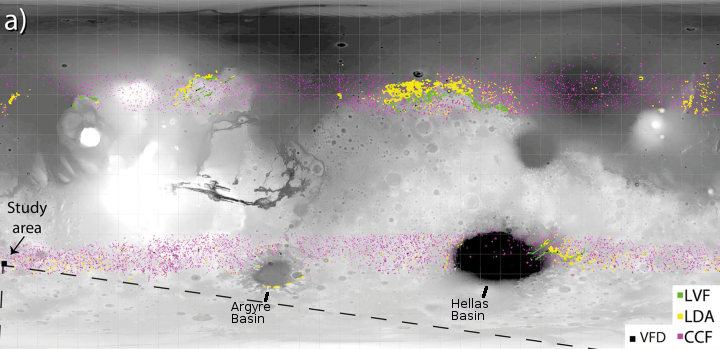
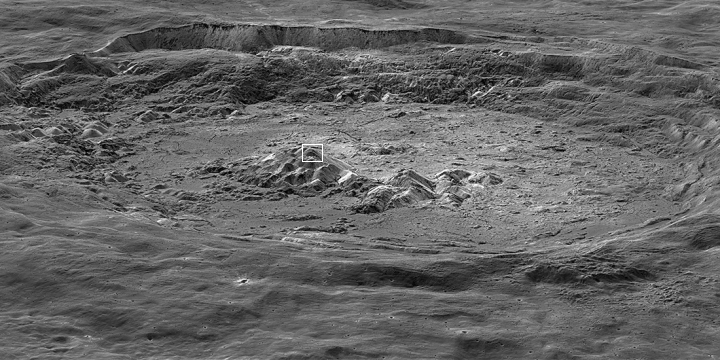
Cool image time! The photo to the right, cropped and reduced to post here, was taken on May 17, 2022 by the high resolution camera on Mars Reconnaissance Orbiter (MRO). It shows what the scientists have labeled “Dipping layers against mound in Deuteronilus Mensae.”

Deuteronilus is the westernmost mensae region in the 2,000-mile-long strip of heavy glaciers found in the northern mid-latitudes that I dub glacier country. This photo, the location of which is marked by the white cross on the overview map above, is another example, though somewhat strange and puzzling. Normally the layers will dip away from the high point. Here, the layers dip towards the mound. I can think of only one explanation, that of prevailing winds causing the erosion in this unusual manner, but I also find that explanation very unsatisfactory.

The layers themselves illustrate the cycles that have shaped Martian geology, caused by the wide swings in the planet’s rotational tilt, from 11 to 60 degrees. When that tilt is high, the poles are warmer than the mid-latitudes, and water ice migrates from the poles towards the equator. When the tilt is low, the mid-latitudes are warmer, and the water ice heads back towards the poles. Thus, the many many layers the orbiters and rovers are now finding everywhere on Mars.

Right now scientists think, because Mars’ tilt is in the middle of these swings at 25 degrees, the planet is in equilibrium, with the water at the poles and mid-latitudes essentially going no where. This conclusion however is not yet confirmed.

0 comments

NRO delays Rocket Lab launch

Capitalism in space: Because it wishes to install software updates to its payload, the National Reconnaissance Office (NRO) has told Rocket Lab to stand down from a planned Electron rocket launch scheduled for July 22, 2022.

This launch had been purchased by NRO as part of a two-launch deal, designed to allow Rocket Lab to demonstrate its ability to quickly schedule and launch two different NRO missions only ten days apart. The first launch took place on July 13th. And it appears that Rocket Lab is prepared to do that second launch, whenever NRO gives it the go-ahead, suggesting the company has fulfilled its part of the bargain.

0 comments

Ispace now aiming for a November ’22 launch of its lunar lander

Capitalism in space: The private Japanese company Ispace today announced that it is targeting November 2022 for the launch of its Hakuto-R lunar lander, carrying commercial as well as governmental payloads.

The launch will be on a Falcon 9 rocket. The payload includes two small rovers, one built by Ispace and a second, Rashid, built by the United Arab Emirates (UAE).

Rashid has already been delivered to SpaceX. This announcement indicates that Hakuto-R is on schedule for delivery in time for that November launch.

Both rovers are engineering tests, and will are expected to only function on the Moon for one lunar day.

0 comments
1 458 459 460 461 462 1,327