First sunspot for the next solar cycle spotted

Solar scientists have spotted the first sunspot on the Sun with a reversed polarity, meaning that it really belongs to the next sunspot cycle.

This is not unusual. The sunspots from different cycles routinely overlap by several years, with the sunspots from the old cycle moving close to the equator with time and the new cycle sunspots appearing at high latitudes. What this does suggest is that there will be sunspots after the upcoming solar minimum, rather than the beginning of a new Grand Minimum with no sunspots for decades.

0 comments

Sunspot activity continues to drop

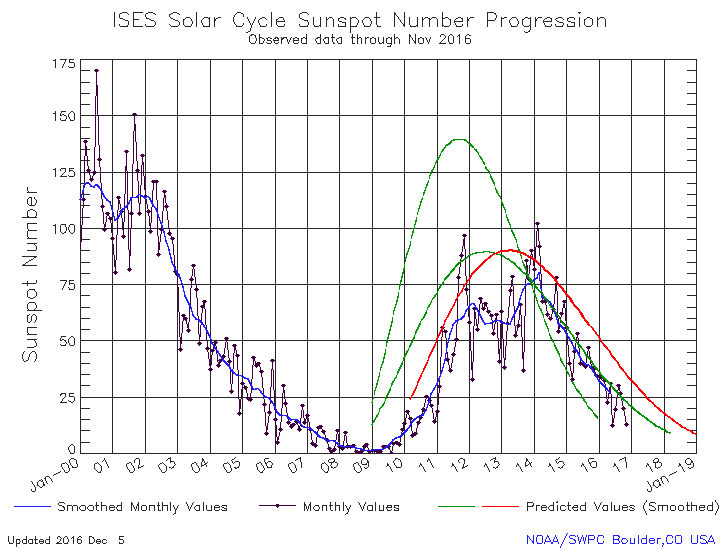
NOAA yesterday posted its monthly update of the solar cycle, covering sunspot activity for November. Below is my monthly annotated version of that update.

November 2016 Solar Cycle graph

The graph above has been modified to show the predictions of the solar science community. The green curves show the community’s two original predictions from April 2007, with half the scientists predicting a very strong maximum and half predicting a weak one. The red curve is their revised May 2009 prediction.

In November sunspot activity dropped again, to the second lowest point seen since 2010. Essentially, activity today is about where it was in 2010 when the solar minimum was finally ending. Now, the solar maximum is ending and we are beginning the next solar minimum.

Throughout the entire just completed solar maximum, the Sun continuously under-performed all predictions. Even now, despite following almost precisely the prediction of the 2007 low prediction during 2014 and 2015, in 2016 the ramp down has begun to slip below that prediction. The trend continues to suggest the arrival of solar minimum will be early, possibly as early as sometime late next year.

2 comments

Sunspot ramp down resumes

On Monday NOAA posted its monthly update of the solar cycle. I am posting it here, as I do every month, with annotations to give it context.

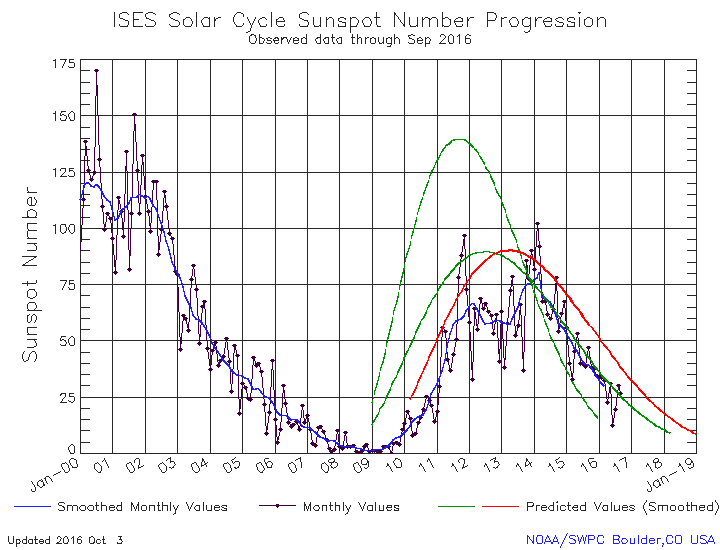
September 2016 Solar Cycle graph

The graph above has been modified to show the predictions of the solar science community. The green curves show the community’s two original predictions from April 2007, with half the scientists predicting a very strong maximum and half predicting a weak one. The red curve is their revised May 2009 prediction.

After two months of increased sunspot activity, the decline in sunspots resumed in September, though activity did not drop significantly. Overall though, the ramp down towards the next solar minimum continues to track quite closely the ramp down predicted by weak prediction made by half the solar science community back in 2007 (the lower green curve above). These scientists however do not have much to brag about. Their same prediction completely missed the ramp up, which happened a year later than predicted, as well as the activity peak, which was far weaker than predicted.

In fact, the ramp down now continues to point to the possibility that this very weak solar cycle will also be a very short one, something that is quite unprecedented, and suggests that we might be seeing the lead in to another Grand Minimum, where there are no sunspots for decades. Since no one understands yet exactly why such grand minimums happen, however, this remains pure speculation. We will only find out by watching what happens, as it happens.

3 comments

Sunspots: A recovery in August

NOAA’s monthly update of the solar cycle was posted today. As I do every month, I am posting it here, with annotations to give it context.

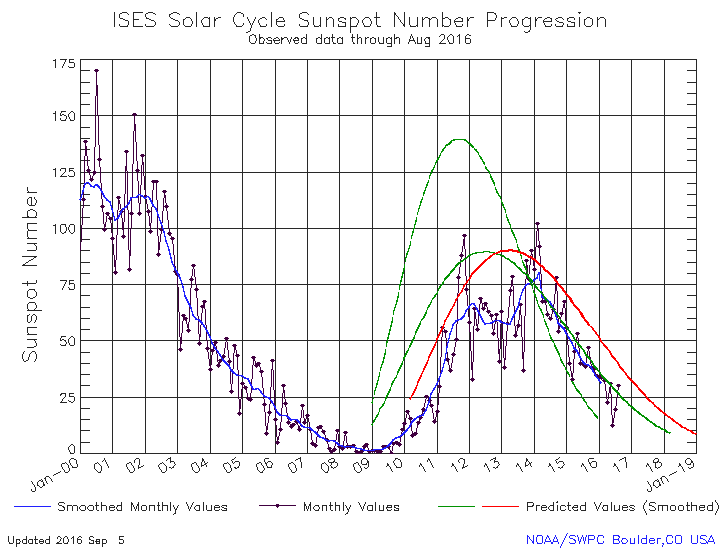
August 2016 Solar Cycle graph

The graph above has been modified to show the predictions of the solar science community. The green curves show the community’s two original predictions from April 2007, with half the scientists predicting a very strong maximum and half predicting a weak one. The red curve is their revised May 2009 prediction.

The recovery in sunspot activity that began in July continued in August. The number of sunspots increased enough to once again raise the overall curve up to match the green curve of the 2007 weak prediction. Even so, this solar maximum remains far weaker than the weakest prediction. Also, this solar maximum, which started later than all the predictions, looks like it will be far shorter than all the predictions. As I have noted previously, this is counter to all previous solar cycles, where it is the more active cycles that are shorter and the weaker cycles are longer. Here, we are getting a weak cycle that is also short, which once again suggests that we are seeing solar behavior previously unobserved. The solar cycle is doing things it hasn’t done since scientists began studying it closely after Galileo.

2 comments

An update on Stereo-B’s status

The engineers working to recover Stereo-B, the solar observatory that was lost for 22 months, have released an update on the spacecraft’s condition.

In the subsequent days, analysis revealed the spacecraft was in a complex spin, with its fuel tanks frozen and the battery state of charge at 30%. The prime goal is now to fully recover battery power and gradually thaw STEREO-B’s instruments and fuel tanks from its deep freeze. It may be clear that the spacecraft is still in a critical condition and that it will take quite some time before imagery, such as those from its twin STEREO-A, will be available again.

If you are interested in more details, go to the Stereo-B update website, where they are posting almost daily reports.

0 comments

Contact re-established with dead solar satellite

Good news! After almost two years since contact was lost, NASA has re-established communications with Stereo-B, one of two solar research satellites designed to study the hemisphere of the Sun that does not face the Earth.

NASA re-established contact with a wayward sun-watching science satellite Sunday nearly two years after the spacecraft suddenly dropped off line during a test, the agency said in a statement Monday. NASA’s Deep Space Network, or DSN, “established a lock on the STEREO-B (spacecraft’s) downlink carrier at 6:27 p.m. EDT,” NASA said in a statement. “The downlink signal was monitored by the Mission Operations team over several hours to characterize the attitude of the spacecraft and then transmitter high voltage was powered down to save battery power. “The STEREO Missions Operations team plans further recovery processes to assess observatory health, re-establish attitude control and evaluate all subsystems and instruments.”

This is a big deal. Not only is it a testament to the spacecraft’s good design, it demonstrates the skill of the engineers at NASA who have regained contact.

1 comment

Sunspot ramp down continues

Below is NOAA’s monthly update of the solar cycle, posted by them on August 7. It shows the Sun’s sunspot activity in July, with annotations.

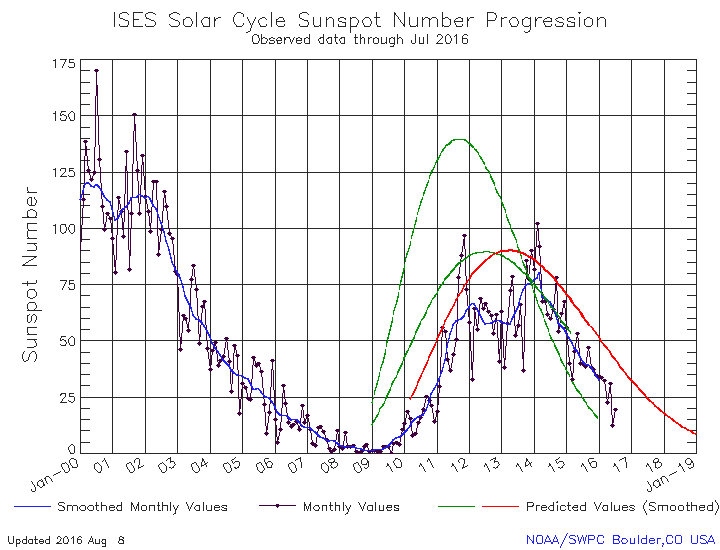
July 2016 Solar Cycle graph

The graph above has been modified to show the predictions of the solar science community. The green curves show the community’s two original predictions from April 2007, with half the scientists predicting a very strong maximum and half predicting a weak one. The red curve is their revised May 2009 prediction.

As expected, there was a recovery in sunspot activity in July compared to June. Also as expected, the recovery was not significant, so that it appears, based on the past two months, as if the ramp down to solar minimum is accelerating so that solar minimum will occur sooner than expected, possibly as soon as two years.

I would not put much stock on that prediction, however. When sunspot activity first reached this level during the past solar cycle in late 2005, it still took three more years before solar minimum was reached. If this cycle matches the last, that would mean that this cycle, from minimum to minimum, will have lasted 10 years, making a short solar cycle though not one of the shortest. However, it is more likely that the ramp down will stretch out, as it usually does, gliding downward to solar minimum in a slow gentle curve that makes for a full cycle of about 11 years.

4 comments

SDO not returning data

For reasons that remain unexplained, the Solar Dynamics Observatory (SDO) did not return to science mode after it passed through the Moon’s shadow on August 2nd.

The only information about this on the SDO webpage simply states, ” The spacecraft did not go back into Science mode at the end of the transit. SDO FOT members are looking into the issue.” Spaceweather.com notes that “Since the transit no new data have appeared on SDO public websites.”

SDO has only been in orbit for six years. It would be a shame to lose it so quickly.

UPDATE: It appears that engineers are getting SDO back into operation. Hat tip James Fincannon.

6 comments

The Sun is blank again

More signs that we are easing down to solar minimum: After a period of two weeks of sunspots, the Sun has once again gone blank.

It takes the Sun’s about four weeks to rotate and complete one “day”. What has essentially happened is that right now one face of the Sun is blank while the other face has sunspots. For two weeks, from the last week in June to the first week in July, the blank face was turned towards the Earth. Then the face with sunspots rotated into view for two weeks, and now the blank face has rotated back to face us.

Though new sunspots can always form on either face, I expect this blank stretch to last a few days, at least.

7 comments

A short but weak solar maximum?

On July 4th NOAA released its monthly update of the solar cycle, showing the Sun’s sunspot activity in June. It is annotated and posted below.
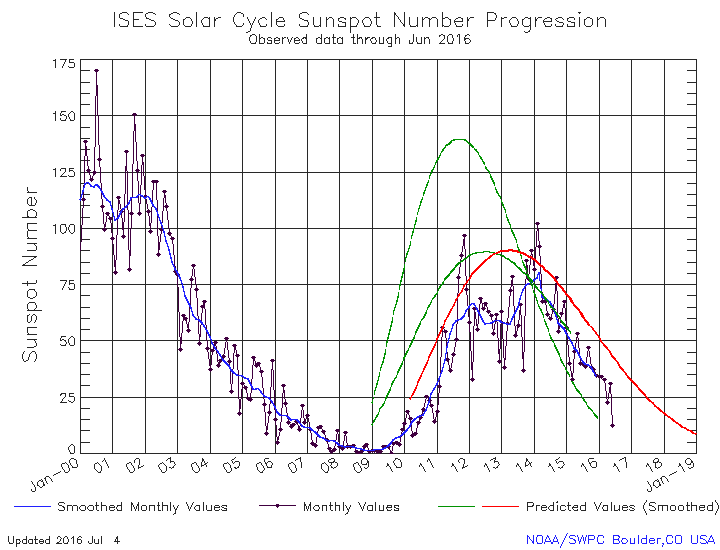
June 2016 Solar Cycle graph

The graph above has been modified to show the predictions of the solar science community. The green curves show the community’s two original predictions from April 2007, with half the scientists predicting a very strong maximum and half predicting a weak one. The red curve is their revised May 2009 prediction.

Not surprisingly, the time periods with no sunspots in June, including a 12 day stretch that just ended today, is reflected by the graph’s precipitous drop in June.

What is significant to me is the speed with which this solar maximum seems to be ending. Normally, weak solar cycles are also long solar cycles. The Sun not only doesn’t get as active, but the ramp up and down is extended, as is the period of the solar minimum. This is what happened during the solar minimum from 2007 to 2010. It was longer than normal, which meant that the solar maximum occurred much later than predicted by the 2007 predictions of the solar science communities (shown in green).

This recent stretch of blank days however is now suggesting that the solar maximum is going to end much sooner than the later 2009 prediction (shown in red). Even more astonishing, the numbers in June aligned with the 2007 high prediction, which would make this one of the shortest solar maximums on record!

I don’t expect these low numbers to continue. I expect sunspot activity to recover and continue, with the minimum likely occurring after 2018. If it does come sooner, however, that will once again be evidence suggesting we are heading for a Grand Minimum, with no sunspots for decades.

2 comments

Sunspot cycle update

NOAA today released its monthly update of the solar cycle, showing the Sun’s sunspot activity in May. It is annotated and posted below.

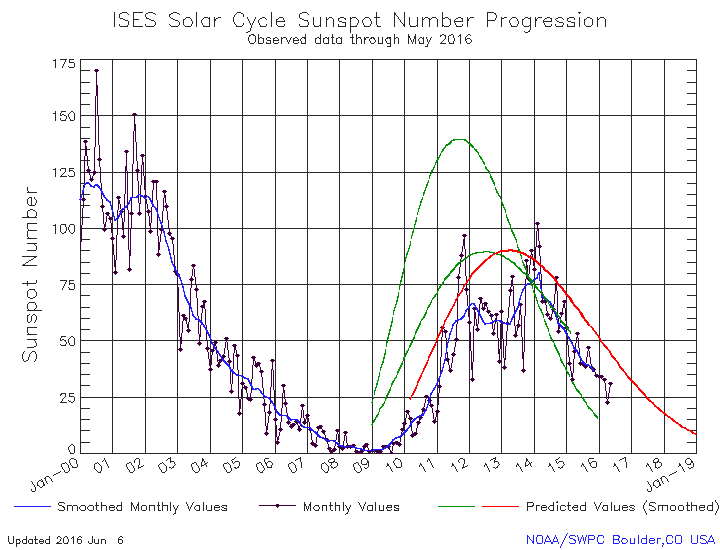
Mayl 2016 Solar Cycle graph

The graph above has been modified to show the predictions of the solar science community. The green curves show the community’s two original predictions from April 2007, with half the scientists predicting a very strong maximum and half predicting a weak one. The red curve is their revised May 2009 prediction.

Though sunspot activity increased in May, the increase was not significant. The ramp down from solar maximum continues to track the 2007 low prediction for this maximum.

Meanwhile, the Sun continues its first multi-day string of blank days since 2011, now up to 3 days with all indications suggesting it will continue at least one more day. This early blank string, combined with the relatively fast decline in sunspots in the past two years, suggests that the solar maximum is ending sooner than predicted by the 2009 prediction (the red curve above), and that the next minimum will possibly be longer as well.

9 comments

No sunspots for the first time in two years

For the first time since July 17, 2014, and only the second time since 2011 at the beginning of the solar maximum, the Sun was blank today, with no sunspots visible on its surface.

I expect the next monthly update of the solar cycle will arrive early next week, and though I expect it will show a slight increase during the past month, it will also show that the ramp down to solar minimum is continuing unabated.

0 comments

Computer simulation models Sun’s magnetic field during grand minimum

The uncertainty of science: A computer simulation, run for six months on a supercomputer, suggests that during grand minimums in the Sun’s solar cycle, when there are no sunspots for decades, its magnetic field remains strong but descends into the star’s interior.

I think this statement by the leader of the science team is most informative:

‘The Sun as such is impossible to replicate on present-day computers – or those of the near future – due to its strong turbulence. And indeed we are not claiming that this modelling would really be the Sun. Instead, it is a 3D construction of various solar phenomena by means of which the star that runs our space climate can be better understood,’ Käpylä explains.

6 comments

Sunspot activity crashes

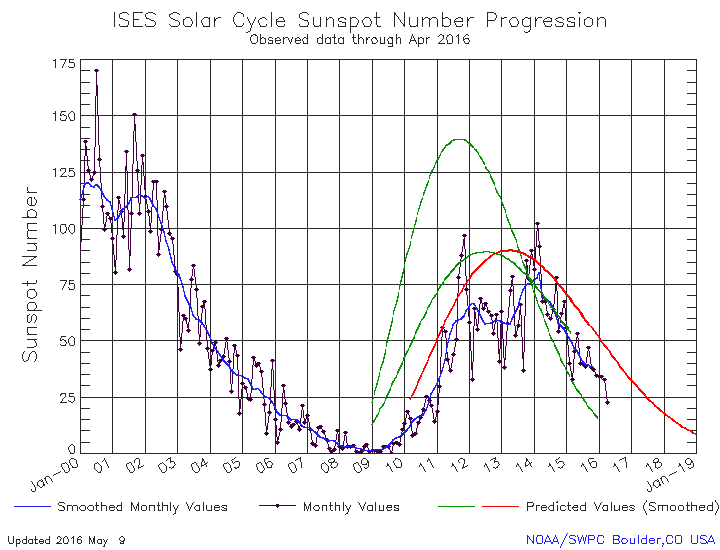
The monthly NOAA update of the solar cycle was released yesterday, showing the Sun’s sunspot activity in April. It is annotated and posted below.

April 2016 Solar Cycle graph

The graph above has been modified to show the predictions of the solar science community. The green curves show the community’s two original predictions from April 2007, with half the scientists predicting a very strong maximum and half predicting a weak one. The red curve is their revised May 2009 prediction.

After four months of steady decline matched exactly with the low prediction from 2007 (the lower green line curve), in April sunspot activity plummeted to the lowest level seen since January 2011.

This decline shouldn’t surprise anyone. The now ending solar maximum has been the weakest in a century and, as noted here, it is now more than a year since the last X-class solar flare, the most powerful kind, with this solar maximum seeing only 45 X-class events, compared to 126 during the previous solar maximum.

As I have noted repeatedly, the big question now is what will happen during the next solar cycle. Will we get another weak solar cycle or will the sun’s sunspot activity recover? Or will sunspots vanish and will the sun enter a grand minimum, with no sunspots for decades? At the moment no one knows, though some solar scientists favor the latter.

2 comments

Pluto’s solar wind interaction more like a planet’s

Data from New Horizons has found that Pluto, in its interaction with the solar wind, behaves more like a planet than a comet.

Previously, most researchers thought that Pluto was characterized more like a comet, which has a large region of gentle slowing of the solar wind, as opposed to the abrupt diversion solar wind encounters at a planet like Mars or Venus. Instead, like a car that’s part gas- and part battery-powered, Pluto is a hybrid, the researchers say. “This is an intermediate interaction, a completely new type. It’s not comet-like, and it’s not planet-like. It’s in-between,” McComas said. “We’ve now visited all nine of the classical planets and examined all their solar wind interactions, and we’ve never seen anything like this.”

…Pluto continues to confound. Since it’s so far from the sun – an average of about 5.9 billion kilometers (3.7 billion miles) – and because it’s so small, scientists thought Pluto’s gravity would not be strong enough to hold heavy ions in its extended atmosphere. But, “Pluto’s gravity clearly is enough to keep material sufficiently confined,” McComas said. Further, the scientists found that very little of Pluto’s atmosphere is comprised of neutral particles converted to electrically charged ions and swept out into space.

As I’ve written previously, we simply don’t know enough yet about planets to come up with a reasonable definition. As far as I’m concerned, Pluto will remain a planet until we do.

3 comments

The sunspot decline continues

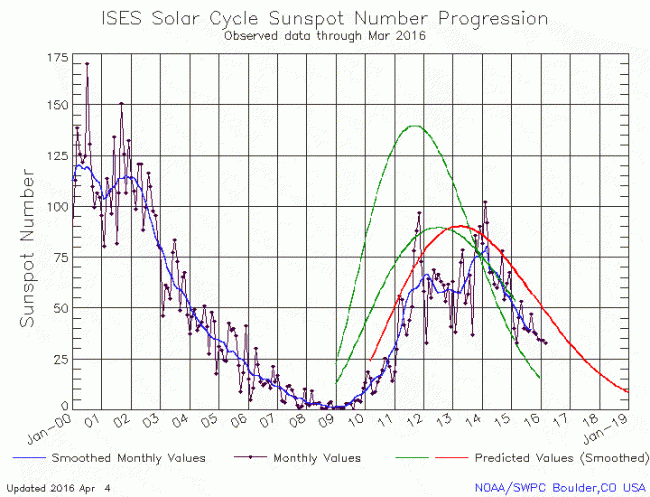
NOAA’s monthly update of the solar cycle was released today, showing the Sun’s sunspot activity in March. It is annotated and posted below.

March 2016 Solar Cycle graph

The graph above has been modified to show the predictions of the solar science community. The green curves show the community’s two original predictions from April 2007, with half the scientists predicting a very strong maximum and half predicting a weak one. The red curve is their revised May 2009 prediction.

For the fourth month in a row the change in the graph is so small you almost need a magnifying glass to see it. Despite this, the decline remains remarkably steady, tracking precisely the decline predicted by the low prediction of the 2007 predictions (indicated by the smaller green line curve).

Recently the number of sunspots has dropped enough that I suspect we are not far the moment when we will once again begin to see days where the Sun is blank of sunspots, a situation last seen in 2010 near the end of the previous solar minimum. When that happens, it will herald the beginning of the next solar minimum.

6 comments
1 8 9 10 11 12 19