One of Dawn’s reaction wheels, used to orient the spacecraft, shut down last week.

Uh-oh: One of Dawn’s reaction wheels, used to orient the spacecraft, shut down last week.

During a planned communications pass on Aug. 9, the team learned that the reaction wheel had been powered off. Telemetry data from the spacecraft suggest the wheel developed excessive friction, similar to the experience with another Dawn reaction wheel in June 2010. The Dawn team demonstrated during the cruise to Vesta in 2011 that, if necessary, they could complete the cruise to Ceres without the use of reaction wheels.

That the spacecraft can get to Ceres without reaction wheels is good. However, can it be oriented precisely to do science without these wheels? The JPL press release does not say.

0 comments

Dawn has begun its slow departure from Vesta in anticipation of its journey to the solar system’s largest asteroid, Ceres.

Dawn has begun its slow departure from Vesta in anticipation of its journey to the solar system’s largest asteroid, Ceres.

The departure was actually announced two weeks ago, but since this is a very slow process it isn’t like we have missed anything. Dawn’s ion engines are very efficient, but they work at a very leisurely pace. It will take a month for the engine’s thrusters to push Dawn out of its orbit around Vesta.

0 comments

A global view of Vesta

Vesta

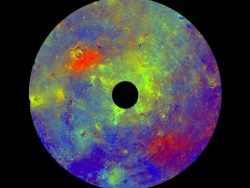
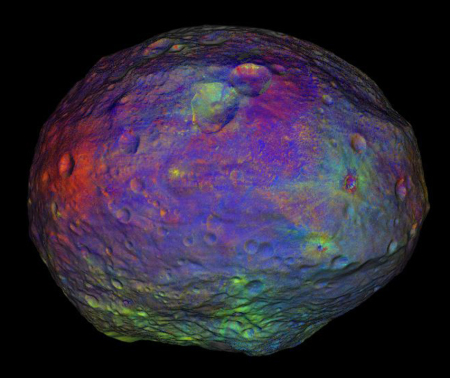
The accumulating data from Dawn has now allowed scientists to compile a global picture of the varied surface makeup of the asteroid Vesta.

The colors were chosen to highlight differences in surface composition that are too subtle for the human eye to see. Scientists are still analyzing what some of the colors mean for the composition of the surface. But it is clear that the orange material thrown out from some impact craters is different from the surrounding surface material. Green shows the relative abundance of iron. Parts of the huge impact basin known as Rheasilvia in Vesta’s southern hemisphere, for instance, have areas with less iron than nearby areas.

It also makes for a very nice image of the giant asteroid.

0 comments

New close-up photos of the asteroid Vesta from Dawn have discovered numerous bright spots scattered across the face of the asteroid Vesta.

New close-up photos of the asteroid Vesta from Dawn have discovered numerous bright spots scattered across the face of the asteroid Vesta.

The photos show surprisingly bright spots all over Vesta, with the most predominant ones located inside or around the asteroid’s many craters. The bright areas range from large spots (around several hundred feet across) to simply huge, with some stretching across 10 miles (16 kilometers) of terrain.

The scientists believe the bright spots might be the asteroid’s oldest material, excavated from below by impacts.

0 comments

Colorful Vesta

False color of Vesta

Tonight’s press conference at the American Geophysical Union conference focused on the latest results from Dawn, orbiting the giant asteroid Vesta. Or to put it as scientist Vishnu Reddy put it, “Vesta is the most colorful asteroid in the solar system.”

At least, in geological terms. To our human eye the asteroid wouldn’t be so spectacular. However, the false color images released by the scientists show the global geological diversity of Vesta. From the press release:
» Read more

0 comments

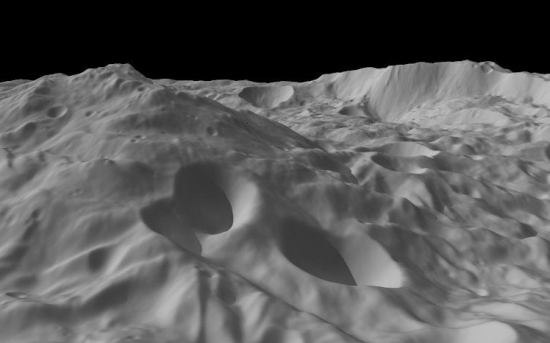
Rough Terrain

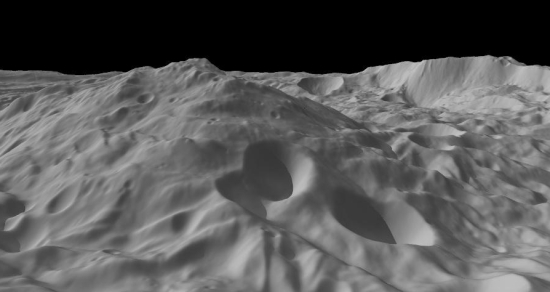
The Dawn scientists have released another spectacular image of the south polar mountain on Vesta whose relative size is three times that of Mount Everest. More information about the image can be found here. From the caption:

The peak of Vesta’s south pole mountain, seen in the center of the image, rises about 13 miles (22 kilometers) above the average height of the surrounding terrain. Another impressive structure is a large scarp, a cliff with a steep slope, on the right side of this image. The scarp bounds part of the south polar depression, and the Dawn team’s scientists believe features around its base are probably the result of landslides.

Mountain on Vesta

It appears the light gravity on Vesta allows for the formation of extreme topology.

0 comments

Video from Dawn

NASA has released an update summarizing what scientists have found since Dawn went into orbit around Vesta in July. The video below, compiled from images Dawn has taken, gives a nice visual overview. The most interesting big feature, understated by the video, is the series of grooves that appear to encircle the asteroid’s equator. To my eye it almost looks like Vesta was once two asteroids that got merged into one, with these grooves indicating the weld point.

The direct link to the video can be found here.

Embedded video from

NASA Jet Propulsion Laboratory California Institute of Technology

1 comment

Sponge in space

Hyperion

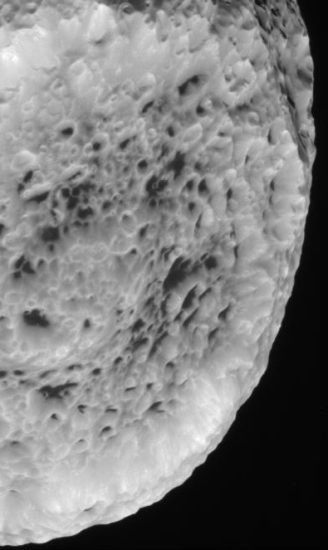
On August 25 Cassini did a close fly-by of the small Saturn moon Hyperion, getting as close as 15,500 miles. The mission has just released images from that fly-by.

Looks like a sponge, doesn’t it? This moon is small, only 168 miles across, which makes it about half the size of the asteroid Vesta that Dawn is presently orbiting. Why it is so peppered with craters is of course the big science question. I would guess this has something to do with the environment around Saturn, with its rings and the innumerable particles that come from it. Yet, other moons of Saturn are not as crater-filled, so there is obviously more to this than meets the eye.

This fly-by was the second closest of Hyperion that Cassini has done, the first passing over the the moon’s surface by only 310 miles. Because the irregularly-shaped moon’s rotation is more like a chaotic tumble, scientists could not predict what part of the surface they would see. To their luck the new images captured new territory.

Another fly-by is scheduled in only three weeks, on September 16, 2011. This time, however, the spacecraft won’t get as close, passing at a distance of about 36,000 miles.

2 comments

Craters, craters, everywhere

Below the fold are two images released today, one from Dawn at Vesta and the other from Messenger at Mercury. What makes them interesting to me is that, though the surfaces of both Vesta and Mercury are crater-packed, there are definitely distinct differences between them that one can spot if you look closely, all highlighting the fundamentally different environments of both worlds.

First, the Vesta photograph. The image looks out past the asteroid’s horizon, showing clearly that this dwarf planet is not spherical, with the south pole depression that puzzles scientists just on the planet’s limb. The parallel long deep grooves that are associated with this depression can be seen on the right. Notice also that the inside walls of all the craters slope downward in a very shallow manner. This gives the impression that the impacts that formed these craters smashed into an almost beachlike sandy surface. Note too the that the center of some craters have what appear to be flat small “ponds,” a phenomenon seen by the spacecraft NEAR when it orbited the asteroid Eros. These ponds are not liquid, but are actually made up of fine-grained particles that settle in the hollows of the asteroid.
» Read more

1 comment

Strange craters on Vesta

strange craters on Vesta

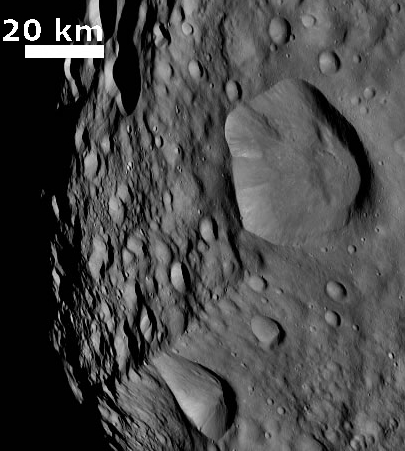
The images from Dawn keep rolling in. The picture on the right, released two days ago, shows the asteroid’s terminator. What makes it intriguing is the weird looking crater near the bottom of the image. It appears to have formed at impact on the wall of a cliff, something that at first glance seems impossible.

This is what I think happened: The impactor sliced down the wall of the cliff, but because of Vesta’s low gravitational field the impact scar never collapsed downward, filling in.

I once wrote an article about asteroids for Astronomy where I described these objects as having the consistency of mashed potatoes and ice cream sundaes. This image illustrates this nicely. The asteroid’s weak gravitational field limits the density of its material, so that puffy strange formations such as this crater can form.

1 comment

Getting closer to Vesta

close-up thumbnail

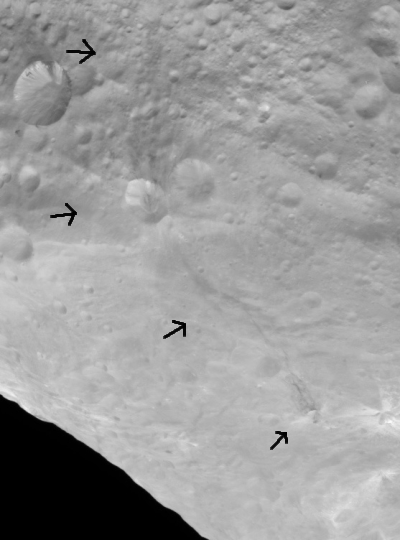
The Dawn mission team released another image today of the giant asteroid Vesta, this time taken from about 2,300 miles away. At this distance the resolution is still somewhat coarse, with the smallest visible detail about 0.43 miles in size.

To the right is a cropped section of the full image, focusing in on what appears to be a very strange geological feature, indicated by the arrows. From what I can tell, the dark meandering streak looks like a rille or flow coming out of the mound or peak near the bottom of the image. Yet, this dark meander continues directly across a crater as if it were a wind-blown dust streak.

I really have no idea what geological process created this. I also suspect that the scientists don’t quite know yet either, though I am sure they have some good theories, mostly based on the very light gravity that should exist on a world only 330 miles in diameter. As I’ve already noted, however, it is going to take them a couple of months to digest the data they are getting and come up with some reasonable conclusions. It will be fun to finally find out what they have learned.

7 comments
1 2 3