Dawn begins science operations in orbit around Vesta

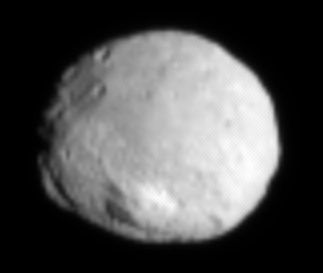
The Dawn science team today released what they are calling “the first full-frame image” of Vesta. The image is shown below the fold.

The picture was taken from 3,200 miles, and shows a pockmarked irregularly shaped world. While many features that resemble the Moon (the craters, the rays radiating out from those craters), that Vesta itself is not spherical makes it very much unlike the Moon. It is probably going to take scientists several months at least to decipher the data they are getting and come up with some concrete conclusions about this strange dwarf planet.
» Read more

1 comment

Bad news for climate modelers

A new analysis of the orbits of Ceres and Vesta says that in a surprisingly short time those orbits become chaotic and therefore unpredictable. More significantly, those orbits interact with the Earth’s and also make its long term orbit chaotic and unpredictable. From the abstract:

Although small, Ceres and Vesta gravitationally interact together and with the other planets of the Solar System. Because of these interactions, they are continuously pulled or pushed slightly out of their initial orbit. Calculations show that, after some time, these effects do not average out. Consequently, the bodies leave their initial orbits and, more importantly, their orbits are chaotic, meaning that we cannot predict their positions. The two bodies also have a significant probability of impacting each other, estimated at 0.2% per billion year. Last but not least, Ceres and Vesta gravitationally interact with the Earth, whose orbit also becomes unpredictable after only 60 million years. This means that the Earth’s eccentricity, which affects the large climatic variations on its surface, cannot be traced back more than 60 million years ago. This is indeed bad news for Paleoclimate studies. [emphasis mine]

The scientists found that it became impossible to calculate the orbits of the two largest asteroids after only several ten thousand years. They also found that “numerous asteroids in the main belt will behave in the same way with . . . much more chaotic behavior than previously thought.” Worse, the possibility of collisions was far higher than ever thought. Ceres and Vesta have a 1 in 500 chance of colliding with each other every billion years, while other asteroids have chances as low as 1 in 1000.

The importance of this discovery, which still needs to be confirmed by other researchers, cannot be understated.
» Read more

1 comment

Another fuzzy Dawn image?

July 9 Vesta image

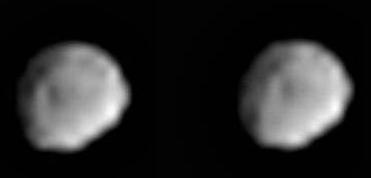
Another image of Vesta from Dawn has been released. This image was taken on July 9 from a distance of 26,000 miles away. It is definitely an improvement over the previous image, with more small details becoming visible. However, I once again wonder about the softness of the image. Look at the limb of the planet. It is soft against the black sky. This is not what one would expect from perfectly focused camera.

Dawn goes into orbit around Vesta next week. We sure learn then for sure if there is a problem with its camera, or whether I am merely being a bit too nervous.

4 comments

A new image of Vesta from Dawn

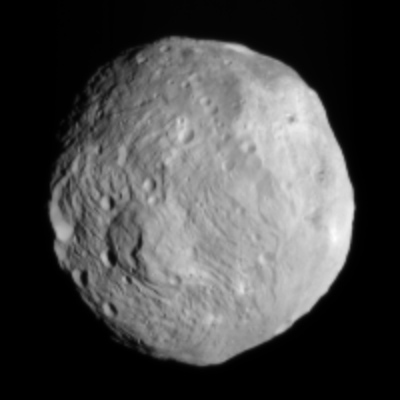
Dawn continues to approach the large asteroid Vesta. Below is an image taken July 1st from about 62,000 miles. The image has a resolution of 5.8 miles per pixel.

Despite Vesta’s large size, 330 miles in diameter, it is nonspherical. This fact, combined with data that says it is differentiated with a core and mantle, suggests that it is the remains of a larger object that subsequently broke up.

Vesta from 62,000 miles

0 comments

Dawn’s approach to Vesta continues

Dawn’s approach to Vesta continues.

Starting at the beginning of the approach phase on May 3, Dawn interrupted thrusting once a week to photograph Vesta against the background stars. These images help navigators determine exactly where the probe is relative to its target. This technique does not replace other means of navigation but rather supplements them. One of the principal methods of establishing the spacecraft’s trajectory relies on accurately timing how long it takes radio signals, traveling, as all readers know, at the universal limit of the speed of light, to make the round trip between Earth and Dawn. Another uses the Doppler shift of the radio waves, or the slight change in pitch caused by the craft’s motion. These sensitive measurements remain essential to navigating the faraway ship as it sails the interplanetary seas.

Despite the very slow approach, the distance is small enough now that observing Vesta weekly is no longer sufficient. To achieve the navigational accuracy required to reach the intended orbit in early August, last week the frequency of imaging was increased to twice per week. In each session, half of the pictures are taken with long exposures to ensure many stars are detectable, thus overexposing the much brighter disc of the nearby Vesta. The other half use short exposures to ensure that the rocky world shows up correctly so its precise location can be measured. The visible and infrared mapping spectrometer has been commanded to observe Vesta during three of these sessions, each time providing valuable information that will help scientists select instrument settings for when Dawn is close enough to begin its detailed scientific measurements.

0 comments

When is an Asteroid Not an Asteroid?

When is an asteroid not an asteroid?

The layered structure of Vesta (core, mantle and crust) is the key trait that makes Vesta more like planets such as Earth, Venus and Mars than the other asteroids, McCord said. Like the planets, Vesta had sufficient radioactive material inside when it coalesced, releasing heat that melted rock and enabled lighter layers to float to the outside. Scientists call this process differentiation.

This question immediately demonstrates once again the terrible mess the International Astronautical Union made when it decided several years ago to define what makes a planet, and came up with a definition that simply doesn’t work. For if Vesta should be considered a planet, why not Pluto?

1 comment
1 2 3