Eagle undocks, Apollo 11, July 20, 1969

An evening pause: In honor of the fiftieth anniversary of Apollo 11, today’s evening pause shows the moment when the lunar module Eagle undocked from the command module Columbia. Though this video includes communications with mission control at the start, the actual undocking occurred on the back side of the moon, when the astronauts were out of touch with the Earth.

Near the end of the video, after they have reacquired communications with the ground, you can hear a recitation of a long string of numbers. This is mission control providing the astronauts the numbers that had to be uploaded into their onboard computer so that it could correctly fire the spacecraft engines at the right time and for the right duration.

7 comments

A wave on the Moon

A lunar ejector blanket

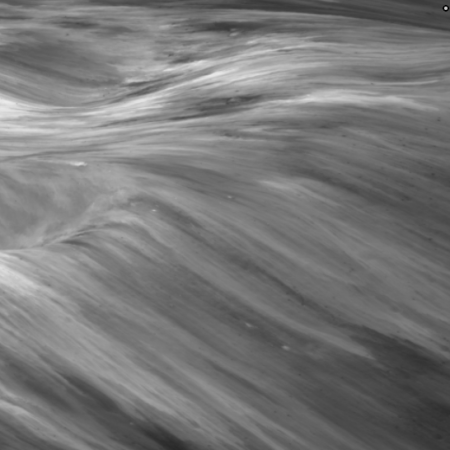
Continuing this week’s celebration of the 50th anniversary of the Apollo 11 mission means we get to look at another cool image from the Moon. The photograph on the right, reduced to post here, was released by the Lunar Reconnaissance Orbiter (LRO) science team in 2016.

What are we looking at? At first glance it looks like a black & white photograph of The Wave in northern Arizona. What it is instead is the pattern of ejecta laid down across the surrounding terrain immediately after the impact that created relatively fresh Chaplygin Crater. From the website:

The delicate patterns of flow across, over, and down local topography clearly show that ejecta traveled as a ground hugging flow for great distances, rather than simply being tossed out on a ballistic trajectory. Very near the rim lies a dark, lacy, discontinuous crust of now frozen impact melt. Clearly this dark material is on top of the bright material so it was the very last material ejected from the crater.

Below the fold is a wider shot of the entire crater and its surrounding terrain, with the rectangle indicating the region covered by the close-up above The dark crust near the rim mentioned in the quote can clearly be seen.
» Read more

1 comment

Weird lunar crater

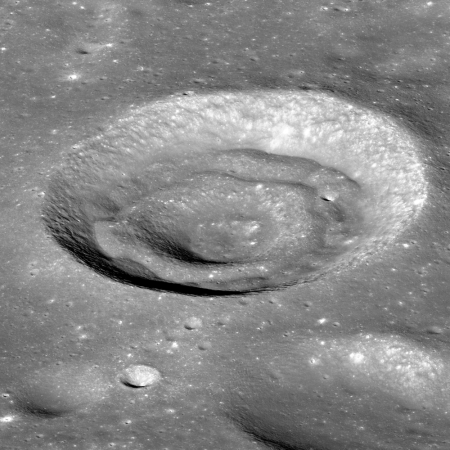
Concentric crater in Apollo Basin on the Moon

In celebration of the 50th anniversary of the Apollo 11 mission, it is time for another cool image from the Moon. The photograph on the right, reduced to post here, was taken by Lunar Reconnaissance Orbiter (LRO) in 2013. It shows a weird crater with concentric features that is found within Apollo Basin, a large 334-mile-wide double-ringed impact feature in the southern hemisphere of the Moon’s far side.

Concentric craters have an inner rim whose formation mechanism is not yet entirely understood, but the concentric mounds may indicate that there is a discontinuity, such as layers with different strengths, in the subsurface excavated by the impact.

Or to put it more bluntly, they really have no idea why this crater ended up looking as it does.

0 comments

Apollo 11 First Stage liftoff

An evening pause: This was originally posted as an evening pause in 2016. I think that today, the fiftieth anniversary of the launch of Apollo 11, it is appropriate to repost it. As I wrote then,

Though the video is more than 8 minutes long, the actual events recorded lasted only about 30 seconds, beginning 5 seconds before T minus 0.

What struck me most as I watched this was the incredible amount of complex engineering that went into every single small detail of the rocket and the launch tower and launchpad. We tend to take for granted the difficulty of rocket engineering. This video will make you appreciate it again.

It is also mesmerizing. A lot happens in a very short period of time.

Tonight’s evening pause begins eight days of pauses dedicated to celebrating, and reliving, the Apollo 11 mission. To the Moon!

6 comments

Apollo 11 in real time

Link here. I should have posted this link earlier. As I post this the Saturn 5 has just launched.

Pick your moment. They will be showing the mission in real time over the next week.

Hat tip Steve Golson for prompting me.

Correction: If you go to the link you can either choose to watch from one minute before launch, or click on the “Now” button to see the status at this moment fifty years ago.

2 comments

Modern journalism celebrates Apollo 11, badly

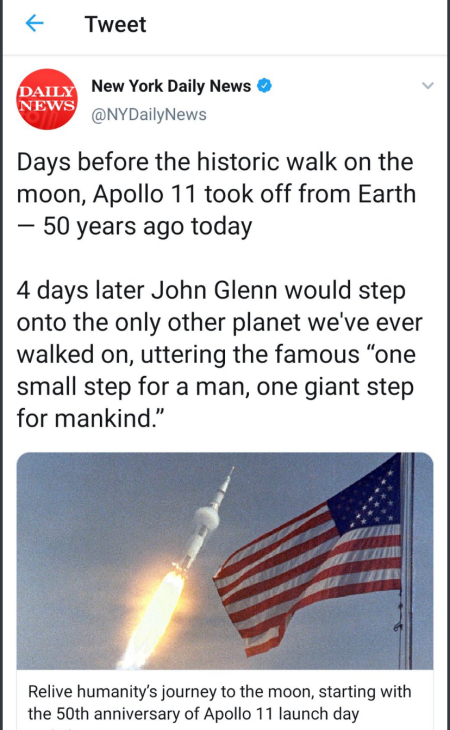
Daily News gets Apollo 11 very wrong

The image on the right came from the twitter feed of the Daily News in New York. It has since been removed, and it is also possible that it was a prank. Nonetheless, in less than fifty words this modern epitome of today’s journalism gets practically everything wrong about Neil Armstrong’s first step on the Moon and the first words he spoke.

John Glenn?

“One giant step for mankind”?

The tweet also calls the moon a “planet”, which I can live with since eventually the definition of a planet will include the Moon. Still, an educated person in this context would have used “world” instead.

I can’t imagine the level of incompetent education someone would have to go through to write this and not realize how much of it is embarrassingly wrong. Nor can I imagine how it is possible for everyone at the Daily News to not realize it as well, unless they are equally uneducated.

Tonight I begin an eight day series of evening pauses dedicated to the Apollo 11 mission, showing the key moments, as they happened. Rather than read some bad and often incorrect interpretation of this singular moment in human history, I am going to give you a chance to live it, as I did, fifty years ago.

Hat tip Jeff Bliss for the Daily News tweet. My readers know that I will not have anything to do with Twitter (which likely reduces my webpage traffic and likely my income as well), but I think it is designed to force people to act like a hateful and childish mob. Or exhibit their ignorance, which this tweet does so well.

My ethics will not allow me there. My observations repeatedly confirm for me the wisdom of this decision.

8 comments

Frank Sinatra – The House I Live In

An evening pause: Since it is July 4th, and the news is filled with depressing outrages from ignorant social justice warriors who have no knowledge at all about the just and noble roots that founded the United States, I think it necessary to post this magnificent song performed by Frank Sinatra.

Written and produced in 1945, as World War II was ending, the short film tried to encapsulate in one short song the true meaning of the American experiment. This version below includes the lead-in scene to show the context for the song, as sung in the film. Some might find that opening overly preachy, but in the context of World War II and the recent discovery then of the Nazi death camps, it is heartfelt, real, and quite accurate. Please watch it all, and recognize this is what the United States — now being condemned routinely by leftist hate-mongers — is really about.

The song begins by asking, “What is America to me?” It answers it clearly in the final verse:

The town I live in
The street, the house, the room
The pavement of the city
Or a garden all in bloom
The church, the school, the clubhouse
The million lights I see
But especially the people
that’s American to me. [emphasis mine]

And that means all the people, not just those who agree with you.

1 comment

1776 – Hatching an Egg

A mid-day pause: Posted by me on almost every Fourth of July since this site was founded, it is time to do it again. From the 1976 movie version of the 1972 musical, 1776. As I said in those earlier posts, “not only did the musical capture the essence of the men who made independency happen, it is also a rollicking and entertaining work of art.”

And as John Kennedy said of himself, ourselves, and these founding fathers. “We stand for freedom.”

3 comments

Far right radicals make declaration

A group of far right radicals, some of which had been accused of many crimes against the legal government, today made a declaration that clearly required their arrest for daring to defy the powers-that-be.

From the first two paragraphs:

When in the Course of human events it becomes necessary for one people to dissolve the political bands which have connected them with another and to assume among the powers of the earth, the separate and equal station to which the Laws of Nature and of Nature’s God entitle them, a decent respect to the opinions of mankind requires that they should declare the causes which impel them to the separation.

We hold these truths to be self-evident, that all men are created equal, that they are endowed by their Creator with certain unalienable Rights, that among these are Life, Liberty and the pursuit of Happiness. β€” That to secure these rights, Governments are instituted among Men, deriving their just powers from the consent of the governed, β€” That whenever any Form of Government becomes destructive of these ends, it is the Right of the People to alter or to abolish it, and to institute new Government, laying its foundation on such principles and organizing its powers in such form, as to them shall seem most likely to effect their Safety and Happiness. Prudence, indeed, will dictate that Governments long established should not be changed for light and transient causes; and accordingly all experience hath shewn that mankind are more disposed to suffer, while evils are sufferable than to right themselves by abolishing the forms to which they are accustomed. But when a long train of abuses and usurpations, pursuing invariably the same Object evinces a design to reduce them under absolute Despotism, it is their right, it is their duty, to throw off such Government, and to provide new Guards for their future security.

Without a doubt our country’s corrupt ruling class in Washington finds these words appalling and unacceptable. Some, mostly leftists and Democrats, consider the man who wrote these words evil, and the men who signed it worse.

But then, these fools have never read these words or anything thing else Thomas Jefferson and the other Founding Fathers wrote. Or if they have, they weren’t smart enough to understand them.

Happy Fourth of July! And as it says on the Liberty Bell, “Proclaim liberty throughout all the land unto all the inhabitants thereof.”

15 comments

Apollo landing tapes for sale

An intern who in 1976 purchased more than a thousand surplus 2-inch videotapes from NASA for $218 is now going to auction off three of those reels that show the Apollo 11 moon walk.

Back in 1976, NASA gave 1,150 reels of 2-inch Quadruplex videotape to a government surplus auction. Gary George, a former intern at NASA’s Johnson Space Center, snapped up the lot of them for $218, in the hopes of selling them to news stations to record over for $50 a pop. He never watched them, but because his dad was a space buff, kept three of the tapes marked as β€œApollo 11 EVA” (aka Extravehicular Activity, better known as a spacewalk). When he eventually watched the tapes, he realized that he had one of three surviving copies of one of the greatest feats of human ingenuity, the July 20, 1969 Moon landing. Now, those videotapes will be auctioned off to the highest bidder when Sotheby’s will mark the 50th anniversary of the moon landing by putting the tapes up for sale on July 20th, at a starting bid of $700,000.

β€œI had no idea there was anything of value on them,” George said in an interview with Reuters. He started to get suspicious in 2006, after NASA admitted they had lost the tapes, and believed they could have been in the 2,614 boxes of Apollo mission tapes that were sent to a storage facility in late 1969. George got in touch with video archivist David Crosthwait in California, who had the necessary equipment to view the vintage tapes. In December 2008, George played the reels and quickly realized what he had been storing over the last few decades. He contacted NASA about the reels but β€œan agreement could not be reached,” according to the auction listing, and off to the auction block they go as part of an auction dedicated to Space Exploration.

The saddest part of this story are the tapes George sold to television stations to use to back-up their daily broadcasts. Some of those tapes probably contained historical recordings of the Apollo missions. While I suspect these tapes were not NASA’s only copies, I cannot be sure, which means some of the source material for the Apollo missions was likely lost.

0 comments

First movie of solar eclipse rediscovered

The first movie ever made of a solar eclipse, taken in 1900, has been rediscovered and restored.

The film was taken by British magician turned pioneering filmmaker Nevil Maskelyne on an expedition by the British Astronomical Association to North Carolina on 28 May, 1900. This was Maskelyne’s second attempt to capture a solar eclipse. In 1898 he travelled to India to photograph an eclipse where succeeded but the film can was stolen on his return journey home. It was not an easy feat to film. Maskelyne had to make a special telescopic adapter for his camera to capture the event. This is the only film by Maskelyne that we know to have survived.

I have embedded the movie below the fold.
» Read more

2 comments

Signals detected from experimental satellite that failed in 1967

NASA has confirmed that the signals detected in 2016 do come from an experimental satellite, LES-1, that failed in 1967.

LES stands for Lincoln Experimental Satellite, and was the first in a series of test satellites built by MIT’s Lincoln Laboratory for the Air Force. It was launched on February 11, 1965. Though it was reported to be operating properly, it was placed in an incorrect orbit that made its experiments useless. It ceased transmissions in 1967 and was thought lost, until amateur astronomer Phil Williams picked up a signal in 2016.

Williams told Southgate Amateur Radio News that the signal he detected from his base in Cornwall seemed to cycle every four seconds, diminishing and returning to create an eerie repetitive sound.

It would later be determined that the fluctuation was the result of the long-lost satellite barreling end over end through the void of space, causing variations in the light reaching the solar panels that Gunter’s Space Page says likely now power the depleted batteries of this 65 lb (30 kg) relic of the space age.

Scientists are unclear as to how the satellite continues to operate β€” Williams himself expressed some uncertainty as to how the craft might continue to function given the particularly harsh environment of space and its tendency to destroy electronic equipment.

This story is nothing more than a curiosity, but a fine one nonetheless.

7 comments

London and art

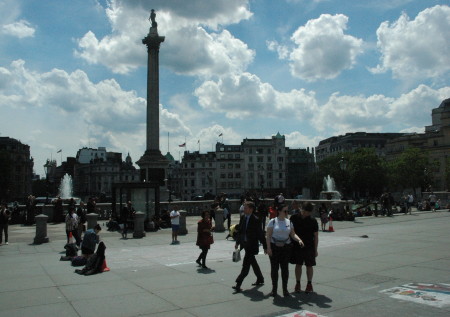
Trafalgar Square

Yesterday we took the train to London and settled into a really super modern hi-tech hotel dubbed “The Hub by Premier Inns.” It is also the crummiest hotel I have ever stayed at. I picked it because it was well recommended and was located less than a block from Trafalgar Square, shown on the right. And yes, it is new and fancy, with motion-controlled LED lights and fancy touch buttons and aps to control everything. It is also tiny, cramped, the controls are too limited and too difficult to decipher, even for a science journalist like myself. I suppose I shouldn’t complain, as it was reasonable in price considering the location. I still dislike the hi-tech nature of the room that only ended up limiting our convenience and comfort.

And the hotel didn’t even have an ice machine!

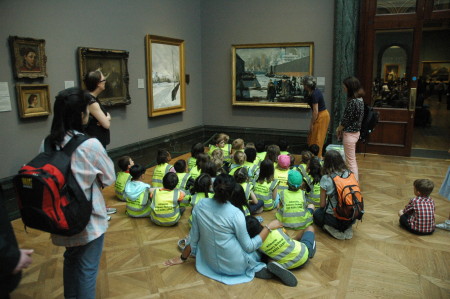
National Gallery in London

Today we wandered about the square, watching the street performers (buskers in British lingo) and admiring the statues and sights. Then we went into the National Gallery to enjoy some of humanity’s greatest art, as were a class of elementary school children as shown in the picture on the right.

The museum was packed with people from everywhere. I saw Japanese, Chinese, and Israeli tour groups. I saw people of all types clearly from London, including several school groups like the one to the right.

Interestingly, these crowds were all found in the permanent exhibits. One temporary exhibit we wandered through, art by an modern abstract artist by the name of Sean Scully, was practically empty.
» Read more

12 comments

New Russian Quartet – Shostakovich Polka

An evening pause: This piece comes from a 1930 Soviet propaganda ballet, with music by Dmitri Shostakovich. It tells the story of a Soviet-era soccer team traveling through Europe in the 1920s, which provides the setting for the propaganda. I like the musical give-and-take. It is almost like two people arguing.

Hat tip Diane Wilson.

2 comments

Wales Day 7

Cregennan

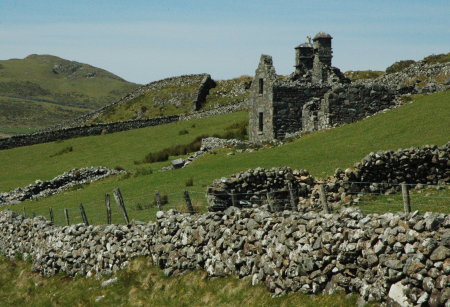
The home of 18th century composer John Williams

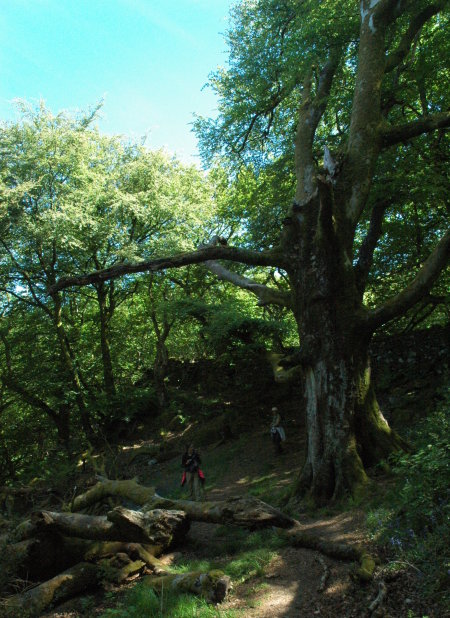
The tree

In our final day of our Wales journey, we spent the day strolling across the beautiful countryside of Cregennan, one of several parks along the flanks of the Cadair Idris range, which runs north-south to the coast. This park is closest to the ocean, so at our highest point we were overlooking the Irish Sea and the town of Barmouth.

The three pictures on the right are only a small selection of the beauty of this region. There were several magnificent lakes nestled amid the mountains and fields. There were pastures with numerous sheep, some eating, some resting like white blobs on the green grass, and some “baa’ing” at each other. It was especially entertaining when a lamb started calling out for its mother, the mother responding, and then the two searching and finding each other.

And of course there were the standing stones and ancient ruins scattered about on several hilltops.

The abandoned house in the second picture is of special interest because it had been the home of an obscure 18th century Welsh composer by the name of John Williams. Williams was actually quite successful in his time, but only recently have some locals rediscovered unpublished manuscripts of his work. They plan a performance this fall.

Apparently his father was a hat-maker of some note, able to accumulate enough wealth to build this large country house in such a setting. Though I don’t know this, I suspect his success came from providing high quality hats to the upper classes, and this in turn gave his son the contacts necessary to become even more successful as a composer.

The last photo was taken as we walked downhill toward the ocean in a forested area beside a flowing stream, passing numerous waterfalls. This area is where our tour leader, Hywel “Taff” Roberts, was born and grew up, so he could give us some extra historical details about everything we saw. For example, the giant tree in that last picture was something that he remembered since childhood, home for birds and animals galore. It is old now, which is why several large branches have broken off.

Tomorrow the tour ends, and Diane and I will be taking the train to London, where we will spend two days before flying back to the states.

4 comments

Wales Day 6

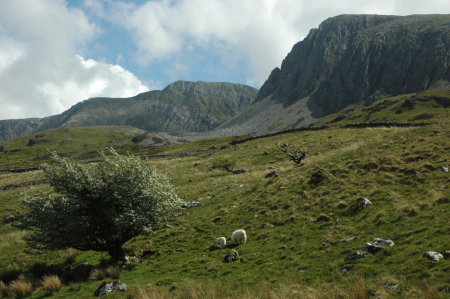
Sheep on the flanks of Cader Idrisc

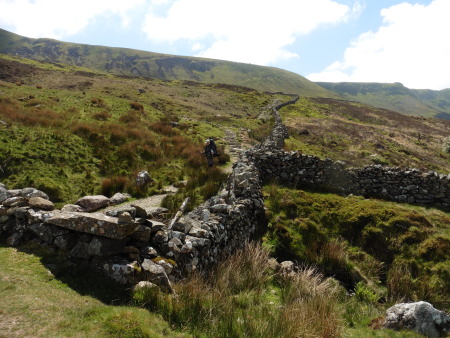
Stone walls on the flanks of Cader Idris

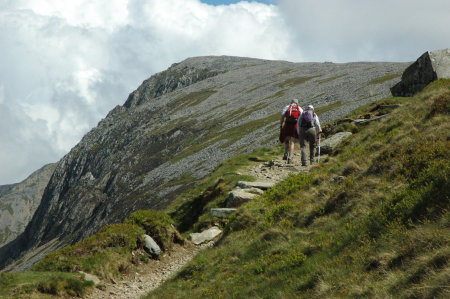
Approaching the halfway point in the hike up Cader Idrisc

After yesterday’s long hike on Mount Snowdon, today was planned as an easier day. First we changed locations, driving south to the village of Dolgellau.

In the morning we heard two short presentations, first about the first discovery of Wales by tourists in the 1700s, and second a more scholarly look at the place names of Wales that appear connected to Arthur. In this case the speaker, Scott Lloyd of the Royal Commission on Ancient and Historical Monuments of Wales, was focused more on what is really known, and was thus less sure about Arthur’s links to Wales than our previous expert, Gareth Roberts. Lloyd has documented the many place names (see his book, The Arthurian Place Names of Wales), but he has also documented the important detail that most started appearing after the first writings about Arthur started to appear, with most appearing several centuries after Arthur supposedly lived. This suggests that the names were chosen because of the legend, not because the man had been there.

In the afternoon some of us did a short hike halfway up the nearby mountain Cader Idris. The first picture shows the mountain at the top right, with sheep in the center, and a hawthorn tree in bloom to the left. The second picture shows the trail going uphill parallel to one of the many typical stone walls found everywhere in Wales. The land is very rocky, and to make it better for grazing farmers would clear the stones from the fields, putting them in piles to the side. Then, when the enclosure laws were passed in the early 1800s they used those stones to build the walls to define their property lines.

The third picture shows Taff and Barbara ahead of me, with Cader Idris in the distance. Shortly thereafter we stopped to lie on the soft heather to chat and admire the countryside and the grey rocky slope going up to the peak ahead of us. We then headed back down for dinner and an evening in town.

1 comment
1 18 19 20 21 22 55