Turkey’s ruling party voids elections it lost, demanding do-over

Turkey’s ruling party has voided the March 31 elections where its opposition won narrow victories and has scheduled new elections for June 23.

Istanbul’s mayoral election was affected by “organised crime and serious corruption”, Turkish President Recep Tayyip Erdogan says. Mr Erdogan was defending the decision to re-run the 31 March vote, which returned a slim win for the opposition.

Opposition candidate Ekrem Imamoglu, who has been stripped of his duties, described the move as “treacherous”. The European Parliament also said the decision would end the credibility of democratic elections in Turkey

I wonder if Erdogan’s ruling party is aligned with our own Democratic Party. They sure behave in a similar manner.

3 comments

The many pits of Arsia Mons

The many pits of Arsia Mons

When it comes to Mars, it appears that if you want to find a pit that might be the entrance to an underground system, the place to look is on the slopes of Arsia Mons, the southernmost volcano in the chain of three giant volcanoes between Olympus Mons to the west and the vast canyon Marineris Valles to the east.

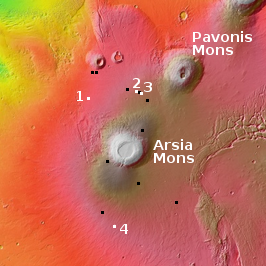
To the right is an overview map showing the pits that have been imaged since November by the high resolution camera of Mars Reconnaissance Orbiter (MRO). The black squares show the pits that I highlighted in previous posts on November 12, 2018, February 22, 2019, and April 2, 2019. The numbered white squares are the new pits found in March photograph release from MRO.

And this is only a tiny sampling. Scientists have identified more than a hundred such pits in this region. Dubbed atypical pit craters by scientists, they “generally have sharp and distinct rims, vertical or overhanging walls that extend down to their floors, surface diameters of ~50–350 m, and high depth to diameter (d/D) ratios” that are much greater than impact craters, facts that all suggest that these are skylights into more extensive lava tubes.

Below are the images of today’s four new pits.
» Read more

1 comment

Lawyer fired for being conservative

They’re coming for you next: A Republican Illinois lawyer being considered for a judgeship was rejected for that position and then fired from his job, merely because in the past he had expressed somewhat reasonable conservative views on social media.

As a Republican precinct committeeman with a Republican governor, my chances were good. Or so I thought. You see, I had a deep, dark secret: I was open about my conservative views. In college fifteen years ago I expressed them in a column for the campus newspaper. And until my son was born three years ago I expressed them on social media. I toned things down as I settled down, but my views became more conservative the more I experienced.

Then it happened. Someone had printed and saved my social media posts from three years ago and more. There were nine of them, most of them links to publications like the National Review, Breitbart, and the Blaze: two were pro-life, one criticized illegal immigration, others made fun of radical feminism and warned about radical Islam, and several were critical of overreach by federal judges. They were strident, but fairly innocuous for social media. By no stretch of the imagination were they racist, sexist, or bigoted.

The result? That Republican governor, now out of office, choice a Democrat instead, and the law firm this man worked for fired him.

The worse aspect of this?

I also learned that to the Left, its enemies are not human. The anonymity and persistence of the mailings put myself and my family in grave fear for our safety. I cannot describe the sleepless nights, the caution exercised every time we stepped out of the house. I made police reports, but without an actual threat, all they could do was document the mailings. None of that mattered. All that mattered was power politics and stopping me at all costs — simply for my personal views.

If this anonymous mailer wanted to assert that I wrote what was in those mailings and that they should disqualify me from office, what shame was there in doing so openly and publicly? They certainly had nothing to fear from me, my family, or my friends. Keeping the process secret stifled open, civil discourse and left the process beholden to rumor and innuendo.

But what is even sadder is that this tactic worked. It set a dangerous precedent for future nominees to the bench. This has shaken my faith in the judicial nomination process, the legal profession itself, and humanity in general.

I repeat: They’re coming for you next.

1 comment

ArianeGroup begins production of first 14 Ariane 6 rockets

Capitalism in space? ArianeGroup has announced it has begun production of the first fourteen Ariane 6 rockets, set for launch beginning in 2020.

Following the initial institutional and commercial launch orders for Ariane 6 obtained by Arianespace since the autumn of 2017, and the resolution of the ESA Council on April 17, 2019, related to the rocket’s exploitation framework, ArianeGroup is starting to build the first series-production batch of 14 Ariane 6 launchers.

These 14 launchers, scheduled to fly between 2021 and 2023, will be built in ArianeGroup plants in France and Germany, as well as in those of its European industrial partners in the 13 countries taking part in the Ariane 6 program.

The April 17 resolution essentially committed the ESA (European Space Agency) to subsidize ArianeGroup should Ariane 6 fail to obtain sufficient launch contracts for the company to make a profit.

Right now, that subsidization seems almost certain, based on the prices ArianeGroup is charging for Ariane 6 and the resulting dearth of sales contracts.

The launch rate announced above illustrates the rocket’s lack of interest. Fourteen launches in three years? SpaceX has been launching that many times in half a year. Granted, Ariane 6 is designed to launch two satellites to Falcon 9’s one, but even so this launch rate is low. And I expect in reality it will be lower than this. I expect them to fail to get launch customers, and will find they have a white elephant on their hands.

0 comments

Relativity gets third launch contract

Capitalism in space: The new startup rocket company Relativity announced yesterday the signing of its third launch contract with Spaceflight, a company that until now has mostly specialized in arranging secondary payloads on big rockets for smallsat companies.

The launch services agreement between the two companies includes an order for one launch of Relativity’s Terran 1 rocket in the third quarter of 2021, with an option for an unspecified number of additional launches. Terms of the deal were not disclosed, although Relativity has publicized a list price of $10 million for the rocket.

Spaceflight will use those launches for dedicated rideshare missions, aggregating a set of small satellites to fly on the rocket.

The previous two contracts were with the long-established satellite communications company Telesat and a newer satellite company from Thailand called mu Space.

Relativity’s ability to get three launch contracts for a rocket that has not yet flown, no less tested, is somewhat puzzling. There are other companies, Rocket Lab, Vector, Firefly, and Virgin Orbit, that are either operational or have already tested prototype rockets or engines.

I suspect all the contracts have easy escape clauses, and are conditional depending on the company’s successful test program. I also suspect that the deals gave significant price breaks to all three companies for their willingness to sign under these circumstances.

0 comments

Pavarotti and Friends – All for Love

An evening pause: Hat tip Edward Thelen.

This pause is late partly because I forgot to schedule something, but mostly because I am desperately in need of suggestions. If you’ve sent me suggestions before, you know the routine. If you haven’t but have something you want to suggest, don’t post the link in a comment here. Just comment that you have something, and I will contact you.

1 comment

Honoring elections is no longer the Democratic Party way

During one of the debates between Hillary Clinton and Donald Trump during the 2016 election campaign, the Democrats became outraged when Trump said he might not immediately accept the election results should Clinton be declared the winner.

Questioned directly as to whether he would accept the outcome should Democratic nominee Hillary Clinton prevail on Nov. 8, Trump demurred. “I will keep you in suspense,” the Republican nominee said. Clinton called Trump’s answer “horrifying,” saying he was “talking down our democracy.”

The response from Democrats ranged from horror to fury. Articles from the entire liberal press attacked Trump for daring to suggest such a thing. Hillary Clinton response was typical, and quite pointed:

“That is not the way our democracy works,” Clinton said. “We’ve been around for 240 years. We have had free and fair elections. We’ve accepted the outcomes when we may not have liked them. And that is what is expected of anyone standing on a debate stage during a general election.”

She continued: “He is denigrating — he’s talking down — our democracy. And I for one, am appalled that somebody who is the nominee of one of our two major parties would take that kind of position.”

Hillary Clinton was correct, but anyone with even an ounce of skepticism would have immediately realized that Hillary Clinton didn’t believe her own words, for a nanosecond. From yesterday:
» Read more

22 comments

Sunspot update April 2019: Not quite minimum

Time for the monthly sunspot update: NOAA yesterday released its the monthly update for the Sun’s sunspot cycle, adding sunspot activity for April 2019 to its graph. As I do every month, I have annotated that graph to give it some context and am posting it below.

While the Sun is clearly at the beginning of what might be an extended or very extended solar minimum, the continuing uptick in activity in both March and April illustrates that we have still not arrived at full minimum.
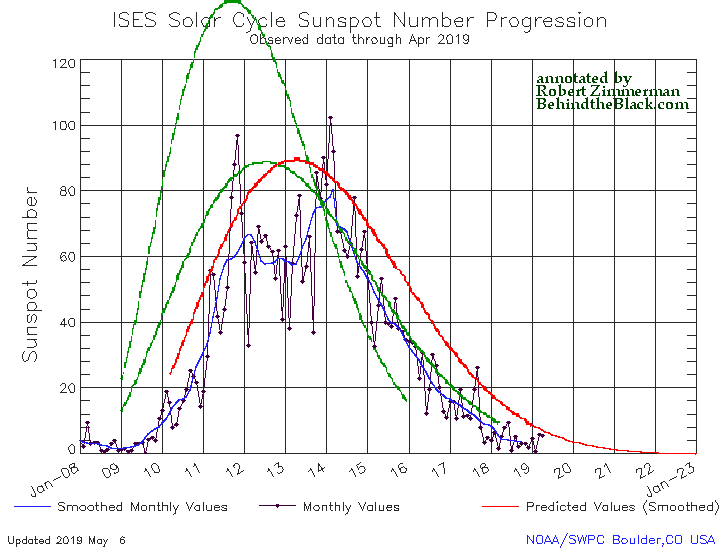
April 2019 sunspot activity

The graph above has been modified to show the predictions of the solar science community for the previous solar maximum. The green curves show the community’s two original predictions from April 2007, with half the scientists predicting a very strong maximum and half predicting a weak one. The red curve is their revised May 2009 prediction, extended in November 2018 four years into the future.

As the Sun ramps down to minimum it will have months where there is no activity, as happened in February 2019, and months, such as in March and April, where more sunspots appear.

Eventually the quiet months will become dominate, and soon thereafter, when activity increases again (assuming it does), the solar science community will then announce the date of true minimum.

We are not there. Normally it can take a year or more for the Sun to settle down. If activity declines as indicated by the red curve, it could take as long four years, which would be a record-long minimum. The difference will tell us whether the eleven-year solar cycle is continuing, or the Sun is heading into a grand minimum, with no significant sunspots for decades.

And as I have said repeatedly in the past five years, a grand minimum could significantly impact the global climate, cooling it. Or not. It is that unknown that will be answered should a grand minimum occur. Circumstantial data suggests an inactive Sun cools the planet, and the arrival of a new grand minimum will allow scientists to confirm or refute that circumstantial data.

6 comments

Bennu from two miles

Bennu from two miles
Click for full image.

In late March OSIRIS-REx completed its fourth fly-by of the asteroid Bennu. The image on the right, cropped and reduced to post here, was taken when the spacecraft was only 2.1 miles above the surface. If you were standing among these large boulders, we could easily see you.

The image itself shows the asteroid’s southern limb, and thus the shadows are accentuated. This makes it easier to see surface details. Though it is clear once again that Bennu is a pile of boulders and rocks cemented together and floating in space, the photograph also shows that it also has areas where the material is either much larger or fused together more solidly, as shown by the more massive sections in the left center of this picture. We might be looking a very large boulders peeking up from below the surface, or possibly this is the hint of some real bedrock.

The OSIRIS-REx team is continuing the spacecraft’s survey phase, gathering high resolution images in order to compile a detailed map of the surface, prior to planning the touch-and-go sample grab.

2 comments

Rocket Lab completes second commercial launch in 2019

Capitalism in space: Rocket Lab has successfully placed three Air Force technology satellites in orbit.

This is their second commercial launch in 2019, and fifth successful launch overall. They have said that they plan a total of 16 launches this year. With eight months left in the year and 14 launches to go, they will have to up their pace to more than once per month pretty soon. As this is their announced intention, their launch rate should accelerate before the year is out.

One more interesting detail: With this launch they have now put 28 small satellites in space, on five launches. At this pace they are beginning to match, in a different way, the capabilities of larger rockets that can launch that many smallsats on a single rocket. Rocket Lab might be more expensive per satellite, but provides each launched satellite a more customized service, including more flexibility in orbital choice and a far more reliable schedule.

The leaders in the 2019 launch race remain unchanged:

6 China
5 SpaceX
4 Europe (Arianespace)
3 Russia

However, the U.S. has now widened its lead over China to 10 to 6.

1 comment

Japanese private company launches rocket on suborbital test

Capitalism in space: The Japanese private company Interstellar Technologies yesterday successfully completed a suborbital test flight of its MOMO rocket.

This success is significant in that Interstellar has tried twice previously to complete a suborbital flight, and failed both times. The first attempt was on July 30, 2017 and the second on June 30, 2018. Furthermore, they had said that the gap between the second and third attempts would be shorter, which it was.

So far, MOMO is designed solely as a suborbital rocket. I would not be surprised if they begin to scale up development to an orbital version once they begin money-making operations with the suborbital version, but this has not been announced by the company.

0 comments
1 98 99 100 101 102 156