Luna Lee – Voodoo Child
A evening pause: The Jimi Hendrix song, played on a customized gayageum. I do not think the Koreans who created this instrument ever expected this kind of music to come from it.
Hat tip Mike Nelson.
A evening pause: The Jimi Hendrix song, played on a customized gayageum. I do not think the Koreans who created this instrument ever expected this kind of music to come from it.
Hat tip Mike Nelson.
The British parliament has voted 438 to 20 to approve prime minister Boris Johnson’s demand that they hold general elections on December 12th in exchange for getting an extension to remain in the European Union until the end of January.
Though polls suggest that the public supports Johnson strongly in his effort to leave the EU, an actual election is something completely different. We shall now see if it will really happen.
Personally, I am pessimistic. The opposition to Brexit, like the opposition to Trump in the U.S., has never accepted the results of their previous defeats. I doubt any who voted against Brexit then have changed their mind since, while their unrelenting effort (like the resistance to Trump) has likely worn down its support.
A federal judge has reinstated the $250 million lawsuit by Covington teenager Nicolas Sandmann against the Washington Post for slandering him during its news coverage.
U.S. District Judge William Bertelsman agreed to permit discovery on three of 33 allegedly libelous statements in The Post’s coverage of the Jan. 18 incident pertaining to teenager Nicholas Sandmann. The Post has insisted that its reporting was fair and accurate.
All three flagged statements from the newspaper’s coverage refer to Omaha Nation elder Nathan Phillips being blocked or impeded by Nicholas, a student at Covington Catholic High School, during their viral encounter at the Lincoln Memorial stairs.
Since the video of the event quite clearly shows that Sandmann never blocked anyone, that if anything Nathan Phillips pursued Sandmann, the Post is now very vulnerable to losing the suit. This decision also suggests that Sandmann’s lawsuits against CNN and NBC will also go forward.

Click for full image.
Using raw Juno images, citizen scientist Gerald Eichstädt has created the processed and color enhanced image to the right, cropped to post here. From the Juno press release:
This view from NASA’s Juno spacecraft captures colorful, intricate patterns in a jet stream region of Jupiter’s northern hemisphere known as “Jet N3.”
Jupiter’s cloud tops do not form a simple, flat surface. Data from Juno helped scientists discover that the swirling bands in the atmosphere extend deep into the planet, to a depth of about 1,900 miles (3,000 kilometers). At center right, a patch of bright, high-altitude “pop-up” clouds rises above the surrounding atmosphere.
Some of the darker areas are darker mostly because they are lower and therefore in shadow.
The raw image was taken on May 29, 2019 when Juno was about 6,000 miles away. Unfortunately, they do not provide a scale, but I suspect that the image is probably close to the size of the entire Earth.

A new image of the asteroid Hygiea has revealed that this main belt object is actually spherical, making it the smallest spherical asteroid so far discovered and suggesting that it could be defined as a planet.
The image, taken by the Very Large Telescope (VLT) in Chile, is to the right. The asteroid was first discovered in 1849 and is the fourth largest in the asteroid belt, after Ceres, Pallas, and Vesta, with a diameter of 267 miles.
The image once again challenges the definition of what makes a planet. It also makes difficult the vague term “dwarf planet.” At what point does a dwarf become a full planet? This has never been clarified, which is why I tend to avoid using the term dwarf planet.
In my many interviews of planetary scientists, they generally dismiss the IAU’s poor definition of a planet and define a planet as anything that has settled into a spherical shape. In the case of Hygiea, that seems to apply.
An evening pause: It is always important to recognize that our heavy machinery is really nothing more than an extension of our hands and arms. This video proves it.
Hat tip Martin Kaselis.
This very interesting article does a nice job of reviewing the history of ISIS since 2010, the year that the Obama administration released just killed ISIS leader Abu Bakr al-Baghdadi, using multiple news sources and stories.
Here is a rough timeline:
Obama presidency:
2008: ISIS forces estimated to be about 700 fighters, holding practically no ground.
2010: al-Baghdadi is released.
2011: al-Baghdadi takes over ISIS.
2014: Obama refers to ISIS as a “JV team.”
2015: ISIS forces estimated to be between 20,000 to 31,000 fighters.
2015: ISIS establishes global terrorism network resulting in terrorist attacks worldwide.
2016: ISIS occupies 17,500 square miles, with 35,000 fighters.
Trump presidency:
2017: (July): ISIS pushed out of Mosul.
2017 (October) ISIS in full retreat to U.S. backed forces, loses its capital Raqqa.
2017 (December): ISIS forces now estimated to be 1,000 fighters, holding 1,900 square miles.
2019: al-Baghadi is killed.
At this moment ISIS remains a threat, but a significantly reduced one from its peak in 2016.
Like Trump or hate him, an objective look at how he has handled this issue versus Obama’s handling once again puts the victory mark in Trump’s column. Obama’s policy made things worse in the Arab Middle East. Trump has so far improved things.
Summary: Curiosity finally on the move after several months drilling two adjacent holes in the clay unit. Yutu-2 continues roving west, has it now operates during its eleventh lunar day on the far side of the Moon.
For the updates in 2018 go here. For a full list of updates before February 8, 2018, go here.

Click for original full image.
For the overall context of Curiosity’s travels, see my March 2016 post, Pinpointing Curiosity’s location in Gale Crater.
I have not done any of my regular rover updates since May 30, 2019 because it was simpler to do individual updates for both Curiosity and Yutu-2, the only working rovers presently on other worlds. (If things had gone well, which they did not, we would have had two other lunar rovers in the past six months, one from Israel and one from India, but both crashed during landing.)
However, since Curiosity is finally on the move after spending several months at one location, where it drilled two holes in the clay unit (the material from one used in a wet cup experiment to look for organic life) it is time to update my readers on where Curiosity is and where it is heading.
The first image above and to the right is an annotated overview of Curiosity’s present position, moving south to a line of buttes which scientists have determined delineates the transition from the clay unit to a new geological layer they have dubbed the Greenheugh Pedimont. The yellow lines indicate the area seen in the panorama below, created from two photographs (here and here) taken by the rover’s navigation camera.
» Read more
Another Democratic stronghold collapsing: Despite an $800 million dollar budget deficit, Chicago’s Democratic mayor is likely going to negotiate a big money increase to its striking school union.
I like the article’s title: “Chicago Mayor Learning that Eventually, You Run Out of Other People’s Money.”
The union is demanding an additional $38 million from the city, over and above what its members presently get. And based on the track record of every big-city Democratic mayor for the past half century, I guarantee they are going to get it, even though the city simply doesn’t have the money.
This quote also illustrates another consistent pattern since World War II:
In their eagerness to sate the appetite for tax dollars, public unions’ ever-escalating demands have made Chicago the only major city of the top five to lose population over the previous decade.
People always flee leftist strongholds, whether they be the Soviet Union, East Germany, North Korea, California, New York, or Chicago. And the only way any of these socialist/communist hellholes found they could stop the exodus was to make their territories the equivalent of prisons, surrounded by barbed wire and armed guards.
Capitalism in space: According to SpaceX’s CEO Gwynne Shotwell at a conference on October 25, the company is targeting the first unmanned cargo landing of Starship on the Moon by 2021, with manned missions shortly thereafter.
Shotwell, speaking at Baron Fund’s annual investment conference at the Metropolitan Opera House on Friday, gave an update on SpaceX’s goals for Starship. “We want Starship in orbit next year; we want to land it on the moon before 2022 with cargo and with people shortly thereafter,” Shotwell said.
However, much like Musk in his presentation last month, Shotwell hedged her estimate, saying that “every time I make a prediction about schedule I turn myself into a liar.”
If they even come close to doing this they will certainly make NASA’s SLS rocket look ridiculous. They began serious development of Starship in early 2019. Even if development takes twice as long as Shotwell’s prediction, they will be landing on the Moon in about six years, in 2025. SLS has been in development since 2004, and its total cost once launched is expected to be more than $25 billion, a cost that does not include an extra $1.6 billion NASA has said it needs to land on the Moon by 2024 and that Congress has so far refused to appropriate.
SpaceX meanwhile has raised $1.3 billion, from private sources, to build Starship.
If you were a customer which product would you buy?
Capitalism in space: SpaceX’s Crew Dragon capsule, planned for a launch abort test in December, has successfully completed a set of static fire engine tests of two of its SuperDraco launch abort engines.
They next plan a static fire test of all eight engines, followed by that launch abort flight. If all goes well with both, the only thing blocking SpaceX from launching its first manned mission early in 2020 will be the paperwork NASA is demanding they fill out prior to flight.
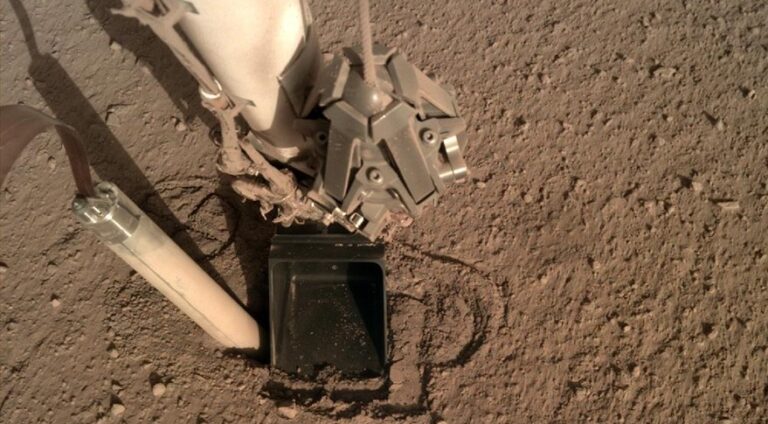
Click for full image.
In a setback for its renewed digging effort, the mole drill on InSight has apparently bounced out of its drilled hole during the most recent drilling, soon after engineers had increased the rate of hammer strokes.
The image to the right shows the mole, the white cylinder on the left, with the scoop of the robot arm mostly covering the hole in its effort to pin the mole in position.
“While digging this weekend the mole backed about halfway out of the ground,” the mission announced via a pair of tweets Oct. 27. “Preliminary assessment points to unexpected soil properties as the main reason.”
…The mission added that one possibility is soil is falling in front of the mole, filling the hole. “Team continues to look over the data and will have a plan in the next few days.”
Without question the alien and fluffy properties of the soil appears to be the problem. Based on how the mole is leaning, I wonder if the left wall of the hole began to widen and collapse, as had the rest of the hole during initial drilling, thus defeating the purpose of the robot arm’s effort to pin the mole in place.
Embedded below the fold in two parts.
» Read more
One of the Air Force’s two X-37B reusable mini-shuttle’s has landed, completing a 780-day record mission.
This was the fifth mission of the X-37B Orbital Test Vehicle. It flew for 780 days during this mission, breaking its own record by being in orbit for more than two years. As of today, the total number of days spent on-orbit for the entire test vehicle program is 2,865 days, the Air Force said. The spaceplane originally was designed to fly for just 270 days.
The mission had launched on a SpaceX Falcon 9 rocket on September 7, 2017, in a deal that had been worked out with the Air Force in June under relatively short notice.
Not surprisingly, there is no word when the next X-37B mission will fly, likely using the Air Force’s other spacecraft.
Capitalism in space: The fourth flight of Exos Aerospace’s suborbital rocket failed yesterday when the rocket’s parachute apparently failed to deploy, sending the rocket crashing to the ground.
A good overview of the company and SARGE’s history can be found here. The live stream of today’s launch is embedded below the fold, cued to just before launch.
This failure appears at this moment to be far more serious than their previous failure, where the rocket shutdown prematurely but safely landed without damage using its chutes.
» Read more
Welcome to Venezuela: PG&E will impose its second planned blackout today for almost a million customers in northern California, all in a vain attempt to prevent wildfires.
Leftist politicians like to blame climate change for these fires, but there is no scientific evidence for such a claim. Instead, the evidence points to the policies of those very leftist politicians, who have been micromanaging PG&E for almost a decade, preventing it from doing proper maintenance, while also forbidding the clearing of brush from state lands.
If you live in California be warned. This is only a taste of what your dismal future is going to be, especially as I see no sign that the voters have any intention of firing these politicians. If anything, election trends have been to give them more power.
Earlier this week Japan announced that it planned to become a partner in NASA’s Artemis program to build a space station in lunar orbit.
That announcement was very vague. Yesterday an official from Mitsubishi Heavy Industries might have offered the first real detail, suggesting that its new H3 rocket, scheduled for its first lift-off in 2020, could be used to launch components for Artemis, as early as 2025. The official described one option for using the H3, sending Japan’s upgraded ISS cargo freighter, the HTV-X, to Gateway in 2025 or 2026.
Launching an HTV-X cargo vessel to the gateway would require two H3 launches, he said. The first launch would send an HTV-X into an orbit around the Earth, he said. The second launch would send up an upper stage with an enlarged fuel tank to dock with the HTV-X and propel it to the Gateway, he said.
What was not stated was who will pay for this. The U.S.? Japan? Either way Mitsubishi, which has failed badly in garnering any of the international commercial satellite business for its H2B rocket, is clearly trying to attract business now for the H3 rocket, supposedly designed to be cheaper to launch.
Capitalism in space: Firefly has agreed to purchase Aerojet Rocketdyne’s AR-1 engine to use in it larger Beta rocket, presently under development.
Though deal also includes help from Aerojet for the development of Firefly’s smaller Alpha rocket,
…the companies made clear that the centerpiece of the agreement was the potential use of the AR1 on Firefly’s Beta rocket, giving Aerojet a customer for the engine while allowing Firefly to increase the performance of the medium-class rocket.
Beta is intended to fill the niche once served by ULA’s Delta 2. “It has left an opportunity for a modern launcher to come in at perhaps a better price point than Delta 2, and can address some of the new missions coming out,” such as small geostationary orbit satellites, he said.
The target payload capacity of Beta is eight metric tons to low Earth orbit, a size Markusic explained was driven by the market and which, in turn, led to a design change for the rocket. Beta’s original design resembled the Alpha but with two additional first stages as side boosters, a triple-core design like the Delta 4 Heavy or Falcon Heavy. Beta is now a single-core vehicle with an AR1 engine in its first stage.
Aerojet Rocketdyne had gotten a lot of Congressional money to develop the AR-1 with the intent it would be used in ULA’s Vulcan rocket. ULA has instead chosen Blue Origin’s BE-4 engine, leaving Aerojet Rocketdyne high and dry without any customers. This deal might save that company, while making Firefly more competitive and robust. Moreover, because of all that money from Congress, Aerojet has probably been able to offer the engine at cut-rate prices.
A smart deal all around.
An evening pause: Hat tip Robert Pratt of Pratt on Texas.
Two stories that have been trending like crazy through the conservative news media in the past 24 hours suggest that the investigation by the Justice Department into the anti-Trump spying and coup attempt by the FBI and the CIA might finally be heating up.
I remain somewhat skeptical. The first story is based on two anonymous sources, which makes me very suspicious. I purposely waited before reporting on it because I have found such stories too often turn out to be either fake or unreliable.
I also don’t take the second story very seriously because Horowitz has been promising his FISA report now for months. His promises, and non-delivery, have increasingly reminded me of Richard Branson’s endless promises that “SpaceShipTwo will be flying in space in mere months!”
At the same time, it is important to note both stories. Horowitz’s FISA probe will be released. And Durham’s investigation, under Attorney General William Barr’s direction, has appeared to be so far aggressive and pointed. If both deliver what these stories suggest, then we might finally get some real prosecutions of some real villains, people in the FBI and CIA who conspired for the past three years to try to overturn a legal U.S. election.