LRO’s 2nd attempt to find Vikram comes up empty

In their second attempt to find India’s failed lunar lander Vikram, the science team of Lunar Reconnaissance Orbiter (LRO) were unsuccessful in spotting it.

A project scientist of Nasa’s LRO mission confirmed that the space agency’s second attempt to locate Vikram had come up empty. “The Lunar Reconnaissance Orbiter imaged the area of the targeted Chandrayaan-2 Vikram landing site on October 14 but did not observe any evidence of the lander,” Noah Edward Petro, the project scientist told news agency PTI.

Petro explained that Nasa compared the images shot by the LRO on October 14 with an image of the same area before Vikram’s landing. Nasa used a technique that would help it spot any signs of impact on the lunar surface indicating Vikram’s possible location. However, the images revealed nothing.

“It is possible that Vikram is located in a shadow or outside of the search area. Because of the low latitude, approximately 70 degrees south, the area is never completely free of shadows,” John Keller, deputy project scientist of Nasa’s LRO mission, explained while speaking to news agency PTI.

Based on the data obtained during the landing attempt, it appeared that Vikram should have crashed within a relatively small target area. That they haven’t seen it yet suggests that it landed within a shadowed area that will take time for the Sun to reach, if ever, or that it is farther away that expected, which implies that during landing much more went wrong than presently believed.

2 comments

Chang’e-4 and Yutu-2 awake for 11th lunar day

Engineers have reactivated both Chang’e-4 and Yutu-2 to begin normal operations on their eleventh lunar day on the far side of the Moon.

As is usual for these reports from the state-run official media in China, the article provides little information. However, this article today from space.com provides an update on the “gel-like” material that Yutu-2 spotted in August.

While gaining the attention of the Yutu 2 team, the material does not appear altogether mysterious, as claimed by Chinese media.

Clive Neal, a lunar scientist at the University of Notre Dame in Indiana, told Space.com that the new image reinforces the previous suggestion that the material is broadly similar in nature to a sample of impact glass found during the Apollo 17 mission in 1972.

…Dan Moriarty, NASA Postdoctoral Program fellow at the Goddard Space Flight Center in Greenbelt, Maryland, has analyzed and processed the image, seeking clues as to its precise nature. While this compressed image lacks a lot of the useful information a raw image would contain, Moriarty said he could gain insights by adjusting parameters. “The shape of the fragments appears fairly similar to other materials in the area. What this tells us is that this material has a similar history as the surrounding material,” Moriarty said. “It was broken up and fractured by impacts on the lunar surface, just like the surrounding soil.

Overall, Yutu-2 has traveled about 950 feet or 290 meters westward from Chang’e-4 since it began roving at the start of the year.

0 comments

InSight’s digging problems reveal the alienness of Mars’ soil

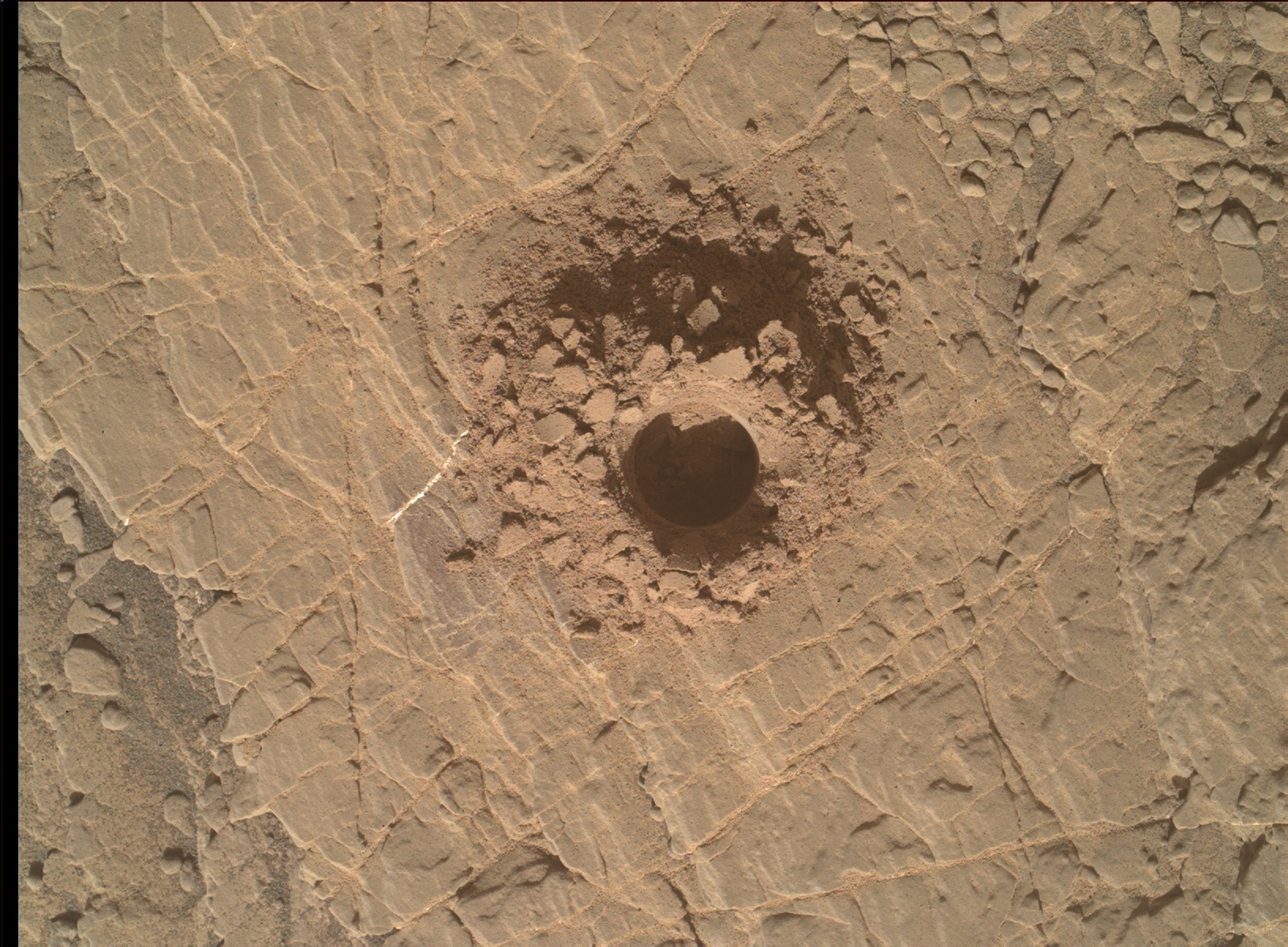
Even as InSight’s mole shaft driller shows signs of working, its difficulties in digging into the Martian soil has revealed how truly alien that soil is from what we normally expect.

[U]nlike typical holes dug here on Earth, the one excavated by InSight’s mole has no lip of dirt around its rim, Hoffman said. “Where did the soil go?” he said. “Basically, it got pounded back into the ground, so it seems like it’s very cohesive, even though it’s very dusty.”

And this is a weird combination of characteristics, strongly suggesting that Mars dirt is alien in more ways than one. “The soil properties are very different than anything we’ve ever seen on Earth, which is already a very interesting result,” Hoffman said.

That the soil of Mars is alien should not be a surprise. The planet’s dusty nature, combined with its light gravity and lack of life, practically guaranteed that the soil would have different and unexpected properties. What is disturbing is that it appears this likelihood was not considered in the slightest by the German engineers who designed the mole for digging.

0 comments

Blue Origin partners with Lockheed Martin, Northrop Grumman, Draper to build lunar lander

At a science conference yesterday Jeff Bezos announced that Blue Origin has formed a partnership with Lockheed Martin, Northrop Grumman, and Draper to propose building a manned lunar lander for NASA.

In the first major update on the company’s lander program since May, Bezos said Blue Origin has assembled a “national team” of aerospace contractors to develop, build and fly the three-stage spacecraft, which is based on Blue Origin’s previous work on the Blue Moon landing system.

“Blue Origin is the prime contractor, Lockheed Martin is building the ascent stage, Northrop Grumman is building the transfer element and Draper is doing the GNC (guidance, navigation and control),” Bezos said Tuesday at the International Astronautical Congress in Washington. “We could not ask for better partners. Blue Origin, in addition to being the prime, is going to build the descent element.”

Blue Origin is competing for a NASA contract to develop a crewed lunar lander, or Human Landing System, for the Artemis program, which aims to return astronauts to the surface of the moon by the end of 2024.

This partnership reminds me of the way the aerospace industry functioned before the arrival of SpaceX. No one would compete. Instead, they would meet like a cartel and divvy up the work so that everyone had a share. The result was that very little new stuff got built, and over time the entire industry began to die.

The goal of this partnership now seems aimed at Congress and convincing legislators (especially the Democrats who control the House) to drop their opposition to Trump’s 2024 Moon proposal and fund it. Whether this will work remains unknown, and will likely have to wait until after the results of the 2020 election.

Meanwhile, it is very interesting that Blue Origin is the prime contractor, considering how very very little Blue Origin has so far achieved in space. I wonder if Bezos has committed some of his personal capital to this venture (more than $2.8 billion cash intended for his space ventures), and doled it out to Lockheed Martin, Northrop Grumman, and Draper as an incentive to become subcontractors.

Bezos’ presentation also provided an update on Blue Origin’s BE-7 engine, designed as part of this lunar lander. It appears however that he said nothing about the BE-4 engine that the company is building for both ULA’s Vulcan rocket and its own New Glenn rocket. Except for one update in August, there has been little said about this engine in about a year and a half. As this engine is key to the entire company’s financial future, this silence makes me continue to wonder if it has issues.

4 comments

British parliament passes Johnson’s Brexit deal while pushing for more delays

The British parliament yesterday finally for the first time passed a deal for leaving the European Union (EU), but then rejected the timetable created by prime minister Boris Johnson to complete that exit by October 31.

The PM [prime minister] did tonight what Theresa May was unable to do in three years – get a majority in the Commons to actually leave the EU. Boris this evening said it was “joyful” that MPs had finally “embraced a deal”.

But minutes later the PM tonight lost his vote 308 – 322 on the crucial timetable motion, leaving his promise to get us out of the bloc by Halloween in tatters. Furious MPs had claimed they didn’t have enough time to look at the 100 page bill.

The PM revealed he would put the Brexit Bill on ice and hit “pause” while the EU consider what to do.

Whether Johnson will have the UK leave at the end of the month, deal or no deal, remains unclear. It increasingly looks like the EU will not give an extension, so if parliament sticks to its guns on rejecting the timetable then the exit will occur on October 31st with no deal. Johnson in turn might also trigger a general election in response.

6 comments

Pence endorses property rights in space

In a speech yesterday at a meeting of the International Astronautical Congress in Washington vice president Mike Pence pushed the importance of property rights in space, noting that the Trump administration is looking for ways to protect those rights.

He made clear that the United States would continue to observe international agreements on space activities — presumably including the Outer Space Treaty, which rules out claims of sovereignty on the moon or other celestial bodies. But Pence also said America’s partners should respect private ownership in space, which is a less settled legal frontier.

“As more nations gain the ability to explore space and develop places beyond Earth’s atmosphere, we must also ensure that we carry into space our shared commitment to freedom, the rule of law and private property,” he said. “The long-term exploration and development of the moon, Mars and other celestial bodies will require the use of resources found in outer space, including water and minerals. And so we must encourage the responsible commercial use of these resources.”

Pence hinted that the United States will be developing new policies relating to the use of space resources. “We will use all available legal and diplomatic means to create a stable and orderly space environment that drives opportunity, creates prosperity and ensures our security on Earth into the vast expanse of space,” he said.

I’m not sure how the U.S. can do this, however, under the limitations placed on us by the Outer Space Treaty. Without the ability to apply U.S. sovereignty to any private operations on the Moon, Mars, or asteroids, it will be impossible to apply U.S. law to those operations.

One avenue that the Trump administration might be considering is an amendment to the treaty that would allow nations to apply their laws to their citizens in space, not the territory on which they land and develop. Such an approach would avoid breaking the treaty’s restrictions on not claiming territory, but it would still achieve essentially the same thing.

6 comments

Storms on Saturn baffle scientists

The uncertainty of science: Scientists have identified a new type of storm on Saturn, and they don’t understand the weather processes that produced it.

Until now, astronomers had seen only two kinds of Saturnian storms: relatively small storms about 2,000 kilometers across that appear as bright clouds for a few days and Great White Spots that are 10 times as large and last for months. The newly spotted weather disturbance was a series of four midsize storms. Each was several thousand kilometers across and lasted between about 1.5 weeks and about seven months.

It appears that these midsize storms don’t fit any of their present theories about the formation of storms on Saturn.

However, for any scientist at this time to suggest that any theory about the storms on gas giants like Jupiter or Saturn can explain things is for that scientist to reveal themselves to be arrogant fools. We simply do not know anything about the deep atmospheres and vast climates of such planets. For example, we have yet to send a satellite to either planet devoted entirely to studying their atmospheres. And considering the size of these planets, such research would require a lot more than one orbiter to get a global picture. And it would require decades of coverage to get a long term picture.

3 comments

Rocket Lab announces new upper stage for taking satellites beyond Earth orbit

Capitalism in space: Rocket Lab yesterday unveiled plans for a new upper stage to their Electron rocket that will allow them to send satellites to lunar orbit.

Rocket Lab will combine its Electron launch vehicle, Photon small spacecraft platform, and a dedicated bulk maneuver stage to accomplish extended-range missions and deliver small spacecraft to lunar flyby, Near Rectilinear Halo Orbit (NRHO), L1/L2 points, or Lunar orbit. These capabilities can then be expanded to deliver even larger payloads throughout cis-lunar space, including as high as geostationary orbit (GEO).

The satellites involved here would all be very small cubesats, but since these small satellites are increasingly becoming the satellite of choice for unmanned missions Rocket Lab’s timing here I think is excellent. They are putting themselves in position to garner this new market share.

1 comment

Liberals in Canada retain control

In tonight’s national election in Canada the leftist Liberal party under Justin Trudeau managed to maintain its control of the government, but without a clear majority, requiring it to form a coalition with one of the smaller parties.

Trudeau appeared to overcome a challenge in Monday’s national elections from the rival Conservatives four years after he channeled his father’s star power to become prime minister. CBC projects Trudeau’s Liberals won’t win the majority of seats in Parliament and will have to rely on another party to pass legislation.

The final numbers are not in, but it doesn’t look like much will change.

I always consider election results the real and true indicator of society’s trends. This result says that the left continues to maintain its hold on western civilization, despite the utter bankruptcy of its ideas and its increasingly totalitarian policies. Apparently a very large percentage of Canada’s population likes what the left is offering.

This also suggests that we will get a similar result in the 2020 U.S. election. We, just like in Canada, have a large population that likes what the Democrats are offering: Free stuff combined with a willingness to impose its will by force if necessary, including the silencing and literal destruction of its opponents.

Not good. Not good at all.

7 comments

Large numbers of minorities and Democrats attend Trump rallies

According to statistics issued by the Trump campaign manager, significant numbers of Democratic voters, minorities, and non-voters have been attending Trump rallies.

In Dallas: “The data revealed that nearly 54,000 voters signed up for the event, with almost one in eight (12 percent) who didn’t vote in the last four elections and more than one in five (21.4 percent) who identified as Democrats. Eleven percent of the registrants were Hispanic.”

In New Mexico: “Of the 45,000 who registered, 94 percent were from within the state and 78 percent were matched to voter files. More than one in five voted in one or none of the past four elections, and 40 percent were Hispanic, the data showed. Nearly one in three were Democrats.”

In Minnesota: “More than 42,000 voters were identified in the data, of whom 13 percent voted in none or one of the past four elections. Also, 30 percent were Democrats.”

If these numbers reflect reality even vaguely, they strongly suggest two things. First, that large numbers of Democrats are abandoning that party. Second, that Trump is bringing in voters who had habitually not voted in the past. Both trends, if true, suggest disaster for the Democratic Party in 2020.

19 comments
1 24 25 26 27 28 156