Major victory for Boris Johnson, Tories, and Brexit

A victory for democracy: In the elections today in the United Kingdom it appears at this moment that the conservative Tories under Boris Johnson, running under a platform to quickly enforce the public’s vote three years ago to leave the European Union, have won the biggest majority since the 1980s under Margaret Thatcher.

As is typical in the modern journalist field, these results are also much more favorable to the conservatives than all the polls, which had called for a much closer result. The result is also a major rejection of Great Britain’s leftist and increasingly anti-Semitic Labor Party under Jeremy Corbyn.

Most important, the victory for Johnson is also a vindication of his strong position that he and Great Britain’s politicians had a responsibility to respect the voters’ choice three years ago to exit the European Union, and the effort by politicians to nullify that vote was a direct attack on democracy. The voters have clearly shown their contempt for that nullification effort, and have said so forcefully at the polls.

My immediate thought, from an American perspective: If only the American voters were as willing to make such a forceful statement. Our Democratic Party has been acting as bad and as anti-democratic as the politicians in the UK these past three years. It is long past time for a major political house-cleaning in Washington.

So far, the American voters have shown no inclination to do this, however, and in fact in the 2018 election did the exact opposite, rewarding the corrupt Democratic Party with more power by giving them control of the House. The result has been this ludicrous impeachment effort by the Democrats that is blatantly an effort to nullify the 2016 presidential election. They have no grounds for impeachment and the removal of Donald Trump, other than the fact that they don’t like him and that he beat them in a fair election.

They should be punished in the same way. Will the American voters do it? So far I remain pessimistic. I also pray every day that my pessimism turns out to be wrong.

55 comments

New Hubble images of Comet 2I/Borisov

Comet 2I/Borisov taken by Hubble prior to and at its closest approach to Sun
Click for full image.

Scientists today released new images taken by the Hubble Space Telescope of the interstellar object Comet 2I/Borisov. The image on the left was taken prior to the comet’s closest approach to the Sun, while the image on the right was taken during that closest approach. The vertical smeared object to the left in the earlier image is a galaxy that happened to be in the field of view. The blue color of both images is a false color to bring out details.

“Hubble gives us the best upper limit of the size of comet Borisov’s nucleus, which is the really important part of the comet,” said David Jewitt, a UCLA professor of planetary science and astronomy, whose team has captured the best and sharpest look at this first confirmed interstellar comet. “Surprisingly, our Hubble images show that its nucleus is more than 15 times smaller than earlier investigations suggested it might be. Our Hubble images show that the radius is smaller than half-a-kilometer. Knowing the size is potentially useful for beginning to estimate how common such objects may be in the solar system and our galaxy. Borisov is the first known interstellar comet, and we would like to learn how many others there are.”

The first image was taken from a distance of 203 million miles, while the second was taken from 185 million miles. Expect more images in late December, when the comet makes its closest approach to Earth at a distance of 180 million miles.

5 comments

OSIRIS-REx team picks primary sample site

Four candidate landing sites
Click for full image.

The OSIRIS-REx science team has picked the site they have dubbed Nightingale as the primary landing site where they will attempt to obtain a sample from the asteroid Bennu in the summer of 2020. The back-up site is Osprey at the equator.

I have embedded the replay of the NASA live stream of the press event below the fold. The first 21 minutes of the video are an overview of the mission, leading up to the announcement by Dante Lauretta, OSIRIS-REx’s principal investigator. He notes then that the site “does have some hazards” but they chose it for its “scientific value.” While its higher latitude location has some advantages, it also makes it more difficult for landing. The one large boulder there, which Lauretta calls “Mt Doom,” also carries risk for the touch-and-go operations.

The back-up site, Osprey, is on the equator with less hazards, but will present more problems obtaining the tiny-sized particles the sample grab equipment was designed to get.

Not that this matters, but if I have been in a betting pool I would have won, since Nightingale has been my guess for which site they’d pick since early November.
» Read more

0 comments

Buyer of Stratolaunch revealed though unconfirmed

A news story today at Geekwire has revealed, based on business filings in Washington and California, the new owner of the company Stratolaunch.

Filings with regulators in California and Washington show that a new LLC business, also called Stratolaunch, was incorporated in late October, at Stratolaunch’s existing offices in Seattle and Mojave, Calif. The new Stratolaunch’s executive vice president is named as Michael Palmer, Cerberus’ managing director.

Private-equity firms typically replace existing managers as a prelude to realigning businesses they buy, which can involve firing, automation and offshoring. However, it appears that Jean Floyd, Stratolaunch’s president and CEO since 2015, remains in his roles for now.

It appears the new owners, who did not confirm the Geekwire story, are now marketing the huge Roc airplane as a launch platform for hypersonic test flights rather than orbital satellites.

0 comments

New Shepard completes another test flight

Capitalism in space: Blue Origin today successfully completed its sixth unmanned test flight (a new record) of its third New Shepard reusable suborbital spacecraft, the twelfth flight total and the ninth to carry commercial payloads.

The capsule reached an altitude of about 342,000 feet elevation.

Blue Origin’s success here is commendable. I just wish their launch pace was faster. At the pace they are setting I am beginning to think that SpaceX will be flying people to the Moon on Starship before Blue Origin flies its first commercial tourist suborbital flight.

I have embedded the video of the flight below the fold.
» Read more

10 comments

A new map of the water ice on Mars

Annotated water ice map of Mars
Click for full resolution image.

In a new science paper planetary scientists have produced a new global map of the water ice of Mars, based on data from Mars Reconnaissance Orbiter (MRO) and Mars Odyssey.

The image above is a lower resolution version of that map, annotated by me. The black areas are regions covered with a thicker layer of dust, so no good data was obtained. As you go from red to green to blue to purple the ice is thought to be closer to the surface, with the depth as small as an inch in the dark purple areas. The white rectangular represents the region best for human settlement, as it has ice near the surface and is at lower latitudes.

The red box indicates the location in Arcadia Planitia that is SpaceX’s candidate landing zone for Starship. Based on this new water ice map it appears that SpaceX has chosen very well. And the scientists who wrote this paper agree, as noted in the press release: “A large portion of a region called Arcadia Planitia is the most tempting target in the northern hemisphere.”

The map also confirms the existence of the 30 to 60 degree latitude bands where scientists believe a lot of buried glaciers exist. Both bands are both very evident in this new map.

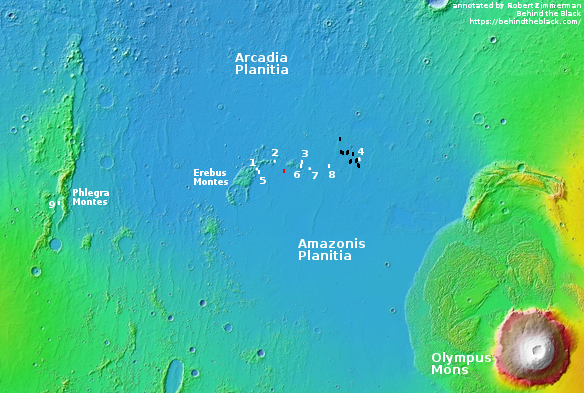
To provide some further context, below is a global map of Mars labeled to show its major geographic features as well as the locations of all previous and upcoming landers/rovers, rearranged to match the water ice map above.
» Read more

10 comments

Russia and India launch satellites

Two launches since yesterday. First, Russia used its Soyuz-2 rocket to place another GPS-type Glonass satellite into orbit. This was Russia’s 20th successful launch in 2019, the first time that country has hit that number since 2015.

Then India used its PSLV rocket to launch a military radar reconnaissance satellite.

The leaders in the 2019 launch race:

29 China
20 Russia
12 SpaceX
7 Europe (Arianespace)
6 Rocket Lab
6 India

China remains the leader in the national rankings, 29 to 25 over the U.S.

0 comments

How the Mars2020 rover differs from Curiosity

A JPL press release today outlines some of the main engineering differences between Curiosity, the rover that has been exploring Gale Crater for the past fifteen years, and Mars2020, the unnamed rover that will be launched in July 2020 to explore Jezero Crater

One of the major the engineering improvements, based on what was learned with Curiosity, are the Mars2020 wheels:

Curiosity has prepared Mars 2020’s team for “off-roading” on the Red Planet. When holes began appearing in the veteran rover’s aluminum wheels, engineers realized that sharp rocks cemented on the Martian surface exert more pressure on the wheels than expected. Careful drive planning, along with a software upgrade, will keep them in shape for the rest of Curiosity’s journey up Mount Sharp.

While Mars 2020’s wheels are made from the same materials, they’re slightly bigger and narrower, with skins that are almost a millimeter thicker. Instead of Curiosity’s chevron-pattern treads, or grousers, Mars 2020 has straighter ones and twice as many per wheel (48 versus 24). Extensive testing in JPL’s Mars Yard has shown these treads better withstand the pressure from sharp rocks but work just as well on sand.

The computer and software has also been upgraded to speed daily operations. In addition, the new rover will have 23 cameras, six more than Curiosity, all of which will be capable of producing color images. And most important, the drill will be larger and will drill cores for obtaining samples that will be stored for possible return by a later mission.

The landing is set for February 18, 2021. If all goes well this rover will be exploring the Martian surface well in to the 2030s.

2 comments
1 5 6 7 8 9 156