
The edge of an eroded buried Martian glacier

The edge of an eroded buried Maritian glacier
Click for full resolution image.
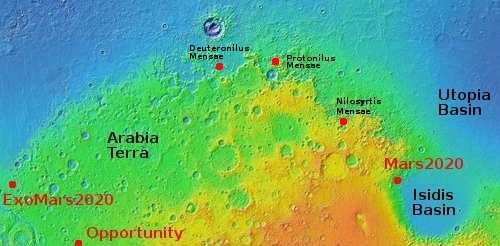
Overview

Cool image time! The image to the right, rotated, cropped, and reduced to post here, was taken by the high resolution camera of Mars Reconnaissance Orbiter (MRO) on April 6, 2020.

The image shows the dying edge of a debris flow coming down from a mesa, the edge of which can be seen as the dark slopes in the upper left. The white arrows point up slope. It is located in the chaos terrain of a mid-latitude region called Deuteronilus Mensae, in the transition zone between the southern highlands and northern lowlands, where many such glacial-like features are found. I featured a similar nearby glacial edge only two months ago, where the image showed the glacier’s break up and collapse at its edge.

Here, the debris flow isn’t breaking up so much as crumbling away, its edge a line of meandering depressions, with the uphill slope covered with many knobs and tiny depressions, reminiscent to me of the many features I see in caves, where the downward flow of water shapes and erodes everything to form cups and holes and knobs, all the same size. If you click on the full resolution image and zoom into that debris slope and then compare it with the linked cave formation photo, you will see the resemblance.

We are almost certainly looking at a buried inactive glacial flow coming off that mesa, though it appears to be eroding at its foot. The overview image to the right shows the context, with the red dots indicating this image as well as similar features in adjacent mensae regions (featured in the linked images above). While the chaotic and rough terrain found along this transition zone does not make them good first settlement sites, the ample evidence of vast reservoirs of buried ice, combined with a variety of topography, will likely someday make this good real estate for those living on Mars.

3 comments

China’s space station

The new colonial movement: China’s propaganda news services today released an article outlining in a somewhat superficial manner the overall design and program of its first full-sized space station, Tiangong-3.

The article does not really provide any new information that was not already reported back in 2016, except for this intriguing detail:

The Long March-2F carrier rocket and Shenzhou manned spacecraft will be used to transport crew and some materials between Earth and the space station. The Shenzhou can carry three astronauts and be used as a rescue spacecraft in emergency.

Earlier reports had suggested they would be using their as-yet unnamed second generation manned capsule and the Long March 5B for these functions. It now appears that they are planning to use both manned ships, probably beginning with the Shenzhou and transitioning to the new manned capsule over time.

The article also describes again their plan to launch and fly in formation with the station a two-meter optical telescope, maintaining it in orbit during the 10-year life of the station using crew from the station. This concept was one that NASA actually considered when it was first conceiving Hubble, but put aside when it was realized that the U.S. station would not launch in time.

Note also that this Chinese space telescope is only slightly smaller than Hubble, its mirror 2 meters across compared to Hubble’s 2.4 meter diameter. It will thus be the second largest optical telescope ever launched, and if it works will allow for astronomical research that will dwarf all the giant ground-based telescopes western astronomers have spent all their time and millions building in the past two decades, rather than launch several Hubble twins.

1 comment

From Pennsylvania: more proof the lock downs were insane

An analysis of all the deaths so far in Pennsylvania reveals once again the absurdity of the government-imposed shut downs that have thrown millions out of work and destroyed whole industries.

[A]lmost 70% of deaths occurred in nursing home and care home settings, and 90% of the deaths were among people who had one or more complicating factors such as heart disease or other severe conditions. The letter goes on to state that as of May 15th, 2020, only 5% of available hospital beds were occupied by COVID19 patients and just over 1% were on ventilators.

The quote is summarizing the details from a letter released by the speaker of Pennsylvania’s House. It shows, without any doubt, that there was never going to be a big influx of Wuhan flu patients. Most of those that got ill were already in nursing homes, or under care for many other serious chronic illnesses. They were already in the healthcare system, meaning the system would not have been overwhelmed.

Moreover, this data once again shows that almost everyone in the population is under no threat from the disease. It only kills those who are old and already badly sick. There is no reason to fear your neighbors, your friends, the people you see on the street. You can go out and hug them. In fact, do it, so that you all get infected and thus kill this damn epidemic sooner so that the old and sick will no longer be threatened by it.

Don’t believe me? Then consider these similar stories:

We have bankrupted ourselves for no reason.

The brainless, panicked, and emotional fear-mongering over this disease has been unconscionable, immoral, and totally unjustified. The data shows overwhelmingly that Elon Musk is right. “The politicians & unelected bureaucrats who stole our liberty should be tarred, feathered & thrown out of town!”

13 comments

Yutu-2 awakes for 18th lunar day on far side of the Moon

The new colonial movement: Chinese engineers have awakened both Chang’e-4 and Yutu-2 for their eighteenth lunar day on far side of the Moon.

The report is from China’s state-run propaganda news services, so it tells us little else. Based on past reports, Yutu-2 will likely continue its slow progress to the northwest, probably traveling about another 75 feet during this lunar day.

0 comments

Atlas 5 launches X-37B spacecraft

Capitalism in space: ULA’s Atlas 5 rocket this morning successfully launched one of the military’s two X-37B reusable mini-shuttles into orbit.

I have embedded the video of the launch below the fold, with the launch occurring at 23:50.

As has been standard procedure during all previous X-37B missions, only a few details about the payloads have been released, though the military has said it wishes to be a bit more open this time.

“This sixth mission is a big step for the X-37B program,” said Randy Walden, director and program executive officer for the Air Force Rapid Capabilities Office. “This will be the first X-37B mission to use a service module to host experiments. The incorporation of a service module on this mission enables us to continue to expand the capabilities of the spacecraft and host more experiments than any of the previous missions.” The service module is attached to the aft end of the X-37B spaceplane, providing additional capacity for experiments and payloads. The X-37B itself, measuring more than 29 feet (8.9 meters) long, also has a cargo bay inside its fuselage.

Secretary of the Air Force Barbara Barrett said Wednesday that the Air Force’s Rapid Capabilities Office is partnering with the U.S. Space force and the Air Force Research Laboratory on the next X-37B mission. … “This important mission will host more experiments than any prior X-37B flight, including two NASA experiments,” Barrett said Wednesday. “One is a sample plate evaluating the reaction of select significant materials to the conditions in space. The second studies the effect of ambient space radiation on seeds.”

The X-37B also carries a space-based solar power experiment. “A third experiment designed by the Naval Research Laboratory transforms solar power into radio frequency microwave energy, then studies transmitting that energy to Earth,” Barrett said.

Once in orbit, the X-37B will also release a small satellite named FalconSat 8. Developed by Air Force Academy cadets in partnership with the Air Force Research Laboratory, the small satellite carries five experimental payloads. It will be operated by by the Air Force Academy’s Cadet Space Operations Squadron

They have not said how long this X-37B will remain in orbit.

The leaders in the 2020 launch race:

8 China
6 SpaceX
6 Russia
6 Europe (Arianespace)
3 ULA

The U.S. now leads China 11 to 8 in the national rankings, and will likely increase that lead very early tomorrow in the next day or so when SpaceX completes its next scheduled Falcon 9 Starlink launch. (Because of weather they have pushed back one day.
» Read more

17 comments

The Artemis Accords: The Trump administration’s effort to bypass the Outer Space Treaty

Capitalism in space: The Trump administration yesterday released the guidelines it will require any international or private partner to follow if they wish to participate in its Artemis lunar and planetary manned program.

The guidelines, which you can download here [pdf], list ten very broad and vague principles. Most reiterate support for the most successful requirements of the 1967 Outer Space Treaty, such as:

  • the requirement that all activities be conducted for peaceful purposes
  • the requirement that everyone design equipment for interoperability and to international standards
  • the requirement that everyone take reasonable steps possible to render assistance to astronauts in distress
  • the requirement that everyone publicly register anything they launch
  • the requirement that everyone release their scientific data publicly
  • the requirement that all parties take actions to mitigate space junk

The remaining four principles appear designed to bend the Outer Space Treaty in the direction of allowing countries and companies to have some control over the territories they occupy in space.
» Read more

4 comments

Large majority of COVID-19 infections are asymptomatic

The evidence continues to build that the majority of people who get infected with the Wuhan flu end up showing no symptoms and do not even know they caught the virus.

The author gives eight solid examples where testing found a large population infected, with most asymptomatic. These included the crew and passengers on three different ships, prison systems in four different states (85% to 98% asymptomatic), a meat-packing plant, the homeless, pregnant women, and even in three nursing homes (!):

A survey published in the New England Journal of Medicine at an anonymous nursing home found that more than half with positive results were asymptomatic. In another nursing home in Washington state, 56% of those who tested positive were asymptomatic. One nursing home in Miami County, Ohio, tested every resident last week, and so far all of those who tested positive are still asymptomatic. [emphasis mine]

He also notes that in all but the last example, the number of fatalities were tiny, or none.

He then makes four common sense points. First,

The overwhelming majority of those infected are asymptomatic, which grows to an absolute super-majority when you factor in the mildly symptomatic. The fatality rate is therefore very small and very confined to a known population. Thus, it makes no sense to lock down younger and healthier people who overwhelmingly don’t get seriously ill, much less deathly ill, even if they contract the virus.

This confirms what was suggested from the beginning, that the death rate for the Wuhan flu is likely comparable to the flu.

Second, this shows it is absurd to release criminals. They almost certainly already have the disease, and weren’t bothered by it. They should serve out their punishments.

Third, “Contact tracing of the entire country is utterly insane. Most people have been spreading this virus while asymptomatic for months. What is left to trace?”

And finally,

By going back to normal with basic precautions for most of the population, we will be able to achieve herd immunity much less painfully than previously thought while shielding the more vulnerable population. … The fact that so many of the more exposed and vulnerable already got it and so many were asymptomatic means we could achieve herd immunity much quicker with fewer lives lost, certainly compared to lockdown.

The lock downs must end. We need to stop panicking and go back to normal. This disease is not the plague the press and politicians have been pushing. It does not require extreme measures to fight.

19 comments

The uncertainties of mask use demand that no one be forced to wear them

The uncertainty of science: Regular readers of Behind the Black will know that I have made it very clear I consider the requirement to wear a mask by government officials to be an incredible and inappropriate overreach of their authority, partly because they don’t have that legal right, and partly because the science is very uncertain, with some studies strongly suggesting that the mask could have serious negative health effects.

Still, the science remains uncertain. Because of this uncertainty, it seems to me in a free society, where everyone respects the idea of freedom, wearing a mask must be left up to each individual.

Sadly, the social justice warriors of our society no longer believe in freedom, and will try to shame and discredit you if you say publicly you will not wear a mask. In the past week I have had two friends tell me bluntly that they will never again be in the same room with me, because they insist that everyone should wear a mask in public, all the time. (This saddens me because I had considered them friends, and it appears those friendships are now over.) One even said “Not wearing a mask in public or with people who are not your immediate family is a true sign of disrespect for others, to put it mildly.”

The context of that last quote is important. » Read more

52 comments

OSIRIS-REx’s landing spot on the asteroid Bennu

Bennu, annotated
Click for full resolution unlabeled image.

The OSIRIS-REx science team today released another image of the asteroid Bennu, this time showing the planned Nightingale touch-and-go sample grab landing site.

The image to the right, reduced, cropped, and annotated by me, is that image. From the caption:

The crater where sample site Nightingale is located can be seen near the top, center of the image – it is a small region containing dark, fine-grained material. Bennu’s prime meridian boulder, Simurgh Saxum , is also visible in the lower left of the image, near the asteroid’s limb. Directly east of Simurgh is Roc Saxum . The field of view is 0.3 miles (0.5 km). For reference, Simurgh is 125 ft (38 m) across, which is about the size of a commercial airliner.

Nightingale is only about 50 feet across, which is about a third the size of the kind of smooth areas they had designed their grab-and-go equipment around. This global image illustrates the difficulties they face with that sample grab. Though there appear to be larger areas in this photo that seem smooth, they really are not. The asteroid has no dust, and the sample grab equipment is designed to suck up particles smaller than 0.8 inches in diameter. Most of the surface is covered with pebbles and gravel larger than this.

Thus they needed to find a spot where the bulk of the material is “fine-grained.” Nightingale fits that bill, though it has a small footprint and also has larger particles that pose a risk to the sample grab because they could damage the spacecraft, or clog the sample grab equipment.

Either way, for the spacecraft to autonomously guide itself accurately down to this small spot, surrounded as it is by much larger boulders, will be challenging, and is why they have done one dress rehearsal already, getting as close as 213 feet, and will do a second in June, getting down to 82 feet.

0 comments
1 107 108 109 110 111 169