ULA successfully launches reconnaissance satellite with Atlas 5

Capitalism in space: ULA today successfully launched a military reconnaissance satellite using its Atlas 5 rocket.

This launch was the first Atlas 5 using these particular Northrop Grumman solid rocket boosters.

Because this was a military launch, the live broadcast ended at the moment the fairings were released, exposing the satellite. Final announcement of the satellite’s successful deployment will come later, assuming all goes well.

The leaders in the 2020 launch race:

30 China
19 SpaceX
5 ULA
4 Russia
4 Europe (Arianespace)
4 Rocket Lab

The U.S. now leads China 31 to 30 in the national rankings, with two more launches scheduled for the next two day. SpaceX is first with its second manned Dragon mission tomorrow, followed by Rocket Lab’s next launch from New Zealand on November 15.

0 comments

A majestic terraced butte on Mars

Majestic butte on Mars
Click for full image.

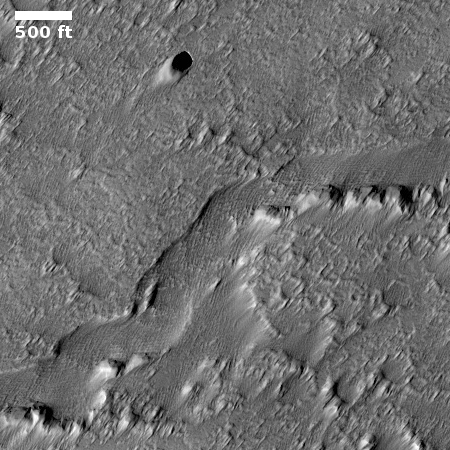
Cool image time! The photo to the right, rotated, cropped, and reduced to post here, was taken on September 8, 2020 by the high resolution camera on Mars Reconnaissance Orbiter (MRO). It shows an outstanding terraced butte that would rival any of the similar buttes scattered throughout the Grand Canyon, and is reminiscent especially of Wotans Throne.

What makes this butte intriguing are its terraces, the obvious result of the repeated deposition of new layers across the surface over time, and now exposed by erosion. What caused them?

As always, location provides the clues. First, this butte is found at about 15 degrees north latitude in the vast Arabia Terra transition region between the Martian northern lowland plains and the southern cratered highlands. At that latitude, we are not looking at any recent glacial features. While there might have been ice here once, it hasn’t likely been present, either on the surface or underground, for a very long time.

This conclusion becomes important once we look at the wider photo below, taken by the high resolution camera on the European orbiter Mars Express. This image gives us the immediate context.
» Read more

0 comments

Ukraine signs Artemis Accords

Ukraine has becomed the ninth nation to sign the Artemis Accords, designed to encourage private enterprise in space.

The article at the link provides little information, other than claiming that ” Ukraine has all the scientific and technical capabilities and experience that allow it to become one of NASA’s important partners in the implementation of the Artemis program.”

Russia and the Ukraine are on opposite sides of a war, with Russia attempting to steal territory, with some success. Russia has also boycotted all Ukrainian space technology, ending a half century of business dealings.

It seems that the Ukrainian government looked at this political landscape, and decided to align itself with the United States. By signing the accords, it now has the opportunity to sell its space technology to NASA, as well as participate in any American effort to get to the Moon and elsewhere. That it chose to pick an ally halfway around the world instead of its big and powerful neighbor, tells us a great deal about the Ukrainian’s opinion of Russia.

I expect there will be a NASA press release in the next day or so that will provide us additional information.

1 comment

Russian spacewalk to inspect leak in Zvezda

The Russian spacewalk to inspect the outside location of the air leak in the Zvezda module on ISS has now been scheduled for November 18, 2020, and NASA will be providing a live stream.

Live coverage of the Russian spacewalk will begin at 8:30 a.m. EST on NASA Television and the agencyโ€™s website. The spacewalk is expected to begin about 9:30 a.m.

Ryzhikov, designated extravehicular crew member 1 (EV1), will wear a Russian Orlan spacesuit with red stripes, and Kud-Sverchkov will wear a spacesuit with blue stripes as extravehicular crew member 2 (EV2). This will be the 47th Russian spacewalk for assembly and maintenance of the station.

During the spacewalk, Ryzhikov and Kud-Sverchkov will first conduct leak inspections outside the hatch, as this will be the first spacewalk using the Poisk module for its purpose as an airlock. Next, they will relocate an antenna from another module, the Pirs docking compartment, to Poisk, the first in a series of tasks over the course of several spacewalks that will prepare Pirs for decommissioning, undocking, and disposal. The Earth-facing Pirs will be replaced by the new Russian Multipurpose Laboratory Module, named โ€œNauka,โ€ Russian for โ€œscience,โ€ which is being prepared for launch at the Baikonur Cosmodrome in Kazakhstan.

What they find could have a significant impact on the future of the space station.

14 comments

The disputed elections must recounted properly, or the states should refuse to certify the results

Signing the Constitution in 1787
The signing of the Constitution in 1787.

The amount of evidence that there was clear election fraud in the states of Pennsylvania, Michigan, Georgia, and Wisconsin continues to build.

For example, in Pennsylvania a review of absentee ballots found that 100,000 had suspicious postmarks, with 23,000 apparently postmarked one day but then marked by the election authorities as having arrived the day before, an impossibility. Tens of thousands of other absentee ballots had similar problems.

In Michigan numerous residents and poll workers have signed affidavits describing blatant violations of election law and suspicious behavior. In addition, one contractor witnessed poll workers rescanning the same votes repeatedly, essentially double counting those votes.

In Wisconsin thousands of absentee votes were submitted in a manner that required no voter identification.

In Georgia there is evidence that the software used to count the ballots is corrupted, or was corrupted, ending up switching many votes from Trump to Biden in what they innocently claim was merely a “glitch.” Worse, this “glitch” in election software has now been found to be exist in other states as well.

The list above is only a small sampling of the numerous stories in the past week of suspicious and well documented incidents of voter fraud. The problems in these states appears widespread and systemic. The election results are thus suspect.

According to the Constitution, the real arbiters of the election are the state legislatures. » Read more

55 comments

MAVEN finds water loss on Mars faster than expected

New data from the Mars orbiter MAVEN has found that the water on Mars moves into the upper atmosphere where it is lost to space much faster than expected.

It had previously been believed that Mars’ water loss only occurred in the lower atmosphere, which is a much slower process. Scientists had also believed that water on Mars would behave as it does on Earth, where temperatures and the atmosphere act to block it from reaching the upper atmosphere where it can easily and quickly be lost to space. Instead, MAVEN found a lot of water in the upper atmosphere.

When the team extrapolated their findings back 1 billion years, they found that this process can account for the loss of a global ocean about 17 inches deep. “If we took water and spread it evenly over the entire surface of Mars, that ocean of water lost to space due to the new process we describe would be over 17 inches deep,” Stone said. “An additional 6.7 inches would be lost due solely to the effects of global dust storms.”

During global dust storms, 20 times more water can be transported to the upper atmosphere. For example, one global dust storm lasting 45 days releases the same amount of water to space as Mars would lose during a calm Martian year, or 687 Earth days.

This data reinforces the theories that Mars once had liquid water on its surface, either as intermittent oceans or as lakes and rivers. Or it suggests that Mars once had a lot more glaciers than it does now, reinforcing a competing theory that glaciers formed the Martian features we on Earth routinely associate with flowing water.

0 comments

China today launched a new communications satellite

The new colonial movement: Using its Long March 3B rocket, China today launched another communications satellite for the Asian market.

No word on whether the rocket’s first stages landed near residential areas, as has happened in the past. Also no word on whether it used grid fins to control its crash somewhat, as China also did previously.

The leaders in the 2020 launch race:

30 China
19 SpaceX
12 Russia
4 ULA
4 Europe (Arianespace)
4 Rocket Lab

The U.S. and China are now tied at 30 in the national rankings. This tie won’t last long, as the U.S. has three launches scheduled for the next three days, a ULA Atlas 5 launch of a military reconnaissance satellite tomorrow, SpaceX’s second manned Dragon launch on November 14, and Rocket Lab’s next commercial launch on November 15.

3 comments

Private space company announces new upgraded tug for moving satellites in orbit

Capitalism in space: The private space company Spaceflight yesterday announced the development of a new upgraded tug for moving small satellites from their launched orbit to their operational locations, including locations in orbit around the Moon.

Spaceflight announced the first flight of its Sherpa-LTE orbital transfer vehicle (OTV) will take place in mid-2021. The vehicle is based on the next-generation Sherpa-FX tug announced in the summer, but equipped with the Apollo Constellation Engine, a Hall effect thruster provided by Apollo Fusion.

With that propulsion system, Sherpa-LTE will be able to generate a change in velocity, or delta-V, of more than 6 kilometers per second. That will allow the vehicle to deliver smallsats to geostationary Earth orbit, cislunar space, or Earth-escape trajectories after a launch into low Earth orbit.

Spaceflight is a direct competitor with Momentus, which already has contracts with several satellite companies for its in-space tug services. Nor is this competition bad. This new cottage industry of tugs helps focus innovation. Satellite companies can focus on improving their satellites, while buying the propulsion from tug companies who can provide that technology best.

0 comments

Hubble sees too much infrared energy from gamma ray burst

The uncertainty of science: During a short gamma ray burst (GRB) that was observed in a distant galaxy on May, astronomers were baffled when measurements from the Hubble Space Telescope detected ten times more near infrared energy that they predict from this type of GRB.

GRBs fall into two classes. First there are the long bursts, which are thought to form from the collapse of a massive star into a black hole, resulting in a powerful supernova and GRB. Second there are the short bursts, which scientists think occur when two neutron stars merge.

The problem with this GRB is that though it was short and somewhat similar to other short GRBs across most wavelengths, in the near infrared Hubble detected far too much energy.

“These observations do not fit traditional explanations for short gamma-ray bursts,” said study leader Wen-fai Fong of Northwestern University in Evanston, Illinois.

…Fong and her team have discussed several possibilities to explain the unusual brightness that Hubble saw. While most short gamma-ray bursts probably result in a black hole, the two neutron stars that merged in this case may have combined to form a magnetar, a supermassive neutron star with a very powerful magnetic field. “You basically have these magnetic field lines that are anchored to the star that are whipping around at about a thousand times a second, and this produces a magnetized wind,” explained Laskar. “These spinning field lines extract the rotational energy of the neutron star formed in the merger, and deposit that energy into the ejecta from the blast, causing the material to glow even brighter.”

What is intriguing about their theory is that this merger of two neutron stars simply resulted in a larger neutron star, not a black hole. This new neutron star was also a magnetar and pulsar, but unlike a black hole, it was a still-visible physical object. And yet its creation in this GRB produced more energy.

When GRBs were first discovered, I was always puzzled why so many astronomers seemed to insist there must be a single explanation for them. With time, when two classes of GRBs were discovered, this assumption was then replaced with the equally puzzling insistence that only two types of events explained them.

It seemed to me that that such explosions had too many potential variables, and could easily have a wide range of causes, though all related to the destruction or merger of massive stars. As the data continues to accumulate this now appears increasingly the case.

1 comment
1 23 24 25 26 27 169