Mars’ polar ice canyons are young and the source for mid-latitude ice

Mars' north pole icecap
Mars’ north polar ice cap.

Scientists have now proposed that the giant ice canyons seen at the edges of Mars’ polar ice caps are very young and are also the source of the water that sublimates away when the planet’s rotational tilt (its obliquity) is high, to fall as snow in the mid-latitudes where it forms the glaciers and ice sheets we now find there.

The image to the right, reduced to post here, shows the entire north pole ice cape on the left, with its spiral canyons. The two inserts on the bottom show for scale Hawaii’s Big Island and the Grand Canyon. From the release:

“Erosion formed a huge ice canyon system, and that erosion is a source of the long-known mid-latitude mantles on Mars,” said Rodriguez, lead author of “North polar trough formation due to in‑situ erosion as a source of young ice in mid‑latitudinal mantles on Mars” that appears in Nature Scientific Reports.

The troughs are arranged in a vast spiral pattern covering an area the size of Texas. We find that their growth lateral to katabatic wind (wind that carries high-density colder air from a higher elevation down a slope) directions produced widespread simple intersections, from which the highly complex spiral arrangement emerged, Rodriguez said. “The spiral pattern seen in the troughs is basically an erosional byproduct,” he said. “As the pits grow and intersect over a pre-existing dome-shaped polar cap, the spiral pattern emerges.

“It has long been proposed that sublimation of water ice from the north polar cap during high-obliquity cycles was an essential source of the planet’s mid-latitude icy plains. Our finding identifies the troughs as direct evidence of those sublimation phases,” Rodriguez said.

These spiral trough features formed very recently, in geologic terms: between a few million and 50,000 years ago, Rodriguez said.

This hypothesis, if true, is very important in understanding the long term geological history of Mars. The present theory is that when the obliquity rises to as high of 60 degrees, compared to today’s 25 degrees (similar to Earth’s), the mid-latitudes are colder than the poles, and the ice at the poles then migrates to the mid-latitudes. This paper gives us the place at the poles where the icecap shrinks as that ice sublimates away.

Knowing that these polar canyons are young and the source of the mid-latitude ice scientists can now begin to write the geological history of the polar ice caps themselves. They can also use this information to maybe determine whether the caps are presently in a steady state, as now believed, or growing or shrinking.

The youth of these canyons also suggests that any mid-latitude ice from them is also young, and thus more likely pure water unpoisoned by the toxic perchlorates found in many places on the Martian surface. It will thus be easier to obtain pure drinkable water from them.
0 comments

The 1st image of a black hole’s magnetic field

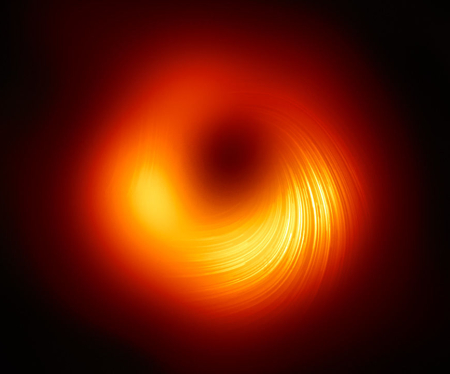
The magnetic field lines of a black hole

Using the data from the first image of a black hole, obtained in 2019, scientists have now extracted evidence of the magnetic field lines near the event horizon, and from this produced the first image of such lines.

The image to the left, reduced to post here, shows the spiraling magnetic field lines against the bright event horizon ring.

As the Event Horizon Telescope (EHT) team describes today in a pair of papers in Astrophysical Journal, the new picture uses the same data as in the original image, produced from a series of observations in 2017 of the supermassive black hole at the core of nearby galaxy M87, using the combined collecting power of eight radio observatories across the world. To extract the polarization information, the data have gone through many months of additional analysis.

The scientists also note that the orientation of the field lines might eventually help explain the jets being thrown from its poles.

3 comments

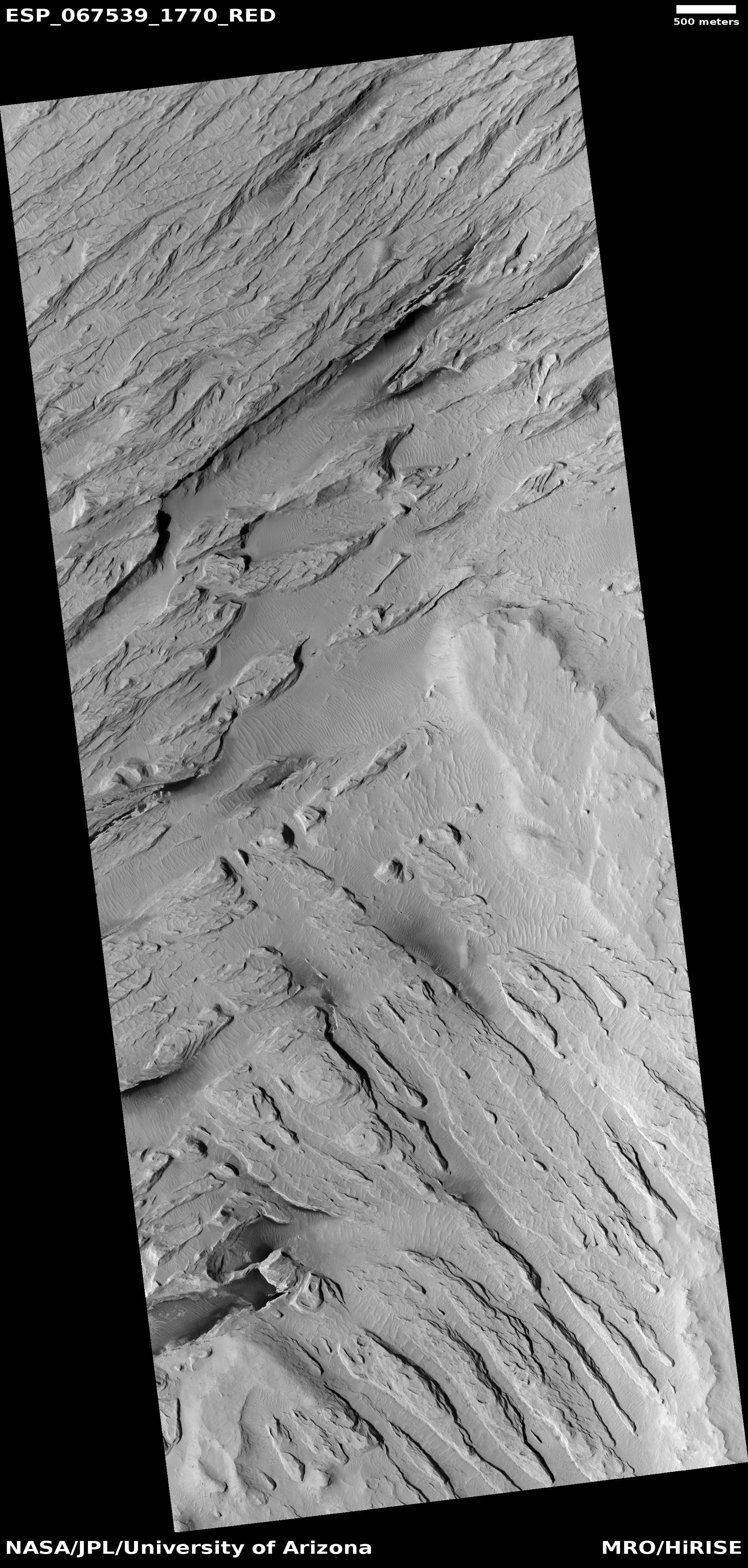
Layers upon layers of Martian volcanic ash

Layers upon layers of Martian volcanic ash
Click for full image.

Today’s cool image provides I think a hint at the vast amount of time that has passed on Mars, allowing uncounted major events to occur which each lay down a bit of the geological history, a history that is now piled up on the surface so deeply that it will take decades of research to untangle it.

The photo to the right, cropped and reduced to post here, was taken on December 23, 2020 by the high resolution camera on Mars Reconnaissance Orbiter (MRO). It shows the layered nature of the Medusae Fossae Formation, the largest volcanic ash deposit on Mars (about the land area of India) and thought by some to be the source of most of the dust across the entire red planet.
» Read more

0 comments

Today’s blacklisted Americans: Lincoln and Washington, by Chicago’s Democratic mayor

Lincoln banned as evil by Chicago politicians
Chicago Democrats to ban Lincoln.

Blacklists are back and the Democrats got ’em: Lori Lightfoot, the Democratic Party mayor of Chicago, has begun the formal process for removing forty historical monuments in Chicago, including statues of Abraham Lincoln, George Washington, and Ulysses S. Grant.

Her reasons for throwing these fundamental Americans into the scrap heap of history? Well, she created a committee to review 500 monuments in Chicago and ended up deciding that 40 should go. It has said this:

Reasons for making the list include promoting narratives of white supremacy; presenting an inaccurate or demeaning portrayal of Native Americans; celebrating people with connections to slavery, genocide or racist acts; or “presenting selective, over-simplified, one-sided views of history.”

…Besides five statutes of Lincoln, others on the list include the General John Logan Monument in Grant Park; the General Philip Henry Sheridan Monument at Belmont and Lake Shore Drive; a statue of Benjamin Franklin in Lincoln Park; the Haymarket Riot Monument/ Police Memorial at 1300 W. Jackson Blvd; the Italo Balbo Monument in Burnham Park; and the Jean Baptiste Beaubien plaque at the Chicago Cultural Center. [emphasis mine]

» Read more

11 comments

ESA awards UK’s Orbex 7.45 million euros to fund rocket development

Capitalism in space: The European Space Agency (ESA) has awarded the new United Kingdom smallsat launch company Orbex 7.45 million euros to help fund the development of its Prime rocket.

This will supplement the 4.7 million euros that Orbex has raised from private capital.

The funds from the award will go towards the completion of spaceflight systems in preparation for the first launches of Orbex’s 19-metre ‘microlauncher’ rocket, Prime. €11.25 million of the total funding will be assigned to work undertaken in the UK, in particular the lightweight avionics designed in-house by Orbex in Forres, and the guidance, navigation and control (GNC) software subsystem being designed by Elecnor Deimos, a strategic investor and partner of Orbex. The remaining €900,000 of the total funding package will support the development of the GNC for the orbital phase being developed by Elecnor Deimos for Orbex in Portugal.

If all goes right, Prime will make its first launch from Sutherland, Scotland, in ’22.

The contract award signals the shift at ESA that resembles what happened at NASA in the past decade, moving from designing and building its rockets and spacecraft to buying the product from private companies. While ESA might be providing a large bulk of the capital to develop Prime, it appears ESA is not involving itself heavily in the development itself, leaving that instead to the company.

0 comments

Scientists: Mars is losing water seasonally through its atmosphere

The uncertainty of science: Two new studies using data Europe’s Trace Gas Orbiter and Mars Express orbiters have found that Mars is losing water seasonally through its atmosphere.

The studies also found that global dust storms accelerate the process.

Anna and colleagues found that water vapour remained confined to below 60 km when Mars was far from the Sun but extended up to 90 km in altitude when Mars was closest to the Sun. Across a full orbit, the distance between the Sun and the Red Planet ranges from 207 million to 249 million km.

Near the Sun, the warmer temperatures and more intensive circulation in the atmosphere prevented water from freezing out at a certain altitude. “Then, the upper atmosphere becomes moistened and saturated with water, explaining why water escape rates speed up during this season – water is carried higher, aiding its escape to space,” adds Anna.

In years when Mars experienced a global dust storm the upper atmosphere became even wetter, accumulating water in excess at altitudes of over 80 km.

But wait, didn’t planetary scientists just announce that Mars hasn’t lost its water through the atmosphere, but instead lost it when it became chemical trapped in the planet’s soil? Yup, they did, but that was a model based on new ground data. This new result is based on atmospheric data.

Or to put it another way, the model was incomplete. While it could be true that a large bulk of Mars’ water is trapped chemically in the ground, that is not proven, only hypothesized. What has been proven, and is now confirmed by these two studies, is that, depending on weather and season, the water of Mars does leak into its upper atmosphere where it can escape into space, never to return.

What remains unknown is how much water escaped into space, and when. Moreover, the ground-based model could still be right, even if it is true that Mars is losing water through its atmosphere. At the moment the data is too incomplete to answer these questions with any certainty.

Meanwhile, this press release once again gives the false impression that the only water left on Mars is at its poles (and in this case, only the south pole). This is not accurate, based on numerous studies finding evidence of buried ice and glaciers everywhere on the planet down to the 30th latitude, in both the north and south hemispheres. Mars might have far less water now than it did billions of years ago, but it still has plenty, and that water is not found only at the poles.

2 comments

India’s SSLV new smallsat rocket fails during static fire test

According to sources inside India’s space agency ISRO, a static fire test of the first stage of its new Small Satellite Launch Vehicle (SSLV) rocket was a failure, and that the planned April inaugural launch will likely be delayed.

“Oscillation was noticed after 60 seconds into the test and nozzle was blown out near the bucket flange where it’s attached with the motor at around 95 seconds”, sources in the Bengaluru-headquartered space agency said. It was supposed to be tested for a total duration of about 110 seconds, officials said.

The Indian Space Research Organisation had targeted to launch the first development flight of SSLV (D1) in April and may now in all probability have to revise this schedule.

Fixing the problem and repeating the test will likely delay the first launch by six months at least.

SSLV is being designed by ISRO to compete against companies like Rocket Lab in the emerging smallsat market and is thus much cheaper and faster to assemble and launch.

3 comments

Ingenuity to fly on Mars no earlier than April 8th

NASA and the Perseverance engineering team announced yesterday their specific plans for the first flights oft he Ingenuity helicopter, setting the flight date as no earlier than April 8th.

They are presently driving Perseverance to its “airfield,” a 33×33 foot area. The deployment then will take six days, because there are a number of steps involved to position and place the helicopter on the ground properly.

Once the team is ready to attempt the first flight, Perseverance will receive and relay to Ingenuity the final flight instructions from JPL mission controllers. Several factors will determine the precise time for the flight, including modeling of local wind patterns plus measurements taken by the Mars Environmental Dynamics Analyzer (MEDA) aboard Perseverance. Ingenuity will run its rotors to 2,537 rpm and, if all final self-checks look good, lift off. After climbing at a rate of about 3 feet per second (1 meter per second), the helicopter will hover at 10 feet (3 meters) above the surface for up to 30 seconds. Then, the Mars Helicopter will descend and touch back down on the Martian surface.

Several hours after the first flight has occurred, Perseverance will downlink Ingenuity’s first set of engineering data and, possibly, images and video from the rover’s Navigation Cameras and Mastcam-Z. From the data downlinked that first evening after the flight, the Mars Helicopter team expect to be able to determine if their first attempt to fly at Mars was a success.

The data from this first attempt will determine what they do next.

UPDATE: Below the fold is an illustration of that planned first flight, showing that they hope to send the rover toward the north, take some images, and then fly it back to its airfield, with a second landing site option at the far end of its flight.
» Read more

0 comments

SpaceX successfully launches another 60 Starlink satellites

SpaceX early today successfully used its Falcon 9 rocket to place another 60 Starlink satellites into orbit, bringing that constellation to over 1,300 satellites.

The first stage landed successfully, for the sixth time. Both fairing halves were also reused, and their recovery method has now been simplified:

SpaceX has recently appeared to adjust its fairing recovery strategy. The ships previously dedicated to fairing catch attempts, GO Ms. Chief and GO Ms. Tree, have been stripped of their nets and arms, a possible sign that dry fairing recoveries will no longer be attempted. Post-splashdown recovery has proven to be fairly successful, as recent missions frequently use fairing halves that have flown once if not multiple times before.

The leaders in the 2021 launch race:

9 SpaceX
6 China
4 Russia
2 Rocket Lab

Counting all launches, the U.S. now leads China 13 to 6 in the national rankings.

2 comments
1 129 130 131 132 133 167