
January 7, 2022 Zimmerman/Batchelor podcast
Embedded below the fold in two parts.
To listen to all of John Batchelor’s podcasts, well worth your time, go here.
» Read more
Embedded below the fold in two parts.
To listen to all of John Batchelor’s podcasts, well worth your time, go here.
» Read more
An evening pause: The scale of the universe is far larger than we can imagine.
Hat tip Dan Morris.

Click for full image.
Many features on Mars immediately make one think of the Grand Canyon and the stark dramatic geology of the American southwest. Today’s cool image on the right, cropped and reduced to post here, is a typical example. Photographed on September 7, 2021 by the high resolution camera on Mars Reconnaissance Orbiter (MRO), it shows a dramatic cliff face that I estimate is about 3,000 feet high.
A closer look, however, almost always shows that this Martian terrain is not like the American southwest at all, but alien in its own way.
At the base of this abrupt cliff the terrain suddenly changes to a series of smooth downward fan-shaped flows. The cliff evokes rough boulders, avalanches, and chaotic erosion. The fans evoke a gentle and organized erosion of small particles like dust or sand. The two processes are completely different, and yet here the former is butted right up against the latter.
The fans also appear to flow out of hollows in the rough cliff, suggesting that somehow as the cliff erodes in chunks those chunks break into sand or dust, find the lowest points, and then flow downward like liquid.
How strange. How Martian. And how truly beautiful.
Click for original image.
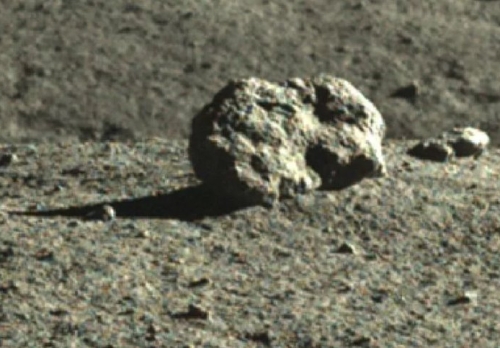
The Chinese state-run press has released some more images from its rover Yutu-2, including a new image of the square-shaped lunar rock that was first identified a month ago. This new image is to the right, cropped and reduced to post here.
In the original image, the rock appeared very square as it was on the horizon and silhouetted by the black sky. As is usual in our emotion- and movie-run society, many began to push wild theories about the rock, proposing it was anything from an alien spacecraft to the monolith from the 1968 movie 2001: A Space Odyssey.
The picture confirms what any thoughtful person would have concluded, that it was simply a rock. The available image does not provide a scale, so I cannot tell you whether this is a large boulder, or a small piece of gravel. However, a wider image taken by Yutu-2 shows that the rock is on the edge of a small crater, which suggests the boulder is probably somewhere between three to ten feet across. The rover has completed only about half of its 260-foot journey to it, and won’t reach it until its next lunar day of operations in February.
The same report also revealed that the rover has now traveled just over 1,000 meters on the far side of the Moon, or about 3,280 feet, since it began operations in early 2019.

Painting by James L. Johnson.
And little child shall lead them: According to one teacher’s union official in Great Britain, children are refusing in “huge numbers” to wear masks or get twice-weekly tests for COVID, despite government mandates requiring both.
In its latest guidance issued on Jan. 2, the UK Department for Education (DfE) recommended that secondary school pupils in England should wear face coverings inside classrooms to slow the spread of the Omicron variant of the CCP (Chinese Communist Party) virus. Before that, masks were already recommended in outdoor communal areas and corridors. Secondary school students are also advised to take a lateral flow test twice a week.
But according to the NASUWT teachers’ union, there has been strong resistance from pupils to the new policy. Damien McNulty, a national executive member of the union, told the BBC on Thursday: “Sadly, we have had reports in the last 24 hours of at least six secondary schools in the northwest of England where children, in huge numbers, are refusing to take lateral flow tests or to wear masks.”
“We’ve got one school in Lancashire where only 67 children out of 1,300 are prepared to have a lateral flow test and wear masks,” he said.
The new colonial movement: The Chinese state-run press yesterday reported that it has successfully used the robot arm on its Tiangong space station to move a Tianzhou freighter from one point to another.
After being unlocked and separated from the space station core module Tianhe, Tianzhou-2 was moved into a predetermined position by the robotic arm. The arm then reversed the maneuvers to bring the spacecraft back to its original position. Tianzhou-2 re-docked with the core module and completed locking.
The test preliminarily verified the feasibility of using the mechanical arm to conduct a space station module transfer, confirmed the effectiveness of relevant technologies, and laid a foundation for the subsequent in-orbit assembly and construction of the country’s space station, said the CMSA [Chinese Manned Space Agency].
The news report did not indicate whether this operation was run from ground control, or by the astronauts on board Tiangong. Either way, it apparently clears the way for the arrival of two more large modules, planned for launch later this year, suggesting that the arm will be used in some manner to position those modules prior to docking.
Capitalism in space: For the first time since Virgin Galactic became a publicly-traded company two years ago, its stock on January 6th dropped below its initial offering price.
On Thursday, stock of the space tourism company fell to as low as $11.30 before rising back to $11.90 by the afternoon. When the company merged with a special purpose acquisition company to go public in 2019, its debut price was $11.75.
In the two years in-between, the price was pumped up to as high as $62, during which the company’s founder, Richard Branson, sold off about 80% of his stock, reducing his holdings from 51% of the company to only 11% and walking away with about $1.25 billion in cash.
Right now the company’s future is very much in question. It has delayed all of its commercial suborbital flights until late this year, if then. Meanwhile, Blue Origin is flying commercial suborbital tourist flights, and the orbital space tourism market is ramping up quite successfully. With no ability to enter that orbital market, Virgin Galactic appears to be at a dead end.
Arianespace today announced a new slew of launch contracts, including two for its mostly Italian-built Vega rocket family and four for its Ariane family of rockets.
The latter launch contract is significant as those four launches, putting eight more Galileo GPS-type satellites in orbit for the European Union over the next three years, will all be launched by Arianespace’s new Ariane-6 rocket, built and owned by the commercial company ArianeGroup.
The significance is twofold. First, Ariane-6 has struggled to get launch customers because its launch cost is far higher than SpaceX’s, to a point that the low number of contracts weren’t paying for the cost of development. This new contract overcomes that difficulty by adding four more launches.
Second, the nature of all of Ariane-6’s contracts underscore the difficulties it is having. Before the arrival of SpaceX’s mostly reusable and very inexpensive Falcon 9 rocket, Arianespace held 50% of the market share for commercial launch contracts, using its Ariane-5 rocket. Those customers have mostly vanished, however, switching to SpaceX. Ariane-6 was conceived — by the government-run European Space Agency — as a newer cheaper rocket that would recapture some of that market. All of its launch contracts, both old and new, demonstrate that it is failing to do so, however. Its only customers so far are coming from European government entities, who are required to use Ariane-6 as part of their partnership in the European Union and the European Space Agency. No private concern, inside or outside Europe, seems interested in using Ariane-6. It just costs too much.
For Europe to compete in the new commercial launch market it needs to build better rockets. And to do this it needs to release its rocket industry from the control of government.
An evening pause: This is so silly, which is why it is funny and worth watching. Silliness is good. The world needs more of it.
Hat tip Charlie Tutino.
Capitalism in space: SpaceX today successfully launched 49 Starlink satellites, thus completing the first launch in 2022.
The first stage landed safely, completing its third flight.
It appears SpaceX alone could have as many as five launches in January, suggesting that 2022 will get off to a very fast start.
Click for full image.
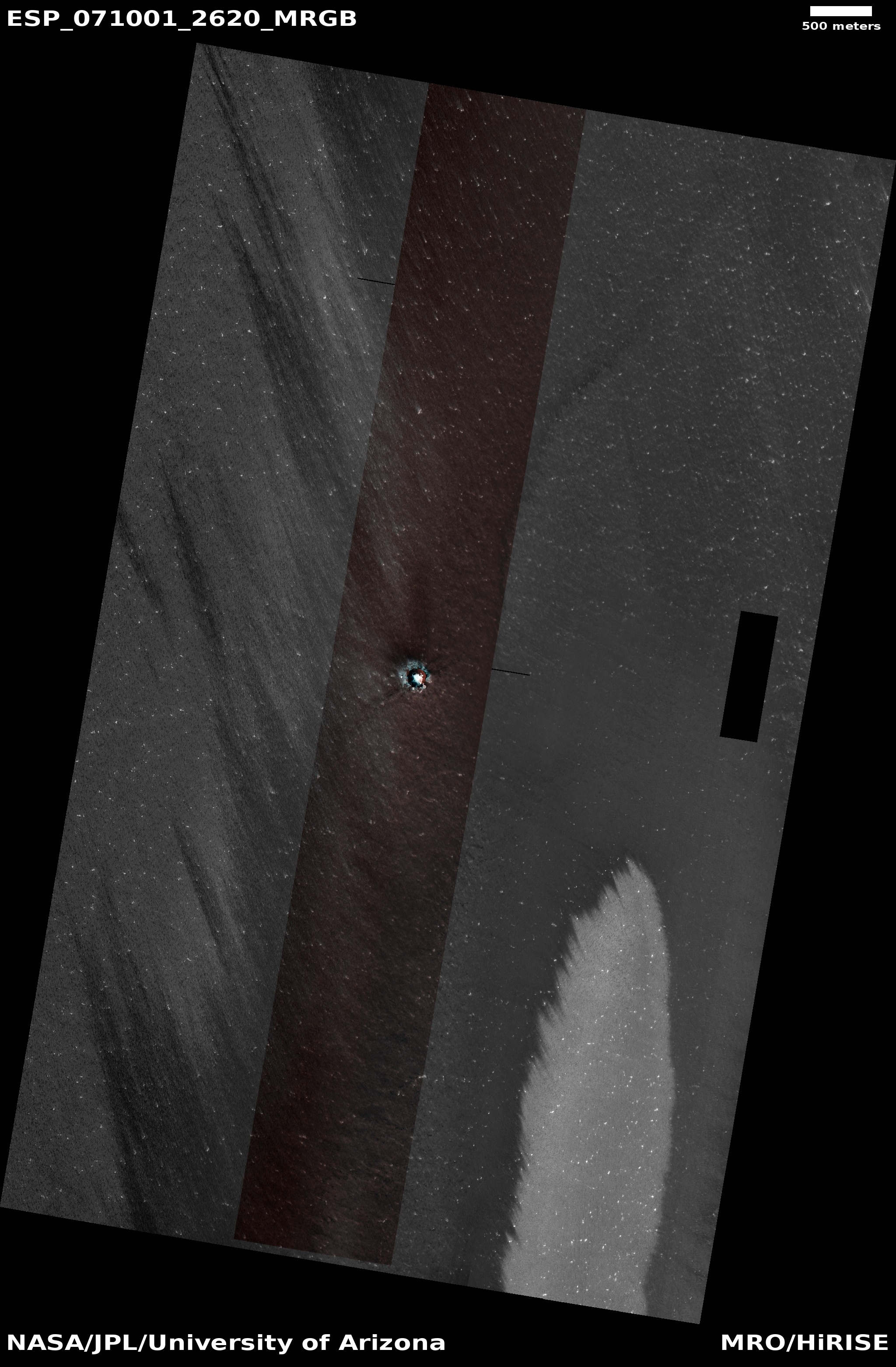
Cool image time! The photo to the right, cropped to post here, was taken on September 18, 2021 by the high resolution camera on Mars Reconnaissance Orbiter (MRO) and shows a very distinct impact crater on top of the layered deposits of ice mixed with dirt that form the bottom layers as well as surround the visible north pole ice cap on Mars.
I purposely cropped the high resolution image so that the crater is off center to show the dark streaks that appear to blow away from the crater to the northwest, west, and southwest. This asymmetric pattern suggests the wind direction at this location generally flows to the west, but the pattern might also be caused by lighting effects. The location is at 82 degrees north latitude, and the Sun was only 31 degrees high when the picture was taken, causing long shadows. Also, in the full image, you can see a whole strip of similarly oriented streaks, suggesting that these are slope streaks descending a slope going downhill to the northwest.
The overview map below also provides important information about this location.
» Read more

What we can look forward to if we all do not
start fighting back, loudly and without fear.
They’re coming for you next: Because Zac Kreigman, Director of Data Science for the Reuters news agency, refused to accept without question the company’s total endorsement of the Black Lives Matter (BLM) organization in 2020 and instead published detailed fact-based internal memos documenting BLM’s bigoted and Marxist agenda, Reuters fired him.
A chain of events—beginning with the death of George Floyd and culminating with a statistical analysis of Black Lives Matter’s claims—would turn the 44-year-old data scientist’s life upside-down. By June 2021, Kriegman would be locked out of Reuters’s servers, denounced by his colleagues, and fired by email. Kriegman had committed an unpardonable offense: he directly criticized the Black Lives Matter movement in the company’s internal communications forum, debunked Reuters’s own biased reporting, and violated a corporate taboo.
Driven by what he called a “moral obligation” to speak out, Kriegman refused to celebrate unquestioningly the BLM narrative and his company’s “diversity and inclusion” programming; to the contrary, he argued that Reuters was exhibiting significant left-wing bias in the newsroom and that the ongoing BLM protests, riots, and calls to “defund the police” would wreak havoc on minority communities. Week after week, Kriegman felt increasingly disillusioned by the Thomson Reuters line. Finally, on the first Tuesday in May 2021, he posted a long, data-intensive critique of BLM’s and his company’s hypocrisy. He was sent to Human Resources and Diversity & Inclusion for the chance to reform his thoughts.
He refused—so they fired him. [emphasis mine]
Of course, Kriegman has been proven right, on all points. The “defund the police” movement pushed by BLM and its allies in the Democratic Party did do great harm to minorities like blacks. Reuters does have a leftist bias, proven not only by Kriegman’s allegations but by his actual firing. He dared express a dissenting view, did not kow-tow to the leftist narrative the company wished to push, and got fired for doing so.
The highlighted words however are the most important. » Read more
New allegations of corruption and lawbreaking against Michelle Lujan Grisham, the Democrat Party governor of New Mexico, were revealed in a lawsuit filed this week by the former chief financial officer of Spaceport America, Zach DeGregorio.
Zach DeGregorio, the former Chief Financial Officer of Spaceport America, alleges that one of Grisham’s political appointees, Alicia Keyes, encouraged him to falsify an economic impact study. He also alleges that Keyes mishandled a bond refinancing for the purpose of defrauding the state. When DeGregorio attempted to report the wrongdoing, he claimed, he was threatened with investigations and a firing.
…The lawsuit also alleges that Spaceport America’s chief client, Virgin Galactic, and its CEO, Richard Branson, bribed Lujan Grisham in exchange for “essential business” status during COVID-19 shutdowns. The governor’s office met with Virgin Galactic shortly before Grisham “ma[d]e changes to the NM Spaceport Authority board,” “ma[d]e staffing changes at the NM Spaceport Authority,” and “made operational changes at the NM Spaceport Authority that benefited Virgin Galactic at the expense of other customers and the NM taxpayers,” according to the lawsuit.
You can read the actual filing here [pdf].
DeGregorio resigned in 2020 after filing an earlier complaint alleging that the CEO of Spaceport America, Daniel Hicks, had broken several laws in operating the spaceport. In the new lawsuit DeGregorio also alleges that Hicks tried to illegally access his email account to read private emails concerning these allegations.
Spaceport America was established a previous Democratic Party governor, Bill Richardson, based on Richard Branson’s false promises that Virgin Galactic would soon be flying hundreds of tourist flights yearly, thus attracting other space-related business to New Mexico. Since then all the state has gotten from the spaceport is expenses, almost no business, and a lot of scandal. This story is not the first, and I suspect it will not be the last, especially if Virgin Galactic goes bankrupt in the next few years (something I personally expect).
What Spaceport America will likely not get is actual business. It can’t work for orbital flights, being in the interior, and there isn’t enough orbital runway business to sustain it, especially since there are thousands of other runways to choose from.
Astronomers have, for the very first time, observed in real time a dying red supergiant star prior to, during, and after it exploded as a supernova, thus destroying itself and collapsing into either a neutron star or a black hole.
This discovery is unprecedented because previous observations of the star prior to its explosion were discovered post-supernova, when astronomers went back and found it in archival footage. In this case the astronomers were studying the star before it exploded, and thus got a far more detailed look at its behavior.
Prior to this, all red supergiants observed before exploding were relatively quiescent: they showed no evidence of violent eruptions or luminous emission, as was observed prior to SN 2020tlf. However, this novel detection of bright radiation coming from a red supergiant in the final year before exploding suggests that at least some of these stars must undergo significant changes in their internal structure that then results in the tumultuous ejection of gas moments before they collapse.
This data will require the computer modelers and theorists to completely revise their computer models and theories for explaining the ignition of a supernova.
Capitalism in space: In a video released today, the Space Force announced a new program, dubbed Orbital Prime, that asks commercial companies to bid on a new test program for removing space junk.
More info here.
The initial solicitation, due by February 17th, asks for proposals capable of achieving the ability to rendezvous, dock and service a piece of space junk, either by “repairing, repositioning, refueling, deorbiting, reusing or recycling” it. The solicitation is aiming for orbital test flights in no more than two to four years.
This approach by the military is excellent news, and continues the transition by the space-related agencies of federal government from trying to design and build everything itself to acting merely as a customer and buying what it needs from the private sector.
There are a number of companies who have already launched robots capable of doing exactly this, including Northrop Grumman and Astroscale. By taking this customer approach, the military will likely not only get a junk removal capability sooner, it will do so for far less cost.
It would also seem that the Russian anti-satellite test that produced thousands of pieces of orbital junk that now threatens ISS and a number of military satellites also helped prompt this announcement. The military has clearly recognized that it needs the capability to remove space junk now. It cannot afford to follow its past behavior of taking forever to accomplish such tasks.
Engineers have successfully replaced the failed engine controller on the core stage of NASA’s SLS rocket.
Last week engineers and technicians successfully removed and replaced an engine controller from one of four RS-25 engines after the team identified an issue during a power-up test of the rocket’s core stage. Engineers are now performing standard engine controller diagnostic tests and check-outs, including controller power-up and flight software load. Subsequently, the team will work to complete all remaining SLS pre-flight diagnostic tests and hardware closeouts in advance of a mid-February rollout for a wet dress rehearsal in late February. NASA will set a target launch date after a successful wet dress rehearsal test.
The official schedule still lists the launch for February, but NASA has already admitted this is now impossible. Once they complete the wet dress rehearsal on the launchpad they will have to roll the rocket back into the Vehicle Assembly Building to do further tests. While it remains possible for NASA to meet an April launch window, more likely the agency will push back to windows during the summer.
Thus, the race between SLS and Starship for completing the first orbital flight remains neck-and-neck. Starship could launch this spring, but it faces an uncertain schedule determined not by SpaceX but by the bureaucracy in the federal government, which is reviewing the FAA’s environment reassessment for the Boca Chica launch site and really has no requirement to meet any schedule at all. The FAA says it plans to approve the reassessment by the end of February, but that is simply made up deadline. It could revise it at will at any time.
NASA meanwhile is still pushing to launch SLS in April, but this launch date is entirely unrealistic. Expect NASA to announce a new target date sometime in the summer in the coming weeks.
Engineers today successfully deployed the heat radiator on the James Webb Space Telescope, allowing for unfolding of its 21-foot-diameter primary mirror over the next two days, the final step in the telescope’s deployment.
At about 8:48 a.m. EST, a specialized radiator assembly necessary for Webb’s science instruments to reach their required low and stable operating temperatures deployed successfully. The Aft Deployable Instrument Radiator, or ADIR, is a large, rectangular, 4 by 8-foot panel, consisting of high-purity aluminum subpanels covered in painted honeycomb cells to create an ultra-black surface. The ADIR, which swings away from the backside of the telescope like a trap door on hinges, is connected to the instruments via flexible straps made of high-purity aluminum foil. The radiator draws heat out of the instruments and dumps it overboard to the extreme cold background of deep space.
The whole operation took fifteen minutes.
If all goes well, by Saturday night (January 8th) engineers and scientists will have in their hands the world’s largest infrared telescope, and it will be operating in space. Actual scientific observations however will not begin immediately. It will still take several weeks for the telescope to cool down to the very cold temperatures it needs to see faint infrared objects, and then about five more months of additional testing to precisely align the mirrors while figuring out how the telescope itself operates in space.
We should expect the first raw and unaligned infrared images in about a month, with the first official observations released sometime in the very early summer.
Embedded below the fold in two parts.
To listen to all of John Batchelor’s podcasts, well worth your time, go here.
» Read more
An evening pause: Performed live 2005.
Hat tip Dan Morris.
After what appears to be about a year and a half delay, NASA finally today made available its new flight termination software so that the aerospace industry can now test it.
“This is a major milestone that enables Rocket Lab and other U.S. launch companies to integrate the software now with their launch vehicle’s hardware and run performance simulations,” said David L. Pierce, Wallops Flight Facility director. “This is a key achievement toward enabling Rocket Lab launches from Wallops, in parallel with the NASA teams’ final safety certification steps, which are currently underway. Rocket Lab’s use of the NASA software will enable a high degree of confidence moving forward toward launch.”
Rocket Lab had hoped to launch from Wallops more than a year ago, but was blocked by NASA because the agency was apparently behind schedule in preparing this software. Now that it is finally available for testing, expect Rocket Lab to move swiftly, with a likely Wallops launch within months.