Pushback: Class action lawsuit against NY’s racial discriminatory COVID policy

No longer exists in New York
New York voids the Civil Rights Act of 1964

The Democratic Party: “Segregation today, segregation tomorrow, segregation forever!”

William Jacobson, the founder of the website Legal Insurrection, has filed a class action lawsuit against New York State’s policy of providing COVID medical treatment not based on health factors but on race.

The suit is specifically against Mary T. Bassett, the Acting Commissioner of the New York Department of Health.

Essentially, Bassett and New York have established the same bigoted policies that have been instituted in states like Texas and Vermont that favor blacks and minorities over whites in determining who should get certain COVID treatments first. Based on the state’s racial criteria, a completely healthy 25-year-old black man would be favored over a 45-year-old white man, even though the latter is at much greater risk of death from COVID.

As stated in the complaint [pdf]:
» Read more
4 comments

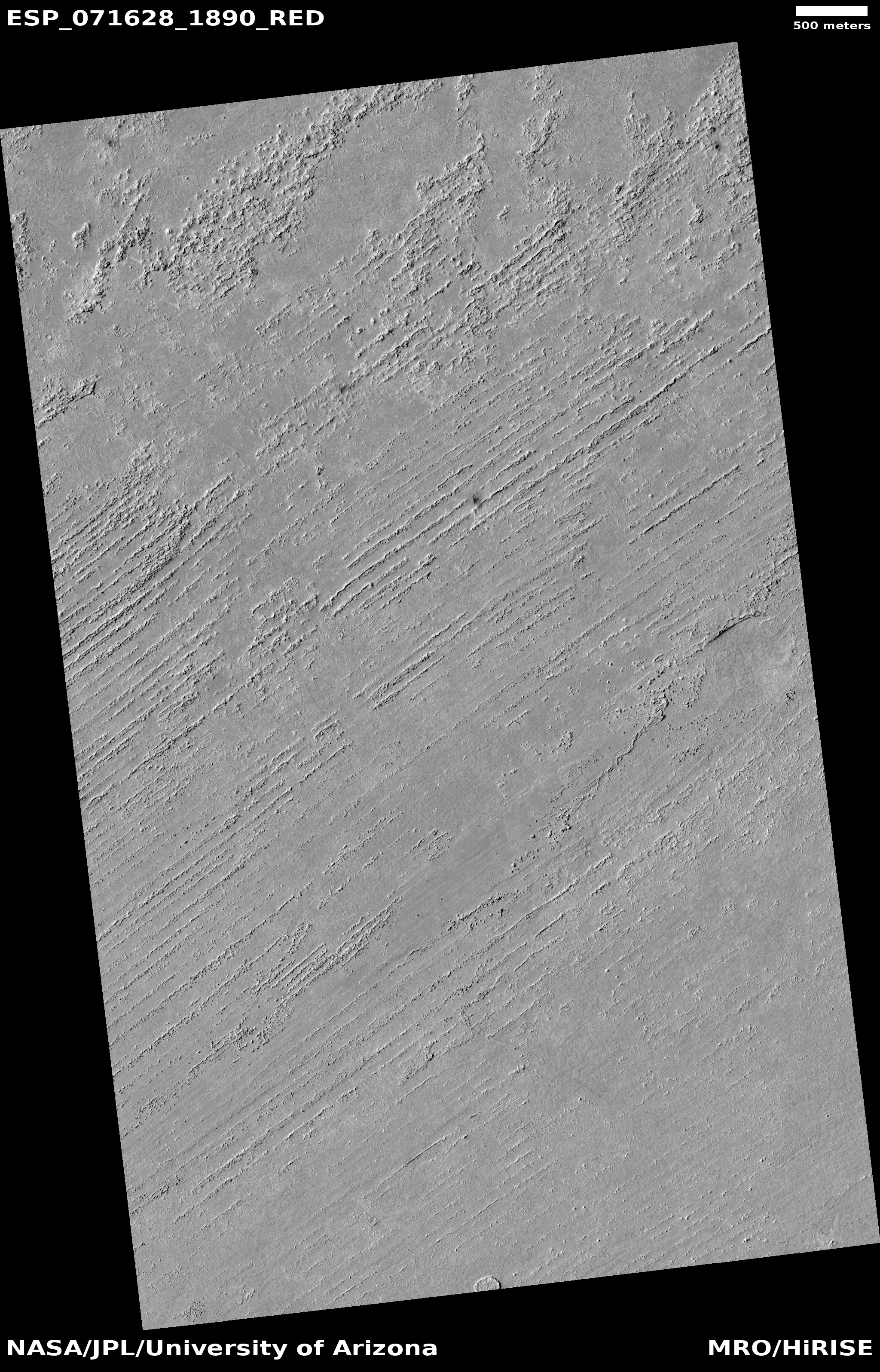
Mars’ youngest lava flow

Mars' youngest lava flow
Click for full image.

Today’s cool image is in some ways another version of my last cool image yesterday. Both are in Mars’s volcano country. Both show what appears to be a lava flow.

Yesterday’s image showed the leftover evidence of a confined flow of lava running in a meandering pattern like a river, and was somewhat distant from the biggest nearby volcanoes. Today’s cool image, to the right and rotated, cropped, and reduced to post here, is instead located smack dab on the inside of what is thought to be Mars’ youngest major lava event, the Athabasca flood lava plain, and in fact is near its outlet, when about 600 million years ago it belched out enough lava in just a matter of a few weeks to cover an area about the size of Great Britain.

The overview map below illustrates this.

» Read more

0 comments

Ukrainian rocket company signs deal with Portuguese spaceport organization

Capitalism in space: Ukrainian startup rocket company Promin Aerospace has signed an agreement with the Atlantic Spaceport Consortium (ASC), a Portugal organization that is aimed at building launch facilities on Portuguese-controlled islands in the Atlantic.

Promin has raised $500K for what it claims will be “the smallest solid rocket capable of launching a payload into orbit.” ASC meanwhile is presently building a suborbital launch site in the Azores.

How much of this is real is entirely unknown. The reality of both appear to me to be somewhat nebulous. Nonetheless, if successful the partnership will put another new cheap orbital rocket as well as another spaceport on the map.

0 comments

Axiom awards construction contract for building Houston space station factory

Capitalism in space: Axiom has awarded its first construction contract for building its space station factory at a Houston industrial park dubbed Spaceport Houston.

Phase I of the Houston Spaceport architecture and engineering design contract was awarded to Jacobs by Axiom Space. This 100,000 sq ft facility will be developed on a 400 acre-site, located within Ellington Airport, at the heart of Space City. Axiom Space, the privately funded space infrastructure developer intends to use this new spaceport to achieve its goal of assembling the first commercial international space station and providing access to low Earth orbit.

The choice by Axiom of Houston for this facility is, at first glance, somewhat puzzling. Once built here Axiom’s large station modules and equipment will then have to be transported to some launch facility, likely Kennedy in Florida. Wouldn’t it have made more sense to build them in Florida, close to where they will be launched?

The explanation lies in politics. Axiom’s management has many close ties to NASA and the Johnson Space Center. Furthermore, Axiom’s first modules will be docked to ISS, run by Johnson. Building in Houston will give Axiom brownie points with these government entities, which will in turn grease the wheels for anything Axiom needs to do at ISS.

2 comments

Strong opposition to new proposed regulation by federal safety board

We’re here to help you! Both the FAA and the rocket industry, led by SpaceX and Blue Origin, have issued detailed written opposition to a proposal by the National Transportation Safety Board (NTSB) that it be placed in charge of all future space accident investigations.

The regulations would require companies conducting a launch or reentry under an FAA license or experimental permit to immediately notify the NTSB in the event of a mishap. The NTSB would conduct an investigation to determine the probable cause and provide recommendations to avoid similar events in the future.

The opposition notes that this will merely duplicate what the industry and the FAA already do. The rocket industry also noted that the NTSB’s present investigation responsibilities are aimed at helping the mature airline industry, not “a nascent industrial sector that is still in development, and is appropriately regulated as such.”

It appears that there is also opposition in the halls of Congress, as two congressmen have expressed their own opposition.

Without doubt the NTSB’s action here has been encouraged by the Biden administration. Democrats always want more regulation to enhance the power of government. Since Biden and his Democratic Party handlers took over, the federal bureaucracy’s effort to regulate and hinder space activities has definitely increased, such as its efforts to block SpaceX’s Starship development at Boca Chica.

Had the NTSB tried to propose this during the Trump administration it would have been quickly quashed. For example, when NOAA tried to claim it had the right to regulate all orbital photography and the Trump administration told them no, in no uncertain terms.

2 comments

Falcon 9 upper stage to impact Moon

A Falcon 9 upper stage launched in February 2015 is apparently now on a course to impact the Moon this coming March.

According to Bill Gray, who writes the widely used Project Pluto software to track near-Earth objects, asteroids, minor planets, and comets, such an impact could come in March.

Earlier this month, Gray put out a call for amateur and professional astronomers to make additional observations of the stage, which appears to be tumbling through space. With this new data, Gray now believes that the Falcon 9’s upper stage will very likely impact the far side of the Moon, near the equator, on March 4.

Grey’s call out for more measurements is because there are uncertainties about this prediction. To prepare for observations of the impact by a variety of lunar orbiters, researchers need better data.

8 comments

NM legislators propose sales tax on Virgin Galactic tourist flights

We’re here to help you: A bi-partisan proposal by two New Mexico legislators would create a 6% to 9% sales tax on any Virgin Galactic space tourist flights that take off from Spaceport America.

“If the flights really became regular, that could be a nice source of income, not only for the state but also from the GRT shared with the local communities,” [one of] the bill’s … sponsors, Democratic Rep. Matthew McQueen, said.

…”I can’t think of a particularly good reason why we wouldn’t tax this activity,” McQueen said.

McQueen might be too stupid to think of a reason, but I can think of dozens, and they are called the many other airport runways across the globe where Virgin Galactic can launch tourists and bypass this tax. The company already has agreements with several.

The stupidity of this legislative proposal at this time is compounded in that Virgin Galactic, the only customer Spaceport America presently has, is struggling badly. It has yet to fly any commercial flights, and is facing investor lawsuits and an aging fleet. Adding a tax on top of these problems could kill it, thus making this bill a perfect example of killing the goose that laid the golden egg, before the goose is even born. Moreover, it will certainly discourage anyone else from launching from New Mexico, especially as there are so many other spaceport options popping up worldwide with no such sales tax.

9 comments

Startup building satellite electric thrusters signs deal with startup building refueling tankers

Capitalism in space: Phase Four, a startup building a new electric xenon thruster for use in satellites has signed an agreement with Orbit Fab, a startup building refueling systems for satellites already in orbit.

Under the agreement announced Jan. 24, the companies will work together to evaluate the refueling potential of traditional electric propulsion propellants like xenon for Phase Four Maxwell engines as well as new propellants like Advanced Spacecraft Energetic Non-Toxic propellant or ASCENT, a monopropellant developed by the Air Force Research Laboratory.

Orbit Fab last year launched its first prototype tanker, successfully testing the refueling port which it wants satellite makers to use so that future tankers can refuel them.

1 comment

Webb successfully inserted in final orbital position at the Sun-Earth Lagrange point

The James Webb Space Telescope today successfully completed a five minute firing of its engines to place it at the Sun-Earth Lagrange point dubbed L2.

Webb’s orbit will allow it a wide view of the cosmos at any given moment, as well as the opportunity for its telescope optics and scientific instruments to get cold enough to function and perform optimal science. Webb has used as little propellant as possible for course corrections while it travels out to the realm of L2, to leave as much remaining propellant as possible for Webb’s ordinary operations over its lifetime: station-keeping (small adjustments to keep Webb in its desired orbit) and momentum unloading (to counteract the effects of solar radiation pressure on the huge sunshield).

Engineers will spend the next three months aligning the segments of Webb’s large primary and secondary mirrors, while they wait for the telescope to cool down to the ambient very cold temperatures required for it to detect the tiny infrared heat emissions from very faint very very very distant objects.

8 comments

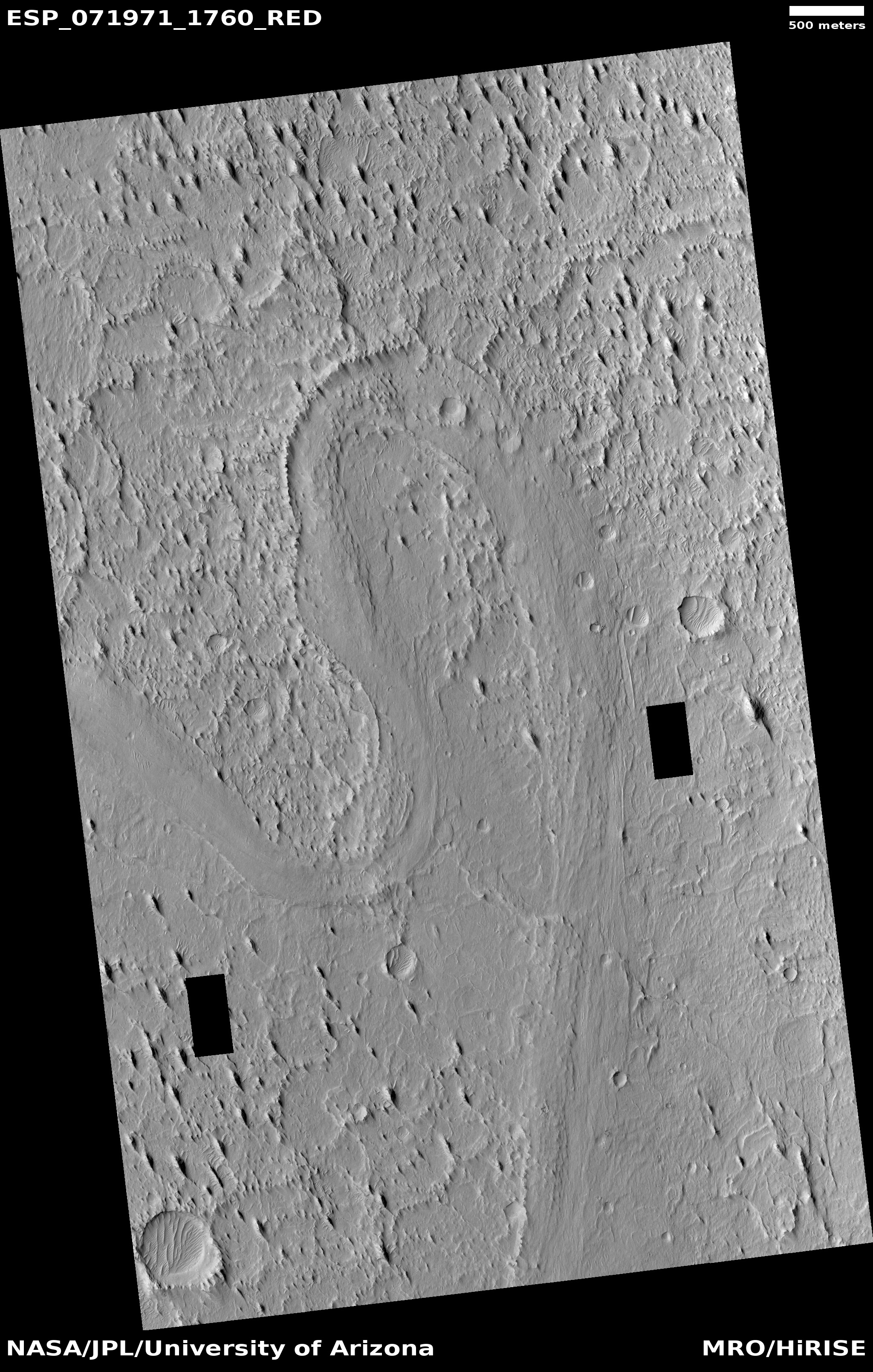
U-shaped meandering Martian ridge

Broad U-Shaped meandering ridge on Mars
Click for full image.

Cool image time! The photo to the right, rotated, cropped, and reduced to post here, was taken on December 3, 2021 by the high resolution camera on Mars Reconnaissance Orbiter (MRO). It shows what the scientists label a “Broad U-Shaped Ridge”. The two black squares are merely areas where no data was gathered.

Is this a fossilized river, of which scientists have identified more than 10,000 in the Arabia Terra transition region between the northern lowland plains and the southern cratered highlands? Arabia Terra however is literally on the other side of Mars, very far away.

The location, as shown in the overview map below, instead suggests that, if this U-shaped meander is a fossilized river, it isn’t one created by water or ice.
» Read more

1 comment

Another study says Mars does not have liquid water under its south pole

The uncertainty of science: A new study now claims that the presumed detection of lakes of liquid water under the Martian southern polar ice cap in 2018 was likely wrong, and that the detection was more likely volcanic rock.

The researchers think their conclusion — volcanic rock buried under ice — is a more plausible explanation for the 2018 discovery, which was already in question after scientists calculated the unlikely conditions needed to keep water in a liquid state at Mars’ cold, arid south pole.

“For water to be sustained this close to the surface, you need both a very salty environment and a strong, locally generated heat source, but that doesn’t match what we know of this region,” says the study’s lead author, Cyril Grima, a planetary scientist at The University of Texas at Austin Jackson School of Geosciences.

So my readers know how uncertain all of this is, note that the 2018 discovery of underwater liquid water was later confirmed by other scientists in 2020, then rejected by different researchers in 2021, who claimed it was clay instead.

In other words, the scientists have some inconclusive data that could mean many different things, either water, clay, volcanic rock, or maybe something else that someone hasn’t yet suggested. To really answer the question will require far more data, with some like required in situ on Mars itself.

2 comments
1 179 180 181 182 183 192