Today’s blacklisted American: Christian preschool shuttered by California for not keeping masks on two-year-olds at all times

What the California government wants
What California’s petty dictators really want to do with those teachers
and children who don’t do what they order.

Now they’re coming for the children: California health officials, outraged that teachers at Foothills Christian Church Preschool could not keep masks on two- and three-year-olds continuously for nine hours a day, have shut the school down and banned its director, Tiffany McHugh, from ever working with children again.

This bears repeating: These insane health officials demanded that school officials keep the masks on little toddlers at all times, a demand that any normal human knows is impossible. Furthermore, even the slightest amount of research will tell you that there is no reason for the kids to wear masks in the first place, as young kids generally don’t get COVID — just like they don’t get the flu — and if they do it has been shown to be harmless in healthy children.

A closer look at the actions of the health officials reveals what was really going on:
» Read more

25 comments

Pseudo-private rocket company in China raises $200 million from Chinese investors

The Chinese pseudo-private rocket company Galactic Energy has successfully raised $200 million from a number of Chinese investors, money that the company will use to develop a mid-size rocket with a reusable first stage.

Though the company is not directly funded by the Chinese government, it is not an independent private company, which is why I label it “pseudo.” Everything it does is closely supervised and approved by the communist government. Also, some of this investment money apparently came from “state-backed investment vehicles,” which in plain language are fronts used by the government to funnel funding to these companies while maintaining the false appearance the companies are entirely private.

The fake nature of this charade has apparently influenced the decisions of real investors:

Incomplete information on funding in China’s emerging commercial space sector suggested that overall investment was lagging just over halfway through 2021, concentrating in fewer players.

It appears that no one outside China is willing to put money behind these companies, and even within China there is hesitancy.

Nonetheless, by letting many such competing operations that can also make profits for investors, China is successfully encouraging some innovation. That Galactic Energy — as well as several others — are planning on building reusable rockets is evidence of that.

4 comments

Astra completes 1st static fire dress rehearsal countdown of Rocket-3 at Kennedy

Capitalism in space: On January 22, 2022, Astra successfully completed at Cape Canaveral the first static fire dress rehearsal countdown of its Rocket-3 rocket.

“Successful static test completed. We will announce launch date and time when we receive our license from the FAA,” said Chris Kemp, founder and CEO of the Alamada, California-based company on Twitter. The company, which was formed in 2016, had been targeting this month for the launch.

The FAA apparently required this successful dress rehearsal before it would provide the launch license. Expect the launch to follow almost immediately after the permit is issued. If successful it will be Astra’s second orbital launch, and the first to carry actual satellites for customers, three cubesats from three different universities and one from NASA’S Johnson Space Center.

1 comment

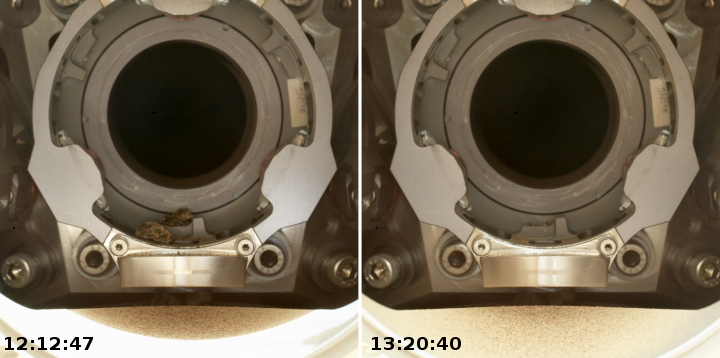
Confirmed: All debris cleared from Perseverance sample tube

Mosaic showing the clearing of debris
Click here and here for original images.

The Perseverance science team today announced in an update that their effort to clear the sample tube of bits of core sample has succeeded, as indicated partly by the two images above that I posted on January 19th.

According to the report, the two small pieces visible bottom center fell out after two small rotations of the carousal. Other pieces however remained, and these were removed as followed:

On Monday, Jan. 17, the team commanded another operation of the rotary percussive drill in an attempt to dislodge more material from the tube. With the tube’s open end still pointed towards the surface, we essentially shook the heck out of it for 208 seconds – by means of the percussive function on the drill. Mastcam-Z imagery taken after the event shows that multiple pieces of sample were dumped onto the surface. Is Tube 261 clear of rock sample? We have new Mastcam-Z images looking down the drill bit into the sample container that indicate little if any debris from the cored-rock sample remains. The sample tube has been cleared for reuse by the project.

The team is now discussing their next step, which could be drilling a new hole at this spot or moving on.

1 comment

It is finally time to end the Wuhan panic of the past two years

How governments today determine policy

When looked at dispassionately, the news about COVID in the past few months has consistently proven two very basic points. First, the reasons to fear COVID are now definitely gone, assuming they ever existed at all. Second, the oppressive lockdown and mask policies imposed by most governments were an epic failure.

Rather than write a lot of text, I am going to provide my readers instead a nice linkfest, divided up into a variety of subcategories. Not only do the recent facts prove the failure of the government reaction to COVID, all these stories should be cause for celebration, as they show that not only has the Wuhan flu never been as dangerous as the fear-mongers have claimed, its limited but serious threat to the aged and sickly is now also fading.

The real question is whether the public and governments will actually celebrate, or stick their heads in the sand because they have fallen in love with their fear of COVID.

So, let’s take a look at the recent facts:
» Read more

80 comments

NASA: No further Artemis Moon landings for at least two years after first in 2025

The tortoise appears to be dying: NASA today announced that there will be a two-plus year pause of Artemis missions to the lunar surface after it completes its hoped-for first manned Moon landing in 2025.

In presentations at a two-day meeting of the NASA Advisory Council’s Human Exploration and Operations Committee Jan. 18 and 19, agency officials said the Artemis 4 mission, the first after the Artemis 3 mission lands astronauts on the moon, will not attempt a landing itself.

Instead, Artemis 4 will be devoted to assembly of the lunar Gateway. The mission will deliver the I-Hab habitat module, developed by the European Space Agency and the Japanese space agency JAXA, to the Gateway. It will be docked with the first Gateway elements, the Power and Propulsion Element and Habitation and Logistics Outpost, which will launch together on a Falcon Heavy in late 2024 and spend a year spiraling out to the near-rectilinear halo orbit around the moon.

Essentially, the Biden administration appears to be switching back to NASA’s original plans, to require use of the Lunar Gateway station for any future lunar exploration, thus delaying that exploration considerably. Do not expect any of this schedule to take place as promised. The 2025 lunar landing will be delayed, as will all subsequent SLS launches for Artemis. The rocket is simply too complicated and cumbersome to even maintain one launch per year, while inserting Gateway into the mix only slows down lunar exploration even more.

NASA officials also revealed that they are limiting their lunar landing Starship contract with SpaceX to only that single planned ’25 Moon mission. For future manned missions to the Moon the agency will request new bids from the entire industry.

NASA’s Human Landing System (HLS) Option A award to SpaceX last year covers only development of a lander and a single crewed flight on Artemis 3. NASA will acquire future landings through a separate effort, called Lunar Exploration Transportation Services (LETS). The goal of LETS is to select one, and possibly more, companies to provide “sustainable” landing services.

The timing of LETS — a draft request for proposals is scheduled for release this spring — means there will be a gap of a couple years before the first landing service acquired through that program would be ready. “It’ll be about two years from the Option A award to the LETS award before we’ll have this sustainable lander,” Kirasich said. “It’s a different lander with more aggressive requirements than Option A.”

It appears that Jeff Bezos’ political lobbying efforts have paid off, and that NASA is now reopening bidding so that his consortium, led by Blue Origin, can once again compete for that lunar lander contract. Whether the Bezos’ team will be able to propose anything comparable to Starship is however very questionable.

None of this really hurts SpaceX. Its contract with NASA helps them develop a Starship lunar lander. Then, while NASA twiddles its thumbs building Gateway, it will be free to fly its own lunar missions, selling tickets on the open market. I suspect that — should NASA succeed in landing humans in ’25 — the next American manned landing on the Moon will be a bunch of SpaceX customers, not that second Artemis mission sometime in the late 2020s.

SpaceX of course will also be able to bid on that second lunar landing competition. And it will be hard for NASA not to award Starship a further contract, even if others are competing against it. Starship will be operational. The others will merely be proposed.


32 comments

Latvian/Bulgarian commercial partnership to launch cubesats to monitor space weather

Capitalism in space: Mission Space, a Latvian company, plans to build a constellation of 24 cubesats designed to monitor space weather and solar activity, using cubesats manufactured by the Bulgarian company EnduroSat.

Mission Space plans to make its software model of the near-Earth radiation environment available in mid-2022, before launching its Aurora-1 detectors with EnduroSat in the fourth quarter of the year.

Mission Space was founded in 2020 to offer space weather monitoring as a service. With data supplied by its constellation, Mission Space will provide data and analytics to government agencies in addition to establishing a cloud-based platform to help commercial satellite operators prepare for solar storms, assess risks and monitor radiation levels.

EndoroSat already has five satellites in orbit, with ten more planned for launch in the next two years.

I think that both these companies demonstrate that a modern satellite business truly can be started in someone’s garage. Because cubesats are so small and are also somewhat standardized, you don’t need a large facility to build them.

0 comments

SpaceX’s Starship gets Air Force point-to-point cargo study contract

Capitalism in space: The Air Force Research Laboratory (AFRL) has signed a $102 million five year contract with SpaceX to study the practicality of using its Starship spacecraft as a method for transporting large cargo point-to-point on Earth.

[Program manager Greg] Spanjers said the SpaceX work is focused in four areas: collecting data from commercial orbital launches and landings; exploring cargo bay designs compatible with U.S. Transportation Command containers [TRANSCOM] and support rapid loading and unloading; researching landing systems that can operate on a variety of terrain; and demonstrating the heavy cargo launch and landing process.

The emphasis on landing options and interoperability with TRANSCOM containers and loading processes is an important element of the project, Spanjers noted, because the department’s vision for how the point-to-point capability could be used is broader than just the commercial business case. While companies are primarily interested in delivering cargo to and from established sites, the military wants to deliver supplies and humanitarian aid to locations that may not have spaceports.

This contract is in many ways similar to NASA’s manned Starship lunar lander contract. Both provide SpaceX some cash for developing a different version of Starship, even as the bulk of development money for building Starship comes from the private investment community.

22 comments

NRO to buy radar data from private companies

Capitalism in space: The National Reconnaissance Office (NRO) has signed contracts with five commercial companies to purchase the Earth radar data that they produce to see if that data will be useful for future reconnaissance and surveillance.

The National Reconnaissance Office announced Jan. 20 it has signed agreements with commercial radar imagery providers Airbus U.S., Capella Space, Iceye U.S., PredaSAR and Umbra.

These agreements are study contracts that give the NRO access to the data collected by these companies’ synthetic aperture radar (SAR) satellites, and are intended to help the agency better understand the quality of commercially available imagery. “We know that users across the national system for geospatial intelligence are eager to explore commercial radar, and these contracts will allow us to rapidly validate capabilities and the benefits to the national mission,” NRO Director Chris Scolese said in a statement.

Essentially, NRO is looking to see if it can fill some of its radar data needs from inexpensive privately built satellites, rather than build and launch its own very costly radar satellites. The agency is already doing the same with commercial optical data.

0 comments
1 180 181 182 183 184 192