
Two days after DART’s impact of Dimorphus, ejected dust extends like a comet tail out more than 6,000 miles

Dust tail from Dimorphus two days after DART impact
Click for full image.

Using a telescope in Chile, astronomers photographed the ejecta two days after the impact of DART into the 525-foot-wide asteroid Dimorphus, and detected a tail of dust extending out more than 6,000 miles.

The picture to the right, cropped and reduced to post here, shows that tail.

In this new image, the dust trail โ€” the ejecta that has been pushed away by the Sunโ€™s radiation pressure, not unlike the tail of a comet โ€” can be seen stretching from the center to the right-hand edge of the field of view. … At Didymos’s distance from Earth at the time of the observation, that would equate to at least 10,000 kilometers (6000 miles) from the point of impact.

Didymos is the larger parent asteroid that Dimorphus orbits.

It is still too soon to get the numbers on how Dimorphus’s path in space was changed by that impact. In fact, we still really don’t have a clear idea what is left of Dimophus itself. The ejecta cloud needs to clear somewhat to see what’s hidden inside it.

5 comments

Today’s blacklisted Americans: All normal girls banned from locker room because one cross-dressing boy demanded it

Blake Allen, punished for being a normal high school girl

They’re coming for you next: This story, which broke on September 28, 2022, is so absurd that at first glance it is hard to believe: Officials running Randolph High School in Vermont have banned from the girls locker room all girls from the school’s volley ball team because one cross-dressing boy was using it and the girls had the unmitigated nerve to express strong discomfort changing clothes in the presence of a male.

The quote below tells the tale, but in order to make it more precisely describe reality, I have replaced the meaningless words (“trans”, “transgender” “they”) that our queer dictators have imposed on mainstream news sources with words that actually describe the facts.

[Blake] Allen [one of the girls] says that the dispute started when the [boy who likes to wear woman’s clothing] made an inappropriate comment while members of the volleyball team were getting changed. She says her issue is not with having the [cross-dresser] student on the team or at school, but specifically in the locker room. โ€œThere are biological boys that go into the girlโ€™s bathroom but never a locker room,โ€ Allen said.
» Read more

14 comments

Europa in true color

Europa in true color
Click for full image.

The photo to the right, cropped and reduced to post here, was taken on September 29, 2022 by the Jupiter orbiter Juno during its close fly-by of Europa. Citizen scientist Bjorn Jonsson has processed it to bring out the details. From his caption:

This is an approximately true color/contrast, reprocessed version of Europa image PJ45_1. It is more carefully processed than the version I posted very shortly after the raw image data was released. The color should be fairly close to Europa’s real color and probably slightly more accurate than the color of the earlier version I posted. North is up.

The Sun is coming from the right, so those are craters in the upper left, close to the shadowed limb of the planet. The red color has been known for decades, and appears in many cases to be seepage coming up from the many meandering ridges that criss-cross the planet’s surface. Their chemistry/make-up is not fully known at this time.

Juno came within 219 miles of Europa, the closest any spacecraft has come since the Galileo orbiter circled Jupiter in the 1990s. I was expecting close-up images of the surface, from that close distance, but have not yet seen any. Instead, most of the images released and processed by citizen scientists have been global images from farther away. Thus, at this moment it does not appear Juno took pictures at this closest distance.

2 comments

Tiny cobbles on Mars

Tiny cobbles on Mars

Our second cool image takes us from grand galaxies, one of the universe’s largest coherent objects, to tiny cobbles on Mars. The picture to the right, taken by one of Perseverance’s close-up cameras on September 29, 2022, covers an area less than an inch across, making the largest rounded pebbles in this image only a few millimeters in size.

The rover presently sits on the floor of Jezero Crater, at the base of the delta that flowed into that crater eons ago. The data suggests that delta was created by flowing water entering a lake that filled the crater.

Did flowing water create these cobbles? These pebbles all have the look of the rounded cobble one finds either in river beds, or in glacial moraines. In both cases, the flow of the water or ice rolls the rocks along until they become rounded.

5 comments

Interacting galaxies

Interacting galaxies
Click for full image.

The news is light this morning, so this cool image will be the first of three. The picture to the right, cropped and reduced to post here, was taken by the Hubble Space Telescope and released today. From the caption:

The two interacting galaxies making up the pair known as Arp-Madore 608-333 seem to float side by side in this image from the NASA/ESA Hubble Space Telescope. Though they appear serene and unperturbed, the two are subtly warping one another through a mutual gravitational interaction that is disrupting and distorting both galaxies.

I did a search for any research of this galaxy pair, and found that its identification was only part of a larger survey, with only a little research done on its spectroscopy. Thus, I can’t tell you the size or distance, or how far apart from each other these galaxies lie.

0 comments

Sunspot update: Activity again exceeds prediction but ramp up pauses

NOAA this weekend published, as it does at the start of every month, its October update of its monthly graph that tracks the number of sunspots on the Sun’s Earth-facing hemisphere. As I have done since I started this website in 2011, I have published that graph below, with some additional details added to provide context.

An increase in sunspot activity in September wiped out the decline seen in August, so that the sunspot number in September once again matched or exceeded the numbers seen during the middle of the previous solar maximum from 2012 to 2014, a low period of activity between that maximum’s two peaks. Activity also continued to exceed the predictions of the panel of government solar scientists put together by NOAA.

At the same time, since May the ramp up to maximum has stalled, something I noted last month and has now become more evident.
» Read more

7 comments

India’s Mars orbiter mission ends after eight years

After eight years in orbit around Mars, India’s Mars orbiter mission, Mangalyaan, has run out of fuel for controlling its orientation, ending its mission.

The Rs 450 crore Mars Orbiter Mission was launched onboard PSLV-C25 on November five, 2013, and the MOM spacecraft was successfully inserted into Martian orbit on September 24, 2014 in its first attempt. “Right now, there is no fuel left. The satellite battery has drained,” sources in the Indian Space Research Organisation (ISRO) told PTI. “The link has been lost”.

There was, however, no official word from the country’s national space agency, headquartered here.

During its mission it produced more than a thousand images, though the mission’s primary objective was technological, proving that India itself could design, build, launch, and manage a planetary mission to another world. For India, Mangalyaan was thus an unqualified success.

0 comments

Fabric debris spotted on Ingenuity during 33rd flight

Tattered fabric debris on Ingenuity's leg during flight
Click to see full movie of flight.

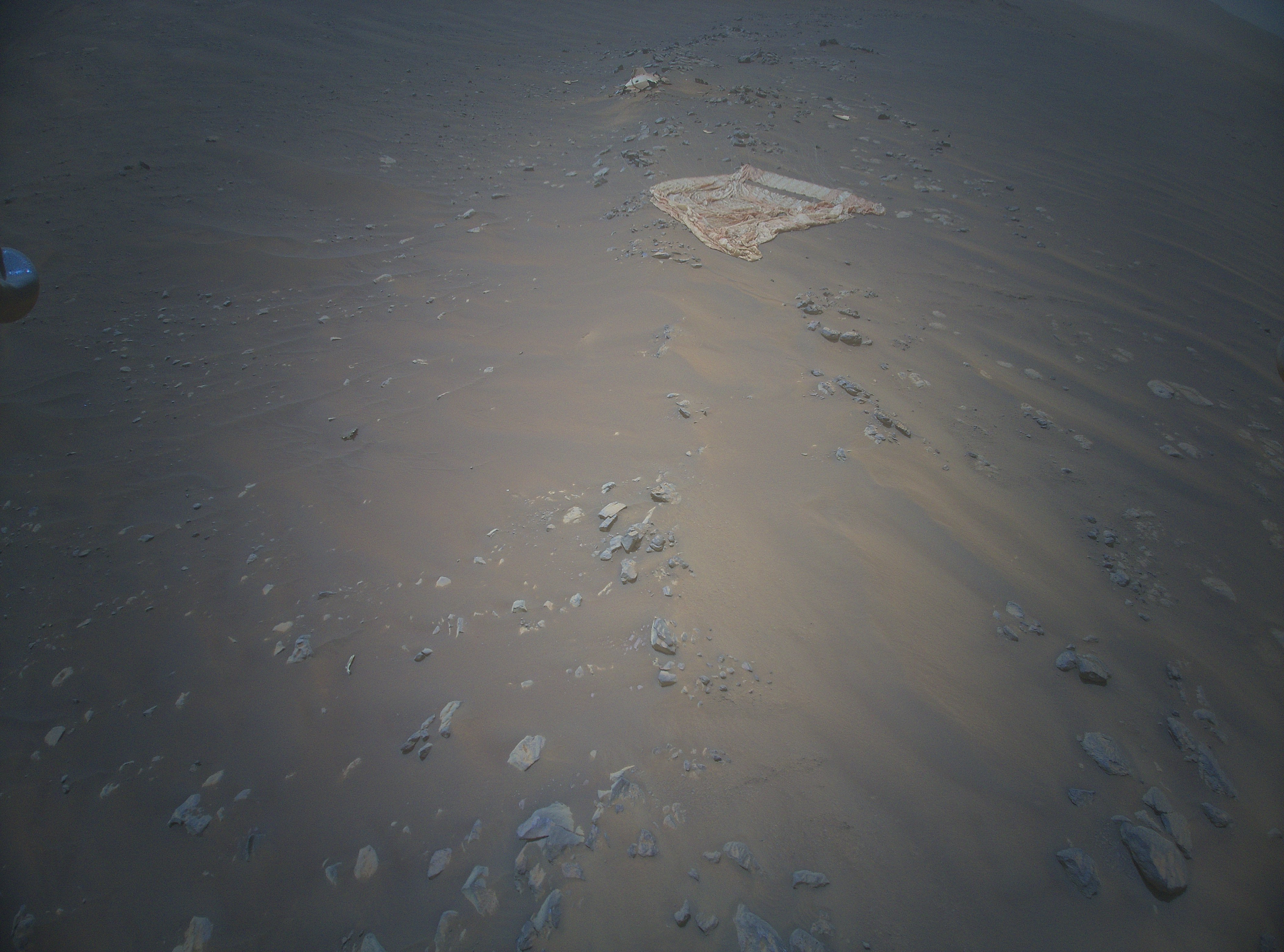
In reviewing the images from Ingenuity’s 33rd flight on September 24, 2022, engineers have spotted what looks like a tattered piece of fabric fluttering on the end of one of the helicopter’s legs, and then disappearing.

The image to the right, cropped, enhanced, and labeled to post here, comes from an animation created from all images taken during the flight.

A small piece of foreign object debris (FOD) was seen in footage from the Mars helicopterโ€™s navigation camera (Navcam) for a portion of its 33rd flight. This FOD was not visible in Navcam footage from the previous flight (32). The FOD is seen in Flight 33 Navcam imagery from the earliest frames to approximately halfway through the video, when it fell from the leg and drifted back to the Mars surface.

The engineers do not yet know what this was, but it apparently caused no harm to the helicopter. It also is likely not from either Ingenuity or Perseverance, as both are functioning perfectly. Most likely it is a piece of the parachute used during landing and then ejected.

7 comments

Head of Commerce’s space office questions new FCC regulations on space junk

Turf war! At a conference yesterday Richard Dalbello, director of the Office of Space Commerce at the Commerce Department, strongly questioned the FCC’s legal authority for its just passed new regulation on the de-orbiting of space junk.

โ€œI think the FCC, for their part, has pushed the boundaries of their authorities pretty aggressively,โ€ he said when asked about what agency should have oversight for issues like that, as his office works to create a civil space traffic management capability. โ€œAlthough I certainly congratulate them on the depth of their intellectual work,โ€ he said of the FCC and its new order, โ€œa lot of the things that they articulated are probably, arguably, outside their job jar.โ€

Dalbello’s comments only add to the many turf wars going on in the DC swamp over space regulation. Some in Congress want all space regulation to shift to his office. Others want it to be distributed across a number of agencies in both the military and civilian bureaucracies.

Regardless, Dalbello’s office is the agency that might actually have the legal authority for regulating space junk. And it is certain that the FCC does not have it.

7 comments

NASA now aiming for SLS launch in November

In finding that Hurricane Ian caused little damage at its vehicle assembly building at Kennedy, NASA managers have decided to target the the November 12 to 27 launch window for the first launch of its SLS rocket.

According to this graph [pdf], November 27th is the only date that will provide NASA with the longest mission for Orion (38 to 42 days). Furthermore, the mission precludes launches on November 13, 20-21, and 26.

Expect them to aim for November 12th, even though that will result in an Orion mission only 26 to 28 days long.

10 comments

Firefly successfully completes first orbital launch of its Alpha rocket

Alpha 1:48 into flight

Capitalism in space: Firefly, a company that just two years ago had gone into bankruptcy, tonight successfully launched their new Alpha rocket into orbit on its second test launch. The screen capture to the right shows the rocket 1:48 minutes into flight, its first stage still firing.

A final 2nd stage engine burn has completed, and we now have confirmation of deployment of the payload satellites. My sources tell me that the second stage under-performed, putting the satellites into a 223x283km orbit, rather than the planned 300km orbit, which will shorten the lifespan of the smallsats. As this was a test launch, not an operational one, this issue does not to my mind make the launch a failure.They reached orbit and the satellites were successfully deployed.

Thus, Firefly now joins SpaceX, Rocket Lab, ULA, Virgin Orbit, and Northrop Grumman as an operational American commercial rocket companies. Astra had been operational, but it has stepped down as it builds a new rocket.

The leaders in the 2022 launch race:

43 SpaceX
41 China
12 Russia
7 Rocket Lab
6 ULA

American private enterprise now leads China 61 to 41 in the national rankings, and is tied with the entire world combined, 61 to 61.

6 comments
1 50 51 52 53 54 192