Part 2: How the liars spread the ugly corrupt lie of the COVID jab

Yesterday I outlined in detail how a growing body of research as well as a great deal of blatantly obvious public data is increasingly demonstrating that the COVID shots carry with them some risk, and that in many cases, especially for those younger than 50, the risks outweigh the relatively minor benefits the jab provides against the Wuhan flu.

Though this data was unknown when the COVID shots were first made available, the amount of uncertainty and risk was great enough to make it unconscionable for any politician or health official to require anyone to get the jab, no matter what. And yet, led by President Joe Biden, government agencies and big corporations nationwide demanded employees get the jab, or be fired.

The result: tens of thousands of individuals, especially the young and healthy, have died unnecessarily from the COVID shots, since COVID itself could never have killed them.

Today I am going to outline the lies perpetuated by politicians and government health officials almost from day one of the Wuhan panic that worked hide these basic facts. Many times these lies were committed with the best of intentions. Many times the liars honestly and sincerely believed the lie was their only course of action.

And in too many cases, the lies were merely lies, said simply to protect the individual from scandal and possible prosecution, should the truth come out.

No matter what the reason, however, these lies were not only dishonest, they were morally wrong, and resulted in routinely bad policy that only made the Wuhan epidemic far worse than it ever had to be.

To begin, let us look at the lies of some specific individuals.
» Read more

10 comments

Lunar mountains and wrinkle ridges

Montes Recti on the Moon

Cool image time! The photo above, taken by Lunar Reconnaissance Orbiter (LRO), was released today by the orbiter’s science team, and provides us an oblique look at the mountains dubbed Montes Recti (lower right) and the wrinkle ridges near them (lower left). The highest point in this mountain range is about 5,900 feet high.

The image looks west across the northern part of the mare region dubbed Mare Imbrium, the dark area on the Moon’s visible hemisphere near its top. In the distance can be the mountains that form part of mare’s rim. The rounded peak in the top right is Promontorium Laplace (about 8,530 feet high). It is named this because it projects out (a promontory) into the mare a considerable distance from the rim. The crater at top center is Laplace D. As for the wrinkle ridges, the scientists describe them like so:

Tectonic landforms are those formed by forces that act to either contract or pull apart crustal materials. These forces develop faults or breaks in the crustal materials, and movement or slip along the faults form either positive or negative relief landforms. On the Moon, positive relief contractional landforms are the most common. The most significant contractional landforms on the Moon are wrinkle ridges, found exclusively in the dark mare basalts.

Essentially, something caused the ground to contract, which caused it to break at these ridges and be forced upward.

3 comments

Jupiter’s north pole cyclones appear as stable as those at the south pole

The northern polar cyclones of Jupiter
Click for original figure.

In reviewing five years of data from Juno, scientists now conclude that the polygon of large storms surrounding Jupiter’s north pole appear as stable as the same poloygon of storms found at the south pole.

Each polygon is made up of a central polar cyclone (PC) surrounded by a number of circum-polar cyclones (CPC). The image to the right, Figure 1 from the paper, compares the north polar storms from 2017 (top) to 2022 (bottom). During the five years of observations the whole polygon “rotated approximately 15° westward,” though it essentially maintained its structure.

After 5 years, the 8 + 1 North PCs structure and the 5 + 1 South one show very small changes; the lifetime of a single cyclone is therefore longer than 25 years and possibly longer than 75 years. Also, single cyclones have their peculiar morphology and this is often retained after 5 years, both in radiance and in morphology. In particular, this is the first time that we can observe the North CPCs system since the discovery in 2017, and we find that the structure is almost unperturbed.

The question that appears to remain unanswered by this data is whether these storms are deep-rooted to the interior of Jupiter or shallow structures. The stability suggests the latter, but this remains unproven.

0 comments

Chang’e-5 samples suggest lunar meteorite impacts took place the same time as big Chicxulub impact

In analyzing lunar samples brought back by China’s Chang’e-5 Moon lander, Australian scientists have found evidence of lunar meteorite impacts that apparently took place the same time as big Chicxulub impact in the Yucatan 66 million years ago, thought by many scientists to have caused the extinction of the dinosaurs.

Their findings suggest that the frequency of meteorite impacts on the Moon may have been mirrored on Earth, and that major impact events on Earth were not stand-alone events and instead were accompanies by a series of smaller impacts. The study has been published in Science Advances.

“We combined a wide range of microscopic analytical techniques, numerical modelling, and geological surveys to determine how these microscopic glass beads from the Moon were formed and when,” says lead author Professor Alexander Nemchin, from the Space Science and Technology Centre (SSTC) in the School of Earth and Planetary Sciences at Curtin University in Perth.

The data suggests two possibilities, neither of which is confirmed. First, the impacts could have occurred because a cluster of large objects hit both Earth and the Moon at the same time. Second, the impacts on the Moon could have been caused by objects thrown up from the Earth when the bigger impact occurred at Chicxulub.

Either way, the data suggests a greater and more complex interaction between events on the Earth and events on the Moon.

6 comments

SpaceX to upgrade 2nd Kennedy launchpad for manned launches

In order to create some increased redundancy, SpaceX and NASA have agreed to upgrade the company’s second launchpad at Cape Canaveral, LC-40, so that both it and pad LC-39A can launch manned Dragon capsules.

This plan grew out of concern by NASA that the new Starship orbital launchpad was too close to LC-39A, and could possibly damage it during a launch. Should that happen, and no back-up launchpad was available, the agency would have no way to get astronauts up to ISS, since Boeing’s Starliner is not yet operational. Because of that concern, NASA made it clear that no Starship launches could occur in Florida until this issue was resolved.

The solution? Make LC-40 a manned launchpad too.

Nothing is known about the nature of the modifications that LC-40 will require. But more likely than not, NASA will require SpaceX to develop something similar to Pad 39A’s facilities. That would involve building a new crew access tower, crew access arm, escape system (39A uses baskets and ziplines), and an on-site bunker for astronauts.

It is also likely that no Starship launches at Kennedy will occur until this work is done and a manned launch from LC-40 takes place. Though this could delay Starship somewhat, I expect not significantly. Before SpaceX is ready to launch operationally in Florida, it still has to do a lot of testing and development of Starship/Superheavy in Boca Chica, work that could take several years. I also suspect that it will get the launchpad work done relatively quickly, especially if NASA agrees to pay for it.

12 comments

Initial Webb results revised because telescope wasn’t yet fully calibrated

The uncertainty of science: Though it appears that no results will have to be abandoned, the scientists who published some of the very first results from the Webb Space Telescope have been scrambling to adjust and revise their papers because the telescope is only now getting fully calibrated.

“This caused a little bit of panic,” says Nathan Adams, an astronomer at the University of Manchester, UK, who, along with his colleagues, pointed out the problem in a 9 August update to a preprint they had posted in late July3. “For those including myself who had written a paper within the first two weeks, it was a bit of — ‘Oh no, is everything that we’ve done wrong, does it all need to go in the bin?’”

To try to standardize all the measurements, the STScI is working through a detailed plan to point Webb at several types of well-understood star, and observe them with every detector in every mode for every instrument on the telescope4. “It just takes a while,” says Karl Gordon, an astronomer at the STScI who helps lead the effort.

In the meantime, astronomers have been reworking manuscripts that describe distant galaxies on the basis of Webb data. “Everyone’s gone back over and had a second look, and it’s not as bad as we thought,” Adams says. Many of the most exciting distant-galaxy candidates still seem to be at or near the distance originally estimated. But other preliminary studies, such as those that draw conclusions about the early Universe by comparing large numbers of faint galaxies, might not stand the test of time. Other fields of research, such as planetary studies, are not affected as much because they depend less on these preliminary brightness measurements.

Overall, it does not appear the more precise calibrations will change much of signficance, since most of the earliest observations were simply that, observations, not theoretical. Because the distance estimates remain largely unchanged however the theorists are left with the same conundrum: The age and apparent nature of the most distant objects does not seem to fit with what the theories had predicted Webb would see.

1 comment

Hubble & Webb make first coordinated observations, tracking DART impact of Dimorphus

Webb and Hubble together look at DART impact of Dimorphus
Click for full image.

For the first time scientists have used both the Hubble Space Telescope and the James Webb Space Telescope to observe the same astronomical event, in this case the impact of the DART spacecraft on the asteroid Dimorphus on September 26, 2022.

The two images to the right show the asteroid several hours after impact. Both telescopes also captured images before the impact as well. From the press release:

Observations from Webb and Hubble together will allow scientists to gain knowledge about the nature of the surface of Dimorphos, how much material was ejected by the collision, and how fast it was ejected. Additionally, Webb and Hubble captured the impact in different wavelengths of light – Webb in infrared and Hubble in visible. Observing the impact across a wide array of wavelengths will reveal the distribution of particle sizes in the expanding dust cloud, helping to determine whether it threw off lots of big chunks or mostly fine dust. Combining this information, along with ground-based telescope observations, will help scientists to understand how effectively a kinetic impact can modify an asteroid’s orbit.

When Webb was first conceived in the late 1990s, it was exactly for this reason, to combine Hubble’s optical vision with Webb’s infrared view. Though more than a decade late, it has finally happened.

It will be months before scientists begin to decipher the data produced by all the telescopes and spacecraft used to observe the DART impact. What we are seeing now are merely hints at what has been learned.

10 comments

Astra’s last rocket failure pinpointed to upper stage engine

Astra has determined that the launch failure in June 2022 was because the upper stage engine of its Rocket 3.3 rocket was burning fuel faster than it was supposed to.

“We’ve determined that the upper stage shut down early due to a higher-than-normal fuel consumption rate,” the update reads. “We have narrowed the root cause to an issue with the upper stage engine. We have also completed many rounds of ground testing, including multiple tests that yielded results consistent with the failure condition in flight.”

When the failure happened, the company had quickly determined that the upper stage had shut down prematurely. The investigation has now determined that it had simply run out of fuel, because of that higher-than-intended burn rate.

While they say they will next institute corrective measures, that seems unlikely for this engine. In August Astra announced it would no longer launch Rocket 3.3, and was instead shifting to the development of a newer bigger rocket, Rocket-4. It now appears that decision was made based on the results of this investigation. The engine probably has fundamental issues that could not be resolved easily.

This decision to cease use of Rocket 3.3 essentially removed Astra as an operational rocket company. Whether the company can re-enter the launch market with a new rocket however remains very unclear.

0 comments

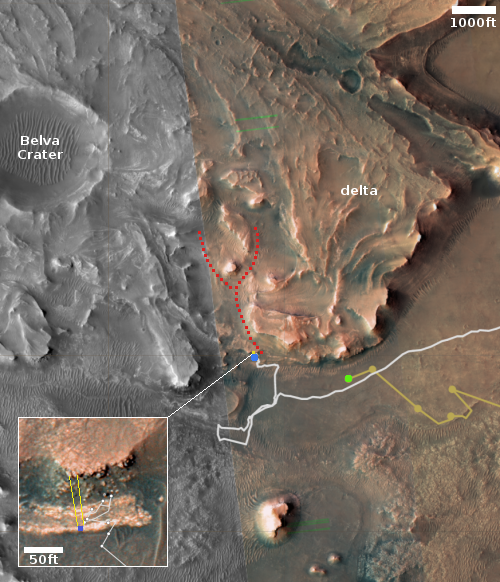
Ingenuity completed 33rd flight this past weekend

This notice is a bit late, but then, there really isn’t much to report. According to the Ingenuity flight log, engineers successfully completed the helicopter’s 33rd flight on September 24, 2022, flying about 364 feet for 55 seconds.

The plan had been to fly 365 feet for 55.6 seconds, so that matched their plan almost exactly. According to the interactive map that tracks the movement of both the rover Perseverance and the helicopter, this flight continued the helicopter’s movement almost due west, bringing it closer to the rover so as to facilitate communications.

The primary goal of Ingenuity’s engineering team at this time is to refine the accuracy of their software in order to better understand how to fly robots on Mars. This will help prepare the next helicopters for future missions.

3 comments

September 28, 2022 Quick space links

Courtesy of Jay, BtB’s stringer.

My heart be still. As the tweet notes, it was a month since the last evidence of test. Blue Origin continues to move at glacial speed, especially considering this engine is three years late.

Jay notes the company plans to use nine of these on their reusable rocket. Sound familiar?

The letter is in response to the FCC’s announcement in early August that it was going to consider imposing regulations on expanding its involvement and regulation of “space missions like satellite refueling, inspecting and repairing in-orbit spacecraft, capturing and removing debris, and transforming materials through manufacturing while in space.”

As I noted then, “none of these goals has anything to do with the electromagnetic spectrum, the regulation of which is the sole and only real responsibility of the Federal Communications Commission.”

It seems Congress wants the FCC to know this as well.

1 comment

Part 1: The ugly corrupt lie of the experimental COVID jab

Joe Biden: dictator
Joe Biden: claiming the power to tell us what medicines we must take

On September 9, 2021, President Joe Biden announced harsh mandates nationwide that forced millions to get COVID shots. You had no choice. If you refused, you would be fired from your job and made a non-person, forbidden in all ways from participating normally in society.

“We’ve been patient, but our patience is wearing thin,” Biden said, making a direct appeal to the 80 million people who he said were still unvaccinated. “Your refusal has cost all of us.”

…”It’s simple [said an official]: If you want to work for the federal government, you must be vaccinated. If you want to do business with the government, you must vaccinate your workforce.”

Those mandates — unreasonably based on very uncertain knowledge at the time — have now been found to have killed thousands of people who did not need to die.

And worst of all, the people imposing those mandates were lying, and knew they were lying.

Killing young adults

For a large majority of the population that either voluntarily chose to get the COVID jab or were forced to submit under duress, the shots and boosters at this point appear to have been harmless. Most people have exhibited no negative symptoms once jabbed, and have so far been able to go on with their lives as if nothing had changed.

The problem is that for many, that jab was a death sentence, with the executioner often arriving unexpectedly but quickly, and completely unnecessarily.
» Read more

14 comments
1 52 53 54 55 56 192